

SUBSCRIBE TO OUR FREE NEWSLETTER
Daily news & progressive opinion—funded by the people, not the corporations—delivered straight to your inbox.
5
#000000
#FFFFFF
To donate by check, phone, or other method, see our More Ways to Give page.
Daily news & progressive opinion—funded by the people, not the corporations—delivered straight to your inbox.
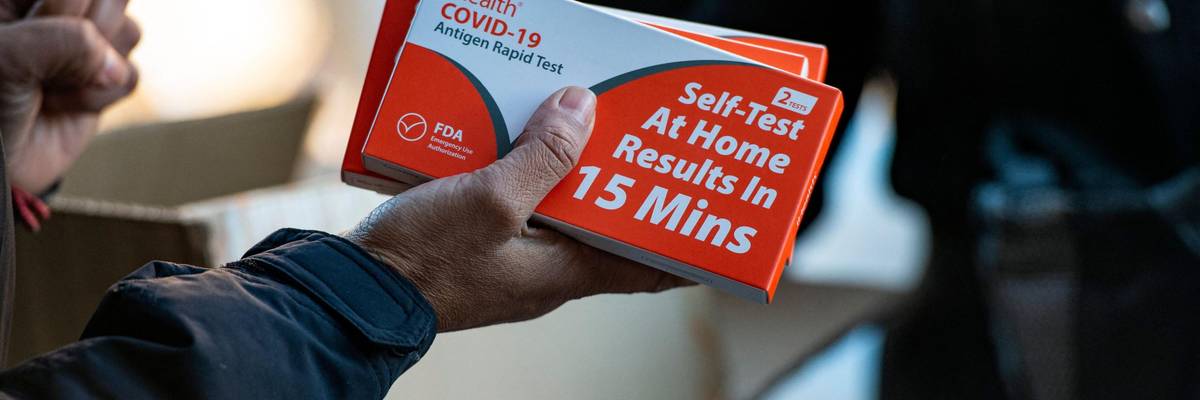
A person is seen holding at-home Covid-19 test kits in Chelsea, Massachusetts, on December 17, 2021. (Photo: Joseph Prezioso/AFP via Getty Images)
Public health advocates on Monday warned that the imminent suspension of the Biden administration's free at-home Covid-19 test program could lead to the autumn and winter surge in infections that officials have feared for months, and denounced the obstruction of Republicans who have refused to pass continued Covid-19 relief this year--even as they've approved hundreds of billions of dollars in military spending.
"It is unfortunate, if unsurprising, to watch Covid become yet another illness inadequately covered by a faulty and fragmented financing system."
"Well this is quite exactly the wrong thing to do going into fall/winter," Dr. Taison Bell, an infectious disease physician at University of Virginia, tweeted as the White House announced on its test-ordering website that a lack of congressional funding has forced the government to end shipments of free tests for the time being.
The federal portal notes that shipments "will be suspended on Friday, September 2 because Congress hasn't provided additional funding to replenish the nation's stockpile of tests."
The White House earlier this year requested $22 billion in coronavirus funding, including $5 billion in global aid to help people across the Global South and prevent new variants from spreading, but Republicans and Democrats were only able to agree on a $10 billion deal excluding global spending. That bill has so far failed to pass.
The government has sent out more than 600 million tests so far, allowing households to place up to three orders since the program began in January under pressure from public health advocates. The Department of Defense said in February that the federal government spent roughly $2 billion on the first shipments of tests.
While Republicans have refused to fund continued Covid spending this year, lawmakers from both parties have agreed to prioritize military spending, including nearly $3 billion in long-term aid for Ukrainian forces that was approved last week, a $40 billion Ukraine package that passed in May, and $782 billion in U.S. military funding that was approved in March--days after the Covid relief was pulled from omnibus legislation.
MSNBC journalist Ayman Mohyeldin on Sunday noted the contrast between the supposed "lack" of funding for relatively inexpensive Covid-19 tests and the availability of hundreds of billions of dollars in defense spending.
According to CBS News, the Biden administration is holding back its stockpile of Covid-19 tests until later in the year to prepare for what a senior official called a potential "new rise in infections and more acute need."
Experts say a winter surge in infections could result in a million hospitalizations and nearly 200,000 deaths in a worst-case scenario.
Advancing Health Equity founder Dr. Uche Blackstock noted that through the fall, sites such as libraries and community health centers will still be distributing free Covid tests in some areas, but noted that "the convenience of ordering the tests online was invaluable."
A funding lapse is also likely to happen with vaccines, Blackstock said.
Though Republicans have obstructed the passage of continued Covid-19 relief including funding for the test program, the White House has also expressed some eagerness to end the federal government's oversight of the coronavirus pandemic.
Earlier this month, White House Covid-19 Response Coordinator Dr. Ashish Jha said at a U.S. Chamber of Commerce Foundation event that the Biden administration hopes to get "out of that acute emergency phase where the U.S. government is buying the vaccines, buying the treatments, buying the diagnostic tests."
"My hope is that in 2023, you're going to see the commercialization of almost all of these products," Jha said. "Some of that is actually going to begin this fall, in the days and weeks ahead. You're going to see commercialization of some of these things."
The Centers for Disease Control and Prevention's Operation Expanded Testing program, which provides tests to schools, will end on December 31, and pharmaceutical company Eli Lilly has begun direct commercial sales of its monoclonal antibody treatment to hospitals and states.
The CEOs of Moderna and Pfizer have alluded to raising the prices of their vaccines once they are being sold in a "private market situation" rather than to the federal government.
Harvard Medical School professor Dr. Adam Gaffney wrote in The New Republic last week that the coming "commercialization" of Covid-19 treatments, tests, and vaccines will sharply reduce access, leading to increased risks for public health.
"Some Medicaid patients could see co-pays for Covid vaccines once they are commercialized--or not have access to these vaccines at all, according to a report from the Brookings Institute," Gaffney wrote. "Provision of vaccines to the uninsured, who are at increased risk of Covid, will almost certainly deteriorate when neither administration nor the products themselves are publicly funded. And co-pays and deductibles for treatments like Paxlovid will presumably pop up for the privately insured."
"The partial decommercialization of the financing of Covid care was a departure from business as usual for American healthcare," he added. "So it is unfortunate, if unsurprising, to watch Covid become yet another illness inadequately covered by a faulty and fragmented financing system."
Dear Common Dreams reader, It’s been nearly 30 years since I co-founded Common Dreams with my late wife, Lina Newhouser. We had the radical notion that journalism should serve the public good, not corporate profits. It was clear to us from the outset what it would take to build such a project. No paid advertisements. No corporate sponsors. No millionaire publisher telling us what to think or do. Many people said we wouldn't last a year, but we proved those doubters wrong. Together with a tremendous team of journalists and dedicated staff, we built an independent media outlet free from the constraints of profits and corporate control. Our mission has always been simple: To inform. To inspire. To ignite change for the common good. Building Common Dreams was not easy. Our survival was never guaranteed. When you take on the most powerful forces—Wall Street greed, fossil fuel industry destruction, Big Tech lobbyists, and uber-rich oligarchs who have spent billions upon billions rigging the economy and democracy in their favor—the only bulwark you have is supporters who believe in your work. But here’s the urgent message from me today. It's never been this bad out there. And it's never been this hard to keep us going. At the very moment Common Dreams is most needed, the threats we face are intensifying. We need your support now more than ever. We don't accept corporate advertising and never will. We don't have a paywall because we don't think people should be blocked from critical news based on their ability to pay. Everything we do is funded by the donations of readers like you. When everyone does the little they can afford, we are strong. But if that support retreats or dries up, so do we. Will you donate now to make sure Common Dreams not only survives but thrives? —Craig Brown, Co-founder |
Public health advocates on Monday warned that the imminent suspension of the Biden administration's free at-home Covid-19 test program could lead to the autumn and winter surge in infections that officials have feared for months, and denounced the obstruction of Republicans who have refused to pass continued Covid-19 relief this year--even as they've approved hundreds of billions of dollars in military spending.
"It is unfortunate, if unsurprising, to watch Covid become yet another illness inadequately covered by a faulty and fragmented financing system."
"Well this is quite exactly the wrong thing to do going into fall/winter," Dr. Taison Bell, an infectious disease physician at University of Virginia, tweeted as the White House announced on its test-ordering website that a lack of congressional funding has forced the government to end shipments of free tests for the time being.
The federal portal notes that shipments "will be suspended on Friday, September 2 because Congress hasn't provided additional funding to replenish the nation's stockpile of tests."
The White House earlier this year requested $22 billion in coronavirus funding, including $5 billion in global aid to help people across the Global South and prevent new variants from spreading, but Republicans and Democrats were only able to agree on a $10 billion deal excluding global spending. That bill has so far failed to pass.
The government has sent out more than 600 million tests so far, allowing households to place up to three orders since the program began in January under pressure from public health advocates. The Department of Defense said in February that the federal government spent roughly $2 billion on the first shipments of tests.
While Republicans have refused to fund continued Covid spending this year, lawmakers from both parties have agreed to prioritize military spending, including nearly $3 billion in long-term aid for Ukrainian forces that was approved last week, a $40 billion Ukraine package that passed in May, and $782 billion in U.S. military funding that was approved in March--days after the Covid relief was pulled from omnibus legislation.
MSNBC journalist Ayman Mohyeldin on Sunday noted the contrast between the supposed "lack" of funding for relatively inexpensive Covid-19 tests and the availability of hundreds of billions of dollars in defense spending.
According to CBS News, the Biden administration is holding back its stockpile of Covid-19 tests until later in the year to prepare for what a senior official called a potential "new rise in infections and more acute need."
Experts say a winter surge in infections could result in a million hospitalizations and nearly 200,000 deaths in a worst-case scenario.
Advancing Health Equity founder Dr. Uche Blackstock noted that through the fall, sites such as libraries and community health centers will still be distributing free Covid tests in some areas, but noted that "the convenience of ordering the tests online was invaluable."
A funding lapse is also likely to happen with vaccines, Blackstock said.
Though Republicans have obstructed the passage of continued Covid-19 relief including funding for the test program, the White House has also expressed some eagerness to end the federal government's oversight of the coronavirus pandemic.
Earlier this month, White House Covid-19 Response Coordinator Dr. Ashish Jha said at a U.S. Chamber of Commerce Foundation event that the Biden administration hopes to get "out of that acute emergency phase where the U.S. government is buying the vaccines, buying the treatments, buying the diagnostic tests."
"My hope is that in 2023, you're going to see the commercialization of almost all of these products," Jha said. "Some of that is actually going to begin this fall, in the days and weeks ahead. You're going to see commercialization of some of these things."
The Centers for Disease Control and Prevention's Operation Expanded Testing program, which provides tests to schools, will end on December 31, and pharmaceutical company Eli Lilly has begun direct commercial sales of its monoclonal antibody treatment to hospitals and states.
The CEOs of Moderna and Pfizer have alluded to raising the prices of their vaccines once they are being sold in a "private market situation" rather than to the federal government.
Harvard Medical School professor Dr. Adam Gaffney wrote in The New Republic last week that the coming "commercialization" of Covid-19 treatments, tests, and vaccines will sharply reduce access, leading to increased risks for public health.
"Some Medicaid patients could see co-pays for Covid vaccines once they are commercialized--or not have access to these vaccines at all, according to a report from the Brookings Institute," Gaffney wrote. "Provision of vaccines to the uninsured, who are at increased risk of Covid, will almost certainly deteriorate when neither administration nor the products themselves are publicly funded. And co-pays and deductibles for treatments like Paxlovid will presumably pop up for the privately insured."
"The partial decommercialization of the financing of Covid care was a departure from business as usual for American healthcare," he added. "So it is unfortunate, if unsurprising, to watch Covid become yet another illness inadequately covered by a faulty and fragmented financing system."
Public health advocates on Monday warned that the imminent suspension of the Biden administration's free at-home Covid-19 test program could lead to the autumn and winter surge in infections that officials have feared for months, and denounced the obstruction of Republicans who have refused to pass continued Covid-19 relief this year--even as they've approved hundreds of billions of dollars in military spending.
"It is unfortunate, if unsurprising, to watch Covid become yet another illness inadequately covered by a faulty and fragmented financing system."
"Well this is quite exactly the wrong thing to do going into fall/winter," Dr. Taison Bell, an infectious disease physician at University of Virginia, tweeted as the White House announced on its test-ordering website that a lack of congressional funding has forced the government to end shipments of free tests for the time being.
The federal portal notes that shipments "will be suspended on Friday, September 2 because Congress hasn't provided additional funding to replenish the nation's stockpile of tests."
The White House earlier this year requested $22 billion in coronavirus funding, including $5 billion in global aid to help people across the Global South and prevent new variants from spreading, but Republicans and Democrats were only able to agree on a $10 billion deal excluding global spending. That bill has so far failed to pass.
The government has sent out more than 600 million tests so far, allowing households to place up to three orders since the program began in January under pressure from public health advocates. The Department of Defense said in February that the federal government spent roughly $2 billion on the first shipments of tests.
While Republicans have refused to fund continued Covid spending this year, lawmakers from both parties have agreed to prioritize military spending, including nearly $3 billion in long-term aid for Ukrainian forces that was approved last week, a $40 billion Ukraine package that passed in May, and $782 billion in U.S. military funding that was approved in March--days after the Covid relief was pulled from omnibus legislation.
MSNBC journalist Ayman Mohyeldin on Sunday noted the contrast between the supposed "lack" of funding for relatively inexpensive Covid-19 tests and the availability of hundreds of billions of dollars in defense spending.
According to CBS News, the Biden administration is holding back its stockpile of Covid-19 tests until later in the year to prepare for what a senior official called a potential "new rise in infections and more acute need."
Experts say a winter surge in infections could result in a million hospitalizations and nearly 200,000 deaths in a worst-case scenario.
Advancing Health Equity founder Dr. Uche Blackstock noted that through the fall, sites such as libraries and community health centers will still be distributing free Covid tests in some areas, but noted that "the convenience of ordering the tests online was invaluable."
A funding lapse is also likely to happen with vaccines, Blackstock said.
Though Republicans have obstructed the passage of continued Covid-19 relief including funding for the test program, the White House has also expressed some eagerness to end the federal government's oversight of the coronavirus pandemic.
Earlier this month, White House Covid-19 Response Coordinator Dr. Ashish Jha said at a U.S. Chamber of Commerce Foundation event that the Biden administration hopes to get "out of that acute emergency phase where the U.S. government is buying the vaccines, buying the treatments, buying the diagnostic tests."
"My hope is that in 2023, you're going to see the commercialization of almost all of these products," Jha said. "Some of that is actually going to begin this fall, in the days and weeks ahead. You're going to see commercialization of some of these things."
The Centers for Disease Control and Prevention's Operation Expanded Testing program, which provides tests to schools, will end on December 31, and pharmaceutical company Eli Lilly has begun direct commercial sales of its monoclonal antibody treatment to hospitals and states.
The CEOs of Moderna and Pfizer have alluded to raising the prices of their vaccines once they are being sold in a "private market situation" rather than to the federal government.
Harvard Medical School professor Dr. Adam Gaffney wrote in The New Republic last week that the coming "commercialization" of Covid-19 treatments, tests, and vaccines will sharply reduce access, leading to increased risks for public health.
"Some Medicaid patients could see co-pays for Covid vaccines once they are commercialized--or not have access to these vaccines at all, according to a report from the Brookings Institute," Gaffney wrote. "Provision of vaccines to the uninsured, who are at increased risk of Covid, will almost certainly deteriorate when neither administration nor the products themselves are publicly funded. And co-pays and deductibles for treatments like Paxlovid will presumably pop up for the privately insured."
"The partial decommercialization of the financing of Covid care was a departure from business as usual for American healthcare," he added. "So it is unfortunate, if unsurprising, to watch Covid become yet another illness inadequately covered by a faulty and fragmented financing system."

