SUBSCRIBE TO OUR FREE NEWSLETTER
Daily news & progressive opinion—funded by the people, not the corporations—delivered straight to your inbox.
5
#000000
#FFFFFF
To donate by check, phone, or other method, see our More Ways to Give page.
Daily news & progressive opinion—funded by the people, not the corporations—delivered straight to your inbox.
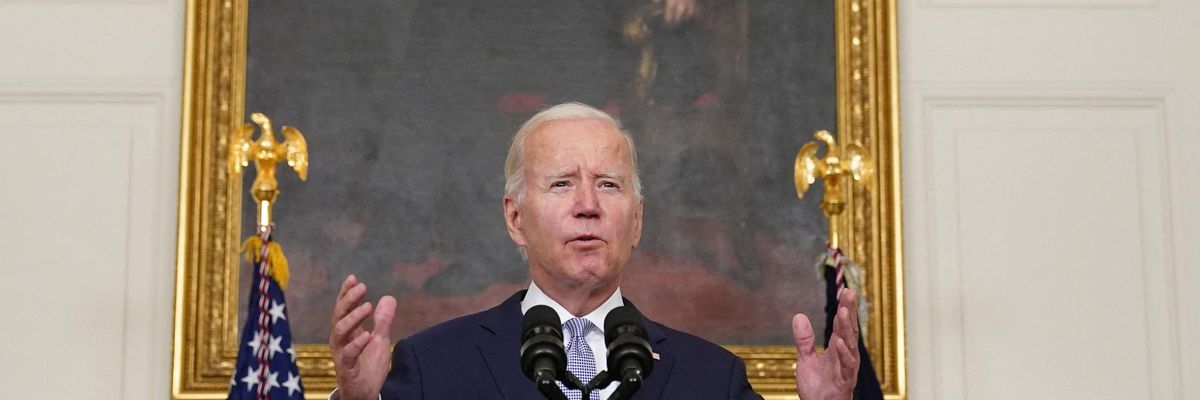
U.S. President Joe Biden speaks at the White House on July 28, 2022. (Photo: Mandel Ngan/AFP via Getty Images)
As the United States formally responded to Iran's comments on a draft nuclear deal, 15 organizations on Wednesday praised the Biden administration's "tireless work" so far and urged the White House to "seize this historic opportunity" to restore the agreement as soon as possible.
"The American people have made it clear that they prefer diplomacy with Iran--a strategy that is not only popular but one we know works."
The United States and Iran returning to the 2015 Joint Comprehensive Plan of Action (JCPOA)--ditched by the Trump administration in 2018--would not only deliver on one of U.S. President Joe Biden's campaign promises but also benefit the whole world, according to the coalition, which includes Win Without War, Global Zero, Indivisible, and Physicians for Social Responsibility.
"An implemented JCPOA would mean constraining an Iranian nuclear program that reached its most advanced state without a deal in place; ending a draconian sanctions policy that has been a humanitarian disaster for people in Iran who have little say in their government's actions; and preventing a war of choice when we are dealing with multiple crises globally, including Russia's invasion of Ukraine," the groups wrote in a letter to Biden.
The letter also highlights European Union negotiators' hopes that a resolution is close and the American public's support for resealing the deal.
As Politico noted Wednesday:
The spokesperson of the Iranian Foreign Ministry Nasser Kanaani confirmed that it had received the U.S. response via E.U. senior official Enrique Mora, who acts as a mediator and coordinator of the talks. Iran still refuses to talk directly with the U.S. "Iran has started reviewing the U.S. comments, and after the review Tehran will submit its views to the coordinator," Kanaani said.
[...]
A person familiar with the U.S. response said it focused on the issue of economic guarantees. The person declined to give details, but said the response "falls short of Iran's expectations. So now we have to see if they realize this is as good as it gets or decide to push for more."
"We are closer now than we were even just a couple of weeks ago because Iran made the decision to make some concessions," John Kirby, a spokesperson for the U.S. National Security Council, said Wednesday, while also warning that "a lot of gaps remain. We're not there yet."
As diplomats from the other nations that struck the initial deal seven years ago--China, France, Germany, Russia, and the United Kingdom--have spent recent months negotiating in Vienna, the Israeli government has privately and publicly pressured the Biden administration on some aspects of the talks.
Axios reported Thursday that a top Israeli official was briefed on the Biden administration's latest comments before they were sent to the E.U. negotiator, and Prime Minister Yair Lapid "said at a meeting of his political party on Wednesday in Tel Aviv that the U.S. had accepted many of Israel's requests in its response."
University of Michigan professor Juan Cole wrote Thursday that right-wingers in Israel and the United States who oppose reviving the Iran nuclear deal only want one thing: regime change. As he put it: "They surely know that the JCPOA worked. They didn't want it to."
Meanwhile, members of the coalition behind the new letter to Biden stressed in a statement Wednesday that restoring the deal will serve the security interests of all nations, including Israel.
"Reestablishment of the Iran nuclear deal would be a significant victory for peace, diplomacy, and stability in the Middle East," declared Hassan El-Tayyab, legislative director for Middle East policy at the Friends Committee on National Legislation. He added that "it's critical the Biden administration" advance to deal to "prevent another disastrous military escalation" in the region.
MoveOn executive director Rahna Epting similarly said that "by taking the Iran nuclear deal through the finish line, the Biden administration will be able to declare a strategic, moral, and political victory. We've seen how wars of choice in the Middle East have ended in unnecessary suffering."
"The American people have made it clear that they prefer diplomacy with Iran--a strategy that is not only popular but one we know works," she continued. "We also know that the Trump administration's strategy of withdrawing from the deal and choosing confrontation failed."
Ryan Costello, policy director at the National Iranian American Council, also emphasized a deal that "ensures Iran cannot get a nuclear weapon, cools escalating tensions, and relieves bad-faith sanctions that have pushed millions of innocent Iranians into poverty" would be a dramatic departure from former President Donald Trump's "disastrous maximum pressure campaign."
While acknowledging that "there is no doubt" a deal serves American interests by preventing an Iranian nuclear bomb and "a disastrous U.S.-Iran war," Trita Parsi of the Quincy Institute for Responsible Statecraft also argued that "experience shows that the deal is only durable if we build on it--diplomacy must now be used to also resolve other areas of U.S.-Iran tensions."
According to Parsi, "The JCPOA can become an opportunity to stabilize the region and bring U.S. troops home from the Middle East."
Dear Common Dreams reader, It’s been nearly 30 years since I co-founded Common Dreams with my late wife, Lina Newhouser. We had the radical notion that journalism should serve the public good, not corporate profits. It was clear to us from the outset what it would take to build such a project. No paid advertisements. No corporate sponsors. No millionaire publisher telling us what to think or do. Many people said we wouldn't last a year, but we proved those doubters wrong. Together with a tremendous team of journalists and dedicated staff, we built an independent media outlet free from the constraints of profits and corporate control. Our mission has always been simple: To inform. To inspire. To ignite change for the common good. Building Common Dreams was not easy. Our survival was never guaranteed. When you take on the most powerful forces—Wall Street greed, fossil fuel industry destruction, Big Tech lobbyists, and uber-rich oligarchs who have spent billions upon billions rigging the economy and democracy in their favor—the only bulwark you have is supporters who believe in your work. But here’s the urgent message from me today. It's never been this bad out there. And it's never been this hard to keep us going. At the very moment Common Dreams is most needed, the threats we face are intensifying. We need your support now more than ever. We don't accept corporate advertising and never will. We don't have a paywall because we don't think people should be blocked from critical news based on their ability to pay. Everything we do is funded by the donations of readers like you. When everyone does the little they can afford, we are strong. But if that support retreats or dries up, so do we. Will you donate now to make sure Common Dreams not only survives but thrives? —Craig Brown, Co-founder |
As the United States formally responded to Iran's comments on a draft nuclear deal, 15 organizations on Wednesday praised the Biden administration's "tireless work" so far and urged the White House to "seize this historic opportunity" to restore the agreement as soon as possible.
"The American people have made it clear that they prefer diplomacy with Iran--a strategy that is not only popular but one we know works."
The United States and Iran returning to the 2015 Joint Comprehensive Plan of Action (JCPOA)--ditched by the Trump administration in 2018--would not only deliver on one of U.S. President Joe Biden's campaign promises but also benefit the whole world, according to the coalition, which includes Win Without War, Global Zero, Indivisible, and Physicians for Social Responsibility.
"An implemented JCPOA would mean constraining an Iranian nuclear program that reached its most advanced state without a deal in place; ending a draconian sanctions policy that has been a humanitarian disaster for people in Iran who have little say in their government's actions; and preventing a war of choice when we are dealing with multiple crises globally, including Russia's invasion of Ukraine," the groups wrote in a letter to Biden.
The letter also highlights European Union negotiators' hopes that a resolution is close and the American public's support for resealing the deal.
As Politico noted Wednesday:
The spokesperson of the Iranian Foreign Ministry Nasser Kanaani confirmed that it had received the U.S. response via E.U. senior official Enrique Mora, who acts as a mediator and coordinator of the talks. Iran still refuses to talk directly with the U.S. "Iran has started reviewing the U.S. comments, and after the review Tehran will submit its views to the coordinator," Kanaani said.
[...]
A person familiar with the U.S. response said it focused on the issue of economic guarantees. The person declined to give details, but said the response "falls short of Iran's expectations. So now we have to see if they realize this is as good as it gets or decide to push for more."
"We are closer now than we were even just a couple of weeks ago because Iran made the decision to make some concessions," John Kirby, a spokesperson for the U.S. National Security Council, said Wednesday, while also warning that "a lot of gaps remain. We're not there yet."
As diplomats from the other nations that struck the initial deal seven years ago--China, France, Germany, Russia, and the United Kingdom--have spent recent months negotiating in Vienna, the Israeli government has privately and publicly pressured the Biden administration on some aspects of the talks.
Axios reported Thursday that a top Israeli official was briefed on the Biden administration's latest comments before they were sent to the E.U. negotiator, and Prime Minister Yair Lapid "said at a meeting of his political party on Wednesday in Tel Aviv that the U.S. had accepted many of Israel's requests in its response."
University of Michigan professor Juan Cole wrote Thursday that right-wingers in Israel and the United States who oppose reviving the Iran nuclear deal only want one thing: regime change. As he put it: "They surely know that the JCPOA worked. They didn't want it to."
Meanwhile, members of the coalition behind the new letter to Biden stressed in a statement Wednesday that restoring the deal will serve the security interests of all nations, including Israel.
"Reestablishment of the Iran nuclear deal would be a significant victory for peace, diplomacy, and stability in the Middle East," declared Hassan El-Tayyab, legislative director for Middle East policy at the Friends Committee on National Legislation. He added that "it's critical the Biden administration" advance to deal to "prevent another disastrous military escalation" in the region.
MoveOn executive director Rahna Epting similarly said that "by taking the Iran nuclear deal through the finish line, the Biden administration will be able to declare a strategic, moral, and political victory. We've seen how wars of choice in the Middle East have ended in unnecessary suffering."
"The American people have made it clear that they prefer diplomacy with Iran--a strategy that is not only popular but one we know works," she continued. "We also know that the Trump administration's strategy of withdrawing from the deal and choosing confrontation failed."
Ryan Costello, policy director at the National Iranian American Council, also emphasized a deal that "ensures Iran cannot get a nuclear weapon, cools escalating tensions, and relieves bad-faith sanctions that have pushed millions of innocent Iranians into poverty" would be a dramatic departure from former President Donald Trump's "disastrous maximum pressure campaign."
While acknowledging that "there is no doubt" a deal serves American interests by preventing an Iranian nuclear bomb and "a disastrous U.S.-Iran war," Trita Parsi of the Quincy Institute for Responsible Statecraft also argued that "experience shows that the deal is only durable if we build on it--diplomacy must now be used to also resolve other areas of U.S.-Iran tensions."
According to Parsi, "The JCPOA can become an opportunity to stabilize the region and bring U.S. troops home from the Middle East."
As the United States formally responded to Iran's comments on a draft nuclear deal, 15 organizations on Wednesday praised the Biden administration's "tireless work" so far and urged the White House to "seize this historic opportunity" to restore the agreement as soon as possible.
"The American people have made it clear that they prefer diplomacy with Iran--a strategy that is not only popular but one we know works."
The United States and Iran returning to the 2015 Joint Comprehensive Plan of Action (JCPOA)--ditched by the Trump administration in 2018--would not only deliver on one of U.S. President Joe Biden's campaign promises but also benefit the whole world, according to the coalition, which includes Win Without War, Global Zero, Indivisible, and Physicians for Social Responsibility.
"An implemented JCPOA would mean constraining an Iranian nuclear program that reached its most advanced state without a deal in place; ending a draconian sanctions policy that has been a humanitarian disaster for people in Iran who have little say in their government's actions; and preventing a war of choice when we are dealing with multiple crises globally, including Russia's invasion of Ukraine," the groups wrote in a letter to Biden.
The letter also highlights European Union negotiators' hopes that a resolution is close and the American public's support for resealing the deal.
As Politico noted Wednesday:
The spokesperson of the Iranian Foreign Ministry Nasser Kanaani confirmed that it had received the U.S. response via E.U. senior official Enrique Mora, who acts as a mediator and coordinator of the talks. Iran still refuses to talk directly with the U.S. "Iran has started reviewing the U.S. comments, and after the review Tehran will submit its views to the coordinator," Kanaani said.
[...]
A person familiar with the U.S. response said it focused on the issue of economic guarantees. The person declined to give details, but said the response "falls short of Iran's expectations. So now we have to see if they realize this is as good as it gets or decide to push for more."
"We are closer now than we were even just a couple of weeks ago because Iran made the decision to make some concessions," John Kirby, a spokesperson for the U.S. National Security Council, said Wednesday, while also warning that "a lot of gaps remain. We're not there yet."
As diplomats from the other nations that struck the initial deal seven years ago--China, France, Germany, Russia, and the United Kingdom--have spent recent months negotiating in Vienna, the Israeli government has privately and publicly pressured the Biden administration on some aspects of the talks.
Axios reported Thursday that a top Israeli official was briefed on the Biden administration's latest comments before they were sent to the E.U. negotiator, and Prime Minister Yair Lapid "said at a meeting of his political party on Wednesday in Tel Aviv that the U.S. had accepted many of Israel's requests in its response."
University of Michigan professor Juan Cole wrote Thursday that right-wingers in Israel and the United States who oppose reviving the Iran nuclear deal only want one thing: regime change. As he put it: "They surely know that the JCPOA worked. They didn't want it to."
Meanwhile, members of the coalition behind the new letter to Biden stressed in a statement Wednesday that restoring the deal will serve the security interests of all nations, including Israel.
"Reestablishment of the Iran nuclear deal would be a significant victory for peace, diplomacy, and stability in the Middle East," declared Hassan El-Tayyab, legislative director for Middle East policy at the Friends Committee on National Legislation. He added that "it's critical the Biden administration" advance to deal to "prevent another disastrous military escalation" in the region.
MoveOn executive director Rahna Epting similarly said that "by taking the Iran nuclear deal through the finish line, the Biden administration will be able to declare a strategic, moral, and political victory. We've seen how wars of choice in the Middle East have ended in unnecessary suffering."
"The American people have made it clear that they prefer diplomacy with Iran--a strategy that is not only popular but one we know works," she continued. "We also know that the Trump administration's strategy of withdrawing from the deal and choosing confrontation failed."
Ryan Costello, policy director at the National Iranian American Council, also emphasized a deal that "ensures Iran cannot get a nuclear weapon, cools escalating tensions, and relieves bad-faith sanctions that have pushed millions of innocent Iranians into poverty" would be a dramatic departure from former President Donald Trump's "disastrous maximum pressure campaign."
While acknowledging that "there is no doubt" a deal serves American interests by preventing an Iranian nuclear bomb and "a disastrous U.S.-Iran war," Trita Parsi of the Quincy Institute for Responsible Statecraft also argued that "experience shows that the deal is only durable if we build on it--diplomacy must now be used to also resolve other areas of U.S.-Iran tensions."
According to Parsi, "The JCPOA can become an opportunity to stabilize the region and bring U.S. troops home from the Middle East."