SUBSCRIBE TO OUR FREE NEWSLETTER
Daily news & progressive opinion—funded by the people, not the corporations—delivered straight to your inbox.
5
#000000
#FFFFFF
To donate by check, phone, or other method, see our More Ways to Give page.
Daily news & progressive opinion—funded by the people, not the corporations—delivered straight to your inbox.
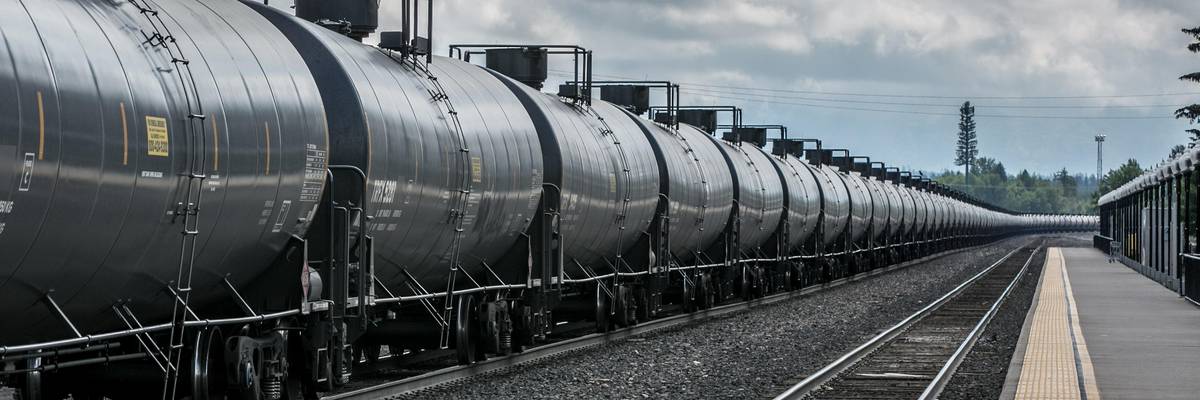
A BNSF freight train hauling tankers loaded with crude oil heads west through a transcontinental railroad hub on June 22, 2018 in Whitefish, Montana, home to Glacier National Park. (Photo: George Rose/Getty Images)
The Biden administration came under fire this week after paving the way for an oil railway that its own projections suggest would increase planet-heating pollution in the United States by almost 1%.
"Unleashing this destructive flood of oil is climate cowardice."
President Joe Biden "should be doing everything in his power to respond to the climate emergency, but he's about to light one of the nation's biggest carbon bombs," Deeda Seed, a campaigner with the Center for Biological Diversity, said Wednesday in a statement.
"This is pouring another 5 billion gallons of oil on the fire every year and bulldozing a national forest in the process," Seed continued. "It's a horrifying step in the wrong direction."
On Tuesday, the U.S. Forest Service rejected challenges to the Uinta Basin Railway, which is expected to quadruple oil extraction in northeast Utah's Uinta Basin by connecting its fracking operations to a transcontinental railroad network that would move hundreds of heated tank cars loaded with waxy crude through the Colorado Rockies en route to Gulf Coast refineries each day.
If completed, the railway would provide enough transportation capacity to increase production from roughly 85,000 barrels per day to 350,000 barrels per day, "amounting to up to 53 million tons of annual carbon pollution--as much or more than what's produced by the nation's three largest power plants," the Center for Biological Diversity, the Sierra Club, and Utah Physicians for a Healthy Environment explained.
"Sending tens of millions of barrels of crude oil each year from Utah to the Houston area for refining would be equivalent to adding a new refinery to the region, which already exceeds national pollution standards," the groups added.
Despite acknowledging that the project would increase nationwide greenhouse gas emissions by 0.8% at a time when scientists warn that global emissions must be halved by 2030 to stave off the worst impacts of the climate crisis, the Forest Service argued that constructing 88 miles of rail line to transport fossil fuels is in the public interest.
The agency issued a special use permit for the roughly 12 miles of tracks that would cross the Ashley National Forest in Utah, dismissing opponents' objections to cutting through public lands protected by the Roadless Area Conservation Rule.
Although the oil trains pose a heightened risk of fires and spills, including along the vulnerable Colorado River that provides drinking water for 40 million people, federal regulators ordered Ashley National Forest officials to issue a right-of-way that would enable construction to begin next year.
Utah Sierra Club director Carly Ferro characterized the Forest Service's move to expand polluting activities "into an area that's protecting an ecosystem critical to public and environmental health" as "an egregious decision that exacerbates climate change instead of addressing the impacts we're feeling right here at home."
The Biden administration's decision to greenlight the Uinta Basin Railway came just days after the U.S. Supreme Court's reactionary majority sharply curtailed the U.S. Environmental Protection Agency's authority to regulate power plant emissions, which prompted progressives to demand stronger executive action on climate from the White House.
It also came less than two weeks after U.S. Secretary of Agriculture Tom Vilsack directed the Forest Service to "take bold actions" to "address the climate crisis."
"There is no such thing as a safe oil train."
"Secretary Vilsack was right to call for bold climate action but unleashing this destructive flood of oil is climate cowardice," said Jonny Vasic, executive director of Utah Physicians for a Healthy Environment. "This area is already facing water and air quality issues."
More than 100 environmental groups representing millions of people urged Vilsack in January to prevent construction of the Uinta Basin Railway by blocking the proposed right-of-way through Ashley National Forest, to no avail.
The federal government's own environmental analysis shows that the project would cause irreparable harm to biodiversity, digging up Utah streams in more than 400 locations and stripping bare 10,000 acres of wildlife habitat, including areas crucial to the survival of pronghorn, mule deer, and greater sage grouse.
Dozens of counties and local governments in Colorado have also voiced opposition to oil railway, with several asking U.S. Sens Michael Bennet (D-Colo.) and John Hickenlooper (D-Colo.) to do everything in their power to stop it.
In a Colorado Sun opinion piece published just three days before the U.S. Surface Transportation Board's (STB) mid-December approval of the Uinta Basin Railway, Seed wrote that "there is no such thing as a safe oil train."
If the railway is built, she noted, "all routes lead through Colorado." Each day, up to 10 two-mile-long trains hauling crude oil would whizz through mountains, valleys, and towns along the Western Slope and through cities in the Front Range.
The oil trains would travel "along the Union Pacific mainline, paralleling the Colorado River almost to its headwaters," Seed pointed out. "The trains will follow the Fraser River to Denver, where they'll head south through Colorado Springs and Pueblo toward refineries along the Gulf of Mexico. This will pose a tremendous health and safety threat to Coloradans and the state's remarkable wildlife and wild places."
In February, a coalition of environmental and public health groups sued the STB, accusing the agency of violating the National Environmental Policy Act by failing to adequately account for the life-threatening consequences of adding 53 million tons of carbon dioxide per year to the atmosphere by extracting and refining 350,000 barrels of oil per day from the Uinta Basin.
The pending lawsuit, filed in the U.S. Court of Appeals for the District of Columbia Circuit, also accuses the U.S. Fish and Wildlife Service of violating the Endangered Species Act by failing to protect rare plants that the Uinta Basin Railway is set to destroy.
Ferro said that "we will stay resilient in the face of the increasingly devastating consequences of the climate and extinction crises by fighting this project."
Dear Common Dreams reader, It’s been nearly 30 years since I co-founded Common Dreams with my late wife, Lina Newhouser. We had the radical notion that journalism should serve the public good, not corporate profits. It was clear to us from the outset what it would take to build such a project. No paid advertisements. No corporate sponsors. No millionaire publisher telling us what to think or do. Many people said we wouldn't last a year, but we proved those doubters wrong. Together with a tremendous team of journalists and dedicated staff, we built an independent media outlet free from the constraints of profits and corporate control. Our mission has always been simple: To inform. To inspire. To ignite change for the common good. Building Common Dreams was not easy. Our survival was never guaranteed. When you take on the most powerful forces—Wall Street greed, fossil fuel industry destruction, Big Tech lobbyists, and uber-rich oligarchs who have spent billions upon billions rigging the economy and democracy in their favor—the only bulwark you have is supporters who believe in your work. But here’s the urgent message from me today. It's never been this bad out there. And it's never been this hard to keep us going. At the very moment Common Dreams is most needed, the threats we face are intensifying. We need your support now more than ever. We don't accept corporate advertising and never will. We don't have a paywall because we don't think people should be blocked from critical news based on their ability to pay. Everything we do is funded by the donations of readers like you. When everyone does the little they can afford, we are strong. But if that support retreats or dries up, so do we. Will you donate now to make sure Common Dreams not only survives but thrives? —Craig Brown, Co-founder |
The Biden administration came under fire this week after paving the way for an oil railway that its own projections suggest would increase planet-heating pollution in the United States by almost 1%.
"Unleashing this destructive flood of oil is climate cowardice."
President Joe Biden "should be doing everything in his power to respond to the climate emergency, but he's about to light one of the nation's biggest carbon bombs," Deeda Seed, a campaigner with the Center for Biological Diversity, said Wednesday in a statement.
"This is pouring another 5 billion gallons of oil on the fire every year and bulldozing a national forest in the process," Seed continued. "It's a horrifying step in the wrong direction."
On Tuesday, the U.S. Forest Service rejected challenges to the Uinta Basin Railway, which is expected to quadruple oil extraction in northeast Utah's Uinta Basin by connecting its fracking operations to a transcontinental railroad network that would move hundreds of heated tank cars loaded with waxy crude through the Colorado Rockies en route to Gulf Coast refineries each day.
If completed, the railway would provide enough transportation capacity to increase production from roughly 85,000 barrels per day to 350,000 barrels per day, "amounting to up to 53 million tons of annual carbon pollution--as much or more than what's produced by the nation's three largest power plants," the Center for Biological Diversity, the Sierra Club, and Utah Physicians for a Healthy Environment explained.
"Sending tens of millions of barrels of crude oil each year from Utah to the Houston area for refining would be equivalent to adding a new refinery to the region, which already exceeds national pollution standards," the groups added.
Despite acknowledging that the project would increase nationwide greenhouse gas emissions by 0.8% at a time when scientists warn that global emissions must be halved by 2030 to stave off the worst impacts of the climate crisis, the Forest Service argued that constructing 88 miles of rail line to transport fossil fuels is in the public interest.
The agency issued a special use permit for the roughly 12 miles of tracks that would cross the Ashley National Forest in Utah, dismissing opponents' objections to cutting through public lands protected by the Roadless Area Conservation Rule.
Although the oil trains pose a heightened risk of fires and spills, including along the vulnerable Colorado River that provides drinking water for 40 million people, federal regulators ordered Ashley National Forest officials to issue a right-of-way that would enable construction to begin next year.
Utah Sierra Club director Carly Ferro characterized the Forest Service's move to expand polluting activities "into an area that's protecting an ecosystem critical to public and environmental health" as "an egregious decision that exacerbates climate change instead of addressing the impacts we're feeling right here at home."
The Biden administration's decision to greenlight the Uinta Basin Railway came just days after the U.S. Supreme Court's reactionary majority sharply curtailed the U.S. Environmental Protection Agency's authority to regulate power plant emissions, which prompted progressives to demand stronger executive action on climate from the White House.
It also came less than two weeks after U.S. Secretary of Agriculture Tom Vilsack directed the Forest Service to "take bold actions" to "address the climate crisis."
"There is no such thing as a safe oil train."
"Secretary Vilsack was right to call for bold climate action but unleashing this destructive flood of oil is climate cowardice," said Jonny Vasic, executive director of Utah Physicians for a Healthy Environment. "This area is already facing water and air quality issues."
More than 100 environmental groups representing millions of people urged Vilsack in January to prevent construction of the Uinta Basin Railway by blocking the proposed right-of-way through Ashley National Forest, to no avail.
The federal government's own environmental analysis shows that the project would cause irreparable harm to biodiversity, digging up Utah streams in more than 400 locations and stripping bare 10,000 acres of wildlife habitat, including areas crucial to the survival of pronghorn, mule deer, and greater sage grouse.
Dozens of counties and local governments in Colorado have also voiced opposition to oil railway, with several asking U.S. Sens Michael Bennet (D-Colo.) and John Hickenlooper (D-Colo.) to do everything in their power to stop it.
In a Colorado Sun opinion piece published just three days before the U.S. Surface Transportation Board's (STB) mid-December approval of the Uinta Basin Railway, Seed wrote that "there is no such thing as a safe oil train."
If the railway is built, she noted, "all routes lead through Colorado." Each day, up to 10 two-mile-long trains hauling crude oil would whizz through mountains, valleys, and towns along the Western Slope and through cities in the Front Range.
The oil trains would travel "along the Union Pacific mainline, paralleling the Colorado River almost to its headwaters," Seed pointed out. "The trains will follow the Fraser River to Denver, where they'll head south through Colorado Springs and Pueblo toward refineries along the Gulf of Mexico. This will pose a tremendous health and safety threat to Coloradans and the state's remarkable wildlife and wild places."
In February, a coalition of environmental and public health groups sued the STB, accusing the agency of violating the National Environmental Policy Act by failing to adequately account for the life-threatening consequences of adding 53 million tons of carbon dioxide per year to the atmosphere by extracting and refining 350,000 barrels of oil per day from the Uinta Basin.
The pending lawsuit, filed in the U.S. Court of Appeals for the District of Columbia Circuit, also accuses the U.S. Fish and Wildlife Service of violating the Endangered Species Act by failing to protect rare plants that the Uinta Basin Railway is set to destroy.
Ferro said that "we will stay resilient in the face of the increasingly devastating consequences of the climate and extinction crises by fighting this project."
The Biden administration came under fire this week after paving the way for an oil railway that its own projections suggest would increase planet-heating pollution in the United States by almost 1%.
"Unleashing this destructive flood of oil is climate cowardice."
President Joe Biden "should be doing everything in his power to respond to the climate emergency, but he's about to light one of the nation's biggest carbon bombs," Deeda Seed, a campaigner with the Center for Biological Diversity, said Wednesday in a statement.
"This is pouring another 5 billion gallons of oil on the fire every year and bulldozing a national forest in the process," Seed continued. "It's a horrifying step in the wrong direction."
On Tuesday, the U.S. Forest Service rejected challenges to the Uinta Basin Railway, which is expected to quadruple oil extraction in northeast Utah's Uinta Basin by connecting its fracking operations to a transcontinental railroad network that would move hundreds of heated tank cars loaded with waxy crude through the Colorado Rockies en route to Gulf Coast refineries each day.
If completed, the railway would provide enough transportation capacity to increase production from roughly 85,000 barrels per day to 350,000 barrels per day, "amounting to up to 53 million tons of annual carbon pollution--as much or more than what's produced by the nation's three largest power plants," the Center for Biological Diversity, the Sierra Club, and Utah Physicians for a Healthy Environment explained.
"Sending tens of millions of barrels of crude oil each year from Utah to the Houston area for refining would be equivalent to adding a new refinery to the region, which already exceeds national pollution standards," the groups added.
Despite acknowledging that the project would increase nationwide greenhouse gas emissions by 0.8% at a time when scientists warn that global emissions must be halved by 2030 to stave off the worst impacts of the climate crisis, the Forest Service argued that constructing 88 miles of rail line to transport fossil fuels is in the public interest.
The agency issued a special use permit for the roughly 12 miles of tracks that would cross the Ashley National Forest in Utah, dismissing opponents' objections to cutting through public lands protected by the Roadless Area Conservation Rule.
Although the oil trains pose a heightened risk of fires and spills, including along the vulnerable Colorado River that provides drinking water for 40 million people, federal regulators ordered Ashley National Forest officials to issue a right-of-way that would enable construction to begin next year.
Utah Sierra Club director Carly Ferro characterized the Forest Service's move to expand polluting activities "into an area that's protecting an ecosystem critical to public and environmental health" as "an egregious decision that exacerbates climate change instead of addressing the impacts we're feeling right here at home."
The Biden administration's decision to greenlight the Uinta Basin Railway came just days after the U.S. Supreme Court's reactionary majority sharply curtailed the U.S. Environmental Protection Agency's authority to regulate power plant emissions, which prompted progressives to demand stronger executive action on climate from the White House.
It also came less than two weeks after U.S. Secretary of Agriculture Tom Vilsack directed the Forest Service to "take bold actions" to "address the climate crisis."
"There is no such thing as a safe oil train."
"Secretary Vilsack was right to call for bold climate action but unleashing this destructive flood of oil is climate cowardice," said Jonny Vasic, executive director of Utah Physicians for a Healthy Environment. "This area is already facing water and air quality issues."
More than 100 environmental groups representing millions of people urged Vilsack in January to prevent construction of the Uinta Basin Railway by blocking the proposed right-of-way through Ashley National Forest, to no avail.
The federal government's own environmental analysis shows that the project would cause irreparable harm to biodiversity, digging up Utah streams in more than 400 locations and stripping bare 10,000 acres of wildlife habitat, including areas crucial to the survival of pronghorn, mule deer, and greater sage grouse.
Dozens of counties and local governments in Colorado have also voiced opposition to oil railway, with several asking U.S. Sens Michael Bennet (D-Colo.) and John Hickenlooper (D-Colo.) to do everything in their power to stop it.
In a Colorado Sun opinion piece published just three days before the U.S. Surface Transportation Board's (STB) mid-December approval of the Uinta Basin Railway, Seed wrote that "there is no such thing as a safe oil train."
If the railway is built, she noted, "all routes lead through Colorado." Each day, up to 10 two-mile-long trains hauling crude oil would whizz through mountains, valleys, and towns along the Western Slope and through cities in the Front Range.
The oil trains would travel "along the Union Pacific mainline, paralleling the Colorado River almost to its headwaters," Seed pointed out. "The trains will follow the Fraser River to Denver, where they'll head south through Colorado Springs and Pueblo toward refineries along the Gulf of Mexico. This will pose a tremendous health and safety threat to Coloradans and the state's remarkable wildlife and wild places."
In February, a coalition of environmental and public health groups sued the STB, accusing the agency of violating the National Environmental Policy Act by failing to adequately account for the life-threatening consequences of adding 53 million tons of carbon dioxide per year to the atmosphere by extracting and refining 350,000 barrels of oil per day from the Uinta Basin.
The pending lawsuit, filed in the U.S. Court of Appeals for the District of Columbia Circuit, also accuses the U.S. Fish and Wildlife Service of violating the Endangered Species Act by failing to protect rare plants that the Uinta Basin Railway is set to destroy.
Ferro said that "we will stay resilient in the face of the increasingly devastating consequences of the climate and extinction crises by fighting this project."