SUBSCRIBE TO OUR FREE NEWSLETTER
Daily news & progressive opinion—funded by the people, not the corporations—delivered straight to your inbox.
5
#000000
#FFFFFF
To donate by check, phone, or other method, see our More Ways to Give page.
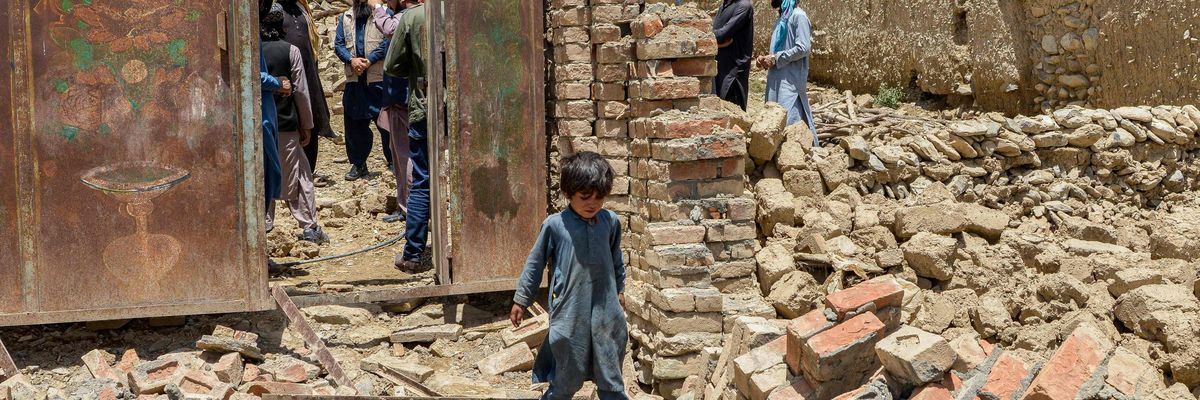
After a massive earthquake killed more than 1,000 people and leveled entire villages in southeast Afghanistan, the Biden administration on Wednesday faced fresh calls to return the roughly $7 billion in central bank assets it seized from the war-torn and impoverished nation as it attempts to recover from the catastrophe.
"Aid organizations have long cited the frozen assets as well as the sanctions regime as insurmountable barriers to ensuring Afghans receive basic needs and emergency aid," tweeted the advocacy group Afghans for a Better Tomorrow. "[President Joe Biden] should move quickly and decisively at this critical moment; time is of the essence."
"Just because we don't like the Taliban doesn't make our collective punishment of Afghan women, children, and the entire population of ordinary Afghans an acceptable policy."
The earthquake added to the already horrific humanitarian crisis facing ordinary Afghans, tens of millions of whom are facing acute hunger as the nation's economy--strangled by U.S. and European sanctions and other punitive measures--verges on total collapse. The United Nations has warned that 97% of the Afghan population could be plunged into poverty this year.
Clare Daly, a socialist member of the European Parliament, demanded Wednesday that Biden administration officials "give back the billions they stole like crooks from the Afghan people."
Those funds, Daly wrote on Twitter, are "needed now more than ever to address the devastation."
Earlier this year, the Biden administration announced a ploy to permanently seize $7 billion in Afghan central bank assets that it froze after the Taliban retook power last August. The administration said it would split the assets between an ill-defined fund to assist ordinary Afghans and family members of 9/11 victims.
The New York Times reported earlier this month that "at least six major groups of victims of the Sept. 11, 2001, attacks have struck a tentative deal to divide about $3.5 billion in Afghan central bank assets they are trying to seize to pay off legal claims against the Taliban."
In a letter to the editor of the Washington Post earlier this week, Kelly Campbell of 9/11 Families for Peaceful Tomorrows--a group that opposes the Biden administration's seizure of Afghan assets--wrote that "just because we don't like the Taliban doesn't make our collective punishment of Afghan women, children, and the entire population of ordinary Afghans an acceptable policy."
"In addition to withholding aid funds, the administration froze billions of dollars in Afghan central bank funds, crippling the country's economy," Campbell added. "If we care about Afghan people, including Afghan women, the United States must release Afghan central bank funds to get the economy on its feet and ensure that aid money is flowing to prevent immediate disaster and, ultimately, a failed state."
Related Content

In response to Wednesday's earthquake, National Security Advisor Jake Sullivan said the Biden administration is "deeply saddened to see the devastating earthquake that took the lives of at least 1,000 people in Afghanistan"--but gave no indication that it is considering returning the country's seized assets.
"President Biden is monitoring developments and has directed USAID and other federal government partners to assess U.S. response options to help those most affected," said Sullivan.
Adnan Junaid, the International Rescue Committee's vice president for Asia, warned in a statement that "the toll this disaster will have on the local communities the affected provinces is catastrophic, and the impact the earthquake will have on the already stretched humanitarian response in Afghanistan is a grave cause for concern."
"Funding is needed now to save lives and support essential services, but the international community must go further and establish a roadmap that sets out strategies to resume development assistance, provide technical support to the central bank, and ultimately release Afghanistan's foreign exchange reserves," said Junaid. "Only a bold strategy that addresses the causes of this crisis will put an end to the spiral of misery being faced by its population."
After a massive earthquake killed more than 1,000 people and leveled entire villages in southeast Afghanistan, the Biden administration on Wednesday faced fresh calls to return the roughly $7 billion in central bank assets it seized from the war-torn and impoverished nation as it attempts to recover from the catastrophe.
"Aid organizations have long cited the frozen assets as well as the sanctions regime as insurmountable barriers to ensuring Afghans receive basic needs and emergency aid," tweeted the advocacy group Afghans for a Better Tomorrow. "[President Joe Biden] should move quickly and decisively at this critical moment; time is of the essence."
"Just because we don't like the Taliban doesn't make our collective punishment of Afghan women, children, and the entire population of ordinary Afghans an acceptable policy."
The earthquake added to the already horrific humanitarian crisis facing ordinary Afghans, tens of millions of whom are facing acute hunger as the nation's economy--strangled by U.S. and European sanctions and other punitive measures--verges on total collapse. The United Nations has warned that 97% of the Afghan population could be plunged into poverty this year.
Clare Daly, a socialist member of the European Parliament, demanded Wednesday that Biden administration officials "give back the billions they stole like crooks from the Afghan people."
Those funds, Daly wrote on Twitter, are "needed now more than ever to address the devastation."
Earlier this year, the Biden administration announced a ploy to permanently seize $7 billion in Afghan central bank assets that it froze after the Taliban retook power last August. The administration said it would split the assets between an ill-defined fund to assist ordinary Afghans and family members of 9/11 victims.
The New York Times reported earlier this month that "at least six major groups of victims of the Sept. 11, 2001, attacks have struck a tentative deal to divide about $3.5 billion in Afghan central bank assets they are trying to seize to pay off legal claims against the Taliban."
In a letter to the editor of the Washington Post earlier this week, Kelly Campbell of 9/11 Families for Peaceful Tomorrows--a group that opposes the Biden administration's seizure of Afghan assets--wrote that "just because we don't like the Taliban doesn't make our collective punishment of Afghan women, children, and the entire population of ordinary Afghans an acceptable policy."
"In addition to withholding aid funds, the administration froze billions of dollars in Afghan central bank funds, crippling the country's economy," Campbell added. "If we care about Afghan people, including Afghan women, the United States must release Afghan central bank funds to get the economy on its feet and ensure that aid money is flowing to prevent immediate disaster and, ultimately, a failed state."
Related Content
In response to Wednesday's earthquake, National Security Advisor Jake Sullivan said the Biden administration is "deeply saddened to see the devastating earthquake that took the lives of at least 1,000 people in Afghanistan"--but gave no indication that it is considering returning the country's seized assets.
"President Biden is monitoring developments and has directed USAID and other federal government partners to assess U.S. response options to help those most affected," said Sullivan.
Adnan Junaid, the International Rescue Committee's vice president for Asia, warned in a statement that "the toll this disaster will have on the local communities the affected provinces is catastrophic, and the impact the earthquake will have on the already stretched humanitarian response in Afghanistan is a grave cause for concern."
"Funding is needed now to save lives and support essential services, but the international community must go further and establish a roadmap that sets out strategies to resume development assistance, provide technical support to the central bank, and ultimately release Afghanistan's foreign exchange reserves," said Junaid. "Only a bold strategy that addresses the causes of this crisis will put an end to the spiral of misery being faced by its population."
After a massive earthquake killed more than 1,000 people and leveled entire villages in southeast Afghanistan, the Biden administration on Wednesday faced fresh calls to return the roughly $7 billion in central bank assets it seized from the war-torn and impoverished nation as it attempts to recover from the catastrophe.
"Aid organizations have long cited the frozen assets as well as the sanctions regime as insurmountable barriers to ensuring Afghans receive basic needs and emergency aid," tweeted the advocacy group Afghans for a Better Tomorrow. "[President Joe Biden] should move quickly and decisively at this critical moment; time is of the essence."
"Just because we don't like the Taliban doesn't make our collective punishment of Afghan women, children, and the entire population of ordinary Afghans an acceptable policy."
The earthquake added to the already horrific humanitarian crisis facing ordinary Afghans, tens of millions of whom are facing acute hunger as the nation's economy--strangled by U.S. and European sanctions and other punitive measures--verges on total collapse. The United Nations has warned that 97% of the Afghan population could be plunged into poverty this year.
Clare Daly, a socialist member of the European Parliament, demanded Wednesday that Biden administration officials "give back the billions they stole like crooks from the Afghan people."
Those funds, Daly wrote on Twitter, are "needed now more than ever to address the devastation."
Earlier this year, the Biden administration announced a ploy to permanently seize $7 billion in Afghan central bank assets that it froze after the Taliban retook power last August. The administration said it would split the assets between an ill-defined fund to assist ordinary Afghans and family members of 9/11 victims.
The New York Times reported earlier this month that "at least six major groups of victims of the Sept. 11, 2001, attacks have struck a tentative deal to divide about $3.5 billion in Afghan central bank assets they are trying to seize to pay off legal claims against the Taliban."
In a letter to the editor of the Washington Post earlier this week, Kelly Campbell of 9/11 Families for Peaceful Tomorrows--a group that opposes the Biden administration's seizure of Afghan assets--wrote that "just because we don't like the Taliban doesn't make our collective punishment of Afghan women, children, and the entire population of ordinary Afghans an acceptable policy."
"In addition to withholding aid funds, the administration froze billions of dollars in Afghan central bank funds, crippling the country's economy," Campbell added. "If we care about Afghan people, including Afghan women, the United States must release Afghan central bank funds to get the economy on its feet and ensure that aid money is flowing to prevent immediate disaster and, ultimately, a failed state."
Related Content
In response to Wednesday's earthquake, National Security Advisor Jake Sullivan said the Biden administration is "deeply saddened to see the devastating earthquake that took the lives of at least 1,000 people in Afghanistan"--but gave no indication that it is considering returning the country's seized assets.
"President Biden is monitoring developments and has directed USAID and other federal government partners to assess U.S. response options to help those most affected," said Sullivan.
Adnan Junaid, the International Rescue Committee's vice president for Asia, warned in a statement that "the toll this disaster will have on the local communities the affected provinces is catastrophic, and the impact the earthquake will have on the already stretched humanitarian response in Afghanistan is a grave cause for concern."
"Funding is needed now to save lives and support essential services, but the international community must go further and establish a roadmap that sets out strategies to resume development assistance, provide technical support to the central bank, and ultimately release Afghanistan's foreign exchange reserves," said Junaid. "Only a bold strategy that addresses the causes of this crisis will put an end to the spiral of misery being faced by its population."