SUBSCRIBE TO OUR FREE NEWSLETTER
Daily news & progressive opinion—funded by the people, not the corporations—delivered straight to your inbox.
5
#000000
#FFFFFF
To donate by check, phone, or other method, see our More Ways to Give page.
Daily news & progressive opinion—funded by the people, not the corporations—delivered straight to your inbox.
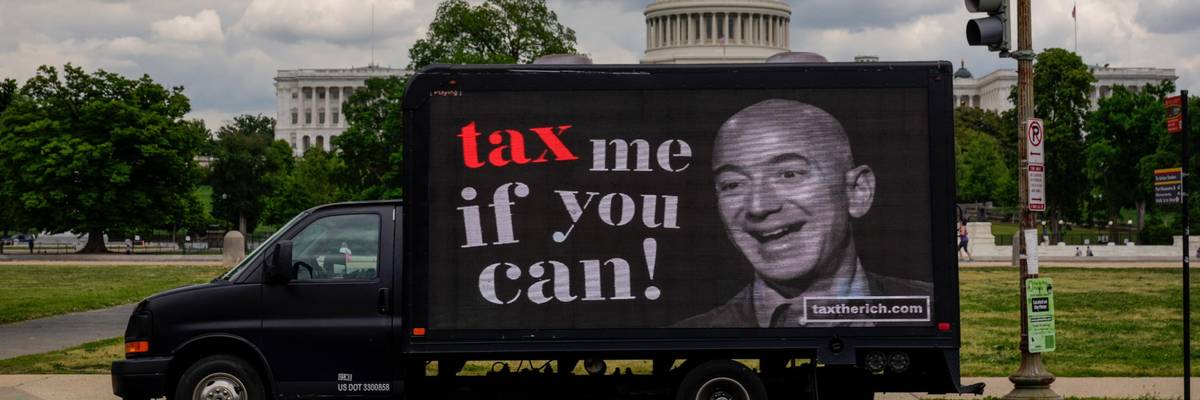
A mobile billboard calling for higher taxes on the ultra-wealthy depicts an image of billionaire businessman Jeff Bezos, the founder of Amazon, near the U.S. Capitol on May 17, 2021. (Photo: Drew Angerer/Getty Images)
A global index published Tuesday ranks the United States as the world's leading perpetrator of financial secrecy, citing the country's refusal to share key information with the tax authorities of other nations and its status as a generous tax haven for foreign oligarchs, rich executives, and other elites.
The ranking comes despite U.S. President Joe Biden's campaign-trail pledge to "bring transparency to the global financial system, go after illicit tax havens, seize stolen assets, and make it more difficult for leaders who steal from their people to hide behind anonymous front companies."
"These rankings show how corrupt actors are weaponizing our financial system against democracy here and abroad."
In December, following the leak of an enormous trove of tax documents that called additional attention to the country's secretive financial system, Treasury Secretary Janet Yellen conceded, "There's a good argument that, right now, the best place to hide and launder ill-gotten gains is actually the United States."
The latest edition of the Financial Secrecy Index, a project of the Tax Justice Network (TJN), echoes that assessment, faulting the U.S. for its weak corporate tax disclosure rules and overall lack of transparency. In fact, the index awarded the U.S. the highest secrecy score since 2009, when the ranking began.
"That isn't a prize the U.S. wants to claim for itself," Gary Kalman, the executive director of Transparency International U.S., said in a statement. "The combination of secrecy and size of our financial system puts the U.S. ahead of other notorious secrecy havens like the Cayman Islands and Switzerland. That's a shameful distinction."
While noting that some progress has been made over the past year and a half--specifically Congress' passage of a ban on anonymous shell companies, entities often used to hide illicit cash--TJN found that "the U.S. now fuels more global financial secrecy than Switzerland, Cayman, and Bermuda combined."
TJN also stressed that the shell company law enacted in January 2021 is riddled with loopholes such as "limited definitions of which legal entities and beneficial owners must register, 23 baked-in exemptions to registration, and an absence of requirements on all trusts."
To improve on its dismal ranking, TJN urged the U.S. to "reciprocally exchange information with other countries by adopting the Common Reporting Standard and become a party to amended Convention on Mutual Administrative Assistance in Tax Matters," steps that "would cut its supply of financial secrecy to the world by 40%."
The U.S.-based Financial Accountability and Corporate Transparency (FACT) Coalition also outlined a number of actions the Biden administration and Congress should take, including "introducing consistent anti-money laundering due diligence and reporting requirements to the $11 trillion U.S. private investment fund industry."
"While the U.S. has committed to being a leader in cracking down on global corruption, these rankings show how corrupt actors are weaponizing our financial system against democracy here and abroad," said Ian Gary, the FACT Coalition's executive director.
The updated index comes a day before G7 finance ministers are set to meet in Bonn, Germany to discuss aid to Ukraine and enforcement of the unprecedented Western sanctions targeting Russian oligarchs, political leaders, and the broader economy.
TJN argued Tuesday that despite "subversion" by G7 countries, global financial secrecy has continued to shrink overall thanks to "more countries adopting or improving beneficial ownership registration laws--which require the identification and registration of the real individual, made of flesh and blood, who ultimately owns, controls, or benefits from a company or legal vehicle--and by more countries, particularly lower-income countries, improving international cooperation on anti-money laundering efforts, information exchange, treaties, and judicial cooperation."
Alex Cobham, TJN's chief executive, said in a statement that "globally, we're starting to curb the financial secrecy used by Russian oligarchs, and also by tax evaders, corrupt politicians, and organized crime around the world to hide and launder ill-gotten wealth."
"But the U.S., U.K., Germany, Italy, and Japan cut back that global progress by more than half, fueling financial secrecy instead of fighting it," Cobham continued. "The G7 must make clear where they stand in the fight against financial secrecy by committing to a global asset register."
TJN researcher Moran Harari added that "once again, a small club of rich countries setting global rules on finance and tax are found to be the ones most responsible for facilitating financial secrecy and tax abuses."
"For decades, rich G7 countries courted billionaires, oligarchs, and corporate giants with secrecy loopholes and eyes-wide-shut-regulations," said Harari. "The regulations they imposed facilitated the robbing of billions from poorer countries' public purses. And now those same regulations are making it nearly impossible for G7 countries themselves to track down the billions held offshore by sanctioned Russian oligarchs."
Dear Common Dreams reader, It’s been nearly 30 years since I co-founded Common Dreams with my late wife, Lina Newhouser. We had the radical notion that journalism should serve the public good, not corporate profits. It was clear to us from the outset what it would take to build such a project. No paid advertisements. No corporate sponsors. No millionaire publisher telling us what to think or do. Many people said we wouldn't last a year, but we proved those doubters wrong. Together with a tremendous team of journalists and dedicated staff, we built an independent media outlet free from the constraints of profits and corporate control. Our mission has always been simple: To inform. To inspire. To ignite change for the common good. Building Common Dreams was not easy. Our survival was never guaranteed. When you take on the most powerful forces—Wall Street greed, fossil fuel industry destruction, Big Tech lobbyists, and uber-rich oligarchs who have spent billions upon billions rigging the economy and democracy in their favor—the only bulwark you have is supporters who believe in your work. But here’s the urgent message from me today. It's never been this bad out there. And it's never been this hard to keep us going. At the very moment Common Dreams is most needed, the threats we face are intensifying. We need your support now more than ever. We don't accept corporate advertising and never will. We don't have a paywall because we don't think people should be blocked from critical news based on their ability to pay. Everything we do is funded by the donations of readers like you. When everyone does the little they can afford, we are strong. But if that support retreats or dries up, so do we. Will you donate now to make sure Common Dreams not only survives but thrives? —Craig Brown, Co-founder |
A global index published Tuesday ranks the United States as the world's leading perpetrator of financial secrecy, citing the country's refusal to share key information with the tax authorities of other nations and its status as a generous tax haven for foreign oligarchs, rich executives, and other elites.
The ranking comes despite U.S. President Joe Biden's campaign-trail pledge to "bring transparency to the global financial system, go after illicit tax havens, seize stolen assets, and make it more difficult for leaders who steal from their people to hide behind anonymous front companies."
"These rankings show how corrupt actors are weaponizing our financial system against democracy here and abroad."
In December, following the leak of an enormous trove of tax documents that called additional attention to the country's secretive financial system, Treasury Secretary Janet Yellen conceded, "There's a good argument that, right now, the best place to hide and launder ill-gotten gains is actually the United States."
The latest edition of the Financial Secrecy Index, a project of the Tax Justice Network (TJN), echoes that assessment, faulting the U.S. for its weak corporate tax disclosure rules and overall lack of transparency. In fact, the index awarded the U.S. the highest secrecy score since 2009, when the ranking began.
"That isn't a prize the U.S. wants to claim for itself," Gary Kalman, the executive director of Transparency International U.S., said in a statement. "The combination of secrecy and size of our financial system puts the U.S. ahead of other notorious secrecy havens like the Cayman Islands and Switzerland. That's a shameful distinction."
While noting that some progress has been made over the past year and a half--specifically Congress' passage of a ban on anonymous shell companies, entities often used to hide illicit cash--TJN found that "the U.S. now fuels more global financial secrecy than Switzerland, Cayman, and Bermuda combined."
TJN also stressed that the shell company law enacted in January 2021 is riddled with loopholes such as "limited definitions of which legal entities and beneficial owners must register, 23 baked-in exemptions to registration, and an absence of requirements on all trusts."
To improve on its dismal ranking, TJN urged the U.S. to "reciprocally exchange information with other countries by adopting the Common Reporting Standard and become a party to amended Convention on Mutual Administrative Assistance in Tax Matters," steps that "would cut its supply of financial secrecy to the world by 40%."
The U.S.-based Financial Accountability and Corporate Transparency (FACT) Coalition also outlined a number of actions the Biden administration and Congress should take, including "introducing consistent anti-money laundering due diligence and reporting requirements to the $11 trillion U.S. private investment fund industry."
"While the U.S. has committed to being a leader in cracking down on global corruption, these rankings show how corrupt actors are weaponizing our financial system against democracy here and abroad," said Ian Gary, the FACT Coalition's executive director.
The updated index comes a day before G7 finance ministers are set to meet in Bonn, Germany to discuss aid to Ukraine and enforcement of the unprecedented Western sanctions targeting Russian oligarchs, political leaders, and the broader economy.
TJN argued Tuesday that despite "subversion" by G7 countries, global financial secrecy has continued to shrink overall thanks to "more countries adopting or improving beneficial ownership registration laws--which require the identification and registration of the real individual, made of flesh and blood, who ultimately owns, controls, or benefits from a company or legal vehicle--and by more countries, particularly lower-income countries, improving international cooperation on anti-money laundering efforts, information exchange, treaties, and judicial cooperation."
Alex Cobham, TJN's chief executive, said in a statement that "globally, we're starting to curb the financial secrecy used by Russian oligarchs, and also by tax evaders, corrupt politicians, and organized crime around the world to hide and launder ill-gotten wealth."
"But the U.S., U.K., Germany, Italy, and Japan cut back that global progress by more than half, fueling financial secrecy instead of fighting it," Cobham continued. "The G7 must make clear where they stand in the fight against financial secrecy by committing to a global asset register."
TJN researcher Moran Harari added that "once again, a small club of rich countries setting global rules on finance and tax are found to be the ones most responsible for facilitating financial secrecy and tax abuses."
"For decades, rich G7 countries courted billionaires, oligarchs, and corporate giants with secrecy loopholes and eyes-wide-shut-regulations," said Harari. "The regulations they imposed facilitated the robbing of billions from poorer countries' public purses. And now those same regulations are making it nearly impossible for G7 countries themselves to track down the billions held offshore by sanctioned Russian oligarchs."
A global index published Tuesday ranks the United States as the world's leading perpetrator of financial secrecy, citing the country's refusal to share key information with the tax authorities of other nations and its status as a generous tax haven for foreign oligarchs, rich executives, and other elites.
The ranking comes despite U.S. President Joe Biden's campaign-trail pledge to "bring transparency to the global financial system, go after illicit tax havens, seize stolen assets, and make it more difficult for leaders who steal from their people to hide behind anonymous front companies."
"These rankings show how corrupt actors are weaponizing our financial system against democracy here and abroad."
In December, following the leak of an enormous trove of tax documents that called additional attention to the country's secretive financial system, Treasury Secretary Janet Yellen conceded, "There's a good argument that, right now, the best place to hide and launder ill-gotten gains is actually the United States."
The latest edition of the Financial Secrecy Index, a project of the Tax Justice Network (TJN), echoes that assessment, faulting the U.S. for its weak corporate tax disclosure rules and overall lack of transparency. In fact, the index awarded the U.S. the highest secrecy score since 2009, when the ranking began.
"That isn't a prize the U.S. wants to claim for itself," Gary Kalman, the executive director of Transparency International U.S., said in a statement. "The combination of secrecy and size of our financial system puts the U.S. ahead of other notorious secrecy havens like the Cayman Islands and Switzerland. That's a shameful distinction."
While noting that some progress has been made over the past year and a half--specifically Congress' passage of a ban on anonymous shell companies, entities often used to hide illicit cash--TJN found that "the U.S. now fuels more global financial secrecy than Switzerland, Cayman, and Bermuda combined."
TJN also stressed that the shell company law enacted in January 2021 is riddled with loopholes such as "limited definitions of which legal entities and beneficial owners must register, 23 baked-in exemptions to registration, and an absence of requirements on all trusts."
To improve on its dismal ranking, TJN urged the U.S. to "reciprocally exchange information with other countries by adopting the Common Reporting Standard and become a party to amended Convention on Mutual Administrative Assistance in Tax Matters," steps that "would cut its supply of financial secrecy to the world by 40%."
The U.S.-based Financial Accountability and Corporate Transparency (FACT) Coalition also outlined a number of actions the Biden administration and Congress should take, including "introducing consistent anti-money laundering due diligence and reporting requirements to the $11 trillion U.S. private investment fund industry."
"While the U.S. has committed to being a leader in cracking down on global corruption, these rankings show how corrupt actors are weaponizing our financial system against democracy here and abroad," said Ian Gary, the FACT Coalition's executive director.
The updated index comes a day before G7 finance ministers are set to meet in Bonn, Germany to discuss aid to Ukraine and enforcement of the unprecedented Western sanctions targeting Russian oligarchs, political leaders, and the broader economy.
TJN argued Tuesday that despite "subversion" by G7 countries, global financial secrecy has continued to shrink overall thanks to "more countries adopting or improving beneficial ownership registration laws--which require the identification and registration of the real individual, made of flesh and blood, who ultimately owns, controls, or benefits from a company or legal vehicle--and by more countries, particularly lower-income countries, improving international cooperation on anti-money laundering efforts, information exchange, treaties, and judicial cooperation."
Alex Cobham, TJN's chief executive, said in a statement that "globally, we're starting to curb the financial secrecy used by Russian oligarchs, and also by tax evaders, corrupt politicians, and organized crime around the world to hide and launder ill-gotten wealth."
"But the U.S., U.K., Germany, Italy, and Japan cut back that global progress by more than half, fueling financial secrecy instead of fighting it," Cobham continued. "The G7 must make clear where they stand in the fight against financial secrecy by committing to a global asset register."
TJN researcher Moran Harari added that "once again, a small club of rich countries setting global rules on finance and tax are found to be the ones most responsible for facilitating financial secrecy and tax abuses."
"For decades, rich G7 countries courted billionaires, oligarchs, and corporate giants with secrecy loopholes and eyes-wide-shut-regulations," said Harari. "The regulations they imposed facilitated the robbing of billions from poorer countries' public purses. And now those same regulations are making it nearly impossible for G7 countries themselves to track down the billions held offshore by sanctioned Russian oligarchs."