

SUBSCRIBE TO OUR FREE NEWSLETTER
Daily news & progressive opinion—funded by the people, not the corporations—delivered straight to your inbox.
5
#000000
#FFFFFF
To donate by check, phone, or other method, see our More Ways to Give page.
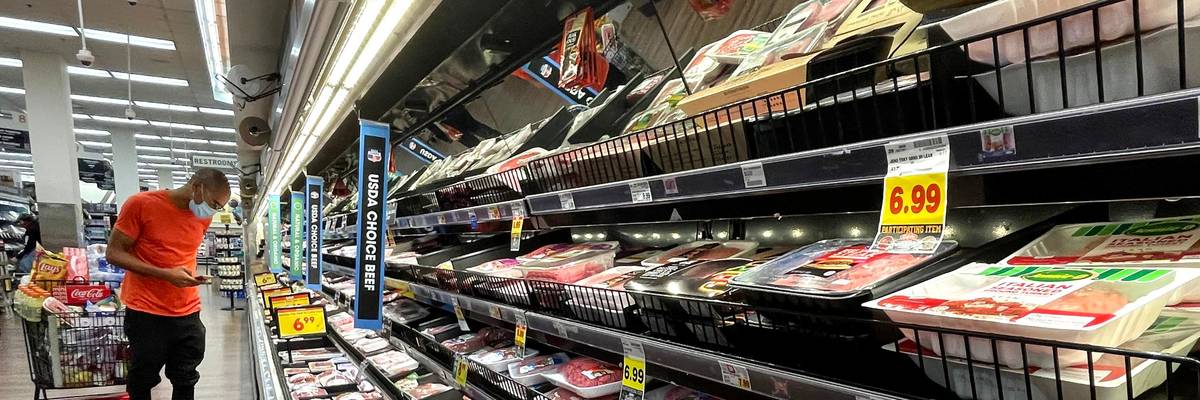
As inflationary pressure drives up costs throughout the economy, a new analysis out Wednesday reveals that corporations are raking in record profits by jacking up prices at the grocery store, gas pump, and beyond--hurting consumers while rewarding investors.
The Guardian, which examined Securities and Exchange Commission filings for 100 U.S. companies, found that net profits increased by a median of 49% from the first quarter of 2020 to the first quarter of this year. Over the same time period, workers' wages grew by just 1.6%.
These corporations have boosted their profit margins over the past two years by charging more for food, fuel, housing, and other basics--using inflation as a pretext to raise prices, negating the modest wage gains that workers made during the coronavirus pandemic. All but 10 have engaged in stock buybacks or dividend bumps to enrich shareholders.
According to The Guardian, which also scrutinized earnings calls, "executives detailed how even as demand and profits rose post-vaccine, they passed on most or all inflationary costs to customers via price increases, and some took the opportunity to add more on top."
"It's obvious that corporations are trying to pass on any form of short-term pain they might be feeling... and that's serving the top, wealthiest class instead of those in need of fair wages or products that are affordable," Krista Brown, a policy analyst at the American Economic Liberties Project, told the newspaper.
Related Content

Last week, Fairness and Accuracy in Reporting documented how prominent news outlets, most of them owned by billionaires, have obscured the role that corporate profiteering has played in pushing prices higher. The Guardian, meanwhile, pointed out how corporate media framing has also given the impression that companies are "sharing in inflationary pain" even as they raise prices and enjoy surging profits.
For instance, despite implementing multiple price hikes last year, Hershey was recently portrayed as the "latest victim of ever-increasing inflation."
Pushing back against this narrative, The Guardian noted that "a closer look at the company's financials suggests a vastly different reality," adding:
Hershey's net profits spiked 62% between the fourth quarters in 2019 and 2021, its operating margin widened, and it recently rewarded shareholders with $200 million in stock buybacks.
Still, customers will pay even more for candy bars in 2022 as Hershey aims for even higher profits: "Pricing will be an important lever for us this year and is expected to drive most of our growth," CEO Michele Buck told investors.
The executives of Kroger and other companies have similarly boasted that inflation is good for business because it can camouflage price gouging.
The Covid-19 pandemic, a supply chain crunch inseparable from decades of neoliberal globalization, and Russia's war on Ukraine have created a "smokescreen," according to Lindsay Owens, executive director of the Groundwork Collaborative, which has drawn attention to the relationship between "corporate greed" and rising prices.
"That gray, nebulous area is fertile ground for companies right now, and you hear about it in their earnings calls," Owens told The Guardian. "Inflation itself is the opportunity."
Oxford University economist Martin Schmalzs said that the newspaper's analysis reveals a massive "transfer of wealth" from the working class, which is paying higher prices as consumers, to the investor class reaping the financial benefits.
Recent survey data indicates that Americans are aware that companies are unnecessarily shifting increased costs onto customers. A Data for Progress poll released in February found that a majority of U.S. voters believe that "large corporations are taking advantage of the pandemic to raise prices unfairly on consumers and increase profits."
"Companies have access to massive capital," George Pearkes, an analyst at Bespoke Investment, told The Guardian. "They could have one or two years that are more painful--not even more painful, just less profitable for their investors, and they're choosing not to."
The newspaper reported, however, that "when Target and Walmart declined to pass all inflationary costs on to customers ahead of the holiday season, an investor revolt ensued, and their shares temporarily plummeted."
Owens said that "shareholders are not interested in seeing anyone be cautious with price increases, and in some cases they're saying 'let's throttle supply, let's see how far we can take this.'"
Progressive lawmakers have taken steps to rein in profiteering amid the global pandemic and war in Ukraine. Last month, Sen. Bernie Sanders (I-Vt.) introduced the Ending Corporate Greed Act, which aims to put a stop to corporate price gouging by imposing a 95% tax on the windfall profits of major companies. Its path through Congress remains unclear.
As inflationary pressure drives up costs throughout the economy, a new analysis out Wednesday reveals that corporations are raking in record profits by jacking up prices at the grocery store, gas pump, and beyond--hurting consumers while rewarding investors.
The Guardian, which examined Securities and Exchange Commission filings for 100 U.S. companies, found that net profits increased by a median of 49% from the first quarter of 2020 to the first quarter of this year. Over the same time period, workers' wages grew by just 1.6%.
These corporations have boosted their profit margins over the past two years by charging more for food, fuel, housing, and other basics--using inflation as a pretext to raise prices, negating the modest wage gains that workers made during the coronavirus pandemic. All but 10 have engaged in stock buybacks or dividend bumps to enrich shareholders.
According to The Guardian, which also scrutinized earnings calls, "executives detailed how even as demand and profits rose post-vaccine, they passed on most or all inflationary costs to customers via price increases, and some took the opportunity to add more on top."
"It's obvious that corporations are trying to pass on any form of short-term pain they might be feeling... and that's serving the top, wealthiest class instead of those in need of fair wages or products that are affordable," Krista Brown, a policy analyst at the American Economic Liberties Project, told the newspaper.
Related Content
Last week, Fairness and Accuracy in Reporting documented how prominent news outlets, most of them owned by billionaires, have obscured the role that corporate profiteering has played in pushing prices higher. The Guardian, meanwhile, pointed out how corporate media framing has also given the impression that companies are "sharing in inflationary pain" even as they raise prices and enjoy surging profits.
For instance, despite implementing multiple price hikes last year, Hershey was recently portrayed as the "latest victim of ever-increasing inflation."
Pushing back against this narrative, The Guardian noted that "a closer look at the company's financials suggests a vastly different reality," adding:
Hershey's net profits spiked 62% between the fourth quarters in 2019 and 2021, its operating margin widened, and it recently rewarded shareholders with $200 million in stock buybacks.
Still, customers will pay even more for candy bars in 2022 as Hershey aims for even higher profits: "Pricing will be an important lever for us this year and is expected to drive most of our growth," CEO Michele Buck told investors.
The executives of Kroger and other companies have similarly boasted that inflation is good for business because it can camouflage price gouging.
The Covid-19 pandemic, a supply chain crunch inseparable from decades of neoliberal globalization, and Russia's war on Ukraine have created a "smokescreen," according to Lindsay Owens, executive director of the Groundwork Collaborative, which has drawn attention to the relationship between "corporate greed" and rising prices.
"That gray, nebulous area is fertile ground for companies right now, and you hear about it in their earnings calls," Owens told The Guardian. "Inflation itself is the opportunity."
Oxford University economist Martin Schmalzs said that the newspaper's analysis reveals a massive "transfer of wealth" from the working class, which is paying higher prices as consumers, to the investor class reaping the financial benefits.
Recent survey data indicates that Americans are aware that companies are unnecessarily shifting increased costs onto customers. A Data for Progress poll released in February found that a majority of U.S. voters believe that "large corporations are taking advantage of the pandemic to raise prices unfairly on consumers and increase profits."
"Companies have access to massive capital," George Pearkes, an analyst at Bespoke Investment, told The Guardian. "They could have one or two years that are more painful--not even more painful, just less profitable for their investors, and they're choosing not to."
The newspaper reported, however, that "when Target and Walmart declined to pass all inflationary costs on to customers ahead of the holiday season, an investor revolt ensued, and their shares temporarily plummeted."
Owens said that "shareholders are not interested in seeing anyone be cautious with price increases, and in some cases they're saying 'let's throttle supply, let's see how far we can take this.'"
Progressive lawmakers have taken steps to rein in profiteering amid the global pandemic and war in Ukraine. Last month, Sen. Bernie Sanders (I-Vt.) introduced the Ending Corporate Greed Act, which aims to put a stop to corporate price gouging by imposing a 95% tax on the windfall profits of major companies. Its path through Congress remains unclear.
As inflationary pressure drives up costs throughout the economy, a new analysis out Wednesday reveals that corporations are raking in record profits by jacking up prices at the grocery store, gas pump, and beyond--hurting consumers while rewarding investors.
The Guardian, which examined Securities and Exchange Commission filings for 100 U.S. companies, found that net profits increased by a median of 49% from the first quarter of 2020 to the first quarter of this year. Over the same time period, workers' wages grew by just 1.6%.
These corporations have boosted their profit margins over the past two years by charging more for food, fuel, housing, and other basics--using inflation as a pretext to raise prices, negating the modest wage gains that workers made during the coronavirus pandemic. All but 10 have engaged in stock buybacks or dividend bumps to enrich shareholders.
According to The Guardian, which also scrutinized earnings calls, "executives detailed how even as demand and profits rose post-vaccine, they passed on most or all inflationary costs to customers via price increases, and some took the opportunity to add more on top."
"It's obvious that corporations are trying to pass on any form of short-term pain they might be feeling... and that's serving the top, wealthiest class instead of those in need of fair wages or products that are affordable," Krista Brown, a policy analyst at the American Economic Liberties Project, told the newspaper.
Related Content
Last week, Fairness and Accuracy in Reporting documented how prominent news outlets, most of them owned by billionaires, have obscured the role that corporate profiteering has played in pushing prices higher. The Guardian, meanwhile, pointed out how corporate media framing has also given the impression that companies are "sharing in inflationary pain" even as they raise prices and enjoy surging profits.
For instance, despite implementing multiple price hikes last year, Hershey was recently portrayed as the "latest victim of ever-increasing inflation."
Pushing back against this narrative, The Guardian noted that "a closer look at the company's financials suggests a vastly different reality," adding:
Hershey's net profits spiked 62% between the fourth quarters in 2019 and 2021, its operating margin widened, and it recently rewarded shareholders with $200 million in stock buybacks.
Still, customers will pay even more for candy bars in 2022 as Hershey aims for even higher profits: "Pricing will be an important lever for us this year and is expected to drive most of our growth," CEO Michele Buck told investors.
The executives of Kroger and other companies have similarly boasted that inflation is good for business because it can camouflage price gouging.
The Covid-19 pandemic, a supply chain crunch inseparable from decades of neoliberal globalization, and Russia's war on Ukraine have created a "smokescreen," according to Lindsay Owens, executive director of the Groundwork Collaborative, which has drawn attention to the relationship between "corporate greed" and rising prices.
"That gray, nebulous area is fertile ground for companies right now, and you hear about it in their earnings calls," Owens told The Guardian. "Inflation itself is the opportunity."
Oxford University economist Martin Schmalzs said that the newspaper's analysis reveals a massive "transfer of wealth" from the working class, which is paying higher prices as consumers, to the investor class reaping the financial benefits.
Recent survey data indicates that Americans are aware that companies are unnecessarily shifting increased costs onto customers. A Data for Progress poll released in February found that a majority of U.S. voters believe that "large corporations are taking advantage of the pandemic to raise prices unfairly on consumers and increase profits."
"Companies have access to massive capital," George Pearkes, an analyst at Bespoke Investment, told The Guardian. "They could have one or two years that are more painful--not even more painful, just less profitable for their investors, and they're choosing not to."
The newspaper reported, however, that "when Target and Walmart declined to pass all inflationary costs on to customers ahead of the holiday season, an investor revolt ensued, and their shares temporarily plummeted."
Owens said that "shareholders are not interested in seeing anyone be cautious with price increases, and in some cases they're saying 'let's throttle supply, let's see how far we can take this.'"
Progressive lawmakers have taken steps to rein in profiteering amid the global pandemic and war in Ukraine. Last month, Sen. Bernie Sanders (I-Vt.) introduced the Ending Corporate Greed Act, which aims to put a stop to corporate price gouging by imposing a 95% tax on the windfall profits of major companies. Its path through Congress remains unclear.

