

SUBSCRIBE TO OUR FREE NEWSLETTER
Daily news & progressive opinion—funded by the people, not the corporations—delivered straight to your inbox.
5
#000000
#FFFFFF
To donate by check, phone, or other method, see our More Ways to Give page.
Daily news & progressive opinion—funded by the people, not the corporations—delivered straight to your inbox.
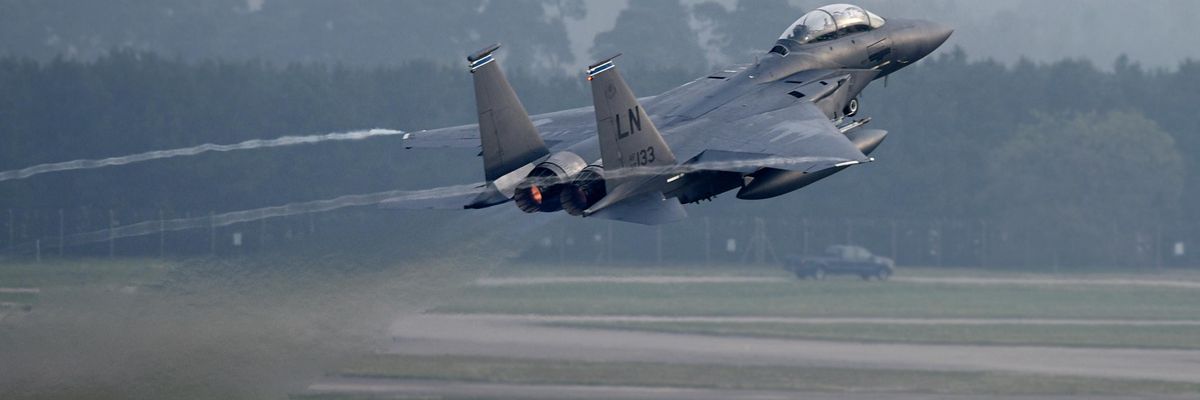
An F-15E Strike Eagle assigned to the 492nd Fighter Squadron takes off from the flightline at RAF Lakenheath, United Kingdom, April 24, 2019. (Photo: U.S. Air Force/Flickr/cc)
Nearly 80 foreign policy experts on Thursday urged the Biden administration to continue opposing a no-fly zone in Ukrainian airspace, warning that such a "reckless" policy would risk bringing the United States into a "shooting war with Russian forces" as they ramp up their assault on their neighbor.
"A no-fly zone would expand the war, not stop it."
"A no-fly zone would commit the U.S. and NATO forces to shoot down any Russian aircraft that enter. It would be naive to think that merely declaring a no-fly zone would convince the Russian military to comply voluntarily," 78 experts led by led by Stephen Wertheim of Carnegie Endowment for International Peace and Will Ruger of the American Institute for Economic Research write in an open letter directed at the White House.
"In short," the letter declares, "a no-fly zone would mean going to war with Russia."
Even a "limited" no-fly zone of the kind advocated in recent days by a number of industry-tied former U.S. diplomats and retired generals, the new letter argues, would heighten the chances of a full-blown conflict directly involving the U.S. and Russia, which together possess more than 90% of the world's nuclear weapons.
"Some of those calling for... a 'limited' no-fly zone admit that they are willing to see the United States and its NATO allies wage war against Russia in defense of Ukraine," the letter notes. "For example, one prominent signatory of a letter advocating a no-fly zone has recently admitted that a no-fly zone 'is an act of war... You have to enforce a no-fly zone, which means you have to be willing to use force against those who break the no-fly zone." Even before the war began, another signatory wrote that 'U.S. leaders should be marshaling an international coalition of the willing, readying military forces to deter Putin and, if necessary, prepare for war.'"
"A no-fly zone," the new letter continues, "would expand the war, not stop it."
The letter came as Russia continued intensifying its aerial attacks on Ukraine, bombing major cities and encircling the capital of Kyiv with ground forces.
"Shooting down Russian planes... would greatly increase the risks of escalation, up to and including a nuclear confrontation."
After the Russian military bombed a children's hospital in the besieged city of Mariupol on Wednesday, Ukrainian President Volodymyr Zelenskyy repeated his demand for a no-fly zone over the country, imploring the West to "close the sky right now!"
Bartosz Cichocki, the Polish ambassador to Kyiv, echoed Zelenskyy's demand on Thursday, claiming in an interview that Russia's attack on Ukraine would be over "much faster" if Western powers close the airspace over Ukraine.
But the U.S. and other NATO countries have thus far rejected calls for a no-fly zone, expressing agreement with analysts that it would almost guarantee an expansion of Russia's war on Ukraine. Putin said Sunday that he would consider a no-fly zone enforced by NATO a declaration of war against Russia.
Anatol Lieven and William Hartung of the Quincy Institute for Responsible Statecraft--both of whom signed the new open letter--argued in a column earlier this week that "implementing a no-fly zone of any sort, whether for all of Ukraine or 'just' to protect humanitarian corridors and Ukrainian defensive systems, would mean that the U.S. Air Force would essentially become the Ukrainian air force, fighting alongside Ukrainian ground forces against Russia."
"President Biden is right to resist these requests," they wrote. "Shooting down Russian planes and bombing Russian anti-aircraft sites would greatly increase the risks of escalation, up to and including a nuclear confrontation. That's reason enough not to go forward, regardless of how loud the demands to do so may be."
Dear Common Dreams reader, It’s been nearly 30 years since I co-founded Common Dreams with my late wife, Lina Newhouser. We had the radical notion that journalism should serve the public good, not corporate profits. It was clear to us from the outset what it would take to build such a project. No paid advertisements. No corporate sponsors. No millionaire publisher telling us what to think or do. Many people said we wouldn't last a year, but we proved those doubters wrong. Together with a tremendous team of journalists and dedicated staff, we built an independent media outlet free from the constraints of profits and corporate control. Our mission has always been simple: To inform. To inspire. To ignite change for the common good. Building Common Dreams was not easy. Our survival was never guaranteed. When you take on the most powerful forces—Wall Street greed, fossil fuel industry destruction, Big Tech lobbyists, and uber-rich oligarchs who have spent billions upon billions rigging the economy and democracy in their favor—the only bulwark you have is supporters who believe in your work. But here’s the urgent message from me today. It's never been this bad out there. And it's never been this hard to keep us going. At the very moment Common Dreams is most needed, the threats we face are intensifying. We need your support now more than ever. We don't accept corporate advertising and never will. We don't have a paywall because we don't think people should be blocked from critical news based on their ability to pay. Everything we do is funded by the donations of readers like you. When everyone does the little they can afford, we are strong. But if that support retreats or dries up, so do we. Will you donate now to make sure Common Dreams not only survives but thrives? —Craig Brown, Co-founder |
Nearly 80 foreign policy experts on Thursday urged the Biden administration to continue opposing a no-fly zone in Ukrainian airspace, warning that such a "reckless" policy would risk bringing the United States into a "shooting war with Russian forces" as they ramp up their assault on their neighbor.
"A no-fly zone would expand the war, not stop it."
"A no-fly zone would commit the U.S. and NATO forces to shoot down any Russian aircraft that enter. It would be naive to think that merely declaring a no-fly zone would convince the Russian military to comply voluntarily," 78 experts led by led by Stephen Wertheim of Carnegie Endowment for International Peace and Will Ruger of the American Institute for Economic Research write in an open letter directed at the White House.
"In short," the letter declares, "a no-fly zone would mean going to war with Russia."
Even a "limited" no-fly zone of the kind advocated in recent days by a number of industry-tied former U.S. diplomats and retired generals, the new letter argues, would heighten the chances of a full-blown conflict directly involving the U.S. and Russia, which together possess more than 90% of the world's nuclear weapons.
"Some of those calling for... a 'limited' no-fly zone admit that they are willing to see the United States and its NATO allies wage war against Russia in defense of Ukraine," the letter notes. "For example, one prominent signatory of a letter advocating a no-fly zone has recently admitted that a no-fly zone 'is an act of war... You have to enforce a no-fly zone, which means you have to be willing to use force against those who break the no-fly zone." Even before the war began, another signatory wrote that 'U.S. leaders should be marshaling an international coalition of the willing, readying military forces to deter Putin and, if necessary, prepare for war.'"
"A no-fly zone," the new letter continues, "would expand the war, not stop it."
The letter came as Russia continued intensifying its aerial attacks on Ukraine, bombing major cities and encircling the capital of Kyiv with ground forces.
"Shooting down Russian planes... would greatly increase the risks of escalation, up to and including a nuclear confrontation."
After the Russian military bombed a children's hospital in the besieged city of Mariupol on Wednesday, Ukrainian President Volodymyr Zelenskyy repeated his demand for a no-fly zone over the country, imploring the West to "close the sky right now!"
Bartosz Cichocki, the Polish ambassador to Kyiv, echoed Zelenskyy's demand on Thursday, claiming in an interview that Russia's attack on Ukraine would be over "much faster" if Western powers close the airspace over Ukraine.
But the U.S. and other NATO countries have thus far rejected calls for a no-fly zone, expressing agreement with analysts that it would almost guarantee an expansion of Russia's war on Ukraine. Putin said Sunday that he would consider a no-fly zone enforced by NATO a declaration of war against Russia.
Anatol Lieven and William Hartung of the Quincy Institute for Responsible Statecraft--both of whom signed the new open letter--argued in a column earlier this week that "implementing a no-fly zone of any sort, whether for all of Ukraine or 'just' to protect humanitarian corridors and Ukrainian defensive systems, would mean that the U.S. Air Force would essentially become the Ukrainian air force, fighting alongside Ukrainian ground forces against Russia."
"President Biden is right to resist these requests," they wrote. "Shooting down Russian planes and bombing Russian anti-aircraft sites would greatly increase the risks of escalation, up to and including a nuclear confrontation. That's reason enough not to go forward, regardless of how loud the demands to do so may be."
Nearly 80 foreign policy experts on Thursday urged the Biden administration to continue opposing a no-fly zone in Ukrainian airspace, warning that such a "reckless" policy would risk bringing the United States into a "shooting war with Russian forces" as they ramp up their assault on their neighbor.
"A no-fly zone would expand the war, not stop it."
"A no-fly zone would commit the U.S. and NATO forces to shoot down any Russian aircraft that enter. It would be naive to think that merely declaring a no-fly zone would convince the Russian military to comply voluntarily," 78 experts led by led by Stephen Wertheim of Carnegie Endowment for International Peace and Will Ruger of the American Institute for Economic Research write in an open letter directed at the White House.
"In short," the letter declares, "a no-fly zone would mean going to war with Russia."
Even a "limited" no-fly zone of the kind advocated in recent days by a number of industry-tied former U.S. diplomats and retired generals, the new letter argues, would heighten the chances of a full-blown conflict directly involving the U.S. and Russia, which together possess more than 90% of the world's nuclear weapons.
"Some of those calling for... a 'limited' no-fly zone admit that they are willing to see the United States and its NATO allies wage war against Russia in defense of Ukraine," the letter notes. "For example, one prominent signatory of a letter advocating a no-fly zone has recently admitted that a no-fly zone 'is an act of war... You have to enforce a no-fly zone, which means you have to be willing to use force against those who break the no-fly zone." Even before the war began, another signatory wrote that 'U.S. leaders should be marshaling an international coalition of the willing, readying military forces to deter Putin and, if necessary, prepare for war.'"
"A no-fly zone," the new letter continues, "would expand the war, not stop it."
The letter came as Russia continued intensifying its aerial attacks on Ukraine, bombing major cities and encircling the capital of Kyiv with ground forces.
"Shooting down Russian planes... would greatly increase the risks of escalation, up to and including a nuclear confrontation."
After the Russian military bombed a children's hospital in the besieged city of Mariupol on Wednesday, Ukrainian President Volodymyr Zelenskyy repeated his demand for a no-fly zone over the country, imploring the West to "close the sky right now!"
Bartosz Cichocki, the Polish ambassador to Kyiv, echoed Zelenskyy's demand on Thursday, claiming in an interview that Russia's attack on Ukraine would be over "much faster" if Western powers close the airspace over Ukraine.
But the U.S. and other NATO countries have thus far rejected calls for a no-fly zone, expressing agreement with analysts that it would almost guarantee an expansion of Russia's war on Ukraine. Putin said Sunday that he would consider a no-fly zone enforced by NATO a declaration of war against Russia.
Anatol Lieven and William Hartung of the Quincy Institute for Responsible Statecraft--both of whom signed the new open letter--argued in a column earlier this week that "implementing a no-fly zone of any sort, whether for all of Ukraine or 'just' to protect humanitarian corridors and Ukrainian defensive systems, would mean that the U.S. Air Force would essentially become the Ukrainian air force, fighting alongside Ukrainian ground forces against Russia."
"President Biden is right to resist these requests," they wrote. "Shooting down Russian planes and bombing Russian anti-aircraft sites would greatly increase the risks of escalation, up to and including a nuclear confrontation. That's reason enough not to go forward, regardless of how loud the demands to do so may be."

