SUBSCRIBE TO OUR FREE NEWSLETTER
Daily news & progressive opinion—funded by the people, not the corporations—delivered straight to your inbox.
5
#000000
#FFFFFF
To donate by check, phone, or other method, see our More Ways to Give page.
Daily news & progressive opinion—funded by the people, not the corporations—delivered straight to your inbox.
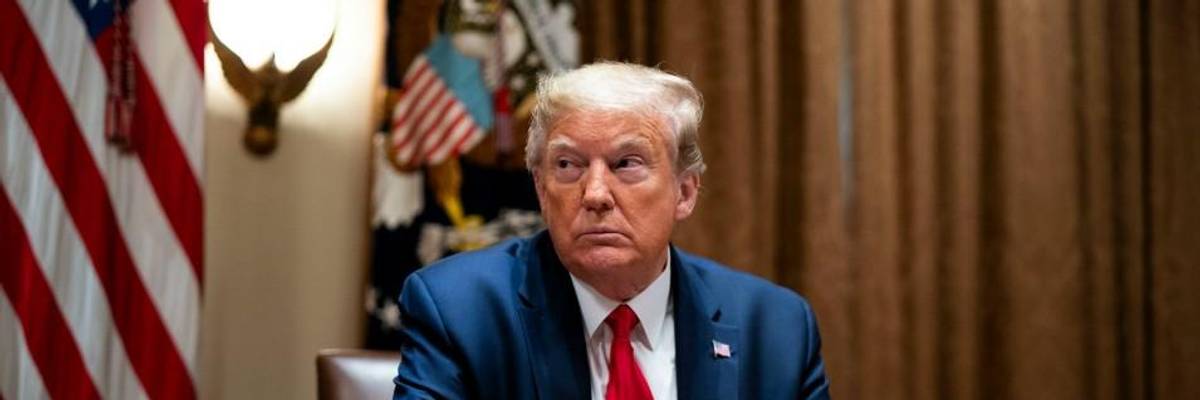
Then-President Donald Trump listened during a meeting with healthcare executives in the Cabinet Room of the White House April 14, 2020 in Washington, D.C. (Photo: Doug Mills-Pool/Getty Images)
The New York Times on Saturday published a detailed account of what led two prosecutors involved with the Manhattan district attorney's investigation into former President Donald Trump's business practices to abruptly resign last month--a "seismic development" that some experts had called "troubling."
The probe was launched under the former district attorney, Cyrus Vance Jr., who did not seek reelection. When prosecutors Carey Dunne and Mark Pomerantz resigned, the newspaper reported that it was because the new DA, Alvin Bragg, had concerns about moving forward with the case.
Following up on their initial reporting, a trio at the Times provided an "account of the investigation's unraveling, drawn from interviews with more than a dozen people knowledgeable about the events," which "pulls back a curtain on one of the most consequential prosecutorial decisions in U.S. history," given that Trump would be the first president to be criminally charged.
Ben Protess, William K. Rashbaum, and Jonah E. Bromwich laid out major developments in the probe and at the office from Vance's final days to the resignations--including a December 9 meeting of the former DA's "brain trust," the public relations "firestorm" Bragg faced over criminal justice reforms and high-profile shootings, and intense discussions between the new district attorney and the two prosecutors in January and February.
As Protess, Rashbaum, and Bromwich reported:
Mr. Bragg was not the only one to question the strength of the case, the interviews show. Late last year, three career prosecutors in the district attorney's office opted to leave the investigation, uncomfortable with the speed at which it was proceeding and with what they maintained were gaps in the evidence. The tension spilled into the new administration, with some career prosecutors raising concerns directly to the new district attorney's team.
Mr. Bragg, whose office is conducting the investigation along with lawyers working for New York's attorney general, Letitia James, had not taken issue with Mr. Dunne and Mr. Pomerantz presenting evidence to the grand jury in his first days as district attorney. But as the weeks passed, he developed concerns about the challenge of showing Mr. Trump's intent--a requirement for proving that he criminally falsified his business records--and about the risks of relying on the former president's onetime fixer, Michael D. Cohen, as a key witness.
The prosecutors quit the day after the new district attorney told them that "he did not want to continue the grand jury presentation" and was not prepared to authorize charges against Trump, according to the report, which noted that "Mr. Dunne and Mr. Pomerantz also bristled at how Mr. Bragg had handled the investigation at times."
While Pomerantz and Dunne declined to comment, Danielle Filson, a spokesperson for Bragg, said that "this is an active investigation and there is a strong team in place working on it." She added that the probe is being led by Susan Hoffinger, the executive assistant district attorney in charge of the office's Investigation Division.
Responding to the new report, former federal prosecutor Renato Mariotti tweeted that "this is a remarkable article that gives us an inside look into the Manhattan DA's deliberations regarding whether to charge Trump. If you believe prosecutors should indict Trump, it's worth reading. We rarely get a window into prosecution decisions."
According to Mariotti, it is not possible to tell from the Times' reporting "whether the current Manhattan DA is making the right call. We don't know the evidence his team has, and ultimately they could develop evidence that convinces them to file charges."
"I wouldn't be surprised if other prosecutors agonize over charging Trump. Not because they believe he's above the law, but because of issues with the evidence they have," he added. "If you're convinced that other prosecutors are doing nothing, they might be doing what this one did."
Dear Common Dreams reader, It’s been nearly 30 years since I co-founded Common Dreams with my late wife, Lina Newhouser. We had the radical notion that journalism should serve the public good, not corporate profits. It was clear to us from the outset what it would take to build such a project. No paid advertisements. No corporate sponsors. No millionaire publisher telling us what to think or do. Many people said we wouldn't last a year, but we proved those doubters wrong. Together with a tremendous team of journalists and dedicated staff, we built an independent media outlet free from the constraints of profits and corporate control. Our mission has always been simple: To inform. To inspire. To ignite change for the common good. Building Common Dreams was not easy. Our survival was never guaranteed. When you take on the most powerful forces—Wall Street greed, fossil fuel industry destruction, Big Tech lobbyists, and uber-rich oligarchs who have spent billions upon billions rigging the economy and democracy in their favor—the only bulwark you have is supporters who believe in your work. But here’s the urgent message from me today. It's never been this bad out there. And it's never been this hard to keep us going. At the very moment Common Dreams is most needed, the threats we face are intensifying. We need your support now more than ever. We don't accept corporate advertising and never will. We don't have a paywall because we don't think people should be blocked from critical news based on their ability to pay. Everything we do is funded by the donations of readers like you. When everyone does the little they can afford, we are strong. But if that support retreats or dries up, so do we. Will you donate now to make sure Common Dreams not only survives but thrives? —Craig Brown, Co-founder |
The New York Times on Saturday published a detailed account of what led two prosecutors involved with the Manhattan district attorney's investigation into former President Donald Trump's business practices to abruptly resign last month--a "seismic development" that some experts had called "troubling."
The probe was launched under the former district attorney, Cyrus Vance Jr., who did not seek reelection. When prosecutors Carey Dunne and Mark Pomerantz resigned, the newspaper reported that it was because the new DA, Alvin Bragg, had concerns about moving forward with the case.
Following up on their initial reporting, a trio at the Times provided an "account of the investigation's unraveling, drawn from interviews with more than a dozen people knowledgeable about the events," which "pulls back a curtain on one of the most consequential prosecutorial decisions in U.S. history," given that Trump would be the first president to be criminally charged.
Ben Protess, William K. Rashbaum, and Jonah E. Bromwich laid out major developments in the probe and at the office from Vance's final days to the resignations--including a December 9 meeting of the former DA's "brain trust," the public relations "firestorm" Bragg faced over criminal justice reforms and high-profile shootings, and intense discussions between the new district attorney and the two prosecutors in January and February.
As Protess, Rashbaum, and Bromwich reported:
Mr. Bragg was not the only one to question the strength of the case, the interviews show. Late last year, three career prosecutors in the district attorney's office opted to leave the investigation, uncomfortable with the speed at which it was proceeding and with what they maintained were gaps in the evidence. The tension spilled into the new administration, with some career prosecutors raising concerns directly to the new district attorney's team.
Mr. Bragg, whose office is conducting the investigation along with lawyers working for New York's attorney general, Letitia James, had not taken issue with Mr. Dunne and Mr. Pomerantz presenting evidence to the grand jury in his first days as district attorney. But as the weeks passed, he developed concerns about the challenge of showing Mr. Trump's intent--a requirement for proving that he criminally falsified his business records--and about the risks of relying on the former president's onetime fixer, Michael D. Cohen, as a key witness.
The prosecutors quit the day after the new district attorney told them that "he did not want to continue the grand jury presentation" and was not prepared to authorize charges against Trump, according to the report, which noted that "Mr. Dunne and Mr. Pomerantz also bristled at how Mr. Bragg had handled the investigation at times."
While Pomerantz and Dunne declined to comment, Danielle Filson, a spokesperson for Bragg, said that "this is an active investigation and there is a strong team in place working on it." She added that the probe is being led by Susan Hoffinger, the executive assistant district attorney in charge of the office's Investigation Division.
Responding to the new report, former federal prosecutor Renato Mariotti tweeted that "this is a remarkable article that gives us an inside look into the Manhattan DA's deliberations regarding whether to charge Trump. If you believe prosecutors should indict Trump, it's worth reading. We rarely get a window into prosecution decisions."
According to Mariotti, it is not possible to tell from the Times' reporting "whether the current Manhattan DA is making the right call. We don't know the evidence his team has, and ultimately they could develop evidence that convinces them to file charges."
"I wouldn't be surprised if other prosecutors agonize over charging Trump. Not because they believe he's above the law, but because of issues with the evidence they have," he added. "If you're convinced that other prosecutors are doing nothing, they might be doing what this one did."
The New York Times on Saturday published a detailed account of what led two prosecutors involved with the Manhattan district attorney's investigation into former President Donald Trump's business practices to abruptly resign last month--a "seismic development" that some experts had called "troubling."
The probe was launched under the former district attorney, Cyrus Vance Jr., who did not seek reelection. When prosecutors Carey Dunne and Mark Pomerantz resigned, the newspaper reported that it was because the new DA, Alvin Bragg, had concerns about moving forward with the case.
Following up on their initial reporting, a trio at the Times provided an "account of the investigation's unraveling, drawn from interviews with more than a dozen people knowledgeable about the events," which "pulls back a curtain on one of the most consequential prosecutorial decisions in U.S. history," given that Trump would be the first president to be criminally charged.
Ben Protess, William K. Rashbaum, and Jonah E. Bromwich laid out major developments in the probe and at the office from Vance's final days to the resignations--including a December 9 meeting of the former DA's "brain trust," the public relations "firestorm" Bragg faced over criminal justice reforms and high-profile shootings, and intense discussions between the new district attorney and the two prosecutors in January and February.
As Protess, Rashbaum, and Bromwich reported:
Mr. Bragg was not the only one to question the strength of the case, the interviews show. Late last year, three career prosecutors in the district attorney's office opted to leave the investigation, uncomfortable with the speed at which it was proceeding and with what they maintained were gaps in the evidence. The tension spilled into the new administration, with some career prosecutors raising concerns directly to the new district attorney's team.
Mr. Bragg, whose office is conducting the investigation along with lawyers working for New York's attorney general, Letitia James, had not taken issue with Mr. Dunne and Mr. Pomerantz presenting evidence to the grand jury in his first days as district attorney. But as the weeks passed, he developed concerns about the challenge of showing Mr. Trump's intent--a requirement for proving that he criminally falsified his business records--and about the risks of relying on the former president's onetime fixer, Michael D. Cohen, as a key witness.
The prosecutors quit the day after the new district attorney told them that "he did not want to continue the grand jury presentation" and was not prepared to authorize charges against Trump, according to the report, which noted that "Mr. Dunne and Mr. Pomerantz also bristled at how Mr. Bragg had handled the investigation at times."
While Pomerantz and Dunne declined to comment, Danielle Filson, a spokesperson for Bragg, said that "this is an active investigation and there is a strong team in place working on it." She added that the probe is being led by Susan Hoffinger, the executive assistant district attorney in charge of the office's Investigation Division.
Responding to the new report, former federal prosecutor Renato Mariotti tweeted that "this is a remarkable article that gives us an inside look into the Manhattan DA's deliberations regarding whether to charge Trump. If you believe prosecutors should indict Trump, it's worth reading. We rarely get a window into prosecution decisions."
According to Mariotti, it is not possible to tell from the Times' reporting "whether the current Manhattan DA is making the right call. We don't know the evidence his team has, and ultimately they could develop evidence that convinces them to file charges."
"I wouldn't be surprised if other prosecutors agonize over charging Trump. Not because they believe he's above the law, but because of issues with the evidence they have," he added. "If you're convinced that other prosecutors are doing nothing, they might be doing what this one did."