SUBSCRIBE TO OUR FREE NEWSLETTER
Daily news & progressive opinion—funded by the people, not the corporations—delivered straight to your inbox.
5
#000000
#FFFFFF
To donate by check, phone, or other method, see our More Ways to Give page.
Daily news & progressive opinion—funded by the people, not the corporations—delivered straight to your inbox.
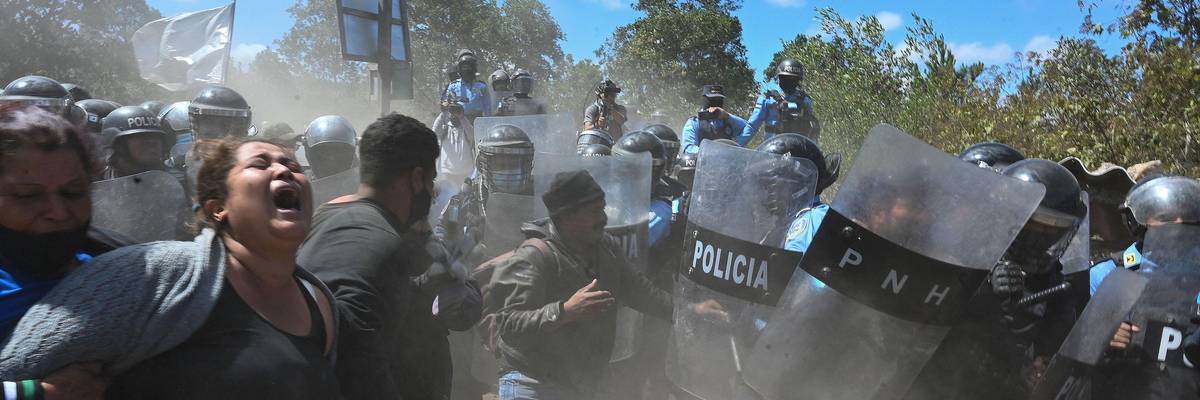
Residents face riot police during an attempted eviction at Tierras del Padre, a Lenca Indigenous community between the municipalities of Ojojona and San Buenaventura, Francisco Morazan department, Honduras, on February 9, 2022. (Photo: Orlando Sierra/AFP via Getty Images)
Honduras' new leftist president on Wednesday intervened to halt a court-ordered eviction of an Indigenous community from their ancestral lands following violent scenes of the attempted forced removal by police earlier in the day.
Human Rights Minister Natalie Roque shared on social media that, with orders from President Xiomara Castro, lawyers and officials from her office went to the Tierras del Padre community, located just south of the capital of Tegucigalpa, to stop the evictions, saying the suspension was in accordance with the law and authorized by the state.
"We are not going to tolerate any aggression or blow against a pregnant woman or against a citizen or against a child," presidential adviser Pedro Amador said on the scene, according to a video circulated on social media
In a tweet, Roque accused judicial officials who'd approved the evictions of continuing "in the power of the dictatorship." As Agence France-Presse reported last month, "four of the five judges in the court's constitutional chamber were named to their posts by the previous Congress, which was dominated by the right-wing National Party of former president Juan Orlando Hernandez."
A statement from the country's human rights ministry called the proposed expulsions--performed at the behest of a businessman and land developer who claims ownership of the area--a "clear violation of the human rights of over 100 families who live in the sector in an ancestral Lenca territory that dates from the year 1739."
Before the federal officials arrived to intervene, community members faced riot police who, according to local reports and photos, intimidated and hit several community members.
The planned evictions sparked concern from the Honduras office of the United Nations High Commissioner for Human Rights.
Of particular concern, the office said in a Wednesday Twitter thread, was that a constitutional appeal of the evictions filed by the community had not yet been processed. The U.N. office further urged the state to halt the eviction order, noting threats to "the effective protection of the rights of the community, particularly its right to housing and food."
Castro, sworn in January 27 following a dozen years of the country being run by the right-wing National Party, is the country's first female president.
She is also the wife of Manuel Zelaya, Honduras's former progressive president who was in power from 2006 until 2009 when he was ousted in a Washington-backed coup.
Dear Common Dreams reader, It’s been nearly 30 years since I co-founded Common Dreams with my late wife, Lina Newhouser. We had the radical notion that journalism should serve the public good, not corporate profits. It was clear to us from the outset what it would take to build such a project. No paid advertisements. No corporate sponsors. No millionaire publisher telling us what to think or do. Many people said we wouldn't last a year, but we proved those doubters wrong. Together with a tremendous team of journalists and dedicated staff, we built an independent media outlet free from the constraints of profits and corporate control. Our mission has always been simple: To inform. To inspire. To ignite change for the common good. Building Common Dreams was not easy. Our survival was never guaranteed. When you take on the most powerful forces—Wall Street greed, fossil fuel industry destruction, Big Tech lobbyists, and uber-rich oligarchs who have spent billions upon billions rigging the economy and democracy in their favor—the only bulwark you have is supporters who believe in your work. But here’s the urgent message from me today. It's never been this bad out there. And it's never been this hard to keep us going. At the very moment Common Dreams is most needed, the threats we face are intensifying. We need your support now more than ever. We don't accept corporate advertising and never will. We don't have a paywall because we don't think people should be blocked from critical news based on their ability to pay. Everything we do is funded by the donations of readers like you. When everyone does the little they can afford, we are strong. But if that support retreats or dries up, so do we. Will you donate now to make sure Common Dreams not only survives but thrives? —Craig Brown, Co-founder |
Honduras' new leftist president on Wednesday intervened to halt a court-ordered eviction of an Indigenous community from their ancestral lands following violent scenes of the attempted forced removal by police earlier in the day.
Human Rights Minister Natalie Roque shared on social media that, with orders from President Xiomara Castro, lawyers and officials from her office went to the Tierras del Padre community, located just south of the capital of Tegucigalpa, to stop the evictions, saying the suspension was in accordance with the law and authorized by the state.
"We are not going to tolerate any aggression or blow against a pregnant woman or against a citizen or against a child," presidential adviser Pedro Amador said on the scene, according to a video circulated on social media
In a tweet, Roque accused judicial officials who'd approved the evictions of continuing "in the power of the dictatorship." As Agence France-Presse reported last month, "four of the five judges in the court's constitutional chamber were named to their posts by the previous Congress, which was dominated by the right-wing National Party of former president Juan Orlando Hernandez."
A statement from the country's human rights ministry called the proposed expulsions--performed at the behest of a businessman and land developer who claims ownership of the area--a "clear violation of the human rights of over 100 families who live in the sector in an ancestral Lenca territory that dates from the year 1739."
Before the federal officials arrived to intervene, community members faced riot police who, according to local reports and photos, intimidated and hit several community members.
The planned evictions sparked concern from the Honduras office of the United Nations High Commissioner for Human Rights.
Of particular concern, the office said in a Wednesday Twitter thread, was that a constitutional appeal of the evictions filed by the community had not yet been processed. The U.N. office further urged the state to halt the eviction order, noting threats to "the effective protection of the rights of the community, particularly its right to housing and food."
Castro, sworn in January 27 following a dozen years of the country being run by the right-wing National Party, is the country's first female president.
She is also the wife of Manuel Zelaya, Honduras's former progressive president who was in power from 2006 until 2009 when he was ousted in a Washington-backed coup.
Honduras' new leftist president on Wednesday intervened to halt a court-ordered eviction of an Indigenous community from their ancestral lands following violent scenes of the attempted forced removal by police earlier in the day.
Human Rights Minister Natalie Roque shared on social media that, with orders from President Xiomara Castro, lawyers and officials from her office went to the Tierras del Padre community, located just south of the capital of Tegucigalpa, to stop the evictions, saying the suspension was in accordance with the law and authorized by the state.
"We are not going to tolerate any aggression or blow against a pregnant woman or against a citizen or against a child," presidential adviser Pedro Amador said on the scene, according to a video circulated on social media
In a tweet, Roque accused judicial officials who'd approved the evictions of continuing "in the power of the dictatorship." As Agence France-Presse reported last month, "four of the five judges in the court's constitutional chamber were named to their posts by the previous Congress, which was dominated by the right-wing National Party of former president Juan Orlando Hernandez."
A statement from the country's human rights ministry called the proposed expulsions--performed at the behest of a businessman and land developer who claims ownership of the area--a "clear violation of the human rights of over 100 families who live in the sector in an ancestral Lenca territory that dates from the year 1739."
Before the federal officials arrived to intervene, community members faced riot police who, according to local reports and photos, intimidated and hit several community members.
The planned evictions sparked concern from the Honduras office of the United Nations High Commissioner for Human Rights.
Of particular concern, the office said in a Wednesday Twitter thread, was that a constitutional appeal of the evictions filed by the community had not yet been processed. The U.N. office further urged the state to halt the eviction order, noting threats to "the effective protection of the rights of the community, particularly its right to housing and food."
Castro, sworn in January 27 following a dozen years of the country being run by the right-wing National Party, is the country's first female president.
She is also the wife of Manuel Zelaya, Honduras's former progressive president who was in power from 2006 until 2009 when he was ousted in a Washington-backed coup.