SUBSCRIBE TO OUR FREE NEWSLETTER
Daily news & progressive opinion—funded by the people, not the corporations—delivered straight to your inbox.
5
#000000
#FFFFFF
To donate by check, phone, or other method, see our More Ways to Give page.
Daily news & progressive opinion—funded by the people, not the corporations—delivered straight to your inbox.
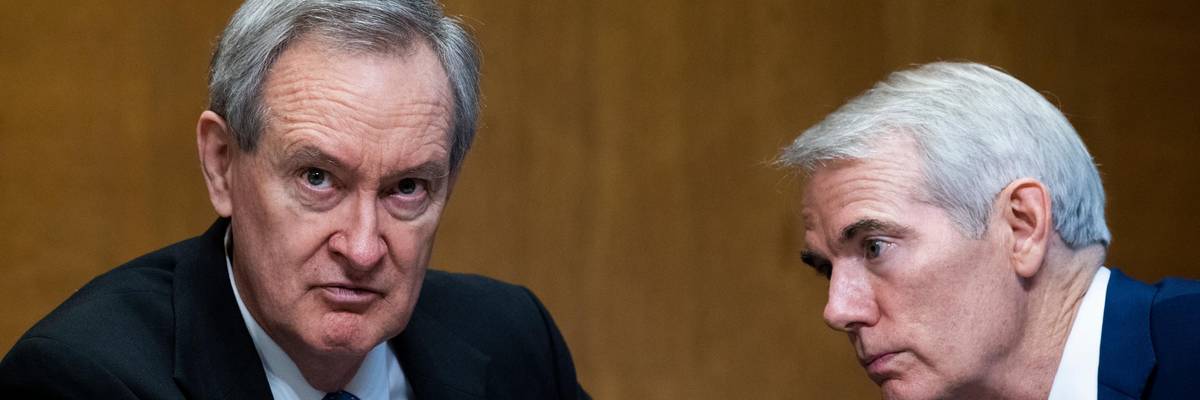
Sen. Mike Crapo (R-Idaho) talks with Sen. Rob Portman (R-Ohio) during a Senate Finance Committee hearing on June 8, 2021. (Photo: Tom Williams-Pool/Getty Images)
Sen. Bernie Sanders: "How many people need to die, how many people need to get unnecessarily sicker, before Congress is prepared to take on the greed of the prescription drug industry?"
Republican Sen. Mike Crapo of Idaho blocked Sen. Bernie Sanders' attempt Wednesday to force a vote on legislation that would slash prescription drug prices, thwarting the Vermont senator's effort to fast-track the new bill as the pharmaceutical industry rushes to hike costs in the new year.
"A lifesaving prescription drug does not mean anything if you cannot afford to buy that drug."
Sanders, chair of the Senate Budget Committee, requested unanimous consent to proceed to debate and a vote on the Cutting Medicare Prescription Drug Prices in Half Act, a measure he introduced earlier Wednesday alongside Sen. Amy Klobuchar (D-Minn.).
If passed, the bill would bring the prices of drugs covered by Medicare into line with what the Department of Veterans Affairs (VA) or the Federal Supply Schedule pay for the same medications. According to a 2017 Government Accountability Office study, the VA "paid an average of 54% less per unit than Medicare" for a sample of hundreds of brand-name and generic drugs.
But Crapo--a major recipient of pharmaceutical and insurance industry donations--objected to Sanders' request to advance the legislation, claiming it would usher in "more bureaucracy." The Idaho Republican is the lead sponsor of a more industry-friendly bill titled the Lower Costs, More Cures Act, which advocates a "market-based approach" to lowering drug prices.
In a floor speech on Wednesday, Sanders said that "for far too long, it has not been Congress that has been regulating the pharmaceutical industry, it has been the pharmaceutical industry that has been regulating Congress."
"All over this country, the American people are asking a simple question: How many people need to die, how many people need to get unnecessarily sicker, before Congress is prepared to take on the greed of the prescription drug industry?" said the Vermont senator. "Enough is enough. A lifesaving prescription drug does not mean anything if you cannot afford to buy that drug."
"We cannot allow the pharmaceutical industry to charge the American people, by far, the highest prices in the world for prescription drugs," Sanders added.
Legislative action against sky-high and rising drug prices frequently ranks as a top priority of voters, and Sanders has warned that Democrats could face disaster in the upcoming midterms if they fail to deliver. The Build Back Better Act, sweeping legislation that includes provisions to cut medicine costs, is stalled in the Senate due to opposition from Sens. Joe Manchin (D-W.Va.), Kyrsten Sinema (D-Ariz.), and every Republican in the chamber.
The attempt by Sanders and Klobuchar to hold a vote on their standalone drug-price legislation came as pharmaceutical firms--which lobbied aggressively against the Build Back Better package--continued to raise the costs of medications that treat a range of serious conditions, from cancer to heart disease to HIV.
An analysis released last week by Patients for Affordable Drugs showed that pharma companies have increased the prices of 742 medications so far this year.
"Of the 742 drugs that the industry raised prices on, 92% were on brand-name drugs, one in four exceeded the most recent rate of inflation available in early January, and 93% exceeded the projected inflation rate for 2023, 2.3%," the group found.
David Mitchell, a cancer patient and the founder of Patients for Affordable Drugs, said in a statement that "right now, Big Pharma has unlimited pricing power on brand-name drugs."
"Consistently," Mitchell continued, "the industry proves it only cares about maximizing profit--not public health--and will continue to raise prices as high as it thinks possible without regard to the millions of Americans who are hurt by high drug prices."
Dear Common Dreams reader, It’s been nearly 30 years since I co-founded Common Dreams with my late wife, Lina Newhouser. We had the radical notion that journalism should serve the public good, not corporate profits. It was clear to us from the outset what it would take to build such a project. No paid advertisements. No corporate sponsors. No millionaire publisher telling us what to think or do. Many people said we wouldn't last a year, but we proved those doubters wrong. Together with a tremendous team of journalists and dedicated staff, we built an independent media outlet free from the constraints of profits and corporate control. Our mission has always been simple: To inform. To inspire. To ignite change for the common good. Building Common Dreams was not easy. Our survival was never guaranteed. When you take on the most powerful forces—Wall Street greed, fossil fuel industry destruction, Big Tech lobbyists, and uber-rich oligarchs who have spent billions upon billions rigging the economy and democracy in their favor—the only bulwark you have is supporters who believe in your work. But here’s the urgent message from me today. It's never been this bad out there. And it's never been this hard to keep us going. At the very moment Common Dreams is most needed, the threats we face are intensifying. We need your support now more than ever. We don't accept corporate advertising and never will. We don't have a paywall because we don't think people should be blocked from critical news based on their ability to pay. Everything we do is funded by the donations of readers like you. When everyone does the little they can afford, we are strong. But if that support retreats or dries up, so do we. Will you donate now to make sure Common Dreams not only survives but thrives? —Craig Brown, Co-founder |
Republican Sen. Mike Crapo of Idaho blocked Sen. Bernie Sanders' attempt Wednesday to force a vote on legislation that would slash prescription drug prices, thwarting the Vermont senator's effort to fast-track the new bill as the pharmaceutical industry rushes to hike costs in the new year.
"A lifesaving prescription drug does not mean anything if you cannot afford to buy that drug."
Sanders, chair of the Senate Budget Committee, requested unanimous consent to proceed to debate and a vote on the Cutting Medicare Prescription Drug Prices in Half Act, a measure he introduced earlier Wednesday alongside Sen. Amy Klobuchar (D-Minn.).
If passed, the bill would bring the prices of drugs covered by Medicare into line with what the Department of Veterans Affairs (VA) or the Federal Supply Schedule pay for the same medications. According to a 2017 Government Accountability Office study, the VA "paid an average of 54% less per unit than Medicare" for a sample of hundreds of brand-name and generic drugs.
But Crapo--a major recipient of pharmaceutical and insurance industry donations--objected to Sanders' request to advance the legislation, claiming it would usher in "more bureaucracy." The Idaho Republican is the lead sponsor of a more industry-friendly bill titled the Lower Costs, More Cures Act, which advocates a "market-based approach" to lowering drug prices.
In a floor speech on Wednesday, Sanders said that "for far too long, it has not been Congress that has been regulating the pharmaceutical industry, it has been the pharmaceutical industry that has been regulating Congress."
"All over this country, the American people are asking a simple question: How many people need to die, how many people need to get unnecessarily sicker, before Congress is prepared to take on the greed of the prescription drug industry?" said the Vermont senator. "Enough is enough. A lifesaving prescription drug does not mean anything if you cannot afford to buy that drug."
"We cannot allow the pharmaceutical industry to charge the American people, by far, the highest prices in the world for prescription drugs," Sanders added.
Legislative action against sky-high and rising drug prices frequently ranks as a top priority of voters, and Sanders has warned that Democrats could face disaster in the upcoming midterms if they fail to deliver. The Build Back Better Act, sweeping legislation that includes provisions to cut medicine costs, is stalled in the Senate due to opposition from Sens. Joe Manchin (D-W.Va.), Kyrsten Sinema (D-Ariz.), and every Republican in the chamber.
The attempt by Sanders and Klobuchar to hold a vote on their standalone drug-price legislation came as pharmaceutical firms--which lobbied aggressively against the Build Back Better package--continued to raise the costs of medications that treat a range of serious conditions, from cancer to heart disease to HIV.
An analysis released last week by Patients for Affordable Drugs showed that pharma companies have increased the prices of 742 medications so far this year.
"Of the 742 drugs that the industry raised prices on, 92% were on brand-name drugs, one in four exceeded the most recent rate of inflation available in early January, and 93% exceeded the projected inflation rate for 2023, 2.3%," the group found.
David Mitchell, a cancer patient and the founder of Patients for Affordable Drugs, said in a statement that "right now, Big Pharma has unlimited pricing power on brand-name drugs."
"Consistently," Mitchell continued, "the industry proves it only cares about maximizing profit--not public health--and will continue to raise prices as high as it thinks possible without regard to the millions of Americans who are hurt by high drug prices."
Republican Sen. Mike Crapo of Idaho blocked Sen. Bernie Sanders' attempt Wednesday to force a vote on legislation that would slash prescription drug prices, thwarting the Vermont senator's effort to fast-track the new bill as the pharmaceutical industry rushes to hike costs in the new year.
"A lifesaving prescription drug does not mean anything if you cannot afford to buy that drug."
Sanders, chair of the Senate Budget Committee, requested unanimous consent to proceed to debate and a vote on the Cutting Medicare Prescription Drug Prices in Half Act, a measure he introduced earlier Wednesday alongside Sen. Amy Klobuchar (D-Minn.).
If passed, the bill would bring the prices of drugs covered by Medicare into line with what the Department of Veterans Affairs (VA) or the Federal Supply Schedule pay for the same medications. According to a 2017 Government Accountability Office study, the VA "paid an average of 54% less per unit than Medicare" for a sample of hundreds of brand-name and generic drugs.
But Crapo--a major recipient of pharmaceutical and insurance industry donations--objected to Sanders' request to advance the legislation, claiming it would usher in "more bureaucracy." The Idaho Republican is the lead sponsor of a more industry-friendly bill titled the Lower Costs, More Cures Act, which advocates a "market-based approach" to lowering drug prices.
In a floor speech on Wednesday, Sanders said that "for far too long, it has not been Congress that has been regulating the pharmaceutical industry, it has been the pharmaceutical industry that has been regulating Congress."
"All over this country, the American people are asking a simple question: How many people need to die, how many people need to get unnecessarily sicker, before Congress is prepared to take on the greed of the prescription drug industry?" said the Vermont senator. "Enough is enough. A lifesaving prescription drug does not mean anything if you cannot afford to buy that drug."
"We cannot allow the pharmaceutical industry to charge the American people, by far, the highest prices in the world for prescription drugs," Sanders added.
Legislative action against sky-high and rising drug prices frequently ranks as a top priority of voters, and Sanders has warned that Democrats could face disaster in the upcoming midterms if they fail to deliver. The Build Back Better Act, sweeping legislation that includes provisions to cut medicine costs, is stalled in the Senate due to opposition from Sens. Joe Manchin (D-W.Va.), Kyrsten Sinema (D-Ariz.), and every Republican in the chamber.
The attempt by Sanders and Klobuchar to hold a vote on their standalone drug-price legislation came as pharmaceutical firms--which lobbied aggressively against the Build Back Better package--continued to raise the costs of medications that treat a range of serious conditions, from cancer to heart disease to HIV.
An analysis released last week by Patients for Affordable Drugs showed that pharma companies have increased the prices of 742 medications so far this year.
"Of the 742 drugs that the industry raised prices on, 92% were on brand-name drugs, one in four exceeded the most recent rate of inflation available in early January, and 93% exceeded the projected inflation rate for 2023, 2.3%," the group found.
David Mitchell, a cancer patient and the founder of Patients for Affordable Drugs, said in a statement that "right now, Big Pharma has unlimited pricing power on brand-name drugs."
"Consistently," Mitchell continued, "the industry proves it only cares about maximizing profit--not public health--and will continue to raise prices as high as it thinks possible without regard to the millions of Americans who are hurt by high drug prices."