

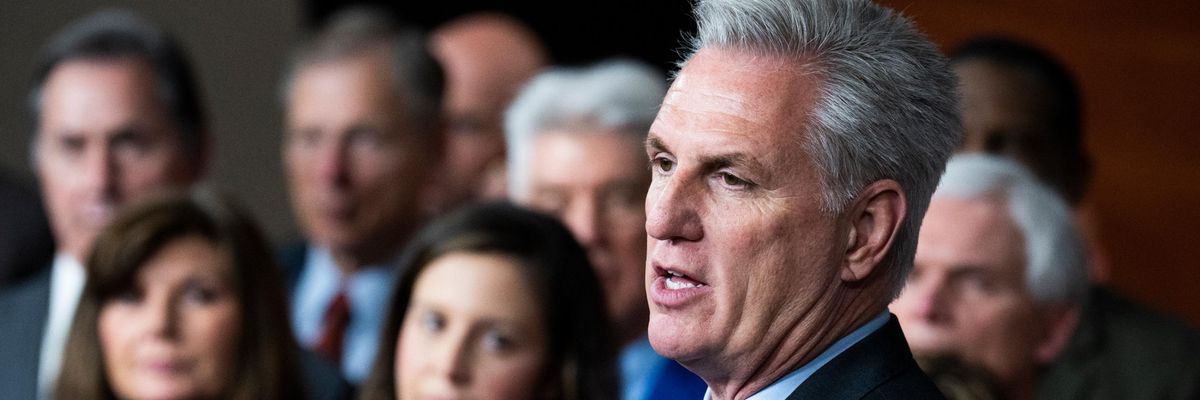
House Minority Leader Kevin McCarthy (R-Calif.) speaks at a news conference on January 20, 2022. (Photo: Tom Williams/CQ-Roll Call, Inc. via Getty Images)
'Party of Union Busters': McCarthy Opposes Congressional Staff Union
The Republican leader claimed that organized staffers would not be "productive for the government."
The sincerity of the GOP's attempt to rebrand as a party of workers was called into further question Monday when Rep. Kevin McCarthy--the Republican leader in the U.S. House--spoke out against congressional staffers' nascent unionization push, which has won the enthusiastic support of progressive lawmakers and Democratic leaders.
"I don't think it would be productive for the government," McCarthy (R-Calif.), a top ally of former President Donald Trump, told Punchbowl News of the unionization effort by Capitol Hill aides, many of whom are paid annual salaries in the low $20,000 range and struggle to afford basic necessities in one of the nation's most expensive cities.
McCarthy's anti-union comments came almost exactly a year after he told Punchbowl that the current GOP is "the American workers' party"--even as more than 100 members of his caucus pushed legislation that would undermine union rights nationwide.
Following McCarthy's latest remarks, observers were quick to highlight the disconnect between the GOP's pre-midterm branding exercise and its actual policy positions, which overwhelmingly favor the wealthy and corporate interests.
"The Republican Party is the party of union busters," tweeted the progressive advocacy group People for Bernie.
In contrast to McCarthy, House Speaker Nancy Pelosi (D-Calif.) and Senate Majority Leader Chuck Schumer (D-N.Y.) both endorsed congressional staffers' collective bargaining push, which was officially launched last week by a group dubbed the Congressional Workers Union.
"Like all Americans, our tireless congressional staff have the right to organize their workplace and join together in a union," Pelosi spokesperson Drew Hammill said in a statement. "If and when staffers choose to exercise that right, they would have Speaker Pelosi's full support."
To move forward, as Insider's Kayla Epstein explains, the organizing effort would require both the U.S. House and Senate to pass resolutions allowing congressional office and committee staffers to unionize.
Rep. Andy Levin (D-Mich.), a member of the Congressional Progressive Caucus, announced Friday that the House would soon "take legislative action to afford congressional staff the freedom to form a union--a fundamental right of all workers." Sen. Sherrod Brown (D-Ohio) is planning to introduce a companion measure in the upper chamber.
In a statement Monday, the Congressional Workers Union applauded the House resolution that is reportedly circulating among lawmakers and urged "each and every member of Congress--especially those who have publicly expressed support for congressional staff unionization efforts--to sign on."
"To better serve the public and improve working conditions here in Congress, congressional staff must have the protections to organize for a better workplace," the group said. "According to Demand Progress' tracker, at least 73 members of Congress express support for staff unionization efforts--but that is not enough. We call on every member of the House to sign and for House leadership to bring this concrete action to the floor for a vote."
Everett Kelley, national president of the American Federation of Government Employees (AFGE)--the largest federal employee union in the U.S.--voiced solidarity with the congressional staffers on Tuesday.
"All workers deserve a union, including those on Capitol Hill," said Kelley. "In their efforts to join together to have a collective voice in their working conditions, congressional staffers have the full support of the 700,000 federal and D.C. government workers we represent at AFGE."
This story has been updated to include a statement from the American Federation of Government Employees.
An Urgent Message From Our Co-Founder
Dear Common Dreams reader, It’s been nearly 30 years since I co-founded Common Dreams with my late wife, Lina Newhouser. We had the radical notion that journalism should serve the public good, not corporate profits. It was clear to us from the outset what it would take to build such a project. No paid advertisements. No corporate sponsors. No millionaire publisher telling us what to think or do. Many people said we wouldn't last a year, but we proved those doubters wrong. Together with a tremendous team of journalists and dedicated staff, we built an independent media outlet free from the constraints of profits and corporate control. Our mission has always been simple: To inform. To inspire. To ignite change for the common good. Building Common Dreams was not easy. Our survival was never guaranteed. When you take on the most powerful forces—Wall Street greed, fossil fuel industry destruction, Big Tech lobbyists, and uber-rich oligarchs who have spent billions upon billions rigging the economy and democracy in their favor—the only bulwark you have is supporters who believe in your work. But here’s the urgent message from me today. It's never been this bad out there. And it's never been this hard to keep us going. At the very moment Common Dreams is most needed, the threats we face are intensifying. We need your support now more than ever. We don't accept corporate advertising and never will. We don't have a paywall because we don't think people should be blocked from critical news based on their ability to pay. Everything we do is funded by the donations of readers like you. When everyone does the little they can afford, we are strong. But if that support retreats or dries up, so do we. Will you donate now to make sure Common Dreams not only survives but thrives? —Craig Brown, Co-founder |
The sincerity of the GOP's attempt to rebrand as a party of workers was called into further question Monday when Rep. Kevin McCarthy--the Republican leader in the U.S. House--spoke out against congressional staffers' nascent unionization push, which has won the enthusiastic support of progressive lawmakers and Democratic leaders.
"I don't think it would be productive for the government," McCarthy (R-Calif.), a top ally of former President Donald Trump, told Punchbowl News of the unionization effort by Capitol Hill aides, many of whom are paid annual salaries in the low $20,000 range and struggle to afford basic necessities in one of the nation's most expensive cities.
McCarthy's anti-union comments came almost exactly a year after he told Punchbowl that the current GOP is "the American workers' party"--even as more than 100 members of his caucus pushed legislation that would undermine union rights nationwide.
Following McCarthy's latest remarks, observers were quick to highlight the disconnect between the GOP's pre-midterm branding exercise and its actual policy positions, which overwhelmingly favor the wealthy and corporate interests.
"The Republican Party is the party of union busters," tweeted the progressive advocacy group People for Bernie.
In contrast to McCarthy, House Speaker Nancy Pelosi (D-Calif.) and Senate Majority Leader Chuck Schumer (D-N.Y.) both endorsed congressional staffers' collective bargaining push, which was officially launched last week by a group dubbed the Congressional Workers Union.
"Like all Americans, our tireless congressional staff have the right to organize their workplace and join together in a union," Pelosi spokesperson Drew Hammill said in a statement. "If and when staffers choose to exercise that right, they would have Speaker Pelosi's full support."
To move forward, as Insider's Kayla Epstein explains, the organizing effort would require both the U.S. House and Senate to pass resolutions allowing congressional office and committee staffers to unionize.
Rep. Andy Levin (D-Mich.), a member of the Congressional Progressive Caucus, announced Friday that the House would soon "take legislative action to afford congressional staff the freedom to form a union--a fundamental right of all workers." Sen. Sherrod Brown (D-Ohio) is planning to introduce a companion measure in the upper chamber.
In a statement Monday, the Congressional Workers Union applauded the House resolution that is reportedly circulating among lawmakers and urged "each and every member of Congress--especially those who have publicly expressed support for congressional staff unionization efforts--to sign on."
"To better serve the public and improve working conditions here in Congress, congressional staff must have the protections to organize for a better workplace," the group said. "According to Demand Progress' tracker, at least 73 members of Congress express support for staff unionization efforts--but that is not enough. We call on every member of the House to sign and for House leadership to bring this concrete action to the floor for a vote."
Everett Kelley, national president of the American Federation of Government Employees (AFGE)--the largest federal employee union in the U.S.--voiced solidarity with the congressional staffers on Tuesday.
"All workers deserve a union, including those on Capitol Hill," said Kelley. "In their efforts to join together to have a collective voice in their working conditions, congressional staffers have the full support of the 700,000 federal and D.C. government workers we represent at AFGE."
This story has been updated to include a statement from the American Federation of Government Employees.
The sincerity of the GOP's attempt to rebrand as a party of workers was called into further question Monday when Rep. Kevin McCarthy--the Republican leader in the U.S. House--spoke out against congressional staffers' nascent unionization push, which has won the enthusiastic support of progressive lawmakers and Democratic leaders.
"I don't think it would be productive for the government," McCarthy (R-Calif.), a top ally of former President Donald Trump, told Punchbowl News of the unionization effort by Capitol Hill aides, many of whom are paid annual salaries in the low $20,000 range and struggle to afford basic necessities in one of the nation's most expensive cities.
McCarthy's anti-union comments came almost exactly a year after he told Punchbowl that the current GOP is "the American workers' party"--even as more than 100 members of his caucus pushed legislation that would undermine union rights nationwide.
Following McCarthy's latest remarks, observers were quick to highlight the disconnect between the GOP's pre-midterm branding exercise and its actual policy positions, which overwhelmingly favor the wealthy and corporate interests.
"The Republican Party is the party of union busters," tweeted the progressive advocacy group People for Bernie.
In contrast to McCarthy, House Speaker Nancy Pelosi (D-Calif.) and Senate Majority Leader Chuck Schumer (D-N.Y.) both endorsed congressional staffers' collective bargaining push, which was officially launched last week by a group dubbed the Congressional Workers Union.
"Like all Americans, our tireless congressional staff have the right to organize their workplace and join together in a union," Pelosi spokesperson Drew Hammill said in a statement. "If and when staffers choose to exercise that right, they would have Speaker Pelosi's full support."
To move forward, as Insider's Kayla Epstein explains, the organizing effort would require both the U.S. House and Senate to pass resolutions allowing congressional office and committee staffers to unionize.
Rep. Andy Levin (D-Mich.), a member of the Congressional Progressive Caucus, announced Friday that the House would soon "take legislative action to afford congressional staff the freedom to form a union--a fundamental right of all workers." Sen. Sherrod Brown (D-Ohio) is planning to introduce a companion measure in the upper chamber.
In a statement Monday, the Congressional Workers Union applauded the House resolution that is reportedly circulating among lawmakers and urged "each and every member of Congress--especially those who have publicly expressed support for congressional staff unionization efforts--to sign on."
"To better serve the public and improve working conditions here in Congress, congressional staff must have the protections to organize for a better workplace," the group said. "According to Demand Progress' tracker, at least 73 members of Congress express support for staff unionization efforts--but that is not enough. We call on every member of the House to sign and for House leadership to bring this concrete action to the floor for a vote."
Everett Kelley, national president of the American Federation of Government Employees (AFGE)--the largest federal employee union in the U.S.--voiced solidarity with the congressional staffers on Tuesday.
"All workers deserve a union, including those on Capitol Hill," said Kelley. "In their efforts to join together to have a collective voice in their working conditions, congressional staffers have the full support of the 700,000 federal and D.C. government workers we represent at AFGE."
This story has been updated to include a statement from the American Federation of Government Employees.