SUBSCRIBE TO OUR FREE NEWSLETTER
Daily news & progressive opinion—funded by the people, not the corporations—delivered straight to your inbox.
5
#000000
#FFFFFF
To donate by check, phone, or other method, see our More Ways to Give page.
Daily news & progressive opinion—funded by the people, not the corporations—delivered straight to your inbox.
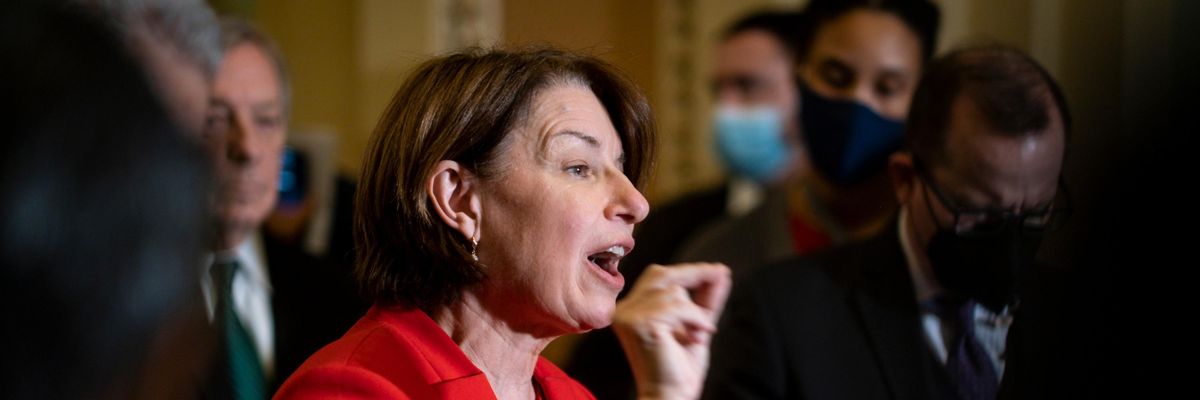
Sen. Amy Klobuchar (D-Minn.) speaks to the press on November 2, 2021 in Washington, D.C. (Photo: Pete Marovich/Getty Images)
The Senate Judiciary Committee on Thursday approved antitrust legislation targeting corporate behemoths such as Google, Apple, and Amazon, a move that anti-monopoly campaigners hailed as a positive step toward reining in Big Tech.
Formally known as the American Innovation and Choice Online Act, the bipartisan legislation cleared the judiciary panel by an overwhelming vote of 16-6 despite fierce lobbying by Google and Apple, whose chief executives personally reached out to lawmakers to express their opposition to the bill.
If passed into law, the measure--sponsored by Sens. Amy Klobuchar (D-Minn.) and Chuck Grassley (R-Iowa)--would prohibit major tech platforms from favoring their own products and services over those of other companies, a practice known as self-preferencing.
The six lawmakers who voted against the bill in committee were all Republicans: Sens. John Cornyn (R-Texas), Mike Lee (R-Utah), Ben Sasse (R-Neb.), Tom Cotton (R-Ark.), Thom Tillis (R-N.C.), and Marsha Blackburn (R-Tenn.).
"This was an even stronger vote than we expected--and notably bodes well about the ability to overcome a filibuster on the floor," said Ginger Quintero-McCall, legal director at Demand Progress. "It will also provide momentum as the debate shifts back to the House."
Sarah Miller, executive director of the American Economic Liberties Project, said in a statement that "despite millions of lobbying dollars by monopolists spent to influence lawmakers, a bipartisan group of senators just stated with a clear voice that Big Tech is too powerful."
"With growing bipartisan appetite to break the power of Big Tech," Miller added, "the Senate should continue to reassert its power over the handful of men whose corporations undermine economic dynamism, eviscerate the free press, and threaten our democracy itself."
While she ultimately voted to advance the legislation, Sen. Dianne Feinstein (D-Calif.)--who represents Silicon Valley--criticized the bill and suggested that Biden administration officials share her concerns.
That prompted a sharp response from Klobuchar, who accused Feinstein of spreading false information about the administration's stance.
Watch the exchange:
The White House has yet to say whether it supports the American Innovation and Choice Online Act, but--as CNBC reported--the Biden administration "has generally pushed for measures that lessen concentration of power and has broadly supported competition reform."
"On Wednesday, top White House officials met with a group of companies including Big Tech critics Sonos and Yelp to hear their concerns about barriers to competition," the outlet noted. "The tech industry has launched an all-out attack on the legislative effort."
In a tweet following Thursday's vote, Klobuchar argued that "right now, Big Tech gets to call all the shots online."
"Does this benefit consumers or small businesses trying to compete? No," she wrote. "The good news: My bipartisan bill to create commonsense digital rules of the road passed the Judiciary Committee today and is closer to becoming law."
Dear Common Dreams reader, It’s been nearly 30 years since I co-founded Common Dreams with my late wife, Lina Newhouser. We had the radical notion that journalism should serve the public good, not corporate profits. It was clear to us from the outset what it would take to build such a project. No paid advertisements. No corporate sponsors. No millionaire publisher telling us what to think or do. Many people said we wouldn't last a year, but we proved those doubters wrong. Together with a tremendous team of journalists and dedicated staff, we built an independent media outlet free from the constraints of profits and corporate control. Our mission has always been simple: To inform. To inspire. To ignite change for the common good. Building Common Dreams was not easy. Our survival was never guaranteed. When you take on the most powerful forces—Wall Street greed, fossil fuel industry destruction, Big Tech lobbyists, and uber-rich oligarchs who have spent billions upon billions rigging the economy and democracy in their favor—the only bulwark you have is supporters who believe in your work. But here’s the urgent message from me today. It's never been this bad out there. And it's never been this hard to keep us going. At the very moment Common Dreams is most needed, the threats we face are intensifying. We need your support now more than ever. We don't accept corporate advertising and never will. We don't have a paywall because we don't think people should be blocked from critical news based on their ability to pay. Everything we do is funded by the donations of readers like you. When everyone does the little they can afford, we are strong. But if that support retreats or dries up, so do we. Will you donate now to make sure Common Dreams not only survives but thrives? —Craig Brown, Co-founder |
The Senate Judiciary Committee on Thursday approved antitrust legislation targeting corporate behemoths such as Google, Apple, and Amazon, a move that anti-monopoly campaigners hailed as a positive step toward reining in Big Tech.
Formally known as the American Innovation and Choice Online Act, the bipartisan legislation cleared the judiciary panel by an overwhelming vote of 16-6 despite fierce lobbying by Google and Apple, whose chief executives personally reached out to lawmakers to express their opposition to the bill.
If passed into law, the measure--sponsored by Sens. Amy Klobuchar (D-Minn.) and Chuck Grassley (R-Iowa)--would prohibit major tech platforms from favoring their own products and services over those of other companies, a practice known as self-preferencing.
The six lawmakers who voted against the bill in committee were all Republicans: Sens. John Cornyn (R-Texas), Mike Lee (R-Utah), Ben Sasse (R-Neb.), Tom Cotton (R-Ark.), Thom Tillis (R-N.C.), and Marsha Blackburn (R-Tenn.).
"This was an even stronger vote than we expected--and notably bodes well about the ability to overcome a filibuster on the floor," said Ginger Quintero-McCall, legal director at Demand Progress. "It will also provide momentum as the debate shifts back to the House."
Sarah Miller, executive director of the American Economic Liberties Project, said in a statement that "despite millions of lobbying dollars by monopolists spent to influence lawmakers, a bipartisan group of senators just stated with a clear voice that Big Tech is too powerful."
"With growing bipartisan appetite to break the power of Big Tech," Miller added, "the Senate should continue to reassert its power over the handful of men whose corporations undermine economic dynamism, eviscerate the free press, and threaten our democracy itself."
While she ultimately voted to advance the legislation, Sen. Dianne Feinstein (D-Calif.)--who represents Silicon Valley--criticized the bill and suggested that Biden administration officials share her concerns.
That prompted a sharp response from Klobuchar, who accused Feinstein of spreading false information about the administration's stance.
Watch the exchange:
The White House has yet to say whether it supports the American Innovation and Choice Online Act, but--as CNBC reported--the Biden administration "has generally pushed for measures that lessen concentration of power and has broadly supported competition reform."
"On Wednesday, top White House officials met with a group of companies including Big Tech critics Sonos and Yelp to hear their concerns about barriers to competition," the outlet noted. "The tech industry has launched an all-out attack on the legislative effort."
In a tweet following Thursday's vote, Klobuchar argued that "right now, Big Tech gets to call all the shots online."
"Does this benefit consumers or small businesses trying to compete? No," she wrote. "The good news: My bipartisan bill to create commonsense digital rules of the road passed the Judiciary Committee today and is closer to becoming law."
The Senate Judiciary Committee on Thursday approved antitrust legislation targeting corporate behemoths such as Google, Apple, and Amazon, a move that anti-monopoly campaigners hailed as a positive step toward reining in Big Tech.
Formally known as the American Innovation and Choice Online Act, the bipartisan legislation cleared the judiciary panel by an overwhelming vote of 16-6 despite fierce lobbying by Google and Apple, whose chief executives personally reached out to lawmakers to express their opposition to the bill.
If passed into law, the measure--sponsored by Sens. Amy Klobuchar (D-Minn.) and Chuck Grassley (R-Iowa)--would prohibit major tech platforms from favoring their own products and services over those of other companies, a practice known as self-preferencing.
The six lawmakers who voted against the bill in committee were all Republicans: Sens. John Cornyn (R-Texas), Mike Lee (R-Utah), Ben Sasse (R-Neb.), Tom Cotton (R-Ark.), Thom Tillis (R-N.C.), and Marsha Blackburn (R-Tenn.).
"This was an even stronger vote than we expected--and notably bodes well about the ability to overcome a filibuster on the floor," said Ginger Quintero-McCall, legal director at Demand Progress. "It will also provide momentum as the debate shifts back to the House."
Sarah Miller, executive director of the American Economic Liberties Project, said in a statement that "despite millions of lobbying dollars by monopolists spent to influence lawmakers, a bipartisan group of senators just stated with a clear voice that Big Tech is too powerful."
"With growing bipartisan appetite to break the power of Big Tech," Miller added, "the Senate should continue to reassert its power over the handful of men whose corporations undermine economic dynamism, eviscerate the free press, and threaten our democracy itself."
While she ultimately voted to advance the legislation, Sen. Dianne Feinstein (D-Calif.)--who represents Silicon Valley--criticized the bill and suggested that Biden administration officials share her concerns.
That prompted a sharp response from Klobuchar, who accused Feinstein of spreading false information about the administration's stance.
Watch the exchange:
The White House has yet to say whether it supports the American Innovation and Choice Online Act, but--as CNBC reported--the Biden administration "has generally pushed for measures that lessen concentration of power and has broadly supported competition reform."
"On Wednesday, top White House officials met with a group of companies including Big Tech critics Sonos and Yelp to hear their concerns about barriers to competition," the outlet noted. "The tech industry has launched an all-out attack on the legislative effort."
In a tweet following Thursday's vote, Klobuchar argued that "right now, Big Tech gets to call all the shots online."
"Does this benefit consumers or small businesses trying to compete? No," she wrote. "The good news: My bipartisan bill to create commonsense digital rules of the road passed the Judiciary Committee today and is closer to becoming law."