SUBSCRIBE TO OUR FREE NEWSLETTER
Daily news & progressive opinion—funded by the people, not the corporations—delivered straight to your inbox.
5
#000000
#FFFFFF
To donate by check, phone, or other method, see our More Ways to Give page.
Daily news & progressive opinion—funded by the people, not the corporations—delivered straight to your inbox.
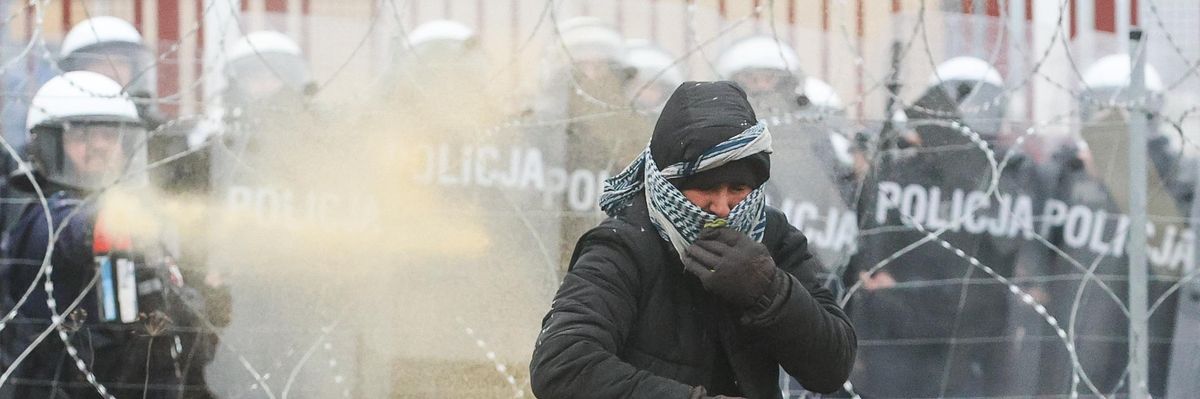
Polish riot police officers and a migrant are seen near the Bruzgi-Kuznica crossing point on the Belarusian-Polish border. Polish border guards use tear gas and water jets to disperse migrants. (Photo: Leonid Shcheglov\TASS via Getty Images)
A group of migrants trapped in freezing conditions at the Belarus-Poland border faced water cannons and tear gas by Polish border guards on Tuesday amid an ongoing humanitarian and political crisis.
Polish forces put the blame for the violence, which took place near the Bruzgi-Kuznica border crossing, on some of the thousands of migrants throwing objects.
"Migrants attacked our soldiers and officers with rocks and are trying to destroy the fence and cross into Poland," Poland's defense ministry said Tuesday. "Our forces used tear gas to quell the migrants' aggression."
The migrants, many of them refugees fleeing war-torn nations in the Middle East, are trying to enter the E.U. at its eastern edge.
Western powers have blamed Belarus' authoritarian President Alexander Lukashenko's government of orchestrating the crisis--retaliation, as Al Jazeera put it, "for E.U. sanctions imposed on the leader after his disputed re-election last year and his crackdown on mass pro-democracy protests."
The Polish government, the New York Times reported, has banned journalists from the border and "has come under criticism from humanitarian organizations for a legal amendment it passed in October that allows migrants to be pushed back at the border and for asylum claims made by those who entered illegally to be ignored."
For those at the makeshift camp, it's a life-or-death situation. "Most are fleeing conflict, poverty, or hopelessness in Syria and Iraq and hope to reach western Europe," the Associated Press reported, noting the deaths of 11 people so far.
"Die here or die in my country; a lot of us have the same situation," said one Iraqi-Kurdish migrant.
According to BBC News:
The migrants, including children, have been living in makeshift camps in freezing conditions just inside Belarus. In recent days, thousands have converged on a crossing at Kuznica, south of Grodno in northwest Belarus.
On Monday, many of those migrants burst through a fence and gathered at a crossing on the Belarusian side of the border. They were blocked by Polish troops and a tense stand-off ensued.
By Tuesday morning, Poland's defense ministry said its forces had responded to migrants attacking a border fence at Kuznica.
The deepening tensions triggered the E.U. to ready a new round of sanctions targeting Lukashenko's government. E.U. foreign policy chief Josep Borrell said Monday they would target "people, airlines, travel agencies and everybody involved on this illegal push of migrants on our borders."
The situation elicited strong criticism last week from human rights defenders.
Michelle Bachelet, the United Nations High Commissioner for Human Rights, called the crisis "intolerable" and said "the strong security-focused and politically charged responses on both sides--including through the increased deployment of troops--and accompanying inflammatory rhetoric, serve only to exacerbate the vulnerability and risks that migrants and refugees face."
The Norwegian Refugee Council's Secretary General Jan Egeland expressed similar criticism.
He called it "shocking to witness Europe's inability to properly handle such a low number of migrants stranded at the Poland-Belarus border."
In addition, said Egeland, Belarus "using migrants and refugees to achieve political ends is equally outrageous. Vulnerable people are not chess pawns to be used in a geopolitical struggle."
"But," he added, "this does not in any way free Europe from its responsibility to ensure that people turning up on our borders are allowed to seek asylum and are treated humanely."
Dear Common Dreams reader, It’s been nearly 30 years since I co-founded Common Dreams with my late wife, Lina Newhouser. We had the radical notion that journalism should serve the public good, not corporate profits. It was clear to us from the outset what it would take to build such a project. No paid advertisements. No corporate sponsors. No millionaire publisher telling us what to think or do. Many people said we wouldn't last a year, but we proved those doubters wrong. Together with a tremendous team of journalists and dedicated staff, we built an independent media outlet free from the constraints of profits and corporate control. Our mission has always been simple: To inform. To inspire. To ignite change for the common good. Building Common Dreams was not easy. Our survival was never guaranteed. When you take on the most powerful forces—Wall Street greed, fossil fuel industry destruction, Big Tech lobbyists, and uber-rich oligarchs who have spent billions upon billions rigging the economy and democracy in their favor—the only bulwark you have is supporters who believe in your work. But here’s the urgent message from me today. It's never been this bad out there. And it's never been this hard to keep us going. At the very moment Common Dreams is most needed, the threats we face are intensifying. We need your support now more than ever. We don't accept corporate advertising and never will. We don't have a paywall because we don't think people should be blocked from critical news based on their ability to pay. Everything we do is funded by the donations of readers like you. When everyone does the little they can afford, we are strong. But if that support retreats or dries up, so do we. Will you donate now to make sure Common Dreams not only survives but thrives? —Craig Brown, Co-founder |
A group of migrants trapped in freezing conditions at the Belarus-Poland border faced water cannons and tear gas by Polish border guards on Tuesday amid an ongoing humanitarian and political crisis.
Polish forces put the blame for the violence, which took place near the Bruzgi-Kuznica border crossing, on some of the thousands of migrants throwing objects.
"Migrants attacked our soldiers and officers with rocks and are trying to destroy the fence and cross into Poland," Poland's defense ministry said Tuesday. "Our forces used tear gas to quell the migrants' aggression."
The migrants, many of them refugees fleeing war-torn nations in the Middle East, are trying to enter the E.U. at its eastern edge.
Western powers have blamed Belarus' authoritarian President Alexander Lukashenko's government of orchestrating the crisis--retaliation, as Al Jazeera put it, "for E.U. sanctions imposed on the leader after his disputed re-election last year and his crackdown on mass pro-democracy protests."
The Polish government, the New York Times reported, has banned journalists from the border and "has come under criticism from humanitarian organizations for a legal amendment it passed in October that allows migrants to be pushed back at the border and for asylum claims made by those who entered illegally to be ignored."
For those at the makeshift camp, it's a life-or-death situation. "Most are fleeing conflict, poverty, or hopelessness in Syria and Iraq and hope to reach western Europe," the Associated Press reported, noting the deaths of 11 people so far.
"Die here or die in my country; a lot of us have the same situation," said one Iraqi-Kurdish migrant.
According to BBC News:
The migrants, including children, have been living in makeshift camps in freezing conditions just inside Belarus. In recent days, thousands have converged on a crossing at Kuznica, south of Grodno in northwest Belarus.
On Monday, many of those migrants burst through a fence and gathered at a crossing on the Belarusian side of the border. They were blocked by Polish troops and a tense stand-off ensued.
By Tuesday morning, Poland's defense ministry said its forces had responded to migrants attacking a border fence at Kuznica.
The deepening tensions triggered the E.U. to ready a new round of sanctions targeting Lukashenko's government. E.U. foreign policy chief Josep Borrell said Monday they would target "people, airlines, travel agencies and everybody involved on this illegal push of migrants on our borders."
The situation elicited strong criticism last week from human rights defenders.
Michelle Bachelet, the United Nations High Commissioner for Human Rights, called the crisis "intolerable" and said "the strong security-focused and politically charged responses on both sides--including through the increased deployment of troops--and accompanying inflammatory rhetoric, serve only to exacerbate the vulnerability and risks that migrants and refugees face."
The Norwegian Refugee Council's Secretary General Jan Egeland expressed similar criticism.
He called it "shocking to witness Europe's inability to properly handle such a low number of migrants stranded at the Poland-Belarus border."
In addition, said Egeland, Belarus "using migrants and refugees to achieve political ends is equally outrageous. Vulnerable people are not chess pawns to be used in a geopolitical struggle."
"But," he added, "this does not in any way free Europe from its responsibility to ensure that people turning up on our borders are allowed to seek asylum and are treated humanely."
A group of migrants trapped in freezing conditions at the Belarus-Poland border faced water cannons and tear gas by Polish border guards on Tuesday amid an ongoing humanitarian and political crisis.
Polish forces put the blame for the violence, which took place near the Bruzgi-Kuznica border crossing, on some of the thousands of migrants throwing objects.
"Migrants attacked our soldiers and officers with rocks and are trying to destroy the fence and cross into Poland," Poland's defense ministry said Tuesday. "Our forces used tear gas to quell the migrants' aggression."
The migrants, many of them refugees fleeing war-torn nations in the Middle East, are trying to enter the E.U. at its eastern edge.
Western powers have blamed Belarus' authoritarian President Alexander Lukashenko's government of orchestrating the crisis--retaliation, as Al Jazeera put it, "for E.U. sanctions imposed on the leader after his disputed re-election last year and his crackdown on mass pro-democracy protests."
The Polish government, the New York Times reported, has banned journalists from the border and "has come under criticism from humanitarian organizations for a legal amendment it passed in October that allows migrants to be pushed back at the border and for asylum claims made by those who entered illegally to be ignored."
For those at the makeshift camp, it's a life-or-death situation. "Most are fleeing conflict, poverty, or hopelessness in Syria and Iraq and hope to reach western Europe," the Associated Press reported, noting the deaths of 11 people so far.
"Die here or die in my country; a lot of us have the same situation," said one Iraqi-Kurdish migrant.
According to BBC News:
The migrants, including children, have been living in makeshift camps in freezing conditions just inside Belarus. In recent days, thousands have converged on a crossing at Kuznica, south of Grodno in northwest Belarus.
On Monday, many of those migrants burst through a fence and gathered at a crossing on the Belarusian side of the border. They were blocked by Polish troops and a tense stand-off ensued.
By Tuesday morning, Poland's defense ministry said its forces had responded to migrants attacking a border fence at Kuznica.
The deepening tensions triggered the E.U. to ready a new round of sanctions targeting Lukashenko's government. E.U. foreign policy chief Josep Borrell said Monday they would target "people, airlines, travel agencies and everybody involved on this illegal push of migrants on our borders."
The situation elicited strong criticism last week from human rights defenders.
Michelle Bachelet, the United Nations High Commissioner for Human Rights, called the crisis "intolerable" and said "the strong security-focused and politically charged responses on both sides--including through the increased deployment of troops--and accompanying inflammatory rhetoric, serve only to exacerbate the vulnerability and risks that migrants and refugees face."
The Norwegian Refugee Council's Secretary General Jan Egeland expressed similar criticism.
He called it "shocking to witness Europe's inability to properly handle such a low number of migrants stranded at the Poland-Belarus border."
In addition, said Egeland, Belarus "using migrants and refugees to achieve political ends is equally outrageous. Vulnerable people are not chess pawns to be used in a geopolitical struggle."
"But," he added, "this does not in any way free Europe from its responsibility to ensure that people turning up on our borders are allowed to seek asylum and are treated humanely."