

SUBSCRIBE TO OUR FREE NEWSLETTER
Daily news & progressive opinion—funded by the people, not the corporations—delivered straight to your inbox.
5
#000000
#FFFFFF
To donate by check, phone, or other method, see our More Ways to Give page.
Daily news & progressive opinion—funded by the people, not the corporations—delivered straight to your inbox.
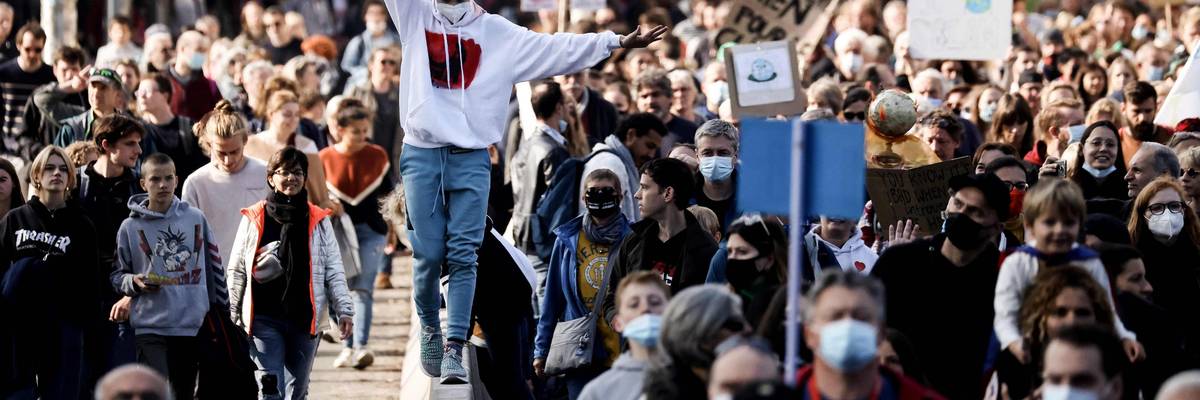
An estimated 70,000 or more protesters took part in a demonstration against climate change in Brussels, on October 10, 2021, ahead of the COP26 climate summit. (Photo: Kenzo Tribouillard)
Tens of thousands of people marched through the streets of Brussels on Sunday to demand Belgium's elected leaders and others from around the world finally dispense with proclamations, broken promises, and half-measures and instead "act" on the climate emergency.
"We need a Belgian Green New Deal and we propose more than 100 concrete solutions to make it happen."
With U.N. climate conference (COP26) set for next month in Glasgow, the estimated 70,000 or more people who took part in the march offered a dramatic show of force for the nation's climate movement.
Zanna Vanrenterghem of Greenpeace Belgium told The Brussels Times on Sunday that her government's climate pledges so far "are not ambitious enough," but that words are no longer enough. "It is one thing to talk about climate," she said, "and another to take concrete action."
Ahead of the march, Vanrenterghem said the message from the Klimaatcoalitie (Climate Coalition), which she co-chairs and that organized the march, was a simple one: "We demand ambitious, solidarity-based and coherent measures. We need a Belgian Green New Deal and we propose more than 100 concrete solutions to make it happen."
According to the Associated Press:
Thousands of people and 80 organizations took part in the protest, aiming for the biggest such event in the European Union's capital since the start of the coronavirus pandemic, which stopped the climate movement's weekly marches in its tracks.
Cyclists, families with children and white-haired demonstrators filled city streets, chanting slogans demanding climate justice and waving banners in English, French and Dutch. One carried a stuffed polar bear on her head, and others were dressed as animals endangered by human-caused climate change.
The crowds was large--with the march often stretching further than the eye could see--and participants each sharing their various reasons for attending. Signs and banners said things like "Destroy the System/Not the Planet"; "Walk the Talk"; and "Protect What You Love."
Lucien Dewanaga, a marcher who spoke with AP, asked the question: "What do we do when we destroy the planet? We have nothing else. Human beings have to live in this world. And there is only one world."
According to Vanrenterghem, extreme weather within Belgium and elsewhere in the world over the past year have offered only more reasons for leaders to turn lofty rhetoric into the concrete policies that scientists say are necessary to stave off the worst impacts.
"The tough climate actions of the past few years have put the climate crisis high on the political agenda," she said. "Now is the time for politicians to turn their promises into concrete action."
Dear Common Dreams reader, It’s been nearly 30 years since I co-founded Common Dreams with my late wife, Lina Newhouser. We had the radical notion that journalism should serve the public good, not corporate profits. It was clear to us from the outset what it would take to build such a project. No paid advertisements. No corporate sponsors. No millionaire publisher telling us what to think or do. Many people said we wouldn't last a year, but we proved those doubters wrong. Together with a tremendous team of journalists and dedicated staff, we built an independent media outlet free from the constraints of profits and corporate control. Our mission has always been simple: To inform. To inspire. To ignite change for the common good. Building Common Dreams was not easy. Our survival was never guaranteed. When you take on the most powerful forces—Wall Street greed, fossil fuel industry destruction, Big Tech lobbyists, and uber-rich oligarchs who have spent billions upon billions rigging the economy and democracy in their favor—the only bulwark you have is supporters who believe in your work. But here’s the urgent message from me today. It's never been this bad out there. And it's never been this hard to keep us going. At the very moment Common Dreams is most needed, the threats we face are intensifying. We need your support now more than ever. We don't accept corporate advertising and never will. We don't have a paywall because we don't think people should be blocked from critical news based on their ability to pay. Everything we do is funded by the donations of readers like you. When everyone does the little they can afford, we are strong. But if that support retreats or dries up, so do we. Will you donate now to make sure Common Dreams not only survives but thrives? —Craig Brown, Co-founder |
Tens of thousands of people marched through the streets of Brussels on Sunday to demand Belgium's elected leaders and others from around the world finally dispense with proclamations, broken promises, and half-measures and instead "act" on the climate emergency.
"We need a Belgian Green New Deal and we propose more than 100 concrete solutions to make it happen."
With U.N. climate conference (COP26) set for next month in Glasgow, the estimated 70,000 or more people who took part in the march offered a dramatic show of force for the nation's climate movement.
Zanna Vanrenterghem of Greenpeace Belgium told The Brussels Times on Sunday that her government's climate pledges so far "are not ambitious enough," but that words are no longer enough. "It is one thing to talk about climate," she said, "and another to take concrete action."
Ahead of the march, Vanrenterghem said the message from the Klimaatcoalitie (Climate Coalition), which she co-chairs and that organized the march, was a simple one: "We demand ambitious, solidarity-based and coherent measures. We need a Belgian Green New Deal and we propose more than 100 concrete solutions to make it happen."
According to the Associated Press:
Thousands of people and 80 organizations took part in the protest, aiming for the biggest such event in the European Union's capital since the start of the coronavirus pandemic, which stopped the climate movement's weekly marches in its tracks.
Cyclists, families with children and white-haired demonstrators filled city streets, chanting slogans demanding climate justice and waving banners in English, French and Dutch. One carried a stuffed polar bear on her head, and others were dressed as animals endangered by human-caused climate change.
The crowds was large--with the march often stretching further than the eye could see--and participants each sharing their various reasons for attending. Signs and banners said things like "Destroy the System/Not the Planet"; "Walk the Talk"; and "Protect What You Love."
Lucien Dewanaga, a marcher who spoke with AP, asked the question: "What do we do when we destroy the planet? We have nothing else. Human beings have to live in this world. And there is only one world."
According to Vanrenterghem, extreme weather within Belgium and elsewhere in the world over the past year have offered only more reasons for leaders to turn lofty rhetoric into the concrete policies that scientists say are necessary to stave off the worst impacts.
"The tough climate actions of the past few years have put the climate crisis high on the political agenda," she said. "Now is the time for politicians to turn their promises into concrete action."
Tens of thousands of people marched through the streets of Brussels on Sunday to demand Belgium's elected leaders and others from around the world finally dispense with proclamations, broken promises, and half-measures and instead "act" on the climate emergency.
"We need a Belgian Green New Deal and we propose more than 100 concrete solutions to make it happen."
With U.N. climate conference (COP26) set for next month in Glasgow, the estimated 70,000 or more people who took part in the march offered a dramatic show of force for the nation's climate movement.
Zanna Vanrenterghem of Greenpeace Belgium told The Brussels Times on Sunday that her government's climate pledges so far "are not ambitious enough," but that words are no longer enough. "It is one thing to talk about climate," she said, "and another to take concrete action."
Ahead of the march, Vanrenterghem said the message from the Klimaatcoalitie (Climate Coalition), which she co-chairs and that organized the march, was a simple one: "We demand ambitious, solidarity-based and coherent measures. We need a Belgian Green New Deal and we propose more than 100 concrete solutions to make it happen."
According to the Associated Press:
Thousands of people and 80 organizations took part in the protest, aiming for the biggest such event in the European Union's capital since the start of the coronavirus pandemic, which stopped the climate movement's weekly marches in its tracks.
Cyclists, families with children and white-haired demonstrators filled city streets, chanting slogans demanding climate justice and waving banners in English, French and Dutch. One carried a stuffed polar bear on her head, and others were dressed as animals endangered by human-caused climate change.
The crowds was large--with the march often stretching further than the eye could see--and participants each sharing their various reasons for attending. Signs and banners said things like "Destroy the System/Not the Planet"; "Walk the Talk"; and "Protect What You Love."
Lucien Dewanaga, a marcher who spoke with AP, asked the question: "What do we do when we destroy the planet? We have nothing else. Human beings have to live in this world. And there is only one world."
According to Vanrenterghem, extreme weather within Belgium and elsewhere in the world over the past year have offered only more reasons for leaders to turn lofty rhetoric into the concrete policies that scientists say are necessary to stave off the worst impacts.
"The tough climate actions of the past few years have put the climate crisis high on the political agenda," she said. "Now is the time for politicians to turn their promises into concrete action."

