SUBSCRIBE TO OUR FREE NEWSLETTER
Daily news & progressive opinion—funded by the people, not the corporations—delivered straight to your inbox.
5
#000000
#FFFFFF
To donate by check, phone, or other method, see our More Ways to Give page.
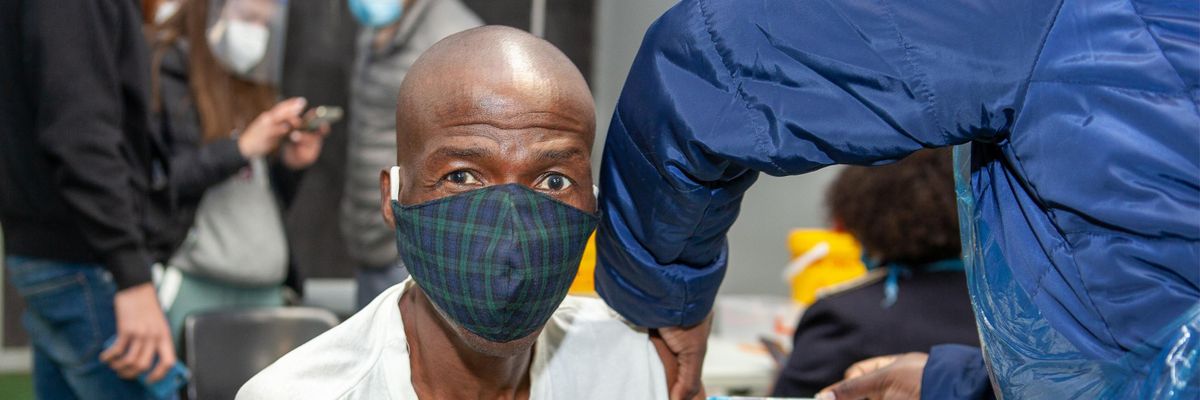
More than two-thirds of Africa's 54 countries were denied the ability to vaccinate at least 10% of their populations against Covid-19 by September's end--a modest World Health Organization target--as rich nations continue to hoard doses and shield the pharmaceutical industry's monopoly control over production.
According to the WHO's Regional Office for Africa, just 15 of the continent's countries reached the 10% vaccination goal. Half of the 52 African nations that have received coronavirus vaccines have fully inoculated 2% or less of their populations, the WHO said Thursday.
Dr. Richard Mihigo, Immunization and Vaccines Development Program coordinator for the WHO's Africa office, said in a statement that "the latest data shows modest gains but there is still a long way to go to reach the WHO target of fully vaccinating 40% of the population by the end of the year."
While donation shipments to the continent are steadily increasing, Mihigo added, "opaque delivery plans are still the number one nuisance that hold Africa back." The WHO warned last week that vaccine shipments to Africa will need to increase seven-fold--from roughly 20 million doses per month to 150 million per month, on average--for the continent to vaccinate 70% of its population by September 2022.
At present, just 4% of Africa's population is fully vaccinated.
"This is about life and death for potentially millions of Africans, so there is no time to waste in getting these shipments moving," said Dr. Matshidiso Moeti, the WHO's Regional Director for Africa. "Actions speak far louder than words, and African countries need clear delivery dates so they can plan properly."
Related Content

Experts and public health campaigners have attributed Africa's struggle to vaccinate even a small fraction of its 1.3 billion-strong population to decision-making by rich countries, which have bought up and clung to much of the global vaccine supply while resisting technology transfer initiatives and other efforts to ramp up production.
While the U.S. and other wealthy nations have added to their donation pledges of late, analysts say the promises still amount to "trickles of charity" that won't put much of a dent in global inequities--let alone end the pandemic.
The ONE Campaign, a global anti-poverty group, estimates that G7 countries will soon be sitting on enough excess doses of the coronavirus vaccine to provide a shot to every adult in Africa. A recent analysis by Airfinity found that G7 nations are set to waste 100 million vaccine doses by the end of 2021 and up to 800 million by mid-2022.
"This pandemic will only be over when it is over for everyone everywhere, which means it is in the self-interest of every nation and every person that the available vaccines are shared equitably, so that we can exit the pandemic and get our lives back to normal," Howard Catton, chief executive officer of the International Coalition of Nurses, said in a statement Thursday.
"The situation in Africa should be a red flag for the rest of the world," Catton added. "We have recently seen a billionaire take a healthcare worker on a journey into space. But back here on planet Earth we have millions of nurses waiting for a vaccine... They should be prioritized, and it should be as of right that they receive that vaccine."
More than two-thirds of Africa's 54 countries were denied the ability to vaccinate at least 10% of their populations against Covid-19 by September's end--a modest World Health Organization target--as rich nations continue to hoard doses and shield the pharmaceutical industry's monopoly control over production.
According to the WHO's Regional Office for Africa, just 15 of the continent's countries reached the 10% vaccination goal. Half of the 52 African nations that have received coronavirus vaccines have fully inoculated 2% or less of their populations, the WHO said Thursday.
Dr. Richard Mihigo, Immunization and Vaccines Development Program coordinator for the WHO's Africa office, said in a statement that "the latest data shows modest gains but there is still a long way to go to reach the WHO target of fully vaccinating 40% of the population by the end of the year."
While donation shipments to the continent are steadily increasing, Mihigo added, "opaque delivery plans are still the number one nuisance that hold Africa back." The WHO warned last week that vaccine shipments to Africa will need to increase seven-fold--from roughly 20 million doses per month to 150 million per month, on average--for the continent to vaccinate 70% of its population by September 2022.
At present, just 4% of Africa's population is fully vaccinated.
"This is about life and death for potentially millions of Africans, so there is no time to waste in getting these shipments moving," said Dr. Matshidiso Moeti, the WHO's Regional Director for Africa. "Actions speak far louder than words, and African countries need clear delivery dates so they can plan properly."
Related Content
Experts and public health campaigners have attributed Africa's struggle to vaccinate even a small fraction of its 1.3 billion-strong population to decision-making by rich countries, which have bought up and clung to much of the global vaccine supply while resisting technology transfer initiatives and other efforts to ramp up production.
While the U.S. and other wealthy nations have added to their donation pledges of late, analysts say the promises still amount to "trickles of charity" that won't put much of a dent in global inequities--let alone end the pandemic.
The ONE Campaign, a global anti-poverty group, estimates that G7 countries will soon be sitting on enough excess doses of the coronavirus vaccine to provide a shot to every adult in Africa. A recent analysis by Airfinity found that G7 nations are set to waste 100 million vaccine doses by the end of 2021 and up to 800 million by mid-2022.
"This pandemic will only be over when it is over for everyone everywhere, which means it is in the self-interest of every nation and every person that the available vaccines are shared equitably, so that we can exit the pandemic and get our lives back to normal," Howard Catton, chief executive officer of the International Coalition of Nurses, said in a statement Thursday.
"The situation in Africa should be a red flag for the rest of the world," Catton added. "We have recently seen a billionaire take a healthcare worker on a journey into space. But back here on planet Earth we have millions of nurses waiting for a vaccine... They should be prioritized, and it should be as of right that they receive that vaccine."
More than two-thirds of Africa's 54 countries were denied the ability to vaccinate at least 10% of their populations against Covid-19 by September's end--a modest World Health Organization target--as rich nations continue to hoard doses and shield the pharmaceutical industry's monopoly control over production.
According to the WHO's Regional Office for Africa, just 15 of the continent's countries reached the 10% vaccination goal. Half of the 52 African nations that have received coronavirus vaccines have fully inoculated 2% or less of their populations, the WHO said Thursday.
Dr. Richard Mihigo, Immunization and Vaccines Development Program coordinator for the WHO's Africa office, said in a statement that "the latest data shows modest gains but there is still a long way to go to reach the WHO target of fully vaccinating 40% of the population by the end of the year."
While donation shipments to the continent are steadily increasing, Mihigo added, "opaque delivery plans are still the number one nuisance that hold Africa back." The WHO warned last week that vaccine shipments to Africa will need to increase seven-fold--from roughly 20 million doses per month to 150 million per month, on average--for the continent to vaccinate 70% of its population by September 2022.
At present, just 4% of Africa's population is fully vaccinated.
"This is about life and death for potentially millions of Africans, so there is no time to waste in getting these shipments moving," said Dr. Matshidiso Moeti, the WHO's Regional Director for Africa. "Actions speak far louder than words, and African countries need clear delivery dates so they can plan properly."
Related Content
Experts and public health campaigners have attributed Africa's struggle to vaccinate even a small fraction of its 1.3 billion-strong population to decision-making by rich countries, which have bought up and clung to much of the global vaccine supply while resisting technology transfer initiatives and other efforts to ramp up production.
While the U.S. and other wealthy nations have added to their donation pledges of late, analysts say the promises still amount to "trickles of charity" that won't put much of a dent in global inequities--let alone end the pandemic.
The ONE Campaign, a global anti-poverty group, estimates that G7 countries will soon be sitting on enough excess doses of the coronavirus vaccine to provide a shot to every adult in Africa. A recent analysis by Airfinity found that G7 nations are set to waste 100 million vaccine doses by the end of 2021 and up to 800 million by mid-2022.
"This pandemic will only be over when it is over for everyone everywhere, which means it is in the self-interest of every nation and every person that the available vaccines are shared equitably, so that we can exit the pandemic and get our lives back to normal," Howard Catton, chief executive officer of the International Coalition of Nurses, said in a statement Thursday.
"The situation in Africa should be a red flag for the rest of the world," Catton added. "We have recently seen a billionaire take a healthcare worker on a journey into space. But back here on planet Earth we have millions of nurses waiting for a vaccine... They should be prioritized, and it should be as of right that they receive that vaccine."