SUBSCRIBE TO OUR FREE NEWSLETTER
Daily news & progressive opinion—funded by the people, not the corporations—delivered straight to your inbox.
5
#000000
#FFFFFF
To donate by check, phone, or other method, see our More Ways to Give page.
Daily news & progressive opinion—funded by the people, not the corporations—delivered straight to your inbox.
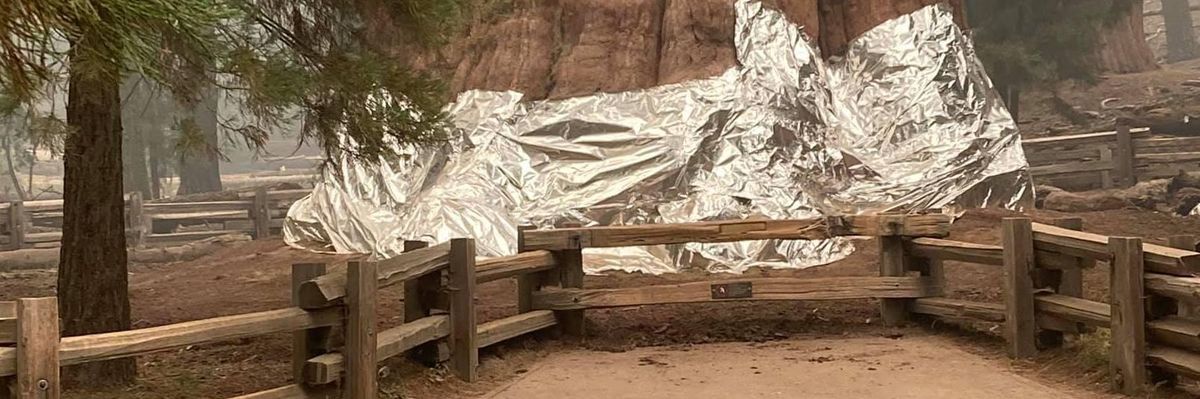
An image shared Thursday by Sequoia and Kings Canyon National Parks shows the General Sherman sequoia, the world's largest tree by volume, with its base wrapped with protective foil as the KNP Complex fire edges closer.
A grove of ancient trees in Sequoia National Park remained Friday in the path of a California wildfire that has already triggered evacuations and other protective efforts including wrapping some of the iconic trees--including the planet's biggest--in protective foil covering.
The immediate threat is the KNP Complex fire. Spanning 9,365 acres, the complex includes the Paradise Fire and the Colony Fire, both sparked by lightning last week.
A Thursday update from the National Park Service indicated that crews were "removing fuel and applying structure wrap on some of the iconic monarch sequoias that characterize the most famous area of Sequoia National Park," adding that "the fire continues to grow in all directions."
Among the giant sequoias covered with the heat-resistant foil is the General Sherman Tree, believed to be at least 2,200 years old, which stands in the park's Giant Forest. It's the largest tree on the planet by volume, standing 275 feet tall with a base measuring over 36 feet.
Sequoias can live for thousands of years and are adapted to repeated fires, with their cones releasing seeds under the dried-out conditions and thriving under ash-covered soil. "But the extraordinary intensity of fires--fueled by climate change--can overwhelm the trees," the Associated Press reported.
The potential for such losses on a planet besieged by the climate crisis was realized last year when the Castle Fire struck the Sierra Nevada. As many as 10,600 large sequoias--10% to 14% of those in the tree's natural range--were killed.
"These trees have been here 1,500 years, so how many fires have they withstood: 80?" Scott Stephens, a fire scientist at UC Berkeley, told NPR as he surveyed the tree damage from the Castle Fire. "And then one fire comes in 2020 and suddenly they're gone."
According to Rep. Mike Levin (D-Calif.), the flames threatening the ancient trees this week should serve as a clear call-to-action on the climate emergency.
"If we don't address the climate crisis with urgency, we risk losing irreplaceable treasures like the famous California Giant sequoias," he tweeted Thursday. "We can't wait any longer to #ActOnClimate."
Dear Common Dreams reader, It’s been nearly 30 years since I co-founded Common Dreams with my late wife, Lina Newhouser. We had the radical notion that journalism should serve the public good, not corporate profits. It was clear to us from the outset what it would take to build such a project. No paid advertisements. No corporate sponsors. No millionaire publisher telling us what to think or do. Many people said we wouldn't last a year, but we proved those doubters wrong. Together with a tremendous team of journalists and dedicated staff, we built an independent media outlet free from the constraints of profits and corporate control. Our mission has always been simple: To inform. To inspire. To ignite change for the common good. Building Common Dreams was not easy. Our survival was never guaranteed. When you take on the most powerful forces—Wall Street greed, fossil fuel industry destruction, Big Tech lobbyists, and uber-rich oligarchs who have spent billions upon billions rigging the economy and democracy in their favor—the only bulwark you have is supporters who believe in your work. But here’s the urgent message from me today. It's never been this bad out there. And it's never been this hard to keep us going. At the very moment Common Dreams is most needed, the threats we face are intensifying. We need your support now more than ever. We don't accept corporate advertising and never will. We don't have a paywall because we don't think people should be blocked from critical news based on their ability to pay. Everything we do is funded by the donations of readers like you. When everyone does the little they can afford, we are strong. But if that support retreats or dries up, so do we. Will you donate now to make sure Common Dreams not only survives but thrives? —Craig Brown, Co-founder |
A grove of ancient trees in Sequoia National Park remained Friday in the path of a California wildfire that has already triggered evacuations and other protective efforts including wrapping some of the iconic trees--including the planet's biggest--in protective foil covering.
The immediate threat is the KNP Complex fire. Spanning 9,365 acres, the complex includes the Paradise Fire and the Colony Fire, both sparked by lightning last week.
A Thursday update from the National Park Service indicated that crews were "removing fuel and applying structure wrap on some of the iconic monarch sequoias that characterize the most famous area of Sequoia National Park," adding that "the fire continues to grow in all directions."
Among the giant sequoias covered with the heat-resistant foil is the General Sherman Tree, believed to be at least 2,200 years old, which stands in the park's Giant Forest. It's the largest tree on the planet by volume, standing 275 feet tall with a base measuring over 36 feet.
Sequoias can live for thousands of years and are adapted to repeated fires, with their cones releasing seeds under the dried-out conditions and thriving under ash-covered soil. "But the extraordinary intensity of fires--fueled by climate change--can overwhelm the trees," the Associated Press reported.
The potential for such losses on a planet besieged by the climate crisis was realized last year when the Castle Fire struck the Sierra Nevada. As many as 10,600 large sequoias--10% to 14% of those in the tree's natural range--were killed.
"These trees have been here 1,500 years, so how many fires have they withstood: 80?" Scott Stephens, a fire scientist at UC Berkeley, told NPR as he surveyed the tree damage from the Castle Fire. "And then one fire comes in 2020 and suddenly they're gone."
According to Rep. Mike Levin (D-Calif.), the flames threatening the ancient trees this week should serve as a clear call-to-action on the climate emergency.
"If we don't address the climate crisis with urgency, we risk losing irreplaceable treasures like the famous California Giant sequoias," he tweeted Thursday. "We can't wait any longer to #ActOnClimate."
A grove of ancient trees in Sequoia National Park remained Friday in the path of a California wildfire that has already triggered evacuations and other protective efforts including wrapping some of the iconic trees--including the planet's biggest--in protective foil covering.
The immediate threat is the KNP Complex fire. Spanning 9,365 acres, the complex includes the Paradise Fire and the Colony Fire, both sparked by lightning last week.
A Thursday update from the National Park Service indicated that crews were "removing fuel and applying structure wrap on some of the iconic monarch sequoias that characterize the most famous area of Sequoia National Park," adding that "the fire continues to grow in all directions."
Among the giant sequoias covered with the heat-resistant foil is the General Sherman Tree, believed to be at least 2,200 years old, which stands in the park's Giant Forest. It's the largest tree on the planet by volume, standing 275 feet tall with a base measuring over 36 feet.
Sequoias can live for thousands of years and are adapted to repeated fires, with their cones releasing seeds under the dried-out conditions and thriving under ash-covered soil. "But the extraordinary intensity of fires--fueled by climate change--can overwhelm the trees," the Associated Press reported.
The potential for such losses on a planet besieged by the climate crisis was realized last year when the Castle Fire struck the Sierra Nevada. As many as 10,600 large sequoias--10% to 14% of those in the tree's natural range--were killed.
"These trees have been here 1,500 years, so how many fires have they withstood: 80?" Scott Stephens, a fire scientist at UC Berkeley, told NPR as he surveyed the tree damage from the Castle Fire. "And then one fire comes in 2020 and suddenly they're gone."
According to Rep. Mike Levin (D-Calif.), the flames threatening the ancient trees this week should serve as a clear call-to-action on the climate emergency.
"If we don't address the climate crisis with urgency, we risk losing irreplaceable treasures like the famous California Giant sequoias," he tweeted Thursday. "We can't wait any longer to #ActOnClimate."