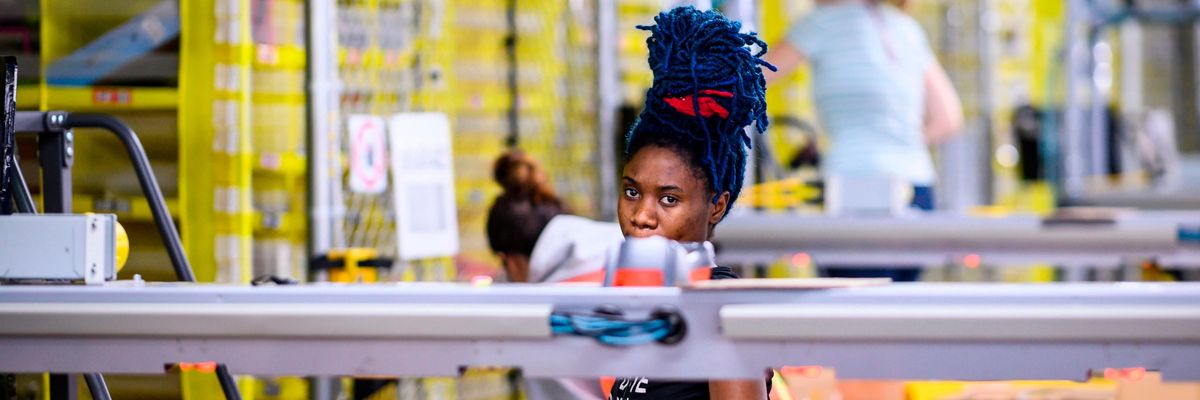
A woman works at a distribution station at the 855,000-square-foot Amazon fulfillment center in Staten Island on February 5, 2019. (Photo: Johannes Eisele/AFP via Getty Images)
'Historic Victory': California Passes Bill to Improve Conditions for Amazon Workers
Assembly Bill 701 would bar companies from using quotas that impede workers' health and safety.
Sep 10, 2021
Labor rights experts and workers praised the passage of a first-of-its-kind bill in California aimed at empowering warehouse employees at Amazon and other companies that use algorithms to enforce quotas--often pushing them to skip breaks and work unsafely in order to "make rate."
The state Senate's passage of Assembly Bill 701--which was expected to pass in the state Assembly on Friday, three months after the chamber approved its own version of the legislation--would require companies to disclose to the government and to their employees the quotas that are used to track productivity, prohibit penalties for "time off-task," and bar companies from retaliating against workers who complain about the metrics used.
"A.B. 701 is how we start winning our power and safety back."
--Athena

Workers would also be empowered to sue companies that continue to use quotas if they keep employees from taking bathroom breaks and following safety guidelines, as has been widely reported at Amazon's fulfillment centers in the U.S. and abroad.
As the workers' rights platform Organise reported in a survey (pdf) taken in 2018, 74% of Amazon warehouse workers avoided taking bathroom breaks for fear of not meeting quotas for packing merchandise, and more than half of the workers said they had suffered from depression since working for the e-commerce giant.
As Common Dreams reported in June, data Amazon provided to the federal Occupational Safety and Health Administration (OSHA) showed that Amazon employees sustain injuries more often than workers at other warehouses. Serious injuries were reported about 80% more often among Amazon workers than other employees.
Journalist James Bloodworth reported after going undercover as an Amazon warehouse employee that his coworkers frequently urinated in plastic bottles to avoid taking the time to go to the restroom--a practice that's also been reported among the company's delivery drivers, as the company was forced to admit earlier this year.
One former Amazon employee who is now an organizer with the Warehouse Worker Resource Center, Yesenia Barrera, told The Guardian that she only learned she was being surveilled at work when she injured herself and her manager saw through the scanner she was using that she went "off-task" due to the injury.
"It is really stressful and physically demanding to keep up," Barrera told the outlet. "They never tell us how much we are doing, you are never really sure how well you are doing--we are just told to keep going."
California Assemblywoman Lorena Gonzalez told the New York Times last week that in writing the legislation, she aimed to take on "this increased use of quotas and discipline based on not meeting the quotas, without a human factor in dealing with a reason why a worker might not make a quota."
Athena, the nationwide grassroots coalition of advocacy groups fighting Amazon's labor practices, hailed the passage of A.B. 701 as an "historic victory."
Dr. Beth Gutelius, research director at the Center for Urban Economic Development at the University of Illinois Chicago, told the Times that it is "unprecedented for a bill to intervene like this in the ways that technology is used in the workplace."
Republican lawmakers in California who opposed the legislation have claimed companies like Amazon--which reported a net income of $21.3 billion in 2020, up $10 billion from the year before, and a revenue of more than $386 billion--will be forced to raise prices due to the cost of complying with the new legislation, if Gov. Gavin Newsom signs the bill into law.
"It was on the backs of those workers that Amazon's profits were supercharged during Covid and Jeff Bezos got richer by $70 billion," said Athena. "That's 2.4 MILLION times what the median Amazon worker makes."
"A.B. 701 is how we start winning our power and safety back," the coalition added.
An Urgent Message From Our Co-Founder
Dear Common Dreams reader, It’s been nearly 30 years since I co-founded Common Dreams with my late wife, Lina Newhouser. We had the radical notion that journalism should serve the public good, not corporate profits. It was clear to us from the outset what it would take to build such a project. No paid advertisements. No corporate sponsors. No millionaire publisher telling us what to think or do. Many people said we wouldn't last a year, but we proved those doubters wrong. Together with a tremendous team of journalists and dedicated staff, we built an independent media outlet free from the constraints of profits and corporate control. Our mission has always been simple: To inform. To inspire. To ignite change for the common good. Building Common Dreams was not easy. Our survival was never guaranteed. When you take on the most powerful forces—Wall Street greed, fossil fuel industry destruction, Big Tech lobbyists, and uber-rich oligarchs who have spent billions upon billions rigging the economy and democracy in their favor—the only bulwark you have is supporters who believe in your work. But here’s the urgent message from me today. It's never been this bad out there. And it's never been this hard to keep us going. At the very moment Common Dreams is most needed, the threats we face are intensifying. We need your support now more than ever. We don't accept corporate advertising and never will. We don't have a paywall because we don't think people should be blocked from critical news based on their ability to pay. Everything we do is funded by the donations of readers like you. When everyone does the little they can afford, we are strong. But if that support retreats or dries up, so do we. Will you donate now to make sure Common Dreams not only survives but thrives? —Craig Brown, Co-founder |
Our work is licensed under Creative Commons (CC BY-NC-ND 3.0). Feel free to republish and share widely.
Labor rights experts and workers praised the passage of a first-of-its-kind bill in California aimed at empowering warehouse employees at Amazon and other companies that use algorithms to enforce quotas--often pushing them to skip breaks and work unsafely in order to "make rate."
The state Senate's passage of Assembly Bill 701--which was expected to pass in the state Assembly on Friday, three months after the chamber approved its own version of the legislation--would require companies to disclose to the government and to their employees the quotas that are used to track productivity, prohibit penalties for "time off-task," and bar companies from retaliating against workers who complain about the metrics used.
"A.B. 701 is how we start winning our power and safety back."
--Athena

Workers would also be empowered to sue companies that continue to use quotas if they keep employees from taking bathroom breaks and following safety guidelines, as has been widely reported at Amazon's fulfillment centers in the U.S. and abroad.
As the workers' rights platform Organise reported in a survey (pdf) taken in 2018, 74% of Amazon warehouse workers avoided taking bathroom breaks for fear of not meeting quotas for packing merchandise, and more than half of the workers said they had suffered from depression since working for the e-commerce giant.
As Common Dreams reported in June, data Amazon provided to the federal Occupational Safety and Health Administration (OSHA) showed that Amazon employees sustain injuries more often than workers at other warehouses. Serious injuries were reported about 80% more often among Amazon workers than other employees.
Journalist James Bloodworth reported after going undercover as an Amazon warehouse employee that his coworkers frequently urinated in plastic bottles to avoid taking the time to go to the restroom--a practice that's also been reported among the company's delivery drivers, as the company was forced to admit earlier this year.
One former Amazon employee who is now an organizer with the Warehouse Worker Resource Center, Yesenia Barrera, told The Guardian that she only learned she was being surveilled at work when she injured herself and her manager saw through the scanner she was using that she went "off-task" due to the injury.
"It is really stressful and physically demanding to keep up," Barrera told the outlet. "They never tell us how much we are doing, you are never really sure how well you are doing--we are just told to keep going."
California Assemblywoman Lorena Gonzalez told the New York Times last week that in writing the legislation, she aimed to take on "this increased use of quotas and discipline based on not meeting the quotas, without a human factor in dealing with a reason why a worker might not make a quota."
Athena, the nationwide grassroots coalition of advocacy groups fighting Amazon's labor practices, hailed the passage of A.B. 701 as an "historic victory."
Dr. Beth Gutelius, research director at the Center for Urban Economic Development at the University of Illinois Chicago, told the Times that it is "unprecedented for a bill to intervene like this in the ways that technology is used in the workplace."
Republican lawmakers in California who opposed the legislation have claimed companies like Amazon--which reported a net income of $21.3 billion in 2020, up $10 billion from the year before, and a revenue of more than $386 billion--will be forced to raise prices due to the cost of complying with the new legislation, if Gov. Gavin Newsom signs the bill into law.
"It was on the backs of those workers that Amazon's profits were supercharged during Covid and Jeff Bezos got richer by $70 billion," said Athena. "That's 2.4 MILLION times what the median Amazon worker makes."
"A.B. 701 is how we start winning our power and safety back," the coalition added.
Labor rights experts and workers praised the passage of a first-of-its-kind bill in California aimed at empowering warehouse employees at Amazon and other companies that use algorithms to enforce quotas--often pushing them to skip breaks and work unsafely in order to "make rate."
The state Senate's passage of Assembly Bill 701--which was expected to pass in the state Assembly on Friday, three months after the chamber approved its own version of the legislation--would require companies to disclose to the government and to their employees the quotas that are used to track productivity, prohibit penalties for "time off-task," and bar companies from retaliating against workers who complain about the metrics used.
"A.B. 701 is how we start winning our power and safety back."
--Athena
Workers would also be empowered to sue companies that continue to use quotas if they keep employees from taking bathroom breaks and following safety guidelines, as has been widely reported at Amazon's fulfillment centers in the U.S. and abroad.
As the workers' rights platform Organise reported in a survey (pdf) taken in 2018, 74% of Amazon warehouse workers avoided taking bathroom breaks for fear of not meeting quotas for packing merchandise, and more than half of the workers said they had suffered from depression since working for the e-commerce giant.
As Common Dreams reported in June, data Amazon provided to the federal Occupational Safety and Health Administration (OSHA) showed that Amazon employees sustain injuries more often than workers at other warehouses. Serious injuries were reported about 80% more often among Amazon workers than other employees.
Journalist James Bloodworth reported after going undercover as an Amazon warehouse employee that his coworkers frequently urinated in plastic bottles to avoid taking the time to go to the restroom--a practice that's also been reported among the company's delivery drivers, as the company was forced to admit earlier this year.
One former Amazon employee who is now an organizer with the Warehouse Worker Resource Center, Yesenia Barrera, told The Guardian that she only learned she was being surveilled at work when she injured herself and her manager saw through the scanner she was using that she went "off-task" due to the injury.
"It is really stressful and physically demanding to keep up," Barrera told the outlet. "They never tell us how much we are doing, you are never really sure how well you are doing--we are just told to keep going."
California Assemblywoman Lorena Gonzalez told the New York Times last week that in writing the legislation, she aimed to take on "this increased use of quotas and discipline based on not meeting the quotas, without a human factor in dealing with a reason why a worker might not make a quota."
Athena, the nationwide grassroots coalition of advocacy groups fighting Amazon's labor practices, hailed the passage of A.B. 701 as an "historic victory."
Dr. Beth Gutelius, research director at the Center for Urban Economic Development at the University of Illinois Chicago, told the Times that it is "unprecedented for a bill to intervene like this in the ways that technology is used in the workplace."
Republican lawmakers in California who opposed the legislation have claimed companies like Amazon--which reported a net income of $21.3 billion in 2020, up $10 billion from the year before, and a revenue of more than $386 billion--will be forced to raise prices due to the cost of complying with the new legislation, if Gov. Gavin Newsom signs the bill into law.
"It was on the backs of those workers that Amazon's profits were supercharged during Covid and Jeff Bezos got richer by $70 billion," said Athena. "That's 2.4 MILLION times what the median Amazon worker makes."
"A.B. 701 is how we start winning our power and safety back," the coalition added.
We've had enough. The 1% own and operate the corporate media. They are doing everything they can to defend the status quo, squash dissent and protect the wealthy and the powerful. The Common Dreams media model is different. We cover the news that matters to the 99%. Our mission? To inform. To inspire. To ignite change for the common good. How? Nonprofit. Independent. Reader-supported. Free to read. Free to republish. Free to share. With no advertising. No paywalls. No selling of your data. Thousands of small donations fund our newsroom and allow us to continue publishing. Can you chip in? We can't do it without you. Thank you.