SUBSCRIBE TO OUR FREE NEWSLETTER
Daily news & progressive opinion—funded by the people, not the corporations—delivered straight to your inbox.
5
#000000
#FFFFFF
To donate by check, phone, or other method, see our More Ways to Give page.
Daily news & progressive opinion—funded by the people, not the corporations—delivered straight to your inbox.
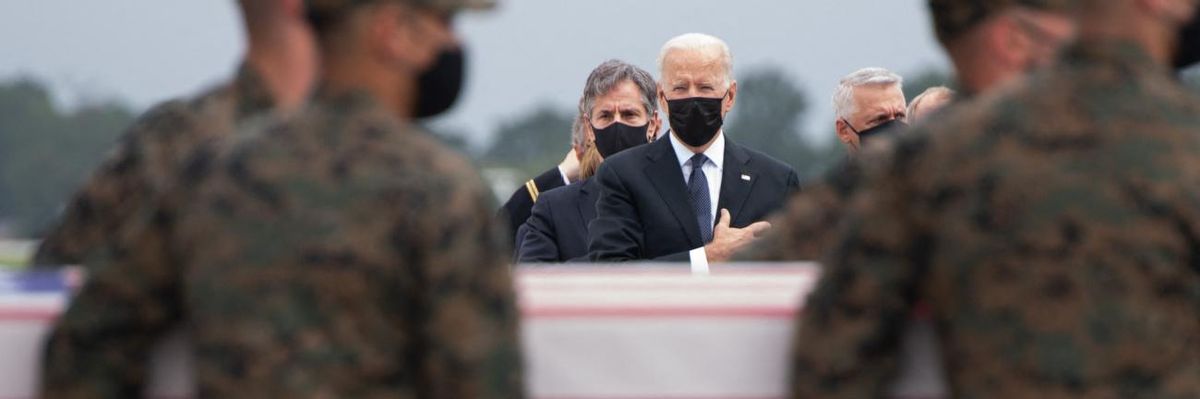
U.S. President Joe Biden attends the dignified transfer of the remains of fallen service members at Dover Air Force Base in Dover, Delaware, August, 29, 2021. (Photo: Saul Loeb/AFP via Getty Images)
Anti-war advocates on Tuesday credited President Joe Biden with finally ending the U.S. war in Afghanistan, even as many expressed surprise that it was ultimately the former chairman of the Senate Foreign Relations Committee, a lifelong proponent of U.S. military intervention, to end the 20-year quagmire.
The then-senator backed the U.S. invasion of Afghanistan in 2001 and voted for the authorization to start the Iraq War in 2003. In the years prior to the U.S. attack on Iraq, Biden claimed that "taking Saddam down"--not diplomacy--was the only way to ensure there were no weapons of mass destruction in the country.
"It takes more courage in Washington to end a war than to start one."
--Trita Parsi, Quincy Institute
But two decades later, wrote MSNBC host Mehdi Hasan in a commentary Monday night after the last U.S. soldiers left Kabul, Biden successfully "stood up to the generals," Beltway pundits, and Republicans who urged him to stay.
While Senate Minority Leader Mitch McConnell (R-Ky.) called the withdrawal "one of the worst foreign policy decisions in American history" on Sunday after ISIS-K claimed responsibility for a bombing near Kabul's airport, Hasan wrote, "President Joe Biden didn't lose this war."
"It was lost in October 2001, when President George W. Bush refused to accept the Taliban's offer to hand over Osama bin Laden to a neutral third country, and in December 2001, when then-Defense Secretary Donald Rumsfeld refused to accept Taliban surrender terms," Hasan added. "He may have been wrong about Iraq in 2003, but Biden is right about Afghanistan in 2021."
Biden reportedly showed impatience with the continued war in Afghanistan while serving as vice president from 2008 to 2016, telling President Barack Obama not to let U.S. military leaders "jam" him, as Hasan wrote.
Defense Secretary Lloyd Austin and Joint Chiefs of Staff Chairman Mark Milley, both reportedly urged the president to maintain a military presence of 2,500 troops in Afghanistan, but Biden refused to further delay the end of the war.
"No one wants to say that we should be in Afghanistan forever, but they insist now is not the right moment to leave," Biden said in April amid pressure from the generals. "So when will it be the right moment to leave? One more year? Two more years? Ten more years?"
Biden's actions in the last two weeks, as critics in Washington and the press fiercely attacked him over the Taliban's rapid takeover of Afghanistan following the beginning of the U.S. withdrawal, prove "it takes more courage in Washington to end a war than to start one," Trita Parsi of the Quincy Institute tweeted on Monday.
The president remained resolute as the political press criticized him over the process of evacuating Americans and vulnerable Afghans and the disturbing images of the Taliban's takeover.
"It was time to end a 20-year war," Biden told reporters last week.
The president deserves credit for "getting out despite the chorus of Washington establishment howls lamenting the war's end," tweeted Ben Friedman, policy director for Defense Priorities.
While condemning the decision by Biden and U.S. Secretary of State Antony Blinken to close the U.S. embassy in Afghanistan and calling for the administration to strive for diplomacy, CODEPINK co-founder Medea Benjamin said late Monday, the "U.S. military is FINALLY out of Afghanistan. And that is good."
In a statement last week, CODEPINK said that if Biden had re-escalated the war instead of sticking to a complete withdrawal, "an even greater number of U.S. and Afghan people would have likely been killed in the ongoing conflict and stalemate that has been America's longest war."
"While we hold in our hearts all those who lost loved ones over the past 20 years," the group said, "we remain grateful that America's longest war has finally ended."
Dear Common Dreams reader, It’s been nearly 30 years since I co-founded Common Dreams with my late wife, Lina Newhouser. We had the radical notion that journalism should serve the public good, not corporate profits. It was clear to us from the outset what it would take to build such a project. No paid advertisements. No corporate sponsors. No millionaire publisher telling us what to think or do. Many people said we wouldn't last a year, but we proved those doubters wrong. Together with a tremendous team of journalists and dedicated staff, we built an independent media outlet free from the constraints of profits and corporate control. Our mission has always been simple: To inform. To inspire. To ignite change for the common good. Building Common Dreams was not easy. Our survival was never guaranteed. When you take on the most powerful forces—Wall Street greed, fossil fuel industry destruction, Big Tech lobbyists, and uber-rich oligarchs who have spent billions upon billions rigging the economy and democracy in their favor—the only bulwark you have is supporters who believe in your work. But here’s the urgent message from me today. It's never been this bad out there. And it's never been this hard to keep us going. At the very moment Common Dreams is most needed, the threats we face are intensifying. We need your support now more than ever. We don't accept corporate advertising and never will. We don't have a paywall because we don't think people should be blocked from critical news based on their ability to pay. Everything we do is funded by the donations of readers like you. When everyone does the little they can afford, we are strong. But if that support retreats or dries up, so do we. Will you donate now to make sure Common Dreams not only survives but thrives? —Craig Brown, Co-founder |
Anti-war advocates on Tuesday credited President Joe Biden with finally ending the U.S. war in Afghanistan, even as many expressed surprise that it was ultimately the former chairman of the Senate Foreign Relations Committee, a lifelong proponent of U.S. military intervention, to end the 20-year quagmire.
The then-senator backed the U.S. invasion of Afghanistan in 2001 and voted for the authorization to start the Iraq War in 2003. In the years prior to the U.S. attack on Iraq, Biden claimed that "taking Saddam down"--not diplomacy--was the only way to ensure there were no weapons of mass destruction in the country.
"It takes more courage in Washington to end a war than to start one."
--Trita Parsi, Quincy Institute
But two decades later, wrote MSNBC host Mehdi Hasan in a commentary Monday night after the last U.S. soldiers left Kabul, Biden successfully "stood up to the generals," Beltway pundits, and Republicans who urged him to stay.
While Senate Minority Leader Mitch McConnell (R-Ky.) called the withdrawal "one of the worst foreign policy decisions in American history" on Sunday after ISIS-K claimed responsibility for a bombing near Kabul's airport, Hasan wrote, "President Joe Biden didn't lose this war."
"It was lost in October 2001, when President George W. Bush refused to accept the Taliban's offer to hand over Osama bin Laden to a neutral third country, and in December 2001, when then-Defense Secretary Donald Rumsfeld refused to accept Taliban surrender terms," Hasan added. "He may have been wrong about Iraq in 2003, but Biden is right about Afghanistan in 2021."
Biden reportedly showed impatience with the continued war in Afghanistan while serving as vice president from 2008 to 2016, telling President Barack Obama not to let U.S. military leaders "jam" him, as Hasan wrote.
Defense Secretary Lloyd Austin and Joint Chiefs of Staff Chairman Mark Milley, both reportedly urged the president to maintain a military presence of 2,500 troops in Afghanistan, but Biden refused to further delay the end of the war.
"No one wants to say that we should be in Afghanistan forever, but they insist now is not the right moment to leave," Biden said in April amid pressure from the generals. "So when will it be the right moment to leave? One more year? Two more years? Ten more years?"
Biden's actions in the last two weeks, as critics in Washington and the press fiercely attacked him over the Taliban's rapid takeover of Afghanistan following the beginning of the U.S. withdrawal, prove "it takes more courage in Washington to end a war than to start one," Trita Parsi of the Quincy Institute tweeted on Monday.
The president remained resolute as the political press criticized him over the process of evacuating Americans and vulnerable Afghans and the disturbing images of the Taliban's takeover.
"It was time to end a 20-year war," Biden told reporters last week.
The president deserves credit for "getting out despite the chorus of Washington establishment howls lamenting the war's end," tweeted Ben Friedman, policy director for Defense Priorities.
While condemning the decision by Biden and U.S. Secretary of State Antony Blinken to close the U.S. embassy in Afghanistan and calling for the administration to strive for diplomacy, CODEPINK co-founder Medea Benjamin said late Monday, the "U.S. military is FINALLY out of Afghanistan. And that is good."
In a statement last week, CODEPINK said that if Biden had re-escalated the war instead of sticking to a complete withdrawal, "an even greater number of U.S. and Afghan people would have likely been killed in the ongoing conflict and stalemate that has been America's longest war."
"While we hold in our hearts all those who lost loved ones over the past 20 years," the group said, "we remain grateful that America's longest war has finally ended."
Anti-war advocates on Tuesday credited President Joe Biden with finally ending the U.S. war in Afghanistan, even as many expressed surprise that it was ultimately the former chairman of the Senate Foreign Relations Committee, a lifelong proponent of U.S. military intervention, to end the 20-year quagmire.
The then-senator backed the U.S. invasion of Afghanistan in 2001 and voted for the authorization to start the Iraq War in 2003. In the years prior to the U.S. attack on Iraq, Biden claimed that "taking Saddam down"--not diplomacy--was the only way to ensure there were no weapons of mass destruction in the country.
"It takes more courage in Washington to end a war than to start one."
--Trita Parsi, Quincy Institute
But two decades later, wrote MSNBC host Mehdi Hasan in a commentary Monday night after the last U.S. soldiers left Kabul, Biden successfully "stood up to the generals," Beltway pundits, and Republicans who urged him to stay.
While Senate Minority Leader Mitch McConnell (R-Ky.) called the withdrawal "one of the worst foreign policy decisions in American history" on Sunday after ISIS-K claimed responsibility for a bombing near Kabul's airport, Hasan wrote, "President Joe Biden didn't lose this war."
"It was lost in October 2001, when President George W. Bush refused to accept the Taliban's offer to hand over Osama bin Laden to a neutral third country, and in December 2001, when then-Defense Secretary Donald Rumsfeld refused to accept Taliban surrender terms," Hasan added. "He may have been wrong about Iraq in 2003, but Biden is right about Afghanistan in 2021."
Biden reportedly showed impatience with the continued war in Afghanistan while serving as vice president from 2008 to 2016, telling President Barack Obama not to let U.S. military leaders "jam" him, as Hasan wrote.
Defense Secretary Lloyd Austin and Joint Chiefs of Staff Chairman Mark Milley, both reportedly urged the president to maintain a military presence of 2,500 troops in Afghanistan, but Biden refused to further delay the end of the war.
"No one wants to say that we should be in Afghanistan forever, but they insist now is not the right moment to leave," Biden said in April amid pressure from the generals. "So when will it be the right moment to leave? One more year? Two more years? Ten more years?"
Biden's actions in the last two weeks, as critics in Washington and the press fiercely attacked him over the Taliban's rapid takeover of Afghanistan following the beginning of the U.S. withdrawal, prove "it takes more courage in Washington to end a war than to start one," Trita Parsi of the Quincy Institute tweeted on Monday.
The president remained resolute as the political press criticized him over the process of evacuating Americans and vulnerable Afghans and the disturbing images of the Taliban's takeover.
"It was time to end a 20-year war," Biden told reporters last week.
The president deserves credit for "getting out despite the chorus of Washington establishment howls lamenting the war's end," tweeted Ben Friedman, policy director for Defense Priorities.
While condemning the decision by Biden and U.S. Secretary of State Antony Blinken to close the U.S. embassy in Afghanistan and calling for the administration to strive for diplomacy, CODEPINK co-founder Medea Benjamin said late Monday, the "U.S. military is FINALLY out of Afghanistan. And that is good."
In a statement last week, CODEPINK said that if Biden had re-escalated the war instead of sticking to a complete withdrawal, "an even greater number of U.S. and Afghan people would have likely been killed in the ongoing conflict and stalemate that has been America's longest war."
"While we hold in our hearts all those who lost loved ones over the past 20 years," the group said, "we remain grateful that America's longest war has finally ended."