SUBSCRIBE TO OUR FREE NEWSLETTER
Daily news & progressive opinion—funded by the people, not the corporations—delivered straight to your inbox.
5
#000000
#FFFFFF
To donate by check, phone, or other method, see our More Ways to Give page.
Daily news & progressive opinion—funded by the people, not the corporations—delivered straight to your inbox.
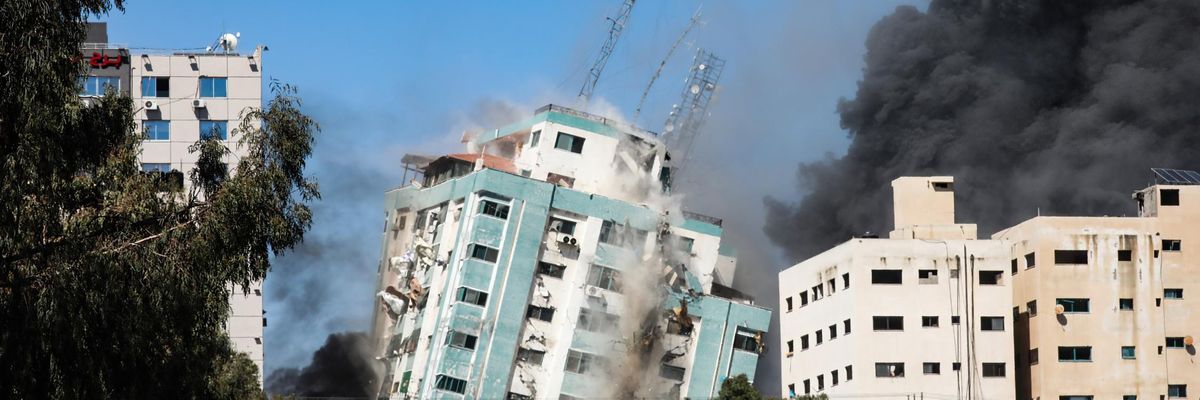
An Israeli airstrike destroys a high-rise building in Gaza City that housed several media outlets, including the Associated Press and Al-Jazeera. (Photo: Nidal Alwaheidi/SOPA Images/LightRocket via Getty Images)
Human Rights Watch said Monday that the Israeli military's May bombings that leveled four high-rise buildings in Gaza were "apparently unlawful" and possibly amount to war crimes.
The organization--which noted that those strikes represented "just a small fraction of the Israeli military's attacks in Gaza" in the May 10 to May 21 fighting--cited in its new analysis a lack of any evidence to back up Israeli authorities' claims that the buildings were being used by Hamas for military purposes The report also noted the disproportionate harm to civilian property caused by the Israeli attacks.
For its latest analysis of attacks during the 11-day assault, HRW reviewed video and photo evidence of the aftermath of the bombardments and conducted interviews with victims and eyewitnesses.
"The apparently unlawful Israeli strikes on four high-rise towers in Gaza City caused serious, lasting harm for countless Palestinians who lived, worked, shopped, or benefitted from businesses based there," said Richard Weir, crisis and conflict researcher at Human Rights Watch, in a statement.
"The Israeli military should publicly produce the evidence that it says it relied on to carry out these attacks," he said.
At issue are strikes on the Hanadi, al-Jawhara, al-Shorouk, and al-Jalaa towers. The latter housed offices of media outlets including Al Jazeera English and the Associated Press.
The four towers also included residences and numerous businesses including doctors' offices.
While no deaths were reported for the attacks on the four towers, unlike other Israeli military strikes in May, the destruction appeared "consistent with the use of munitions with large high-explosive warheads," said HRW. "These explosive weapons produced wide-area effects, resulting in tpresche complete destruction or serious damage to each of the towers and damage to surrounding areas, including to homes, businesses, and infrastructure."
In addition to displacing thousands, the attacks "destroyed civilian property worth millions of U.S. dollars," the human rights group said.
Forty-five-year old computer engineer Nihad Abdellatif Taha, who had a programming and digital marketing company, Portals, described the devasation to HRW.
"I had 36 employees and we were renting two apartments--360 square meters with furniture, offices, meeting rooms, surveillance cameras--all of this is gone," he said. "In addition to very important documents, all the company's papers are gone, including stamps and the employees' contracts--all gone."
The new analysis also pushes back on the Israeli military's contention that Hamas used parts of any of the buildings for "military research and development" or "military intelligence" purposes.
"Human Rights Watch found no evidence that members of Palestinian groups involved in military operations had a current or long-term presence in any of the towers at the time they were attacked," the group said. What's more, "even if there were such a presence, the attacks appeared to cause foreseeably disproportionate harm to civilian property."
Weir, in his statement, said reconstruction for Palestinians requires not just ending Israel's repeated--and ongoing--attacks on Gaza but termination of the blockade.
"Throughout the May hostilities, unlawful Israeli strikes not only killed many civilians, but also destroyed high-rise towers, wiping out scores of businesses and homes, upending the lives of thousands of Palestinians," Weir said.
"Donor funding alone will not rebuild Gaza," he said. "The crushing closure of the Gaza Strip needs to end, along with the impunity that fuels ongoing serious abuses."
Israel's May attacks on Gaza has also come under the scrutiny of United Nations High Commissioner for Human Rights Michelle Bachelet, who said that they "may constitute war crimes."
"Despite Israel's claims that many of these buildings were hosting armed groups or being used for military purposes," she said in May, "we have not seen evidence in this regard."
Dear Common Dreams reader, It’s been nearly 30 years since I co-founded Common Dreams with my late wife, Lina Newhouser. We had the radical notion that journalism should serve the public good, not corporate profits. It was clear to us from the outset what it would take to build such a project. No paid advertisements. No corporate sponsors. No millionaire publisher telling us what to think or do. Many people said we wouldn't last a year, but we proved those doubters wrong. Together with a tremendous team of journalists and dedicated staff, we built an independent media outlet free from the constraints of profits and corporate control. Our mission has always been simple: To inform. To inspire. To ignite change for the common good. Building Common Dreams was not easy. Our survival was never guaranteed. When you take on the most powerful forces—Wall Street greed, fossil fuel industry destruction, Big Tech lobbyists, and uber-rich oligarchs who have spent billions upon billions rigging the economy and democracy in their favor—the only bulwark you have is supporters who believe in your work. But here’s the urgent message from me today. It's never been this bad out there. And it's never been this hard to keep us going. At the very moment Common Dreams is most needed, the threats we face are intensifying. We need your support now more than ever. We don't accept corporate advertising and never will. We don't have a paywall because we don't think people should be blocked from critical news based on their ability to pay. Everything we do is funded by the donations of readers like you. When everyone does the little they can afford, we are strong. But if that support retreats or dries up, so do we. Will you donate now to make sure Common Dreams not only survives but thrives? —Craig Brown, Co-founder |
Human Rights Watch said Monday that the Israeli military's May bombings that leveled four high-rise buildings in Gaza were "apparently unlawful" and possibly amount to war crimes.
The organization--which noted that those strikes represented "just a small fraction of the Israeli military's attacks in Gaza" in the May 10 to May 21 fighting--cited in its new analysis a lack of any evidence to back up Israeli authorities' claims that the buildings were being used by Hamas for military purposes The report also noted the disproportionate harm to civilian property caused by the Israeli attacks.
For its latest analysis of attacks during the 11-day assault, HRW reviewed video and photo evidence of the aftermath of the bombardments and conducted interviews with victims and eyewitnesses.
"The apparently unlawful Israeli strikes on four high-rise towers in Gaza City caused serious, lasting harm for countless Palestinians who lived, worked, shopped, or benefitted from businesses based there," said Richard Weir, crisis and conflict researcher at Human Rights Watch, in a statement.
"The Israeli military should publicly produce the evidence that it says it relied on to carry out these attacks," he said.
At issue are strikes on the Hanadi, al-Jawhara, al-Shorouk, and al-Jalaa towers. The latter housed offices of media outlets including Al Jazeera English and the Associated Press.
The four towers also included residences and numerous businesses including doctors' offices.
While no deaths were reported for the attacks on the four towers, unlike other Israeli military strikes in May, the destruction appeared "consistent with the use of munitions with large high-explosive warheads," said HRW. "These explosive weapons produced wide-area effects, resulting in tpresche complete destruction or serious damage to each of the towers and damage to surrounding areas, including to homes, businesses, and infrastructure."
In addition to displacing thousands, the attacks "destroyed civilian property worth millions of U.S. dollars," the human rights group said.
Forty-five-year old computer engineer Nihad Abdellatif Taha, who had a programming and digital marketing company, Portals, described the devasation to HRW.
"I had 36 employees and we were renting two apartments--360 square meters with furniture, offices, meeting rooms, surveillance cameras--all of this is gone," he said. "In addition to very important documents, all the company's papers are gone, including stamps and the employees' contracts--all gone."
The new analysis also pushes back on the Israeli military's contention that Hamas used parts of any of the buildings for "military research and development" or "military intelligence" purposes.
"Human Rights Watch found no evidence that members of Palestinian groups involved in military operations had a current or long-term presence in any of the towers at the time they were attacked," the group said. What's more, "even if there were such a presence, the attacks appeared to cause foreseeably disproportionate harm to civilian property."
Weir, in his statement, said reconstruction for Palestinians requires not just ending Israel's repeated--and ongoing--attacks on Gaza but termination of the blockade.
"Throughout the May hostilities, unlawful Israeli strikes not only killed many civilians, but also destroyed high-rise towers, wiping out scores of businesses and homes, upending the lives of thousands of Palestinians," Weir said.
"Donor funding alone will not rebuild Gaza," he said. "The crushing closure of the Gaza Strip needs to end, along with the impunity that fuels ongoing serious abuses."
Israel's May attacks on Gaza has also come under the scrutiny of United Nations High Commissioner for Human Rights Michelle Bachelet, who said that they "may constitute war crimes."
"Despite Israel's claims that many of these buildings were hosting armed groups or being used for military purposes," she said in May, "we have not seen evidence in this regard."
Human Rights Watch said Monday that the Israeli military's May bombings that leveled four high-rise buildings in Gaza were "apparently unlawful" and possibly amount to war crimes.
The organization--which noted that those strikes represented "just a small fraction of the Israeli military's attacks in Gaza" in the May 10 to May 21 fighting--cited in its new analysis a lack of any evidence to back up Israeli authorities' claims that the buildings were being used by Hamas for military purposes The report also noted the disproportionate harm to civilian property caused by the Israeli attacks.
For its latest analysis of attacks during the 11-day assault, HRW reviewed video and photo evidence of the aftermath of the bombardments and conducted interviews with victims and eyewitnesses.
"The apparently unlawful Israeli strikes on four high-rise towers in Gaza City caused serious, lasting harm for countless Palestinians who lived, worked, shopped, or benefitted from businesses based there," said Richard Weir, crisis and conflict researcher at Human Rights Watch, in a statement.
"The Israeli military should publicly produce the evidence that it says it relied on to carry out these attacks," he said.
At issue are strikes on the Hanadi, al-Jawhara, al-Shorouk, and al-Jalaa towers. The latter housed offices of media outlets including Al Jazeera English and the Associated Press.
The four towers also included residences and numerous businesses including doctors' offices.
While no deaths were reported for the attacks on the four towers, unlike other Israeli military strikes in May, the destruction appeared "consistent with the use of munitions with large high-explosive warheads," said HRW. "These explosive weapons produced wide-area effects, resulting in tpresche complete destruction or serious damage to each of the towers and damage to surrounding areas, including to homes, businesses, and infrastructure."
In addition to displacing thousands, the attacks "destroyed civilian property worth millions of U.S. dollars," the human rights group said.
Forty-five-year old computer engineer Nihad Abdellatif Taha, who had a programming and digital marketing company, Portals, described the devasation to HRW.
"I had 36 employees and we were renting two apartments--360 square meters with furniture, offices, meeting rooms, surveillance cameras--all of this is gone," he said. "In addition to very important documents, all the company's papers are gone, including stamps and the employees' contracts--all gone."
The new analysis also pushes back on the Israeli military's contention that Hamas used parts of any of the buildings for "military research and development" or "military intelligence" purposes.
"Human Rights Watch found no evidence that members of Palestinian groups involved in military operations had a current or long-term presence in any of the towers at the time they were attacked," the group said. What's more, "even if there were such a presence, the attacks appeared to cause foreseeably disproportionate harm to civilian property."
Weir, in his statement, said reconstruction for Palestinians requires not just ending Israel's repeated--and ongoing--attacks on Gaza but termination of the blockade.
"Throughout the May hostilities, unlawful Israeli strikes not only killed many civilians, but also destroyed high-rise towers, wiping out scores of businesses and homes, upending the lives of thousands of Palestinians," Weir said.
"Donor funding alone will not rebuild Gaza," he said. "The crushing closure of the Gaza Strip needs to end, along with the impunity that fuels ongoing serious abuses."
Israel's May attacks on Gaza has also come under the scrutiny of United Nations High Commissioner for Human Rights Michelle Bachelet, who said that they "may constitute war crimes."
"Despite Israel's claims that many of these buildings were hosting armed groups or being used for military purposes," she said in May, "we have not seen evidence in this regard."