SUBSCRIBE TO OUR FREE NEWSLETTER
Daily news & progressive opinion—funded by the people, not the corporations—delivered straight to your inbox.
5
#000000
#FFFFFF
To donate by check, phone, or other method, see our More Ways to Give page.
Daily news & progressive opinion—funded by the people, not the corporations—delivered straight to your inbox.
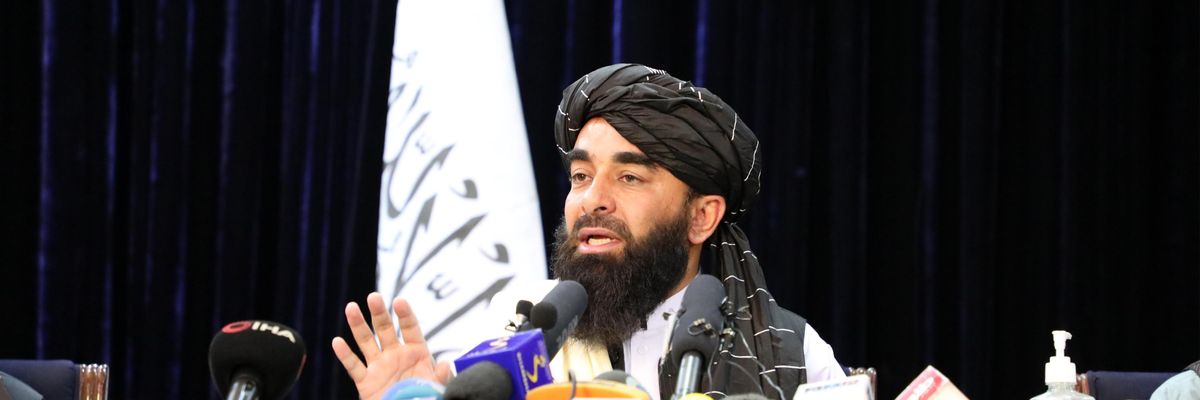
Taliban spokesperson Zabihullah Mujahid gestures as he speaks during the first press conference in Kabul on August 17, 2021. (Photo: Hoshang Hashimi/AFP via Getty Images)
During their first press conference since retaking control of Afghanistan, Taliban representatives on Tuesday vowed not to seek retribution against fellow Afghans who worked with U.S. occupation forces and said the new government will respect the rights of women--with the caveat that they must adhere to the group's interpretation of Sharia law.
"Whoever has worked in the military, in translation, we have given amnesty to everybody. There is no revenge," Taliban spokesperson Zabihullah Mujahid said from the capital of Kabul as the U.S. resumed evacuation flights for Americans and some Afghans who worked with U.S. forces, which have been in the country since the disastrous 2001 invasion.
"We have given amnesty to everybody," Mujahid added. "We want them to give us forgiveness."
Taliban officials are currently in talks to form a government following the swift collapse of the U.S.-backed regime headed by former President Ashraf Ghani, who fled the country as Taliban fighters advanced on Kabul over the weekend.
Mujahid said Tuesday that women "should be in [the] government structure according to Shariah law," adding that women are "a very important part of our society" and should be able to work and go to school.
If Afghan women "continue to live according to Sharia, we will be happy, they will be happy," said Mujahid.
Medea Benjamin, co-founder of the women-led anti-war group CodePink, noted that Mujahid qualified his expressions of support for women's rights as "within the framework of Sharia norms."
"There's the rub," Benjamin said. "How will that be interpreted?"
During the Taliban's previous stint in power between 1996 and 2001, Al Jazeera reported, "women could not work, girls were not allowed to attend school, and women had to cover their face and be accompanied by a male relative if they wanted to venture out of their homes."
"Women who broke the rules sometimes suffered humiliation and public beatings by the Taliban's religious police under the group's ultra-strict interpretation of Islamic law," Al Jazeera added.
Benjamin also responded skeptically to Mujahid vow of "no revenge" against Afghans who worked with the U.S. and the former government, while describing the comments as a positive signal.
"Taliban spokesperson is saying that all Afghans, even those who worked with the U.S. and fought the Taliban, have amnesty and will not be harmed," Benjamin tweeted. "Can we believe this? Not sure, especially as there are many rogue elements [of the Taliban]. But it is great he is saying this."
The press conference came as the U.S. military continued evacuation flights out of Kabul after they were briefly halted on Monday in an effort to clear the tarmac of people desperately attempting to flee Afghanistan, which has long been in a state of humanitarian crisis, with women and children disproportionately impacted.
According to Brown University's Costs of War project, 3.2 million Afghans have been internally displaced since 2001, the year the U.S. invaded the country. During the two decades-long war, more than 47,000 Afghan civilians were killed, the Costs of War project estimates.
The United Nations Children's Fund (UNICEF) said Tuesday that roughly 18 million people across Afghanistan are in urgent need of humanitarian assistance and around a third of the country's children are expected to be severely malnourished this year.
"Women and girls are paying the price of decades of failed U.S. policy," the global women's rights organization MADRE said in a statement Monday. "From the earliest days of the U.S. war in Afghanistan, women's rights justifications were conscripted to rally support. Instead, the U.S. trained and funded armed groups in Afghanistan that have committed atrocities, including terrible violence against women."
"In its efforts to defeat the Taliban, the U.S. allied itself with warlords, many of whom came to hold prominent government positions and continued to violate rights with impunity," the group added. "Ultimately, the U.S. spent almost 1,000 times more money on its military intervention than on women's rights efforts."
During a briefing on Tuesday, UNICEF's Mustapha Ben Messaoud said he is "quite optimistic" that humanitarian aid will continue to be distributed in Afghanistan, noting that "we have not [had] a single issue with the Taliban" at UNICEF field offices in the country.
Rupert Colville, a spokesperson for U.N. High Commissioner for Human Rights Michelle Bachelet, urged Taliban leaders to uphold their vows to protect the rights of women and girls and stick to their commitment not to pursue reprisals against Afghans who worked with U.S. forces.
"We call on the Taliban to demonstrate through their actions, not just their words, that the fears for the safety of so many people from so many different walks of life are addressed," said Colville.
Dear Common Dreams reader, It’s been nearly 30 years since I co-founded Common Dreams with my late wife, Lina Newhouser. We had the radical notion that journalism should serve the public good, not corporate profits. It was clear to us from the outset what it would take to build such a project. No paid advertisements. No corporate sponsors. No millionaire publisher telling us what to think or do. Many people said we wouldn't last a year, but we proved those doubters wrong. Together with a tremendous team of journalists and dedicated staff, we built an independent media outlet free from the constraints of profits and corporate control. Our mission has always been simple: To inform. To inspire. To ignite change for the common good. Building Common Dreams was not easy. Our survival was never guaranteed. When you take on the most powerful forces—Wall Street greed, fossil fuel industry destruction, Big Tech lobbyists, and uber-rich oligarchs who have spent billions upon billions rigging the economy and democracy in their favor—the only bulwark you have is supporters who believe in your work. But here’s the urgent message from me today. It's never been this bad out there. And it's never been this hard to keep us going. At the very moment Common Dreams is most needed, the threats we face are intensifying. We need your support now more than ever. We don't accept corporate advertising and never will. We don't have a paywall because we don't think people should be blocked from critical news based on their ability to pay. Everything we do is funded by the donations of readers like you. When everyone does the little they can afford, we are strong. But if that support retreats or dries up, so do we. Will you donate now to make sure Common Dreams not only survives but thrives? —Craig Brown, Co-founder |
During their first press conference since retaking control of Afghanistan, Taliban representatives on Tuesday vowed not to seek retribution against fellow Afghans who worked with U.S. occupation forces and said the new government will respect the rights of women--with the caveat that they must adhere to the group's interpretation of Sharia law.
"Whoever has worked in the military, in translation, we have given amnesty to everybody. There is no revenge," Taliban spokesperson Zabihullah Mujahid said from the capital of Kabul as the U.S. resumed evacuation flights for Americans and some Afghans who worked with U.S. forces, which have been in the country since the disastrous 2001 invasion.
"We have given amnesty to everybody," Mujahid added. "We want them to give us forgiveness."
Taliban officials are currently in talks to form a government following the swift collapse of the U.S.-backed regime headed by former President Ashraf Ghani, who fled the country as Taliban fighters advanced on Kabul over the weekend.
Mujahid said Tuesday that women "should be in [the] government structure according to Shariah law," adding that women are "a very important part of our society" and should be able to work and go to school.
If Afghan women "continue to live according to Sharia, we will be happy, they will be happy," said Mujahid.
Medea Benjamin, co-founder of the women-led anti-war group CodePink, noted that Mujahid qualified his expressions of support for women's rights as "within the framework of Sharia norms."
"There's the rub," Benjamin said. "How will that be interpreted?"
During the Taliban's previous stint in power between 1996 and 2001, Al Jazeera reported, "women could not work, girls were not allowed to attend school, and women had to cover their face and be accompanied by a male relative if they wanted to venture out of their homes."
"Women who broke the rules sometimes suffered humiliation and public beatings by the Taliban's religious police under the group's ultra-strict interpretation of Islamic law," Al Jazeera added.
Benjamin also responded skeptically to Mujahid vow of "no revenge" against Afghans who worked with the U.S. and the former government, while describing the comments as a positive signal.
"Taliban spokesperson is saying that all Afghans, even those who worked with the U.S. and fought the Taliban, have amnesty and will not be harmed," Benjamin tweeted. "Can we believe this? Not sure, especially as there are many rogue elements [of the Taliban]. But it is great he is saying this."
The press conference came as the U.S. military continued evacuation flights out of Kabul after they were briefly halted on Monday in an effort to clear the tarmac of people desperately attempting to flee Afghanistan, which has long been in a state of humanitarian crisis, with women and children disproportionately impacted.
According to Brown University's Costs of War project, 3.2 million Afghans have been internally displaced since 2001, the year the U.S. invaded the country. During the two decades-long war, more than 47,000 Afghan civilians were killed, the Costs of War project estimates.
The United Nations Children's Fund (UNICEF) said Tuesday that roughly 18 million people across Afghanistan are in urgent need of humanitarian assistance and around a third of the country's children are expected to be severely malnourished this year.
"Women and girls are paying the price of decades of failed U.S. policy," the global women's rights organization MADRE said in a statement Monday. "From the earliest days of the U.S. war in Afghanistan, women's rights justifications were conscripted to rally support. Instead, the U.S. trained and funded armed groups in Afghanistan that have committed atrocities, including terrible violence against women."
"In its efforts to defeat the Taliban, the U.S. allied itself with warlords, many of whom came to hold prominent government positions and continued to violate rights with impunity," the group added. "Ultimately, the U.S. spent almost 1,000 times more money on its military intervention than on women's rights efforts."
During a briefing on Tuesday, UNICEF's Mustapha Ben Messaoud said he is "quite optimistic" that humanitarian aid will continue to be distributed in Afghanistan, noting that "we have not [had] a single issue with the Taliban" at UNICEF field offices in the country.
Rupert Colville, a spokesperson for U.N. High Commissioner for Human Rights Michelle Bachelet, urged Taliban leaders to uphold their vows to protect the rights of women and girls and stick to their commitment not to pursue reprisals against Afghans who worked with U.S. forces.
"We call on the Taliban to demonstrate through their actions, not just their words, that the fears for the safety of so many people from so many different walks of life are addressed," said Colville.
During their first press conference since retaking control of Afghanistan, Taliban representatives on Tuesday vowed not to seek retribution against fellow Afghans who worked with U.S. occupation forces and said the new government will respect the rights of women--with the caveat that they must adhere to the group's interpretation of Sharia law.
"Whoever has worked in the military, in translation, we have given amnesty to everybody. There is no revenge," Taliban spokesperson Zabihullah Mujahid said from the capital of Kabul as the U.S. resumed evacuation flights for Americans and some Afghans who worked with U.S. forces, which have been in the country since the disastrous 2001 invasion.
"We have given amnesty to everybody," Mujahid added. "We want them to give us forgiveness."
Taliban officials are currently in talks to form a government following the swift collapse of the U.S.-backed regime headed by former President Ashraf Ghani, who fled the country as Taliban fighters advanced on Kabul over the weekend.
Mujahid said Tuesday that women "should be in [the] government structure according to Shariah law," adding that women are "a very important part of our society" and should be able to work and go to school.
If Afghan women "continue to live according to Sharia, we will be happy, they will be happy," said Mujahid.
Medea Benjamin, co-founder of the women-led anti-war group CodePink, noted that Mujahid qualified his expressions of support for women's rights as "within the framework of Sharia norms."
"There's the rub," Benjamin said. "How will that be interpreted?"
During the Taliban's previous stint in power between 1996 and 2001, Al Jazeera reported, "women could not work, girls were not allowed to attend school, and women had to cover their face and be accompanied by a male relative if they wanted to venture out of their homes."
"Women who broke the rules sometimes suffered humiliation and public beatings by the Taliban's religious police under the group's ultra-strict interpretation of Islamic law," Al Jazeera added.
Benjamin also responded skeptically to Mujahid vow of "no revenge" against Afghans who worked with the U.S. and the former government, while describing the comments as a positive signal.
"Taliban spokesperson is saying that all Afghans, even those who worked with the U.S. and fought the Taliban, have amnesty and will not be harmed," Benjamin tweeted. "Can we believe this? Not sure, especially as there are many rogue elements [of the Taliban]. But it is great he is saying this."
The press conference came as the U.S. military continued evacuation flights out of Kabul after they were briefly halted on Monday in an effort to clear the tarmac of people desperately attempting to flee Afghanistan, which has long been in a state of humanitarian crisis, with women and children disproportionately impacted.
According to Brown University's Costs of War project, 3.2 million Afghans have been internally displaced since 2001, the year the U.S. invaded the country. During the two decades-long war, more than 47,000 Afghan civilians were killed, the Costs of War project estimates.
The United Nations Children's Fund (UNICEF) said Tuesday that roughly 18 million people across Afghanistan are in urgent need of humanitarian assistance and around a third of the country's children are expected to be severely malnourished this year.
"Women and girls are paying the price of decades of failed U.S. policy," the global women's rights organization MADRE said in a statement Monday. "From the earliest days of the U.S. war in Afghanistan, women's rights justifications were conscripted to rally support. Instead, the U.S. trained and funded armed groups in Afghanistan that have committed atrocities, including terrible violence against women."
"In its efforts to defeat the Taliban, the U.S. allied itself with warlords, many of whom came to hold prominent government positions and continued to violate rights with impunity," the group added. "Ultimately, the U.S. spent almost 1,000 times more money on its military intervention than on women's rights efforts."
During a briefing on Tuesday, UNICEF's Mustapha Ben Messaoud said he is "quite optimistic" that humanitarian aid will continue to be distributed in Afghanistan, noting that "we have not [had] a single issue with the Taliban" at UNICEF field offices in the country.
Rupert Colville, a spokesperson for U.N. High Commissioner for Human Rights Michelle Bachelet, urged Taliban leaders to uphold their vows to protect the rights of women and girls and stick to their commitment not to pursue reprisals against Afghans who worked with U.S. forces.
"We call on the Taliban to demonstrate through their actions, not just their words, that the fears for the safety of so many people from so many different walks of life are addressed," said Colville.