SUBSCRIBE TO OUR FREE NEWSLETTER
Daily news & progressive opinion—funded by the people, not the corporations—delivered straight to your inbox.
5
#000000
#FFFFFF
To donate by check, phone, or other method, see our More Ways to Give page.
Daily news & progressive opinion—funded by the people, not the corporations—delivered straight to your inbox.
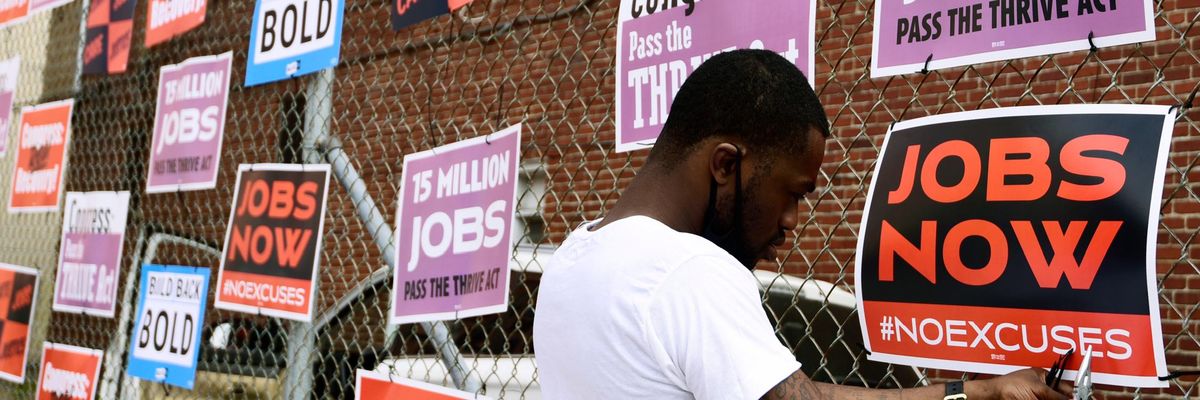
Derrick Davis, a member of West Virginia New Jobs Coalition, hangs up signage during a community gathering and job fair on April 8, 2021 in Charleston, West Virginia. (Photo: Emilee Chinn/Getty Images for Green New Deal Network)
As conservatives in the Senate Democratic caucus gripe about the $3.5 trillion price tag of an emerging reconciliation package, a new poll released Thursday shows that two-thirds of U.S. voters support the sweeping proposal, which is expected to include historic investments in climate action, an expansion of Medicare benefits, universal pre-K, and higher taxes on the rich.
Conducted by progressive polling outfit Data for Progress on behalf of the advocacy group Invest in America Now, the survey (pdf) finds that 66% of U.S. voters--85% of Democrats, 60% of independents, and 47% of Republicans--have a favorable view of the $3.5 trillion proposal.
"This is a large and unprecedented piece of legislation. But we are living in an unprecedented moment. Now is the time for bold action."
--Sen. Bernie Sanders
The poll also shows solid public support for individual components of the reconciliation package, from investments in long-term care for seniors and people with disabilities (81%), modernizing the U.S. electric grid (72%), increasing the IRS budget to pursue wealthy tax cheats (67%), and funding a Civilian Climate Corps (59%).
Overall, according to Data for Progress, the $3.5 trillion proposal is slightly more popular than the much more narrow $550 billion bipartisan infrastructure package that's set to receive a Senate vote in the coming days. The latter proposal is viewed favorably by 65% of U.S. voters, including 83% of Democrats, 62% of independents, and 46% of Republicans.
Despite the overwhelming popularity of the $3.5 trillion proposal, some Senate Democrats--most prominently Kyrsten Sinema of Arizona--have balked at the bill's size. To pass the Senate, the legislation will need the support of all 50 members of the Democratic caucus.
"While I will support beginning this process, I do not support a bill that costs $3.5 trillion--and in the coming months, I will work in good faith to develop this legislation with my colleagues and the administration," Sinema said in a statement last month.
In an interview with NPR on Wednesday, Sinema reiterated her opposition to any package of that size but declined to specify a level of spending she would be willing to support.
"The reason's quite simple: We haven't even introduced the legislation," said Sinema. "We haven't even started it."
Sen. Joe Manchin (D-W.Va.), another key conservative swing vote in the Democratic caucus, said he intends to "reserve any final judgement" on the $3.5 trillion framework until he has "had the opportunity to fully evaluate the proposal," which Senate Democratic leaders unveiled last month.
One of the senators who helped hash out the details of the initial reconciliation framework, Sen. Bernie Sanders (I-Vt.), has described the proposal as "the most consequential legislation for working people since the New Deal."
Senate Democrats hope to hold a vote on a budget resolution setting the boundaries of the reconciliation package at some point this month.
In an op-ed for the Wall Street Journal on Wednesday, Sanders--chair of the Senate Budget Committee--wrote that the reconciliation package contains much-needed "structural reforms to improve the lives of U.S. families."
"We are going to end the days of billionaires not paying their fair share of taxes by closing loopholes," Sanders declared. "We will take on the greed of the pharmaceutical industry... Perhaps most important, we will begin the process of shifting our energy system away from fossil fuels and toward sustainable energy to combat the existential threat of climate change."
"This is a large and unprecedented piece of legislation," Sanders added. "But we are living in an unprecedented moment. Now is the time for bold action."
Dear Common Dreams reader, It’s been nearly 30 years since I co-founded Common Dreams with my late wife, Lina Newhouser. We had the radical notion that journalism should serve the public good, not corporate profits. It was clear to us from the outset what it would take to build such a project. No paid advertisements. No corporate sponsors. No millionaire publisher telling us what to think or do. Many people said we wouldn't last a year, but we proved those doubters wrong. Together with a tremendous team of journalists and dedicated staff, we built an independent media outlet free from the constraints of profits and corporate control. Our mission has always been simple: To inform. To inspire. To ignite change for the common good. Building Common Dreams was not easy. Our survival was never guaranteed. When you take on the most powerful forces—Wall Street greed, fossil fuel industry destruction, Big Tech lobbyists, and uber-rich oligarchs who have spent billions upon billions rigging the economy and democracy in their favor—the only bulwark you have is supporters who believe in your work. But here’s the urgent message from me today. It's never been this bad out there. And it's never been this hard to keep us going. At the very moment Common Dreams is most needed, the threats we face are intensifying. We need your support now more than ever. We don't accept corporate advertising and never will. We don't have a paywall because we don't think people should be blocked from critical news based on their ability to pay. Everything we do is funded by the donations of readers like you. When everyone does the little they can afford, we are strong. But if that support retreats or dries up, so do we. Will you donate now to make sure Common Dreams not only survives but thrives? —Craig Brown, Co-founder |
As conservatives in the Senate Democratic caucus gripe about the $3.5 trillion price tag of an emerging reconciliation package, a new poll released Thursday shows that two-thirds of U.S. voters support the sweeping proposal, which is expected to include historic investments in climate action, an expansion of Medicare benefits, universal pre-K, and higher taxes on the rich.
Conducted by progressive polling outfit Data for Progress on behalf of the advocacy group Invest in America Now, the survey (pdf) finds that 66% of U.S. voters--85% of Democrats, 60% of independents, and 47% of Republicans--have a favorable view of the $3.5 trillion proposal.
"This is a large and unprecedented piece of legislation. But we are living in an unprecedented moment. Now is the time for bold action."
--Sen. Bernie Sanders
The poll also shows solid public support for individual components of the reconciliation package, from investments in long-term care for seniors and people with disabilities (81%), modernizing the U.S. electric grid (72%), increasing the IRS budget to pursue wealthy tax cheats (67%), and funding a Civilian Climate Corps (59%).
Overall, according to Data for Progress, the $3.5 trillion proposal is slightly more popular than the much more narrow $550 billion bipartisan infrastructure package that's set to receive a Senate vote in the coming days. The latter proposal is viewed favorably by 65% of U.S. voters, including 83% of Democrats, 62% of independents, and 46% of Republicans.
Despite the overwhelming popularity of the $3.5 trillion proposal, some Senate Democrats--most prominently Kyrsten Sinema of Arizona--have balked at the bill's size. To pass the Senate, the legislation will need the support of all 50 members of the Democratic caucus.
"While I will support beginning this process, I do not support a bill that costs $3.5 trillion--and in the coming months, I will work in good faith to develop this legislation with my colleagues and the administration," Sinema said in a statement last month.
In an interview with NPR on Wednesday, Sinema reiterated her opposition to any package of that size but declined to specify a level of spending she would be willing to support.
"The reason's quite simple: We haven't even introduced the legislation," said Sinema. "We haven't even started it."
Sen. Joe Manchin (D-W.Va.), another key conservative swing vote in the Democratic caucus, said he intends to "reserve any final judgement" on the $3.5 trillion framework until he has "had the opportunity to fully evaluate the proposal," which Senate Democratic leaders unveiled last month.
One of the senators who helped hash out the details of the initial reconciliation framework, Sen. Bernie Sanders (I-Vt.), has described the proposal as "the most consequential legislation for working people since the New Deal."
Senate Democrats hope to hold a vote on a budget resolution setting the boundaries of the reconciliation package at some point this month.
In an op-ed for the Wall Street Journal on Wednesday, Sanders--chair of the Senate Budget Committee--wrote that the reconciliation package contains much-needed "structural reforms to improve the lives of U.S. families."
"We are going to end the days of billionaires not paying their fair share of taxes by closing loopholes," Sanders declared. "We will take on the greed of the pharmaceutical industry... Perhaps most important, we will begin the process of shifting our energy system away from fossil fuels and toward sustainable energy to combat the existential threat of climate change."
"This is a large and unprecedented piece of legislation," Sanders added. "But we are living in an unprecedented moment. Now is the time for bold action."
As conservatives in the Senate Democratic caucus gripe about the $3.5 trillion price tag of an emerging reconciliation package, a new poll released Thursday shows that two-thirds of U.S. voters support the sweeping proposal, which is expected to include historic investments in climate action, an expansion of Medicare benefits, universal pre-K, and higher taxes on the rich.
Conducted by progressive polling outfit Data for Progress on behalf of the advocacy group Invest in America Now, the survey (pdf) finds that 66% of U.S. voters--85% of Democrats, 60% of independents, and 47% of Republicans--have a favorable view of the $3.5 trillion proposal.
"This is a large and unprecedented piece of legislation. But we are living in an unprecedented moment. Now is the time for bold action."
--Sen. Bernie Sanders
The poll also shows solid public support for individual components of the reconciliation package, from investments in long-term care for seniors and people with disabilities (81%), modernizing the U.S. electric grid (72%), increasing the IRS budget to pursue wealthy tax cheats (67%), and funding a Civilian Climate Corps (59%).
Overall, according to Data for Progress, the $3.5 trillion proposal is slightly more popular than the much more narrow $550 billion bipartisan infrastructure package that's set to receive a Senate vote in the coming days. The latter proposal is viewed favorably by 65% of U.S. voters, including 83% of Democrats, 62% of independents, and 46% of Republicans.
Despite the overwhelming popularity of the $3.5 trillion proposal, some Senate Democrats--most prominently Kyrsten Sinema of Arizona--have balked at the bill's size. To pass the Senate, the legislation will need the support of all 50 members of the Democratic caucus.
"While I will support beginning this process, I do not support a bill that costs $3.5 trillion--and in the coming months, I will work in good faith to develop this legislation with my colleagues and the administration," Sinema said in a statement last month.
In an interview with NPR on Wednesday, Sinema reiterated her opposition to any package of that size but declined to specify a level of spending she would be willing to support.
"The reason's quite simple: We haven't even introduced the legislation," said Sinema. "We haven't even started it."
Sen. Joe Manchin (D-W.Va.), another key conservative swing vote in the Democratic caucus, said he intends to "reserve any final judgement" on the $3.5 trillion framework until he has "had the opportunity to fully evaluate the proposal," which Senate Democratic leaders unveiled last month.
One of the senators who helped hash out the details of the initial reconciliation framework, Sen. Bernie Sanders (I-Vt.), has described the proposal as "the most consequential legislation for working people since the New Deal."
Senate Democrats hope to hold a vote on a budget resolution setting the boundaries of the reconciliation package at some point this month.
In an op-ed for the Wall Street Journal on Wednesday, Sanders--chair of the Senate Budget Committee--wrote that the reconciliation package contains much-needed "structural reforms to improve the lives of U.S. families."
"We are going to end the days of billionaires not paying their fair share of taxes by closing loopholes," Sanders declared. "We will take on the greed of the pharmaceutical industry... Perhaps most important, we will begin the process of shifting our energy system away from fossil fuels and toward sustainable energy to combat the existential threat of climate change."
"This is a large and unprecedented piece of legislation," Sanders added. "But we are living in an unprecedented moment. Now is the time for bold action."