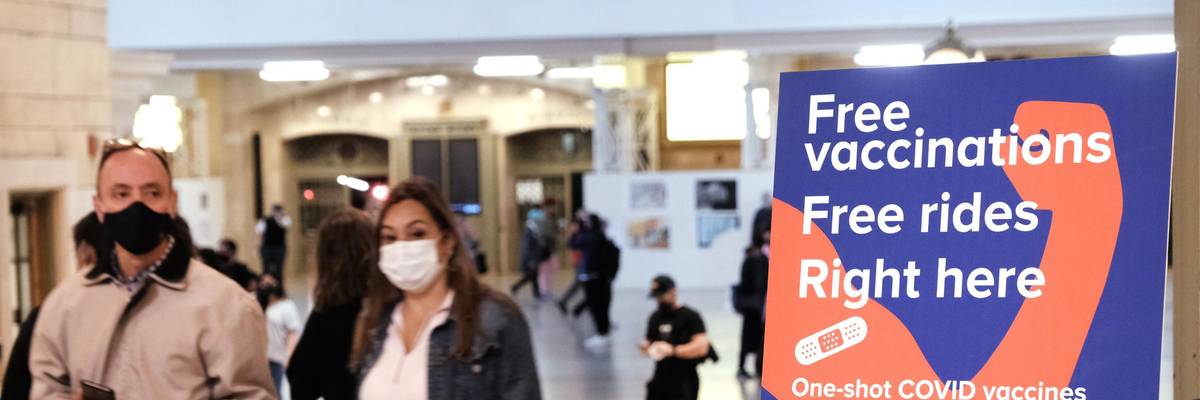
People walk through Grand Central Terminal where a pop-up site for Covid-19 vaccinations opened on May 12, 2021 in New York City. (Photo: Spencer Platt via Getty Images)
Fear of Surprise Bills Contributing to Vaccine Hesitancy in US
"Let's build a healthcare system that people aren't terrified to use," said one Medicare for All advocate.
While coronavirus vaccines are free in the United States--where 51% of adults have been fully inoculated against Covid-19--the fear of unexpected medical expenses is contributing to vaccine hesitancy, the New York Times reported Tuesday.
"A recent Kaiser Family Foundation poll found that about a third of unvaccinated adults were unsure whether insurance covered the new vaccine and were concerned they might need to pay for the shot," the Times reported. "The concern was especially pronounced among Hispanic and Black survey respondents."
Even though lawmakers have barred pharmacies and hospitals from charging patients for jabs and despite the efforts of health officials to communicate to the public that coronavirus vaccines are free, "some unvaccinated adults cite concerns about a surprise bill as a reason for not getting the shot," the newspaper noted. "Many of them are accustomed to a health system in which the bills are frequent, large, and often unexpected."
According to the Times, roughly 1.5 million doses are being administered per day on average, down 56% from the peak of 3.38 million on April 13.
"The conversations we have are like: 'Yes, I know it's good. Yes, I want it, but I don't have insurance,'" Ilan Shapiro, medical director of AltaMed, a community health network in Southern California that serves a large Hispanic population, told the newspaper. "We're trying to make sure everyone knows it's free."
Liz Hamel, director of survey research at Kaiser, said that "people may have heard it's available for free, but [do] not believe it" as a result of previous negative experiences with the healthcare system.
In response, journalist and Medicare for All advocate Natalie Shure said Tuesday: "Let's build a healthcare system that people aren't terrified to use."
Shure argued that cost-related vaccine hesitancy is just one clear illustration of the extent to which the nation's unequal, profit-driven health insurance model conspires to prevent or discourage low-income people from seeking care.
"This is also a problem with endless ACA tinkering as a solution to healthcare woes," Shure continued. "Many uninsured people do qualify for Medicaid/federal subsidies, and either don't know about it [or] are freaked out by how tedious [and] confusing it all is and assume they'd get screwed anyway."
Although coronavirus tests and vaccines are free in the U.S., dozens of patients were mistakenly billed for tests along with a handful for vaccines. Meanwhile, the costs of treatment are not covered by the federal government. CNN reported Monday that a growing number of Covid-19 survivors have been burdened with huge medical bills after being hospitalized, suggesting that the relatively common concerns about pandemic-related healthcare expenses are not unfounded.
"With the pandemic tidal wave finally receding in the United States, the damage left behind is finally emerging, and the financial toll on families laid bare," the news outlet noted. "The threat of financial insecurity from large medical bills following Covid-19 treatment adds a new and frightening layer for patients and families."
For example, singer Irena Schulz, who has suffered from job-threatening hearing loss as a result of her bout with Covid-19, was left with more than lingering and debilitating symptoms as a result of her serious infection. After "a hospital stay, trips to specialists for hearing loss, and new hearing aids," Schulz completely depleted her family's emergency savings and is now drowning in "nearly $10,000 of credit card debt from medical bills," according to CNN.
Despite lawmakers' pledges that coronavirus vaccines are free, the prevalence of nightmare financial scenarios following interactions with the healthcare system--which take place in a country where 87 million people were uninsured or underinsured before the pandemic kicked millions of workers off of their employer-based plans--lends credence to individuals' worries about being unexpectedly billed for vaccines at some point in the future.
As the Times reported Tuesday:
When Paul Moser considers getting a coronavirus vaccine, he also thinks about his outstanding medical debt: $1,200 from a few urology visits that he has been unable to pay off.
Mr. Moser, a 52-year-old gas station cashier in New York State, has friends who were surprised by bills for coronavirus tests, and worries the same could happen with the vaccine. For now, he's holding off on getting his shot.
"We were told by the legislators that all the testing was supposed to be free, and then surprise, it's $150," he said. "I agree it's important to get vaccinated, but I don't have a sense of urgency around it."
The Times noted that cost-related vaccine hesitancy may be especially acute among people with medical debt, who are "more likely to skip needed care than people who hold other types of debt, like outstanding credit card bills or student loans, according to a 2013 study by Lucie Kalousova, an assistant professor of sociology at the University of California, Riverside."'
Longstanding healthcare injustices in the U.S., including the existence of medical debt as well as lawmakers' refusal to cover the costs of Covid-19 treatments, have provoked a not entirely irrational distrust of elected officials' promises that vaccines are free for the duration of the ongoing public health crisis.
"For someone who has incurred medical debt, they may be told by the media and everyone else that the vaccine is cost-free," Kalousova told the Times, "but they've also had this very negative, prior encounter with the medical system that has created feelings of mistrust."
As one unvaccinated woman told the newspaper: "This is America. Your healthcare is not free. I just feel like that is how the vaccination process is going to go. They're going to try to capitalize on it."
Right now in the U.S., some healthcare is free, but not all--and only temporarily. Hence the widespread confusion and skepticism, which is contributing to a plateau in vaccinations.
"We need a healthcare system that actually works for us," Schulz told CNN. "We should not have to worry about whether we can afford to go to the doctor, or whether we're going to be able to afford the procedure or the treatments or the drugs. We shouldn't have to worry about this."
We are at a crossroads
This country and this world are at a monumental crossroads. In a few short weeks, US voters will have an opportunity to beat back the forces of fascism and confront the billionaires who are rigging the economy, our media system, and our democracy, making it increasingly impossible for ordinary people to get by. We’re not just talking about the election. We’re talking about what must be done once these fascist elements are vanquished from power. We need a bolder set of solutions than what either major party has so far been willing to offer and a working-class movement ready to fight like hell for it. Trump didn't emerge from nowhere. The conditions that fueled MAGA authoritarianism were created by decades of radical neoliberal economic policies and a corrupt political system dominated by corporate interests. They slashed taxes on the super-rich, promising that the benefits would trickle down. They said giveaways to the corporate titans would make life more affordable for the rest of us. It was all bullshit. And when a bitter, betrayed populace searches for someone to blame, right-wing demagogues have little trouble finding scapegoats. People know when they're being lied to, but you won't hear any of this from the corporate media. Only independent journalism—powered and funded by people who believe in building a better world—can deliver truly trustworthy daily news. Our Fall Campaign is underway, and we need your help. To power our newsroom through the rest of the year, we need to raise $125,000 by midnight on October 31. So if you share our vision, please contribute whatever you can to sustain our work. |
While coronavirus vaccines are free in the United States--where 51% of adults have been fully inoculated against Covid-19--the fear of unexpected medical expenses is contributing to vaccine hesitancy, the New York Times reported Tuesday.
"A recent Kaiser Family Foundation poll found that about a third of unvaccinated adults were unsure whether insurance covered the new vaccine and were concerned they might need to pay for the shot," the Times reported. "The concern was especially pronounced among Hispanic and Black survey respondents."
Even though lawmakers have barred pharmacies and hospitals from charging patients for jabs and despite the efforts of health officials to communicate to the public that coronavirus vaccines are free, "some unvaccinated adults cite concerns about a surprise bill as a reason for not getting the shot," the newspaper noted. "Many of them are accustomed to a health system in which the bills are frequent, large, and often unexpected."
According to the Times, roughly 1.5 million doses are being administered per day on average, down 56% from the peak of 3.38 million on April 13.
"The conversations we have are like: 'Yes, I know it's good. Yes, I want it, but I don't have insurance,'" Ilan Shapiro, medical director of AltaMed, a community health network in Southern California that serves a large Hispanic population, told the newspaper. "We're trying to make sure everyone knows it's free."
Liz Hamel, director of survey research at Kaiser, said that "people may have heard it's available for free, but [do] not believe it" as a result of previous negative experiences with the healthcare system.
In response, journalist and Medicare for All advocate Natalie Shure said Tuesday: "Let's build a healthcare system that people aren't terrified to use."
Shure argued that cost-related vaccine hesitancy is just one clear illustration of the extent to which the nation's unequal, profit-driven health insurance model conspires to prevent or discourage low-income people from seeking care.
"This is also a problem with endless ACA tinkering as a solution to healthcare woes," Shure continued. "Many uninsured people do qualify for Medicaid/federal subsidies, and either don't know about it [or] are freaked out by how tedious [and] confusing it all is and assume they'd get screwed anyway."
Although coronavirus tests and vaccines are free in the U.S., dozens of patients were mistakenly billed for tests along with a handful for vaccines. Meanwhile, the costs of treatment are not covered by the federal government. CNN reported Monday that a growing number of Covid-19 survivors have been burdened with huge medical bills after being hospitalized, suggesting that the relatively common concerns about pandemic-related healthcare expenses are not unfounded.
"With the pandemic tidal wave finally receding in the United States, the damage left behind is finally emerging, and the financial toll on families laid bare," the news outlet noted. "The threat of financial insecurity from large medical bills following Covid-19 treatment adds a new and frightening layer for patients and families."
For example, singer Irena Schulz, who has suffered from job-threatening hearing loss as a result of her bout with Covid-19, was left with more than lingering and debilitating symptoms as a result of her serious infection. After "a hospital stay, trips to specialists for hearing loss, and new hearing aids," Schulz completely depleted her family's emergency savings and is now drowning in "nearly $10,000 of credit card debt from medical bills," according to CNN.
Despite lawmakers' pledges that coronavirus vaccines are free, the prevalence of nightmare financial scenarios following interactions with the healthcare system--which take place in a country where 87 million people were uninsured or underinsured before the pandemic kicked millions of workers off of their employer-based plans--lends credence to individuals' worries about being unexpectedly billed for vaccines at some point in the future.
As the Times reported Tuesday:
When Paul Moser considers getting a coronavirus vaccine, he also thinks about his outstanding medical debt: $1,200 from a few urology visits that he has been unable to pay off.
Mr. Moser, a 52-year-old gas station cashier in New York State, has friends who were surprised by bills for coronavirus tests, and worries the same could happen with the vaccine. For now, he's holding off on getting his shot.
"We were told by the legislators that all the testing was supposed to be free, and then surprise, it's $150," he said. "I agree it's important to get vaccinated, but I don't have a sense of urgency around it."
The Times noted that cost-related vaccine hesitancy may be especially acute among people with medical debt, who are "more likely to skip needed care than people who hold other types of debt, like outstanding credit card bills or student loans, according to a 2013 study by Lucie Kalousova, an assistant professor of sociology at the University of California, Riverside."'
Longstanding healthcare injustices in the U.S., including the existence of medical debt as well as lawmakers' refusal to cover the costs of Covid-19 treatments, have provoked a not entirely irrational distrust of elected officials' promises that vaccines are free for the duration of the ongoing public health crisis.
"For someone who has incurred medical debt, they may be told by the media and everyone else that the vaccine is cost-free," Kalousova told the Times, "but they've also had this very negative, prior encounter with the medical system that has created feelings of mistrust."
As one unvaccinated woman told the newspaper: "This is America. Your healthcare is not free. I just feel like that is how the vaccination process is going to go. They're going to try to capitalize on it."
Right now in the U.S., some healthcare is free, but not all--and only temporarily. Hence the widespread confusion and skepticism, which is contributing to a plateau in vaccinations.
"We need a healthcare system that actually works for us," Schulz told CNN. "We should not have to worry about whether we can afford to go to the doctor, or whether we're going to be able to afford the procedure or the treatments or the drugs. We shouldn't have to worry about this."
While coronavirus vaccines are free in the United States--where 51% of adults have been fully inoculated against Covid-19--the fear of unexpected medical expenses is contributing to vaccine hesitancy, the New York Times reported Tuesday.
"A recent Kaiser Family Foundation poll found that about a third of unvaccinated adults were unsure whether insurance covered the new vaccine and were concerned they might need to pay for the shot," the Times reported. "The concern was especially pronounced among Hispanic and Black survey respondents."
Even though lawmakers have barred pharmacies and hospitals from charging patients for jabs and despite the efforts of health officials to communicate to the public that coronavirus vaccines are free, "some unvaccinated adults cite concerns about a surprise bill as a reason for not getting the shot," the newspaper noted. "Many of them are accustomed to a health system in which the bills are frequent, large, and often unexpected."
According to the Times, roughly 1.5 million doses are being administered per day on average, down 56% from the peak of 3.38 million on April 13.
"The conversations we have are like: 'Yes, I know it's good. Yes, I want it, but I don't have insurance,'" Ilan Shapiro, medical director of AltaMed, a community health network in Southern California that serves a large Hispanic population, told the newspaper. "We're trying to make sure everyone knows it's free."
Liz Hamel, director of survey research at Kaiser, said that "people may have heard it's available for free, but [do] not believe it" as a result of previous negative experiences with the healthcare system.
In response, journalist and Medicare for All advocate Natalie Shure said Tuesday: "Let's build a healthcare system that people aren't terrified to use."
Shure argued that cost-related vaccine hesitancy is just one clear illustration of the extent to which the nation's unequal, profit-driven health insurance model conspires to prevent or discourage low-income people from seeking care.
"This is also a problem with endless ACA tinkering as a solution to healthcare woes," Shure continued. "Many uninsured people do qualify for Medicaid/federal subsidies, and either don't know about it [or] are freaked out by how tedious [and] confusing it all is and assume they'd get screwed anyway."
Although coronavirus tests and vaccines are free in the U.S., dozens of patients were mistakenly billed for tests along with a handful for vaccines. Meanwhile, the costs of treatment are not covered by the federal government. CNN reported Monday that a growing number of Covid-19 survivors have been burdened with huge medical bills after being hospitalized, suggesting that the relatively common concerns about pandemic-related healthcare expenses are not unfounded.
"With the pandemic tidal wave finally receding in the United States, the damage left behind is finally emerging, and the financial toll on families laid bare," the news outlet noted. "The threat of financial insecurity from large medical bills following Covid-19 treatment adds a new and frightening layer for patients and families."
For example, singer Irena Schulz, who has suffered from job-threatening hearing loss as a result of her bout with Covid-19, was left with more than lingering and debilitating symptoms as a result of her serious infection. After "a hospital stay, trips to specialists for hearing loss, and new hearing aids," Schulz completely depleted her family's emergency savings and is now drowning in "nearly $10,000 of credit card debt from medical bills," according to CNN.
Despite lawmakers' pledges that coronavirus vaccines are free, the prevalence of nightmare financial scenarios following interactions with the healthcare system--which take place in a country where 87 million people were uninsured or underinsured before the pandemic kicked millions of workers off of their employer-based plans--lends credence to individuals' worries about being unexpectedly billed for vaccines at some point in the future.
As the Times reported Tuesday:
When Paul Moser considers getting a coronavirus vaccine, he also thinks about his outstanding medical debt: $1,200 from a few urology visits that he has been unable to pay off.
Mr. Moser, a 52-year-old gas station cashier in New York State, has friends who were surprised by bills for coronavirus tests, and worries the same could happen with the vaccine. For now, he's holding off on getting his shot.
"We were told by the legislators that all the testing was supposed to be free, and then surprise, it's $150," he said. "I agree it's important to get vaccinated, but I don't have a sense of urgency around it."
The Times noted that cost-related vaccine hesitancy may be especially acute among people with medical debt, who are "more likely to skip needed care than people who hold other types of debt, like outstanding credit card bills or student loans, according to a 2013 study by Lucie Kalousova, an assistant professor of sociology at the University of California, Riverside."'
Longstanding healthcare injustices in the U.S., including the existence of medical debt as well as lawmakers' refusal to cover the costs of Covid-19 treatments, have provoked a not entirely irrational distrust of elected officials' promises that vaccines are free for the duration of the ongoing public health crisis.
"For someone who has incurred medical debt, they may be told by the media and everyone else that the vaccine is cost-free," Kalousova told the Times, "but they've also had this very negative, prior encounter with the medical system that has created feelings of mistrust."
As one unvaccinated woman told the newspaper: "This is America. Your healthcare is not free. I just feel like that is how the vaccination process is going to go. They're going to try to capitalize on it."
Right now in the U.S., some healthcare is free, but not all--and only temporarily. Hence the widespread confusion and skepticism, which is contributing to a plateau in vaccinations.
"We need a healthcare system that actually works for us," Schulz told CNN. "We should not have to worry about whether we can afford to go to the doctor, or whether we're going to be able to afford the procedure or the treatments or the drugs. We shouldn't have to worry about this."