

SUBSCRIBE TO OUR FREE NEWSLETTER
Daily news & progressive opinion—funded by the people, not the corporations—delivered straight to your inbox.
5
#000000
#FFFFFF
To donate by check, phone, or other method, see our More Ways to Give page.
Daily news & progressive opinion—funded by the people, not the corporations—delivered straight to your inbox.
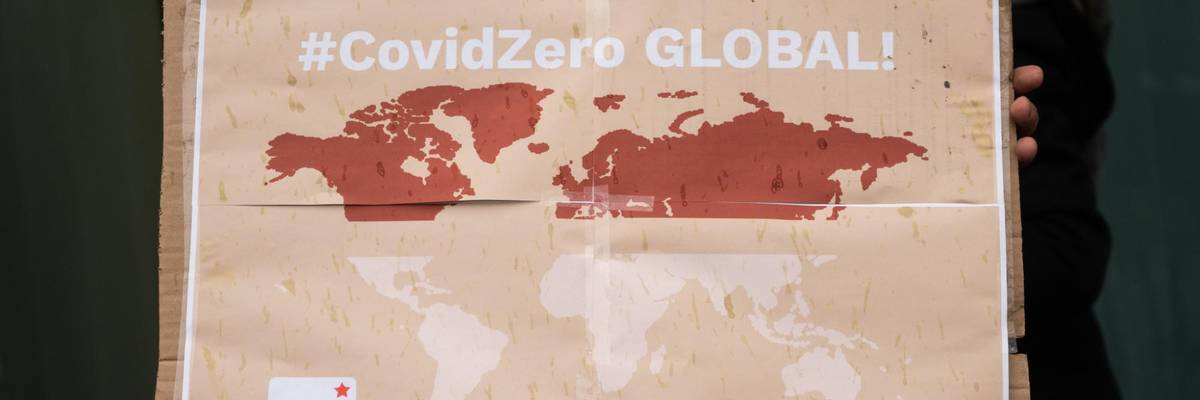
A demonstrator carries a banner that reads "Vaccine For All! #CovidZero Global!" during a protest in front of Pfizer headquarters in Berlin, Germany on January 23, 2021. (Photo: Christophe Gateau/Picture Alliance via Getty Images)
A new survey conducted by a global coalition of public health advocacy groups shows that an average of 70% of the people across G7 nations believe their governments should take action to require pharmaceutical companies to share vaccine formulas and know-how with the world.
"The public doesn't want Big Pharma to hold monopolies on vaccines that were developed largely with public money."
--Heidi Chow, Global Justice Now
Released just ahead of Wednesday's meeting of the World Trade Organization (WTO)--where member nations will consider a proposal to waive coronavirus vaccine patents--the poll by the People's Vaccine Alliance finds that support for government action to compel the sharing of vaccine recipes is strongest in Italy at 82%, followed by Canada at 76%, the United Kingdom at 74%, Germany at 70%, and the U.S. at 69%.
"The public doesn't want Big Pharma to hold monopolies on vaccines that were developed largely with public money," Heidi Chow, senior campaigns and policy manager at Global Justice Now, said in a statement. "These vaccines are a global public good that should be available to everyone, everywhere. That much is obvious to the public across G7 nations, but political leaders are burying their heads in the sand while people die around them."
Despite widespread support among their populations for ending the pharmaceutical industry's monopoly control of vaccine production, none of the G7 nations have yet backed South Africa and India's proposal to temporarily suspend certain intellectual property rights that are standing in the way of efforts to ramp up manufacturing for developing nations.
If approved by consensus at the WTO, the patent waiver would allow generic manufacturers to replicate vaccine formulas without fear of legal retribution, which proponents say is a necessary step to meet global vaccine needs as coronavirus infections surge across the developing world.
"The horrific situation in India should shake G7 leaders to their core. Now is not the time for an ideological defense of intellectual property rules."
--Saoirse Fitzpatrick, STOPAIDS
"The horrific situation in India should shake G7 leaders to their core," said Saoirse Fitzpatrick, advocacy manager at STOPAIDS. "Now is not the time for an ideological defense of intellectual property rules. Bilateral deals with pharmaceutical companies have not worked. Governments need to step in and force pharmaceutical companies to share their intellectual property and vaccine know-how with the world."
Experts have argued for months that after pumping massive public funding into the rapid development of coronavirus vaccines, the governments of rich nations have significant leverage to force pharmaceutical companies to share their technical knowledge with manufacturers around the world in the interest of increasing global supply and ending the pandemic.
"Vaccine manufacturers are currently hoarding technology, for commercial reasons," James Love, director of Knowledge Ecology International, said earlier this year. "Governments have to intervene, and they have the leverage to compel companies to share manufacturing know-how, not just within a cartel, but everywhere there are qualified manufacturers."
But rich countries have thus far refused to act on their leverage, leaving vaccine production under the control of pharmaceutical companies and buying up much of the artificially scarce supply for themselves.
Major pharmaceutical giants, for their part, have lobbied hard against any patent waiver and refused to participate in a voluntary technology-sharing initiative set up by the World Health Organization.
"It's time to waive the intellectual property rules, ramp up production, and put people's lives before profits."
--Anna Marriott, Oxfam International
"The sole reason these vaccines aren't being produced widely by other makers is because these companies don't want to give up their monopoly," Matthew Kavanagh, director of the Global Health Policy and Governance Initiative at Georgetown's O'Neill Institute, told the Los Angeles Times last week. "Instead, we put all the world's eggs into one basket. It's a tragedy."
According to WHO Director-General, just 0.3% of total coronavirus vaccine doses administered across the globe have gone to low-income countries. By contrast, people in high- and upper-middle-income countries have received 81% of the total doses.
"People are dying by the thousands in low- and middle-income countries while rich nations have jumped the vaccine queue," Anna Marriott, health policy manager at Oxfam International, said in a statement. "G7 leaders need to face up to reality. We don't have enough vaccines for everyone and the biggest barrier to increasing supply is that a few profit hungry pharmaceutical corporations keep the rights to produce them under the lock and key."
"It's time to waive the intellectual property rules, ramp up production, and put people's lives before profits," Marriott added. "It's time for a People's Vaccine."
Dear Common Dreams reader, It’s been nearly 30 years since I co-founded Common Dreams with my late wife, Lina Newhouser. We had the radical notion that journalism should serve the public good, not corporate profits. It was clear to us from the outset what it would take to build such a project. No paid advertisements. No corporate sponsors. No millionaire publisher telling us what to think or do. Many people said we wouldn't last a year, but we proved those doubters wrong. Together with a tremendous team of journalists and dedicated staff, we built an independent media outlet free from the constraints of profits and corporate control. Our mission has always been simple: To inform. To inspire. To ignite change for the common good. Building Common Dreams was not easy. Our survival was never guaranteed. When you take on the most powerful forces—Wall Street greed, fossil fuel industry destruction, Big Tech lobbyists, and uber-rich oligarchs who have spent billions upon billions rigging the economy and democracy in their favor—the only bulwark you have is supporters who believe in your work. But here’s the urgent message from me today. It's never been this bad out there. And it's never been this hard to keep us going. At the very moment Common Dreams is most needed, the threats we face are intensifying. We need your support now more than ever. We don't accept corporate advertising and never will. We don't have a paywall because we don't think people should be blocked from critical news based on their ability to pay. Everything we do is funded by the donations of readers like you. When everyone does the little they can afford, we are strong. But if that support retreats or dries up, so do we. Will you donate now to make sure Common Dreams not only survives but thrives? —Craig Brown, Co-founder |
A new survey conducted by a global coalition of public health advocacy groups shows that an average of 70% of the people across G7 nations believe their governments should take action to require pharmaceutical companies to share vaccine formulas and know-how with the world.
"The public doesn't want Big Pharma to hold monopolies on vaccines that were developed largely with public money."
--Heidi Chow, Global Justice Now
Released just ahead of Wednesday's meeting of the World Trade Organization (WTO)--where member nations will consider a proposal to waive coronavirus vaccine patents--the poll by the People's Vaccine Alliance finds that support for government action to compel the sharing of vaccine recipes is strongest in Italy at 82%, followed by Canada at 76%, the United Kingdom at 74%, Germany at 70%, and the U.S. at 69%.
"The public doesn't want Big Pharma to hold monopolies on vaccines that were developed largely with public money," Heidi Chow, senior campaigns and policy manager at Global Justice Now, said in a statement. "These vaccines are a global public good that should be available to everyone, everywhere. That much is obvious to the public across G7 nations, but political leaders are burying their heads in the sand while people die around them."
Despite widespread support among their populations for ending the pharmaceutical industry's monopoly control of vaccine production, none of the G7 nations have yet backed South Africa and India's proposal to temporarily suspend certain intellectual property rights that are standing in the way of efforts to ramp up manufacturing for developing nations.
If approved by consensus at the WTO, the patent waiver would allow generic manufacturers to replicate vaccine formulas without fear of legal retribution, which proponents say is a necessary step to meet global vaccine needs as coronavirus infections surge across the developing world.
"The horrific situation in India should shake G7 leaders to their core. Now is not the time for an ideological defense of intellectual property rules."
--Saoirse Fitzpatrick, STOPAIDS
"The horrific situation in India should shake G7 leaders to their core," said Saoirse Fitzpatrick, advocacy manager at STOPAIDS. "Now is not the time for an ideological defense of intellectual property rules. Bilateral deals with pharmaceutical companies have not worked. Governments need to step in and force pharmaceutical companies to share their intellectual property and vaccine know-how with the world."
Experts have argued for months that after pumping massive public funding into the rapid development of coronavirus vaccines, the governments of rich nations have significant leverage to force pharmaceutical companies to share their technical knowledge with manufacturers around the world in the interest of increasing global supply and ending the pandemic.
"Vaccine manufacturers are currently hoarding technology, for commercial reasons," James Love, director of Knowledge Ecology International, said earlier this year. "Governments have to intervene, and they have the leverage to compel companies to share manufacturing know-how, not just within a cartel, but everywhere there are qualified manufacturers."
But rich countries have thus far refused to act on their leverage, leaving vaccine production under the control of pharmaceutical companies and buying up much of the artificially scarce supply for themselves.
Major pharmaceutical giants, for their part, have lobbied hard against any patent waiver and refused to participate in a voluntary technology-sharing initiative set up by the World Health Organization.
"It's time to waive the intellectual property rules, ramp up production, and put people's lives before profits."
--Anna Marriott, Oxfam International
"The sole reason these vaccines aren't being produced widely by other makers is because these companies don't want to give up their monopoly," Matthew Kavanagh, director of the Global Health Policy and Governance Initiative at Georgetown's O'Neill Institute, told the Los Angeles Times last week. "Instead, we put all the world's eggs into one basket. It's a tragedy."
According to WHO Director-General, just 0.3% of total coronavirus vaccine doses administered across the globe have gone to low-income countries. By contrast, people in high- and upper-middle-income countries have received 81% of the total doses.
"People are dying by the thousands in low- and middle-income countries while rich nations have jumped the vaccine queue," Anna Marriott, health policy manager at Oxfam International, said in a statement. "G7 leaders need to face up to reality. We don't have enough vaccines for everyone and the biggest barrier to increasing supply is that a few profit hungry pharmaceutical corporations keep the rights to produce them under the lock and key."
"It's time to waive the intellectual property rules, ramp up production, and put people's lives before profits," Marriott added. "It's time for a People's Vaccine."
A new survey conducted by a global coalition of public health advocacy groups shows that an average of 70% of the people across G7 nations believe their governments should take action to require pharmaceutical companies to share vaccine formulas and know-how with the world.
"The public doesn't want Big Pharma to hold monopolies on vaccines that were developed largely with public money."
--Heidi Chow, Global Justice Now
Released just ahead of Wednesday's meeting of the World Trade Organization (WTO)--where member nations will consider a proposal to waive coronavirus vaccine patents--the poll by the People's Vaccine Alliance finds that support for government action to compel the sharing of vaccine recipes is strongest in Italy at 82%, followed by Canada at 76%, the United Kingdom at 74%, Germany at 70%, and the U.S. at 69%.
"The public doesn't want Big Pharma to hold monopolies on vaccines that were developed largely with public money," Heidi Chow, senior campaigns and policy manager at Global Justice Now, said in a statement. "These vaccines are a global public good that should be available to everyone, everywhere. That much is obvious to the public across G7 nations, but political leaders are burying their heads in the sand while people die around them."
Despite widespread support among their populations for ending the pharmaceutical industry's monopoly control of vaccine production, none of the G7 nations have yet backed South Africa and India's proposal to temporarily suspend certain intellectual property rights that are standing in the way of efforts to ramp up manufacturing for developing nations.
If approved by consensus at the WTO, the patent waiver would allow generic manufacturers to replicate vaccine formulas without fear of legal retribution, which proponents say is a necessary step to meet global vaccine needs as coronavirus infections surge across the developing world.
"The horrific situation in India should shake G7 leaders to their core. Now is not the time for an ideological defense of intellectual property rules."
--Saoirse Fitzpatrick, STOPAIDS
"The horrific situation in India should shake G7 leaders to their core," said Saoirse Fitzpatrick, advocacy manager at STOPAIDS. "Now is not the time for an ideological defense of intellectual property rules. Bilateral deals with pharmaceutical companies have not worked. Governments need to step in and force pharmaceutical companies to share their intellectual property and vaccine know-how with the world."
Experts have argued for months that after pumping massive public funding into the rapid development of coronavirus vaccines, the governments of rich nations have significant leverage to force pharmaceutical companies to share their technical knowledge with manufacturers around the world in the interest of increasing global supply and ending the pandemic.
"Vaccine manufacturers are currently hoarding technology, for commercial reasons," James Love, director of Knowledge Ecology International, said earlier this year. "Governments have to intervene, and they have the leverage to compel companies to share manufacturing know-how, not just within a cartel, but everywhere there are qualified manufacturers."
But rich countries have thus far refused to act on their leverage, leaving vaccine production under the control of pharmaceutical companies and buying up much of the artificially scarce supply for themselves.
Major pharmaceutical giants, for their part, have lobbied hard against any patent waiver and refused to participate in a voluntary technology-sharing initiative set up by the World Health Organization.
"It's time to waive the intellectual property rules, ramp up production, and put people's lives before profits."
--Anna Marriott, Oxfam International
"The sole reason these vaccines aren't being produced widely by other makers is because these companies don't want to give up their monopoly," Matthew Kavanagh, director of the Global Health Policy and Governance Initiative at Georgetown's O'Neill Institute, told the Los Angeles Times last week. "Instead, we put all the world's eggs into one basket. It's a tragedy."
According to WHO Director-General, just 0.3% of total coronavirus vaccine doses administered across the globe have gone to low-income countries. By contrast, people in high- and upper-middle-income countries have received 81% of the total doses.
"People are dying by the thousands in low- and middle-income countries while rich nations have jumped the vaccine queue," Anna Marriott, health policy manager at Oxfam International, said in a statement. "G7 leaders need to face up to reality. We don't have enough vaccines for everyone and the biggest barrier to increasing supply is that a few profit hungry pharmaceutical corporations keep the rights to produce them under the lock and key."
"It's time to waive the intellectual property rules, ramp up production, and put people's lives before profits," Marriott added. "It's time for a People's Vaccine."

