SUBSCRIBE TO OUR FREE NEWSLETTER
Daily news & progressive opinion—funded by the people, not the corporations—delivered straight to your inbox.
5
#000000
#FFFFFF
To donate by check, phone, or other method, see our More Ways to Give page.
Daily news & progressive opinion—funded by the people, not the corporations—delivered straight to your inbox.
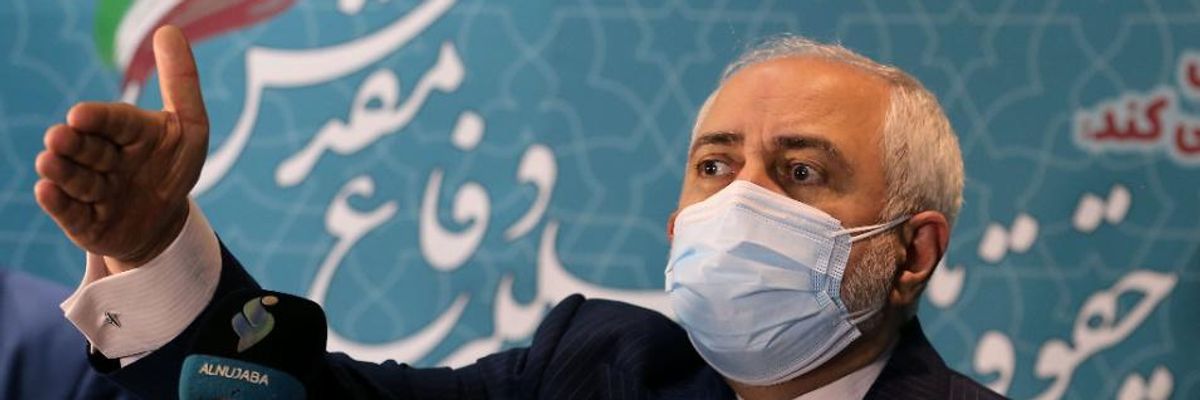
Iranian Foreign Minister Mohammad Javad Zarif speaks during a press conference at the International Conference on the Legal-International Claims of the Holy Defense in the capital Tehran on February 23, 2021. (Photo by ATTA KENARE / AFP) (Photo by ATTA KENARE/AFP via Getty Images)
In a development hailed as a key "breakthrough" that the Biden administration must not squander, parties to the Iran nuclear accord announced Friday morning that American officials will join talks next week to bring the U.S. back into compliance with the deal that former President Donald Trump violated in 2018.
Following a virtual meeting of the Joint Commission of the Joint Comprehensive Plan of Action (JCPOA), European diplomats said in a statement that top officials from Iran, France, Germany, the U.K., Russia, China, and the U.S. will gather in Vienna next week to discuss "a full return of the U.S. to the JCPOA."
"The U.S. can't afford to let this window pass without restoring the strong nonproliferation agreement that already navigated the difficult politics of Washington and Tehran. It is time to reseal the deal."
--Jamal Abdi, National Iranian American Council
While no direct talks between U.S. and Iranian officials are expected to take place, the Wall Street Journal described the forthcoming Vienna gathering as "the first serious effort to rescue the agreement since President Biden took office in January."
"This is the breakthrough we have been hoping for," Jamal Abdi, president of the National Iranian American Council, said in a statement Friday. "The American people, and the Iranian-American community in particular, want the Biden administration to resolve our ongoing disputes with Iran through diplomacy."
"Under Trump, the specter of war loomed large and was only narrowly avoided," Abdi continued. "It is encouraging to see renewed momentum toward a return to the deal under Biden. The U.S. can't afford to let this window pass without restoring the strong nonproliferation agreement that already navigated the difficult politics of Washington and Tehran. It is time to reseal the deal."
Biden vowed on the campaign trial to work to quickly restore the nuclear deal, but progress on that front has been virtually non-existent since his presidency began. The Biden administration said last month that it was prepared to rejoin talks over the deal, but Iran declined to meet with the U.S. directly, citing the White House's refusal to guarantee swift relief from crippling Trump-imposed sanctions that violated the 2015 accord.
But an anonymous U.S. official told the New York Times Friday that the Biden administration "would not seek to retain some sanctions for leverage" in the Vienna talks, "arguing that the previous 'maximum pressure' campaign waged against Iran by the Trump administration had failed."
Abbas Araghchi, Iran's top nuclear negotiator, said Friday that "the path is quite clear" for a U.S. return to the nuclear deal.
"The U.S. can return to the deal and stop breaching the law in the same way it withdrew from the deal and imposed illegal sanctions on Iran," said Araghchi.
Mohammad Javad Zarif, Iran's top diplomat, said the goal of next week's gathering in Vienna should be to "rapidly finalize sanction-lifting and nuclear measures for choreographed removal of all sanctions, followed by Iran ceasing remedial measures."
"No Iran-U.S. meeting," Zarif added. "Unnecessary."
News of the Vienna talks came as Democratic members of the U.S. Congress have been publicly and privately calling on the Biden administration to move with more urgency to reverse the Trump administration's withdrawal from an effective deal, a move that dramatically escalated tensions between the Iran and the U.S. and nearly resulted in all-out war.
"Let's just speak plainly: it has been a disappointing start when it comes to Iran policy from the administration. They should have been already trying to get into this deal," Rep. Ro Khanna (D-Calif.) said during an event hosted by NIAC earlier this week. "I think we have to continue to make a very simple case that we have to try to get back into the JCPOA by getting back into the JCPOA, not by playing a game of chicken."
Sen. Chris Murphy (D-Conn.) echoed that message, slamming the Trump administration's so-called "maximum pressure" strategy as a "miserable, 100% failure."
"The United States was the first to leave, and so the United States shouldn't be wary of taking the first step back into the agreement," Murphy added. "There is no weakness in the United States admitting that, but for our non-compliance, the JCPOA would still likely be alive and well today."
This country and this world are at a monumental crossroads. US voters have an opportunity to beat back the forces of fascism and confront the billionaires who are rigging the economy, our media system, and our democracy, making it increasingly impossible for ordinary people to get by. We’re not just talking about the election. We’re talking about what must be done once these fascist elements are vanquished from power. We need a bolder set of solutions than what either major party has so far been willing to offer and a working-class movement ready to fight like hell for it. Trump didn't emerge from nowhere. The conditions that fueled MAGA authoritarianism were created by decades of radical neoliberal economic policies and a corrupt political system dominated by corporate interests. They slashed taxes on the super-rich, promising that the benefits would trickle down. They said giveaways to the corporate titans would make life more affordable for the rest of us. It was all bullshit. And when a bitter, betrayed populace searches for someone to blame, right-wing demagogues have little trouble finding scapegoats. People know when they're being lied to, but you won't hear any of this from the corporate media. Only independent journalism—powered and funded by people who believe in building a better world—can deliver truly trustworthy daily news. If you share our vision, please contribute whatever you can to sustain our work. |
In a development hailed as a key "breakthrough" that the Biden administration must not squander, parties to the Iran nuclear accord announced Friday morning that American officials will join talks next week to bring the U.S. back into compliance with the deal that former President Donald Trump violated in 2018.
Following a virtual meeting of the Joint Commission of the Joint Comprehensive Plan of Action (JCPOA), European diplomats said in a statement that top officials from Iran, France, Germany, the U.K., Russia, China, and the U.S. will gather in Vienna next week to discuss "a full return of the U.S. to the JCPOA."
"The U.S. can't afford to let this window pass without restoring the strong nonproliferation agreement that already navigated the difficult politics of Washington and Tehran. It is time to reseal the deal."
--Jamal Abdi, National Iranian American Council
While no direct talks between U.S. and Iranian officials are expected to take place, the Wall Street Journal described the forthcoming Vienna gathering as "the first serious effort to rescue the agreement since President Biden took office in January."
"This is the breakthrough we have been hoping for," Jamal Abdi, president of the National Iranian American Council, said in a statement Friday. "The American people, and the Iranian-American community in particular, want the Biden administration to resolve our ongoing disputes with Iran through diplomacy."
"Under Trump, the specter of war loomed large and was only narrowly avoided," Abdi continued. "It is encouraging to see renewed momentum toward a return to the deal under Biden. The U.S. can't afford to let this window pass without restoring the strong nonproliferation agreement that already navigated the difficult politics of Washington and Tehran. It is time to reseal the deal."
Biden vowed on the campaign trial to work to quickly restore the nuclear deal, but progress on that front has been virtually non-existent since his presidency began. The Biden administration said last month that it was prepared to rejoin talks over the deal, but Iran declined to meet with the U.S. directly, citing the White House's refusal to guarantee swift relief from crippling Trump-imposed sanctions that violated the 2015 accord.
But an anonymous U.S. official told the New York Times Friday that the Biden administration "would not seek to retain some sanctions for leverage" in the Vienna talks, "arguing that the previous 'maximum pressure' campaign waged against Iran by the Trump administration had failed."
Abbas Araghchi, Iran's top nuclear negotiator, said Friday that "the path is quite clear" for a U.S. return to the nuclear deal.
"The U.S. can return to the deal and stop breaching the law in the same way it withdrew from the deal and imposed illegal sanctions on Iran," said Araghchi.
Mohammad Javad Zarif, Iran's top diplomat, said the goal of next week's gathering in Vienna should be to "rapidly finalize sanction-lifting and nuclear measures for choreographed removal of all sanctions, followed by Iran ceasing remedial measures."
"No Iran-U.S. meeting," Zarif added. "Unnecessary."
News of the Vienna talks came as Democratic members of the U.S. Congress have been publicly and privately calling on the Biden administration to move with more urgency to reverse the Trump administration's withdrawal from an effective deal, a move that dramatically escalated tensions between the Iran and the U.S. and nearly resulted in all-out war.
"Let's just speak plainly: it has been a disappointing start when it comes to Iran policy from the administration. They should have been already trying to get into this deal," Rep. Ro Khanna (D-Calif.) said during an event hosted by NIAC earlier this week. "I think we have to continue to make a very simple case that we have to try to get back into the JCPOA by getting back into the JCPOA, not by playing a game of chicken."
Sen. Chris Murphy (D-Conn.) echoed that message, slamming the Trump administration's so-called "maximum pressure" strategy as a "miserable, 100% failure."
"The United States was the first to leave, and so the United States shouldn't be wary of taking the first step back into the agreement," Murphy added. "There is no weakness in the United States admitting that, but for our non-compliance, the JCPOA would still likely be alive and well today."