
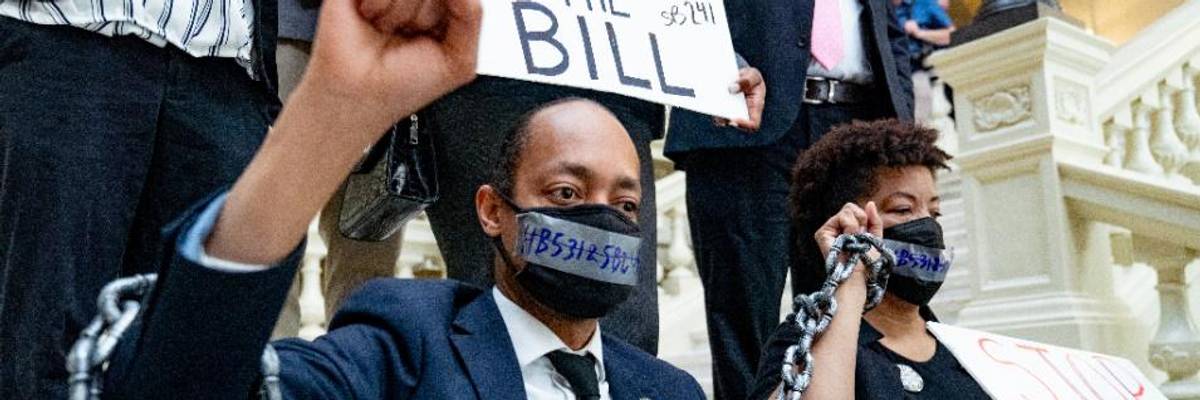
Demonstrators wear chains while holding a sit-in inside the Capitol building in opposition of House Bill 531 on March 8, 2021 in Atlanta, Georgia. (Photo: Megan Varner/Getty Images)
Activists Demand Georgia-Based Corporations Like Coca-Cola End Complicity in GOP Assault on Voting
"It is a dangerous thing for the business community to be silent."
Racial justice activists in Georgia this week intensified a pressure campaign aimed at forcing major corporations headquartered in the state's capital--from Coca-Cola to Home Depot to UPS--to end their complicity in the GOP's sweeping assault on voting rights and actively combat the draconian disenfranchisement efforts currently making their way through the legislature.
A coalition of civil rights groups--including Black Voters Matter, the New Georgia Project Action Fund, the Georgia NAACP, and other organizations--is urging is members and supporters to "contact CEOs, presidents, and headquarters of major Georgia-based corporations" and demand they cut off financial support to state Republican lawmakers and forcefully speak out against the voter suppression effort, as CNBC reported over the weekend.
"Black buying power contributes more than $106 billion to Georgia businesses every year--and the dollars we spend shouldn't go to politicians who are working to suppress our votes with racist legislation."
--Service Employees International Union
The groups have also placed advertisements in local newspapers and held protests at the World of Coca-Cola, the state Capitol building, and other Atlanta locations.
Given that many large Atlanta-based companies bankroll the Republican lawmakers behind the new voter suppression bills, activists are hoping that the threat of major financial consequences as well as massive public backlash will help stop the disenfranchisement push, which is part of a nationwide Republican assault on voting rights.
"We've got the power of organized people. They've got the power of organized money. And between us and them, we could put pressure on these legislators or, worst-case scenario, the governor to kill these bills," Black Voters Matter co-founder Cliff Albright told CNBC.
Service Employees International Union (SEIU) Workers United and Progress Georgia joined the fray on Monday, issuing a joint statement condemning major corporations for "spending months running public message campaigns claiming to support Georgians' freedom to vote, but then staying silent when GOP lawmakers--who have received tens of thousands of dollars in political contributions from these corporations--are leading this assault on Black, Latino, and [Asian American and Pacific Islander] voters."
"Black buying power contributes more than $106 billion to Georgia businesses every year--and the dollars we spend shouldn't go to politicians who are working to suppress our votes with racist legislation," SEIU said on Twitter.
Apparently feeling the heat, Coca-Cola, Delta, and other corporate giants released mealy-mouthed statements this week calling ballot access a "foundational right" and vowing to "engage with state lawmakers"--but not taking any concrete positions on H.B. 531 or S.B. 241, bills that have been described as two of the most extreme attacks on the franchise since the Jim Crow era.
H.B. 531 passed the Georgia House on March 1 and S.B. 241 passed the Senate on March 8. If signed into law, the legislation would significantly roll back absentee voting, curtail weekend voting days, impose more strict voter ID requirements, limit the number of available ballot drop boxes, and more.
Republican Gov. Brian Kemp has not yet said whether he would sign the measures.
Judd Legum of the Popular Information newsletter reported earlier this month that since 2018, "Coca-Cola has donated $34,750 to the sponsors of both pieces of legislation to restrict voting."
"Coca-Cola is not alone," Legum noted. "Popular Information's investigation found that, since 2018, corporations have donated $7.4 million to the sponsors of the Georgia legislation to restrict voting rights. A significant portion of this money comes from prominent national corporations that publicly profess their support for voting rights."
As of this writing, Salesforce--a software corporation based in San Francisco--is the only major company that has spoken out against either of the two Republican bills.
"It is a dangerous thing for the business community to be silent," Stacey Abrams, the former Georgia Democratic gubernatorial candidate and founder of voting rights group Fair Fight Action, told The Guardian on Wednesday.
"We are obliged at this moment to call for all voices to be lifted up," said Abrams. "And for the alarm to ring not only through the communities that are threatened directly, but by those businesses that rely on the durability of our democracy."
We are at a crossroads
This country and this world are at a monumental crossroads. In a few short weeks, US voters will have an opportunity to beat back the forces of fascism and confront the billionaires who are rigging the economy, our media system, and our democracy, making it increasingly impossible for ordinary people to get by. We’re not just talking about the election. We’re talking about what must be done once these fascist elements are vanquished from power. We need a bolder set of solutions than what either major party has so far been willing to offer and a working-class movement ready to fight like hell for it. Trump didn't emerge from nowhere. The conditions that fueled MAGA authoritarianism were created by decades of radical neoliberal economic policies and a corrupt political system dominated by corporate interests. They slashed taxes on the super-rich, promising that the benefits would trickle down. They said giveaways to the corporate titans would make life more affordable for the rest of us. It was all bullshit. And when a bitter, betrayed populace searches for someone to blame, right-wing demagogues have little trouble finding scapegoats. People know when they're being lied to, but you won't hear any of this from the corporate media. Only independent journalism—powered and funded by people who believe in building a better world—can deliver truly trustworthy daily news. Our Fall Campaign is underway, and we need your help. To power our newsroom through the rest of the year, we need to raise $125,000 by midnight on October 31. So if you share our vision, please contribute whatever you can to sustain our work. |
Racial justice activists in Georgia this week intensified a pressure campaign aimed at forcing major corporations headquartered in the state's capital--from Coca-Cola to Home Depot to UPS--to end their complicity in the GOP's sweeping assault on voting rights and actively combat the draconian disenfranchisement efforts currently making their way through the legislature.
A coalition of civil rights groups--including Black Voters Matter, the New Georgia Project Action Fund, the Georgia NAACP, and other organizations--is urging is members and supporters to "contact CEOs, presidents, and headquarters of major Georgia-based corporations" and demand they cut off financial support to state Republican lawmakers and forcefully speak out against the voter suppression effort, as CNBC reported over the weekend.
"Black buying power contributes more than $106 billion to Georgia businesses every year--and the dollars we spend shouldn't go to politicians who are working to suppress our votes with racist legislation."
--Service Employees International Union
The groups have also placed advertisements in local newspapers and held protests at the World of Coca-Cola, the state Capitol building, and other Atlanta locations.
Given that many large Atlanta-based companies bankroll the Republican lawmakers behind the new voter suppression bills, activists are hoping that the threat of major financial consequences as well as massive public backlash will help stop the disenfranchisement push, which is part of a nationwide Republican assault on voting rights.
"We've got the power of organized people. They've got the power of organized money. And between us and them, we could put pressure on these legislators or, worst-case scenario, the governor to kill these bills," Black Voters Matter co-founder Cliff Albright told CNBC.
Service Employees International Union (SEIU) Workers United and Progress Georgia joined the fray on Monday, issuing a joint statement condemning major corporations for "spending months running public message campaigns claiming to support Georgians' freedom to vote, but then staying silent when GOP lawmakers--who have received tens of thousands of dollars in political contributions from these corporations--are leading this assault on Black, Latino, and [Asian American and Pacific Islander] voters."
"Black buying power contributes more than $106 billion to Georgia businesses every year--and the dollars we spend shouldn't go to politicians who are working to suppress our votes with racist legislation," SEIU said on Twitter.
Apparently feeling the heat, Coca-Cola, Delta, and other corporate giants released mealy-mouthed statements this week calling ballot access a "foundational right" and vowing to "engage with state lawmakers"--but not taking any concrete positions on H.B. 531 or S.B. 241, bills that have been described as two of the most extreme attacks on the franchise since the Jim Crow era.
H.B. 531 passed the Georgia House on March 1 and S.B. 241 passed the Senate on March 8. If signed into law, the legislation would significantly roll back absentee voting, curtail weekend voting days, impose more strict voter ID requirements, limit the number of available ballot drop boxes, and more.
Republican Gov. Brian Kemp has not yet said whether he would sign the measures.
Judd Legum of the Popular Information newsletter reported earlier this month that since 2018, "Coca-Cola has donated $34,750 to the sponsors of both pieces of legislation to restrict voting."
"Coca-Cola is not alone," Legum noted. "Popular Information's investigation found that, since 2018, corporations have donated $7.4 million to the sponsors of the Georgia legislation to restrict voting rights. A significant portion of this money comes from prominent national corporations that publicly profess their support for voting rights."
As of this writing, Salesforce--a software corporation based in San Francisco--is the only major company that has spoken out against either of the two Republican bills.
"It is a dangerous thing for the business community to be silent," Stacey Abrams, the former Georgia Democratic gubernatorial candidate and founder of voting rights group Fair Fight Action, told The Guardian on Wednesday.
"We are obliged at this moment to call for all voices to be lifted up," said Abrams. "And for the alarm to ring not only through the communities that are threatened directly, but by those businesses that rely on the durability of our democracy."
Racial justice activists in Georgia this week intensified a pressure campaign aimed at forcing major corporations headquartered in the state's capital--from Coca-Cola to Home Depot to UPS--to end their complicity in the GOP's sweeping assault on voting rights and actively combat the draconian disenfranchisement efforts currently making their way through the legislature.
A coalition of civil rights groups--including Black Voters Matter, the New Georgia Project Action Fund, the Georgia NAACP, and other organizations--is urging is members and supporters to "contact CEOs, presidents, and headquarters of major Georgia-based corporations" and demand they cut off financial support to state Republican lawmakers and forcefully speak out against the voter suppression effort, as CNBC reported over the weekend.
"Black buying power contributes more than $106 billion to Georgia businesses every year--and the dollars we spend shouldn't go to politicians who are working to suppress our votes with racist legislation."
--Service Employees International Union
The groups have also placed advertisements in local newspapers and held protests at the World of Coca-Cola, the state Capitol building, and other Atlanta locations.
Given that many large Atlanta-based companies bankroll the Republican lawmakers behind the new voter suppression bills, activists are hoping that the threat of major financial consequences as well as massive public backlash will help stop the disenfranchisement push, which is part of a nationwide Republican assault on voting rights.
"We've got the power of organized people. They've got the power of organized money. And between us and them, we could put pressure on these legislators or, worst-case scenario, the governor to kill these bills," Black Voters Matter co-founder Cliff Albright told CNBC.
Service Employees International Union (SEIU) Workers United and Progress Georgia joined the fray on Monday, issuing a joint statement condemning major corporations for "spending months running public message campaigns claiming to support Georgians' freedom to vote, but then staying silent when GOP lawmakers--who have received tens of thousands of dollars in political contributions from these corporations--are leading this assault on Black, Latino, and [Asian American and Pacific Islander] voters."
"Black buying power contributes more than $106 billion to Georgia businesses every year--and the dollars we spend shouldn't go to politicians who are working to suppress our votes with racist legislation," SEIU said on Twitter.
Apparently feeling the heat, Coca-Cola, Delta, and other corporate giants released mealy-mouthed statements this week calling ballot access a "foundational right" and vowing to "engage with state lawmakers"--but not taking any concrete positions on H.B. 531 or S.B. 241, bills that have been described as two of the most extreme attacks on the franchise since the Jim Crow era.
H.B. 531 passed the Georgia House on March 1 and S.B. 241 passed the Senate on March 8. If signed into law, the legislation would significantly roll back absentee voting, curtail weekend voting days, impose more strict voter ID requirements, limit the number of available ballot drop boxes, and more.
Republican Gov. Brian Kemp has not yet said whether he would sign the measures.
Judd Legum of the Popular Information newsletter reported earlier this month that since 2018, "Coca-Cola has donated $34,750 to the sponsors of both pieces of legislation to restrict voting."
"Coca-Cola is not alone," Legum noted. "Popular Information's investigation found that, since 2018, corporations have donated $7.4 million to the sponsors of the Georgia legislation to restrict voting rights. A significant portion of this money comes from prominent national corporations that publicly profess their support for voting rights."
As of this writing, Salesforce--a software corporation based in San Francisco--is the only major company that has spoken out against either of the two Republican bills.
"It is a dangerous thing for the business community to be silent," Stacey Abrams, the former Georgia Democratic gubernatorial candidate and founder of voting rights group Fair Fight Action, told The Guardian on Wednesday.
"We are obliged at this moment to call for all voices to be lifted up," said Abrams. "And for the alarm to ring not only through the communities that are threatened directly, but by those businesses that rely on the durability of our democracy."