

SUBSCRIBE TO OUR FREE NEWSLETTER
Daily news & progressive opinion—funded by the people, not the corporations—delivered straight to your inbox.
5
#000000
#FFFFFF
To donate by check, phone, or other method, see our More Ways to Give page.
Daily news & progressive opinion—funded by the people, not the corporations—delivered straight to your inbox.
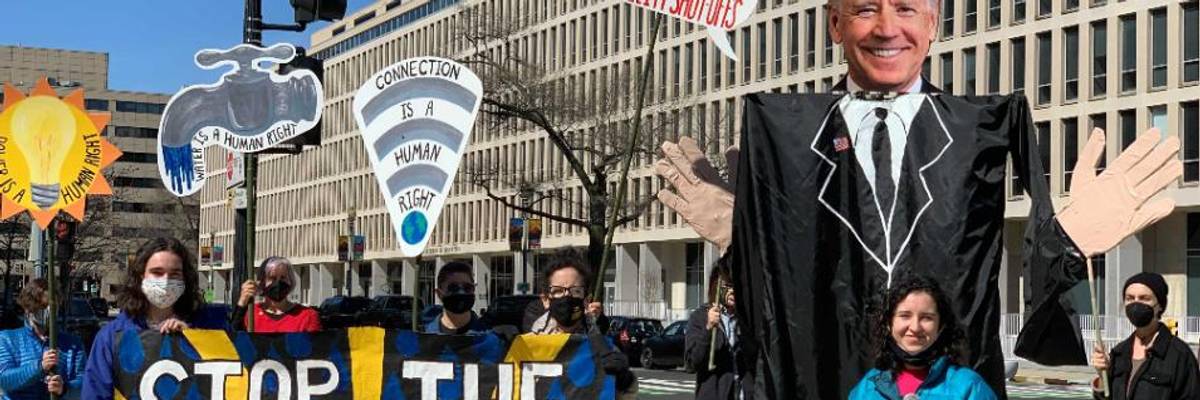
Activists rallied on Saturday, March 13, 2021 to urge President Joe Biden to use his executive authority to halt utility shutoffs nationwide. (Photo: Jean Su/Center for Biological Diversity)
Environmental justice and open internet activists rallied outside the Department of Health and Human Services building in Washington, D.C. on Saturday to urge President Joe Biden to issue a nationwide moratorium on utility shutoffs as the few remaining state-level restrictions are lifted, leaving tens of millions of households vulnerable to losing water, power, and broadband.
Advocacy organizations have been demanding a nationwide ban on "inhumane" utility shutoffs for months as the coronavirus pandemic and resulting economic crisis have left countless families unable to afford monthly payments. While some states took early action to prevent utility companies from disconnecting customers during the crisis, many of those restrictions have since either expired or been rolled back. Pennsylvania, for instance, is set to lift its limited moratorium on utility disconnections at the end of the month, putting over a million people at risk.
"It's been one year since Covid started ravaging the country, but Congress, the president, and local officials are still not protecting access to life-saving utility services."
--Gaby Sarri-Tobar, Center for Biological Diversity
The federal government, meanwhile, has yet to take sweeping action to prevent utility shutoffs. The newly approved American Rescue Plan includes some funding to assist low-income households struggling to afford water and electricity bills, but that is well short of the national moratorium that advocacy groups are demanding.
"We need a national moratorium on utility shutoffs so everyone has access to water, electricity, and broadband," said Jean Su of the Center for Biological Diversity (CBD), one of the groups that helped organize Saturday's rally.
In a press release, CBD noted that currently "only nine states and D.C. have moratoria on disconnections."
"But D.C.'s will expire soon unless the city government renews it," the group said. "Almost 72,000 residential D.C. customers owe a collective $30 million in debt to Pepco, the District's Exelon-owned electric utility. Meanwhile, Pepco Holdings reported $81 million in earnings in its fourth quarter."
A week before the president took office in January, a diverse coalition of more than 600 advocacy groups implored Biden to support a nationwide moratorium on utility shutoffs, calling the proposal "an important and urgent measure to help slow the spread of Covid-19." The groups even presented Biden and Vice President Kamala Harris with a draft executive order (pdf).
But Biden has not assented to the demand, with the White House agreeing only to support new spending to help families cover unpaid bills that have been piling up since last year.
"It's been one year since Covid started ravaging the country, but Congress, the president, and local officials are still not protecting access to life-saving utility services," Gaby Sarri-Tobar, an energy justice campaigner with CBD, said Saturday. "We urge President Biden and Health and Human Services to put a shutoffs moratorium in place."
"We also need universal utility reform to build a just, equitable energy future where households aren't forced into choosing between keeping their lights on or feeding their families," added Sarri-Tobar.
Dear Common Dreams reader, It’s been nearly 30 years since I co-founded Common Dreams with my late wife, Lina Newhouser. We had the radical notion that journalism should serve the public good, not corporate profits. It was clear to us from the outset what it would take to build such a project. No paid advertisements. No corporate sponsors. No millionaire publisher telling us what to think or do. Many people said we wouldn't last a year, but we proved those doubters wrong. Together with a tremendous team of journalists and dedicated staff, we built an independent media outlet free from the constraints of profits and corporate control. Our mission has always been simple: To inform. To inspire. To ignite change for the common good. Building Common Dreams was not easy. Our survival was never guaranteed. When you take on the most powerful forces—Wall Street greed, fossil fuel industry destruction, Big Tech lobbyists, and uber-rich oligarchs who have spent billions upon billions rigging the economy and democracy in their favor—the only bulwark you have is supporters who believe in your work. But here’s the urgent message from me today. It's never been this bad out there. And it's never been this hard to keep us going. At the very moment Common Dreams is most needed, the threats we face are intensifying. We need your support now more than ever. We don't accept corporate advertising and never will. We don't have a paywall because we don't think people should be blocked from critical news based on their ability to pay. Everything we do is funded by the donations of readers like you. When everyone does the little they can afford, we are strong. But if that support retreats or dries up, so do we. Will you donate now to make sure Common Dreams not only survives but thrives? —Craig Brown, Co-founder |
Environmental justice and open internet activists rallied outside the Department of Health and Human Services building in Washington, D.C. on Saturday to urge President Joe Biden to issue a nationwide moratorium on utility shutoffs as the few remaining state-level restrictions are lifted, leaving tens of millions of households vulnerable to losing water, power, and broadband.
Advocacy organizations have been demanding a nationwide ban on "inhumane" utility shutoffs for months as the coronavirus pandemic and resulting economic crisis have left countless families unable to afford monthly payments. While some states took early action to prevent utility companies from disconnecting customers during the crisis, many of those restrictions have since either expired or been rolled back. Pennsylvania, for instance, is set to lift its limited moratorium on utility disconnections at the end of the month, putting over a million people at risk.
"It's been one year since Covid started ravaging the country, but Congress, the president, and local officials are still not protecting access to life-saving utility services."
--Gaby Sarri-Tobar, Center for Biological Diversity
The federal government, meanwhile, has yet to take sweeping action to prevent utility shutoffs. The newly approved American Rescue Plan includes some funding to assist low-income households struggling to afford water and electricity bills, but that is well short of the national moratorium that advocacy groups are demanding.
"We need a national moratorium on utility shutoffs so everyone has access to water, electricity, and broadband," said Jean Su of the Center for Biological Diversity (CBD), one of the groups that helped organize Saturday's rally.
In a press release, CBD noted that currently "only nine states and D.C. have moratoria on disconnections."
"But D.C.'s will expire soon unless the city government renews it," the group said. "Almost 72,000 residential D.C. customers owe a collective $30 million in debt to Pepco, the District's Exelon-owned electric utility. Meanwhile, Pepco Holdings reported $81 million in earnings in its fourth quarter."
A week before the president took office in January, a diverse coalition of more than 600 advocacy groups implored Biden to support a nationwide moratorium on utility shutoffs, calling the proposal "an important and urgent measure to help slow the spread of Covid-19." The groups even presented Biden and Vice President Kamala Harris with a draft executive order (pdf).
But Biden has not assented to the demand, with the White House agreeing only to support new spending to help families cover unpaid bills that have been piling up since last year.
"It's been one year since Covid started ravaging the country, but Congress, the president, and local officials are still not protecting access to life-saving utility services," Gaby Sarri-Tobar, an energy justice campaigner with CBD, said Saturday. "We urge President Biden and Health and Human Services to put a shutoffs moratorium in place."
"We also need universal utility reform to build a just, equitable energy future where households aren't forced into choosing between keeping their lights on or feeding their families," added Sarri-Tobar.
Environmental justice and open internet activists rallied outside the Department of Health and Human Services building in Washington, D.C. on Saturday to urge President Joe Biden to issue a nationwide moratorium on utility shutoffs as the few remaining state-level restrictions are lifted, leaving tens of millions of households vulnerable to losing water, power, and broadband.
Advocacy organizations have been demanding a nationwide ban on "inhumane" utility shutoffs for months as the coronavirus pandemic and resulting economic crisis have left countless families unable to afford monthly payments. While some states took early action to prevent utility companies from disconnecting customers during the crisis, many of those restrictions have since either expired or been rolled back. Pennsylvania, for instance, is set to lift its limited moratorium on utility disconnections at the end of the month, putting over a million people at risk.
"It's been one year since Covid started ravaging the country, but Congress, the president, and local officials are still not protecting access to life-saving utility services."
--Gaby Sarri-Tobar, Center for Biological Diversity
The federal government, meanwhile, has yet to take sweeping action to prevent utility shutoffs. The newly approved American Rescue Plan includes some funding to assist low-income households struggling to afford water and electricity bills, but that is well short of the national moratorium that advocacy groups are demanding.
"We need a national moratorium on utility shutoffs so everyone has access to water, electricity, and broadband," said Jean Su of the Center for Biological Diversity (CBD), one of the groups that helped organize Saturday's rally.
In a press release, CBD noted that currently "only nine states and D.C. have moratoria on disconnections."
"But D.C.'s will expire soon unless the city government renews it," the group said. "Almost 72,000 residential D.C. customers owe a collective $30 million in debt to Pepco, the District's Exelon-owned electric utility. Meanwhile, Pepco Holdings reported $81 million in earnings in its fourth quarter."
A week before the president took office in January, a diverse coalition of more than 600 advocacy groups implored Biden to support a nationwide moratorium on utility shutoffs, calling the proposal "an important and urgent measure to help slow the spread of Covid-19." The groups even presented Biden and Vice President Kamala Harris with a draft executive order (pdf).
But Biden has not assented to the demand, with the White House agreeing only to support new spending to help families cover unpaid bills that have been piling up since last year.
"It's been one year since Covid started ravaging the country, but Congress, the president, and local officials are still not protecting access to life-saving utility services," Gaby Sarri-Tobar, an energy justice campaigner with CBD, said Saturday. "We urge President Biden and Health and Human Services to put a shutoffs moratorium in place."
"We also need universal utility reform to build a just, equitable energy future where households aren't forced into choosing between keeping their lights on or feeding their families," added Sarri-Tobar.

