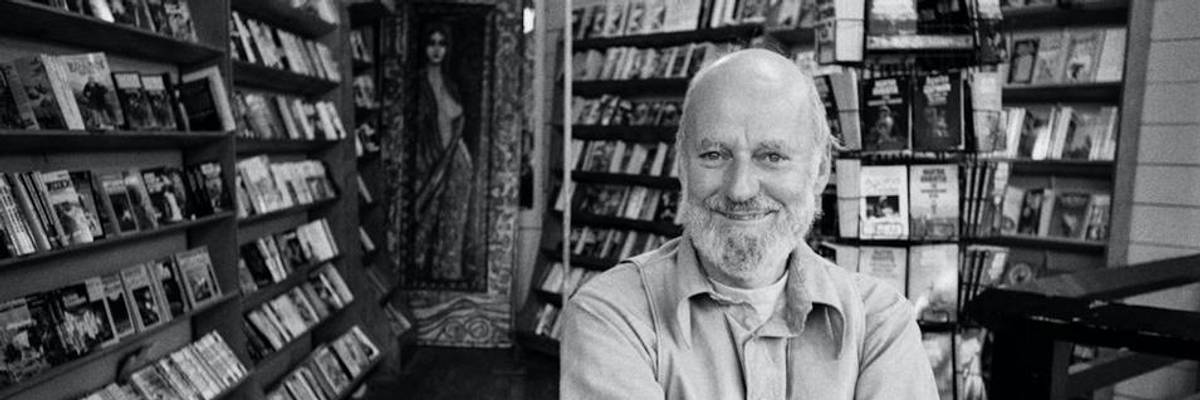
Lawrence Ferlinghetti was photographed in 1977 in the venerable City Lights Bookstore he founded in San Francisco's North Beach neighborhood in 1953. (Photo: Janet Fries/Getty Images)
Lawrence Ferlinghetti--Poet, Publisher, and Activist--Dies in His Beloved San Francisco at Age 101
"Lawrence Ferlinghetti kicked open the door to free up publishing in this country. He risked a great deal for a lot of books that are now considered classics."
Lawrence Ferlinghetti--acclaimed poet, playwright, novelist, artist, independent publisher, activist, first Poet Laureate of San Francisco, and co-founder of the iconic City Lights Bookstore--died Monday at the age of 101.
"Poetry should be dissident and subversive and an agent for change."
--Lawrence Ferlinghetti
The San Francisco Chronicle reports Ferlinghetti died of a degenerative lung condition in the apartment where he lived for 40 years in the city's North Beach neighborhood. That's where he founded City Lights on Columbus Avenue in 1953 with professor Peter D. Martin.
After serving in the U.S. Navy during World War II and earning a master's degree in English literature at Columbia University, Ferlinghetti--a native of Yonkers, New York and a graduate of the University of North Carolina at Chapel Hill--moved to San Francisco and opened his bookstore and publishing house.
"It was still the last frontier when I arrived in 1951," he recalled on his 96th birthday. "It was a wide-open city. You could come here and just start anything you wanted, because, in New York City, it would have been impossible to start a bookstore unless you had lots of money."
City Lights--which published the works of Beat giants including Jack Kerouac and Allen Ginsberg--was the lodestar in the firmament of a burgeoning San Francisco-based counterculture that over the course of two tumultuous decades would transform the world. Ferlinghetti's publication of Ginsberg's Howl and Other Poems (1956) would establish City Lights as the Beat generation's most venerable literary institution and hangout.
It also hung a target on the Beats' backs, as Howl--which referenced illicit drugs and sex acts--resulted in the 1957 arrests of Ferlinghetti and City Lights manager Shig Murao and a subsequent obscenity trial. The judge in the case ruled that Howl was not obscene due to its "redeeming social significance."
"Lawrence Ferlinghetti kicked open the door to free up publishing in this country," San Francisco novelist Herbert Gold told the Chronicle. "He risked a great deal for a lot of books that are now considered classics."
Although he did not consider himself a Beat poet, Ferlinghetti was nonetheless a giant of the Beat scene, publishing his first poetry collection, A Coney Island of the Mind, in 1958. The book contains some of Ferlinghetti's most renowned works, including "I Am Waiting" and "Junkman's Obbligato," which were recited with jazz accompaniment.
In one work from the book, "In Goya's Greatest Scenes We Seem to See," Ferlinghetti compares the suffering depicted in Los Desastres de la Guerra (The Disasters of War)--the Spanish romantic painter's depiction of the Napoleonic Wars--to post-World War II America:
they are the same people/ only further from home/ on freeways fifty lanes wide/ on a concrete continent/ spaced with bland billboards/ illustrating imbecile illusions of happiness
Ferlinghetti's belief that "art should be accessible to all people, not just a handful of highly educated intellectuals," was evident in his work, which often painted pictures of everyday people doing everyday things. From "In Golden Gate Park That Day" (1958):
In Golden Gate Park that day/ a man and his wife were coming along/ thru the enormous meadow/ which was the meadow of the world/ He was wearing green suspenders/ and carrying and old beat-up flute in one hand/ while his wife had a bunch of grapes/ which she kept handing out individually/ to various squirrels as if each were a little joke
A self-described philosophical anarchist, Ferlinghetti was a leading figure in the anti-war movement of the 1960s and beyond. In 1967--the year of San Francisco's famous "Summer of Love"--he was a featured presenter at the Human Be-In, and the following year he was a key signatory of the Writers and Editors War Tax Protest pledge against the Vietnam War. In January 1968 Ferlinghetti was sentenced to 17 days in the Alameda County Jail for protesting outside an Oakland military induction center.
Ferlinghetti's activism did not fade away like that psychedelic summer of '67; it lived on in his words and deeds. One of his final poems, "Trump's Trojan Horse" (2017), began:
Homer didn't live long enough/ To tell of Trump's White House/ Which is his Trojan Horse/ From which all the President's men/ Burst out to destroy democracy
"Poetry should be dissident and subversive and an agent for change," wrote Ferlinghetti in his final book, Poetry as Insurgent Art (2007). "Question everything and everyone, including Socrates, who questioned everything. Strive to change the world in such a way that there is no further need to be need dissident. A natural-born nonviolent enemy of the state."
Although he never lost his love for his adopted city, Ferlinghetti did lament the transformational changes it underwent beginning in the first dot-com boom and bust, blasting Silicon Valley millionaires who flooded San Francisco with "bags full of cash and no manners" and priced his fellow artists out of town. From "The Poetic City That Was" (2001):
Fifty years later/ he awoke one fine morning/ looking for anywhere he could live and work/ The new owners of his old flat now wanted $4,500 a month/ And many of his friends were also evicted
On Tuesday, tributes poured in from Ferlinghetti's friends and fans.
"It was my good fortune to have worked closely with him for more than 50 years," City Lights co-owner and former executive director Nancy Peters told the Chronicle. "We've lost a great poet and visionary. Lawrence--never Larry--was a legend in his time and a great San Franciscan."
We are at a crossroads
This country and this world are at a monumental crossroads. In a few short weeks, US voters will have an opportunity to beat back the forces of fascism and confront the billionaires who are rigging the economy, our media system, and our democracy, making it increasingly impossible for ordinary people to get by. We’re not just talking about the election. We’re talking about what must be done once these fascist elements are vanquished from power. We need a bolder set of solutions than what either major party has so far been willing to offer and a working-class movement ready to fight like hell for it. Trump didn't emerge from nowhere. The conditions that fueled MAGA authoritarianism were created by decades of radical neoliberal economic policies and a corrupt political system dominated by corporate interests. They slashed taxes on the super-rich, promising that the benefits would trickle down. They said giveaways to the corporate titans would make life more affordable for the rest of us. It was all bullshit. And when a bitter, betrayed populace searches for someone to blame, right-wing demagogues have little trouble finding scapegoats. People know when they're being lied to, but you won't hear any of this from the corporate media. Only independent journalism—powered and funded by people who believe in building a better world—can deliver truly trustworthy daily news. Our Fall Campaign is underway, and we need your help. To power our newsroom through the rest of the year, we need to raise $125,000 by midnight on October 31. So if you share our vision, please contribute whatever you can to sustain our work. |
Lawrence Ferlinghetti--acclaimed poet, playwright, novelist, artist, independent publisher, activist, first Poet Laureate of San Francisco, and co-founder of the iconic City Lights Bookstore--died Monday at the age of 101.
"Poetry should be dissident and subversive and an agent for change."
--Lawrence Ferlinghetti
The San Francisco Chronicle reports Ferlinghetti died of a degenerative lung condition in the apartment where he lived for 40 years in the city's North Beach neighborhood. That's where he founded City Lights on Columbus Avenue in 1953 with professor Peter D. Martin.
After serving in the U.S. Navy during World War II and earning a master's degree in English literature at Columbia University, Ferlinghetti--a native of Yonkers, New York and a graduate of the University of North Carolina at Chapel Hill--moved to San Francisco and opened his bookstore and publishing house.
"It was still the last frontier when I arrived in 1951," he recalled on his 96th birthday. "It was a wide-open city. You could come here and just start anything you wanted, because, in New York City, it would have been impossible to start a bookstore unless you had lots of money."
City Lights--which published the works of Beat giants including Jack Kerouac and Allen Ginsberg--was the lodestar in the firmament of a burgeoning San Francisco-based counterculture that over the course of two tumultuous decades would transform the world. Ferlinghetti's publication of Ginsberg's Howl and Other Poems (1956) would establish City Lights as the Beat generation's most venerable literary institution and hangout.
It also hung a target on the Beats' backs, as Howl--which referenced illicit drugs and sex acts--resulted in the 1957 arrests of Ferlinghetti and City Lights manager Shig Murao and a subsequent obscenity trial. The judge in the case ruled that Howl was not obscene due to its "redeeming social significance."
"Lawrence Ferlinghetti kicked open the door to free up publishing in this country," San Francisco novelist Herbert Gold told the Chronicle. "He risked a great deal for a lot of books that are now considered classics."
Although he did not consider himself a Beat poet, Ferlinghetti was nonetheless a giant of the Beat scene, publishing his first poetry collection, A Coney Island of the Mind, in 1958. The book contains some of Ferlinghetti's most renowned works, including "I Am Waiting" and "Junkman's Obbligato," which were recited with jazz accompaniment.
In one work from the book, "In Goya's Greatest Scenes We Seem to See," Ferlinghetti compares the suffering depicted in Los Desastres de la Guerra (The Disasters of War)--the Spanish romantic painter's depiction of the Napoleonic Wars--to post-World War II America:
they are the same people/ only further from home/ on freeways fifty lanes wide/ on a concrete continent/ spaced with bland billboards/ illustrating imbecile illusions of happiness
Ferlinghetti's belief that "art should be accessible to all people, not just a handful of highly educated intellectuals," was evident in his work, which often painted pictures of everyday people doing everyday things. From "In Golden Gate Park That Day" (1958):
In Golden Gate Park that day/ a man and his wife were coming along/ thru the enormous meadow/ which was the meadow of the world/ He was wearing green suspenders/ and carrying and old beat-up flute in one hand/ while his wife had a bunch of grapes/ which she kept handing out individually/ to various squirrels as if each were a little joke
A self-described philosophical anarchist, Ferlinghetti was a leading figure in the anti-war movement of the 1960s and beyond. In 1967--the year of San Francisco's famous "Summer of Love"--he was a featured presenter at the Human Be-In, and the following year he was a key signatory of the Writers and Editors War Tax Protest pledge against the Vietnam War. In January 1968 Ferlinghetti was sentenced to 17 days in the Alameda County Jail for protesting outside an Oakland military induction center.
Ferlinghetti's activism did not fade away like that psychedelic summer of '67; it lived on in his words and deeds. One of his final poems, "Trump's Trojan Horse" (2017), began:
Homer didn't live long enough/ To tell of Trump's White House/ Which is his Trojan Horse/ From which all the President's men/ Burst out to destroy democracy
"Poetry should be dissident and subversive and an agent for change," wrote Ferlinghetti in his final book, Poetry as Insurgent Art (2007). "Question everything and everyone, including Socrates, who questioned everything. Strive to change the world in such a way that there is no further need to be need dissident. A natural-born nonviolent enemy of the state."
Although he never lost his love for his adopted city, Ferlinghetti did lament the transformational changes it underwent beginning in the first dot-com boom and bust, blasting Silicon Valley millionaires who flooded San Francisco with "bags full of cash and no manners" and priced his fellow artists out of town. From "The Poetic City That Was" (2001):
Fifty years later/ he awoke one fine morning/ looking for anywhere he could live and work/ The new owners of his old flat now wanted $4,500 a month/ And many of his friends were also evicted
On Tuesday, tributes poured in from Ferlinghetti's friends and fans.
"It was my good fortune to have worked closely with him for more than 50 years," City Lights co-owner and former executive director Nancy Peters told the Chronicle. "We've lost a great poet and visionary. Lawrence--never Larry--was a legend in his time and a great San Franciscan."
Lawrence Ferlinghetti--acclaimed poet, playwright, novelist, artist, independent publisher, activist, first Poet Laureate of San Francisco, and co-founder of the iconic City Lights Bookstore--died Monday at the age of 101.
"Poetry should be dissident and subversive and an agent for change."
--Lawrence Ferlinghetti
The San Francisco Chronicle reports Ferlinghetti died of a degenerative lung condition in the apartment where he lived for 40 years in the city's North Beach neighborhood. That's where he founded City Lights on Columbus Avenue in 1953 with professor Peter D. Martin.
After serving in the U.S. Navy during World War II and earning a master's degree in English literature at Columbia University, Ferlinghetti--a native of Yonkers, New York and a graduate of the University of North Carolina at Chapel Hill--moved to San Francisco and opened his bookstore and publishing house.
"It was still the last frontier when I arrived in 1951," he recalled on his 96th birthday. "It was a wide-open city. You could come here and just start anything you wanted, because, in New York City, it would have been impossible to start a bookstore unless you had lots of money."
City Lights--which published the works of Beat giants including Jack Kerouac and Allen Ginsberg--was the lodestar in the firmament of a burgeoning San Francisco-based counterculture that over the course of two tumultuous decades would transform the world. Ferlinghetti's publication of Ginsberg's Howl and Other Poems (1956) would establish City Lights as the Beat generation's most venerable literary institution and hangout.
It also hung a target on the Beats' backs, as Howl--which referenced illicit drugs and sex acts--resulted in the 1957 arrests of Ferlinghetti and City Lights manager Shig Murao and a subsequent obscenity trial. The judge in the case ruled that Howl was not obscene due to its "redeeming social significance."
"Lawrence Ferlinghetti kicked open the door to free up publishing in this country," San Francisco novelist Herbert Gold told the Chronicle. "He risked a great deal for a lot of books that are now considered classics."
Although he did not consider himself a Beat poet, Ferlinghetti was nonetheless a giant of the Beat scene, publishing his first poetry collection, A Coney Island of the Mind, in 1958. The book contains some of Ferlinghetti's most renowned works, including "I Am Waiting" and "Junkman's Obbligato," which were recited with jazz accompaniment.
In one work from the book, "In Goya's Greatest Scenes We Seem to See," Ferlinghetti compares the suffering depicted in Los Desastres de la Guerra (The Disasters of War)--the Spanish romantic painter's depiction of the Napoleonic Wars--to post-World War II America:
they are the same people/ only further from home/ on freeways fifty lanes wide/ on a concrete continent/ spaced with bland billboards/ illustrating imbecile illusions of happiness
Ferlinghetti's belief that "art should be accessible to all people, not just a handful of highly educated intellectuals," was evident in his work, which often painted pictures of everyday people doing everyday things. From "In Golden Gate Park That Day" (1958):
In Golden Gate Park that day/ a man and his wife were coming along/ thru the enormous meadow/ which was the meadow of the world/ He was wearing green suspenders/ and carrying and old beat-up flute in one hand/ while his wife had a bunch of grapes/ which she kept handing out individually/ to various squirrels as if each were a little joke
A self-described philosophical anarchist, Ferlinghetti was a leading figure in the anti-war movement of the 1960s and beyond. In 1967--the year of San Francisco's famous "Summer of Love"--he was a featured presenter at the Human Be-In, and the following year he was a key signatory of the Writers and Editors War Tax Protest pledge against the Vietnam War. In January 1968 Ferlinghetti was sentenced to 17 days in the Alameda County Jail for protesting outside an Oakland military induction center.
Ferlinghetti's activism did not fade away like that psychedelic summer of '67; it lived on in his words and deeds. One of his final poems, "Trump's Trojan Horse" (2017), began:
Homer didn't live long enough/ To tell of Trump's White House/ Which is his Trojan Horse/ From which all the President's men/ Burst out to destroy democracy
"Poetry should be dissident and subversive and an agent for change," wrote Ferlinghetti in his final book, Poetry as Insurgent Art (2007). "Question everything and everyone, including Socrates, who questioned everything. Strive to change the world in such a way that there is no further need to be need dissident. A natural-born nonviolent enemy of the state."
Although he never lost his love for his adopted city, Ferlinghetti did lament the transformational changes it underwent beginning in the first dot-com boom and bust, blasting Silicon Valley millionaires who flooded San Francisco with "bags full of cash and no manners" and priced his fellow artists out of town. From "The Poetic City That Was" (2001):
Fifty years later/ he awoke one fine morning/ looking for anywhere he could live and work/ The new owners of his old flat now wanted $4,500 a month/ And many of his friends were also evicted
On Tuesday, tributes poured in from Ferlinghetti's friends and fans.
"It was my good fortune to have worked closely with him for more than 50 years," City Lights co-owner and former executive director Nancy Peters told the Chronicle. "We've lost a great poet and visionary. Lawrence--never Larry--was a legend in his time and a great San Franciscan."