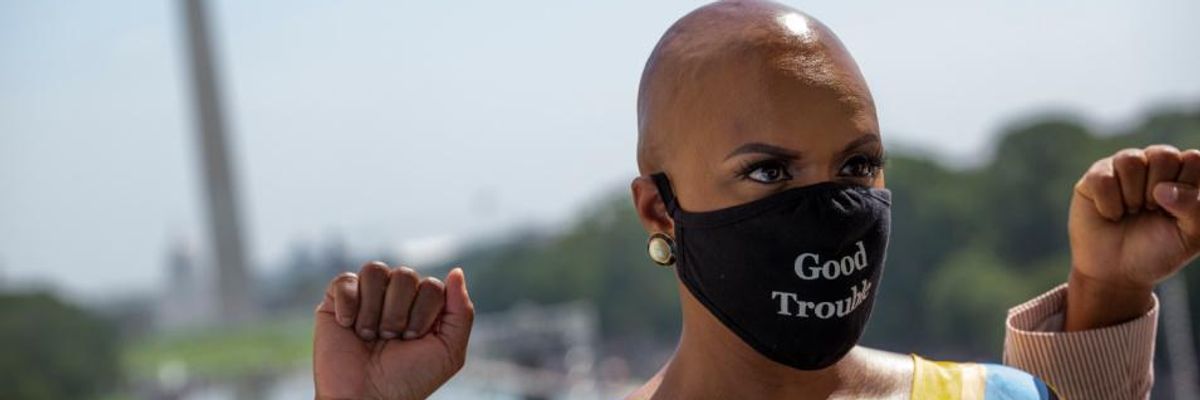
Rep. Ayanna Pressley (D-Mass.) raises her fist during the 57th annual March on Washington on Friday, August 28, 2020 in Washington, D.C. (Photo: Erin Lefevre/NurPhoto via Getty Images)
Demanding 'Dignified Work and a Living Wage' as Legal Rights, Ayanna Pressley Unveils Jobs Guarantee Resolution
"It's time to establish a legal right to a job for all people in America."
With the backing of civil rights organizations, labor unions, and economic experts, Congresswoman Ayanna Pressley on Thursday morning unveiled a jobs guarantee resolution demanding that "meaningful, dignified work" at a livable wage be made an enforceable legal right in the United States.
Presenting her resolution as an effort to build on the work of generations of civil rights leaders who have connected the cause of racial justice with the fight for full employment, Pressley said in a statement Thursday that "it's long past time to pursue bold, intentional policies that affirm equity and recognize the dignity and humanity of all people"--an objective that requires sweeping legislative action, not mere tinkering by the Federal Reserve.
"A federal job guarantee is an important investment in the American people, our communities, and an equitable economy that works for all. It affirms the right to meaningful, dignified work and a living wage."
--Rep. Ayanna Pressley
"It's time to establish a legal right to a job for all people in America," said the Massachusetts Democrat. "A federal job guarantee is an important investment in the American people, our communities, and an equitable economy that works for all. It affirms the right to meaningful, dignified work and a living wage."
The 16-page resolution (pdf), introduced amid widespread economic dislocation caused by the coronavirus pandemic, invokes as inspiration the 1963 March on Washington for Jobs and Freedom, which placed the right to employment and decent pay at the heart of the civil rights struggle.
"What is the value of winning access to public accommodations for those who lack money to use them?" Bayard Rustin, the principal organizer of the march, asked in 1965. "The minute the movement faced this question, it was compelled to expand its vision beyond race relations to economic relations."
Pressley's resolution goes on to cite the legacy of Coretta Scott King--the wife of Martin Luther King, Jr.--who "led a grassroots movement to enact a job guarantee," as well as President Franklin Delano Roosevelt's 1944 Economic Bill of Rights, which included "the right to a useful and remunerative job" among its slate of demands.
"These leaders all built on and advanced the work of earlier pioneers like Sadie T.M. Alexander, the nation's first Black economist, who advocated a job guarantee to address racial discrimination against Black workers, while improving labor market conditions for all workers in the 1940s; and... throughout the past 100 years, activists and intellectuals like Ella Baker and the Mississippi Freedom Democratic Party have all seen a federal job guarantee as a key element of racial justice," the resolution states.
In a statement endorsing Pressley's proposal, Sunrise Movement executive director Varshini Prakash called the resolution "a step towards a brighter future for young people, working people, and for people of color" and "a vital leap towards what's needed for a Green New Deal."
"Congresswoman Pressley's resolution is an opportunity for our country to step up and invest in its people, rather than big corporations and fossil fuel CEOs," Prakash added.
According to a summary (pdf) released by Pressley's office, the resolution calls for a permanent jobs program that would be administered by the Department of Labor in partnership with the Treasury Secretary.
"The Secretary of Labor would direct Treasury funds to local Employment Offices to manage job guarantee projects and match job seekers to projects, as well as cover any related capital and administrative costs," the summary states.
Jobs created under the new federal program, according to Pressley's office, would be geared toward:
- Ensuring the delivery of high-quality, professional care to children, seniors, and others in need of long-term support in family based, informal, and formal settings;
- Augmenting the staffing of public education and early childhood learning, including Head Start and preschool;
- Strengthening public afterschool programs, libraries, and recreational programs to provide lifelong learning and enrichment for people of all ages;
- Implementing community infrastructure and improvement projects that revitalize neighborhoods and increase accessibility...;
- Expanding emergency preparedness, and relief and recovery from natural and community disasters, including public health, natural disasters, and environmental emergencies;
- Producing works of public art and documentation of American history akin to the WPA's Federal Arts Project;
- Implementing environmental conservation, remediation, and sustainability initiatives and increasing the energy efficiency of buildings and our housing stock to address climate change;
- Rehabilitating and retrofitting our existing affordable housing stock to ensure safe, affordable, accessible, quality homes, and supporting the development of new affordable housing and social housing to address the nation's housing crisis; and
- Other projects that address public needs and can be implemented quickly.
"At a time when 28 percent of full-time workers earn less than $15 per hour,a job guarantee would set a new standard for quality jobs, pressuring low-wage employers to increase wages and benefits," the summary reads.
"By hiring workers in the midst of a downturn," the document continues, "a permanent job guarantee would operate as an automatic stabilizer, maintaining consumer spending and protecting us from prolonged recessions and jobless recoveries--making the economy more resilient as well as more inclusive."
We are at a crossroads
This country and this world are at a monumental crossroads. In a few short weeks, US voters will have an opportunity to beat back the forces of fascism and confront the billionaires who are rigging the economy, our media system, and our democracy, making it increasingly impossible for ordinary people to get by. We’re not just talking about the election. We’re talking about what must be done once these fascist elements are vanquished from power. We need a bolder set of solutions than what either major party has so far been willing to offer and a working-class movement ready to fight like hell for it. Trump didn't emerge from nowhere. The conditions that fueled MAGA authoritarianism were created by decades of radical neoliberal economic policies and a corrupt political system dominated by corporate interests. They slashed taxes on the super-rich, promising that the benefits would trickle down. They said giveaways to the corporate titans would make life more affordable for the rest of us. It was all bullshit. And when a bitter, betrayed populace searches for someone to blame, right-wing demagogues have little trouble finding scapegoats. People know when they're being lied to, but you won't hear any of this from the corporate media. Only independent journalism—powered and funded by people who believe in building a better world—can deliver truly trustworthy daily news. Our Fall Campaign is underway, and we need your help. To power our newsroom through the rest of the year, we need to raise $125,000 by midnight on October 31. So if you share our vision, please contribute whatever you can to sustain our work. |
With the backing of civil rights organizations, labor unions, and economic experts, Congresswoman Ayanna Pressley on Thursday morning unveiled a jobs guarantee resolution demanding that "meaningful, dignified work" at a livable wage be made an enforceable legal right in the United States.
Presenting her resolution as an effort to build on the work of generations of civil rights leaders who have connected the cause of racial justice with the fight for full employment, Pressley said in a statement Thursday that "it's long past time to pursue bold, intentional policies that affirm equity and recognize the dignity and humanity of all people"--an objective that requires sweeping legislative action, not mere tinkering by the Federal Reserve.
"A federal job guarantee is an important investment in the American people, our communities, and an equitable economy that works for all. It affirms the right to meaningful, dignified work and a living wage."
--Rep. Ayanna Pressley
"It's time to establish a legal right to a job for all people in America," said the Massachusetts Democrat. "A federal job guarantee is an important investment in the American people, our communities, and an equitable economy that works for all. It affirms the right to meaningful, dignified work and a living wage."
The 16-page resolution (pdf), introduced amid widespread economic dislocation caused by the coronavirus pandemic, invokes as inspiration the 1963 March on Washington for Jobs and Freedom, which placed the right to employment and decent pay at the heart of the civil rights struggle.
"What is the value of winning access to public accommodations for those who lack money to use them?" Bayard Rustin, the principal organizer of the march, asked in 1965. "The minute the movement faced this question, it was compelled to expand its vision beyond race relations to economic relations."
Pressley's resolution goes on to cite the legacy of Coretta Scott King--the wife of Martin Luther King, Jr.--who "led a grassroots movement to enact a job guarantee," as well as President Franklin Delano Roosevelt's 1944 Economic Bill of Rights, which included "the right to a useful and remunerative job" among its slate of demands.
"These leaders all built on and advanced the work of earlier pioneers like Sadie T.M. Alexander, the nation's first Black economist, who advocated a job guarantee to address racial discrimination against Black workers, while improving labor market conditions for all workers in the 1940s; and... throughout the past 100 years, activists and intellectuals like Ella Baker and the Mississippi Freedom Democratic Party have all seen a federal job guarantee as a key element of racial justice," the resolution states.
In a statement endorsing Pressley's proposal, Sunrise Movement executive director Varshini Prakash called the resolution "a step towards a brighter future for young people, working people, and for people of color" and "a vital leap towards what's needed for a Green New Deal."
"Congresswoman Pressley's resolution is an opportunity for our country to step up and invest in its people, rather than big corporations and fossil fuel CEOs," Prakash added.
According to a summary (pdf) released by Pressley's office, the resolution calls for a permanent jobs program that would be administered by the Department of Labor in partnership with the Treasury Secretary.
"The Secretary of Labor would direct Treasury funds to local Employment Offices to manage job guarantee projects and match job seekers to projects, as well as cover any related capital and administrative costs," the summary states.
Jobs created under the new federal program, according to Pressley's office, would be geared toward:
- Ensuring the delivery of high-quality, professional care to children, seniors, and others in need of long-term support in family based, informal, and formal settings;
- Augmenting the staffing of public education and early childhood learning, including Head Start and preschool;
- Strengthening public afterschool programs, libraries, and recreational programs to provide lifelong learning and enrichment for people of all ages;
- Implementing community infrastructure and improvement projects that revitalize neighborhoods and increase accessibility...;
- Expanding emergency preparedness, and relief and recovery from natural and community disasters, including public health, natural disasters, and environmental emergencies;
- Producing works of public art and documentation of American history akin to the WPA's Federal Arts Project;
- Implementing environmental conservation, remediation, and sustainability initiatives and increasing the energy efficiency of buildings and our housing stock to address climate change;
- Rehabilitating and retrofitting our existing affordable housing stock to ensure safe, affordable, accessible, quality homes, and supporting the development of new affordable housing and social housing to address the nation's housing crisis; and
- Other projects that address public needs and can be implemented quickly.
"At a time when 28 percent of full-time workers earn less than $15 per hour,a job guarantee would set a new standard for quality jobs, pressuring low-wage employers to increase wages and benefits," the summary reads.
"By hiring workers in the midst of a downturn," the document continues, "a permanent job guarantee would operate as an automatic stabilizer, maintaining consumer spending and protecting us from prolonged recessions and jobless recoveries--making the economy more resilient as well as more inclusive."
With the backing of civil rights organizations, labor unions, and economic experts, Congresswoman Ayanna Pressley on Thursday morning unveiled a jobs guarantee resolution demanding that "meaningful, dignified work" at a livable wage be made an enforceable legal right in the United States.
Presenting her resolution as an effort to build on the work of generations of civil rights leaders who have connected the cause of racial justice with the fight for full employment, Pressley said in a statement Thursday that "it's long past time to pursue bold, intentional policies that affirm equity and recognize the dignity and humanity of all people"--an objective that requires sweeping legislative action, not mere tinkering by the Federal Reserve.
"A federal job guarantee is an important investment in the American people, our communities, and an equitable economy that works for all. It affirms the right to meaningful, dignified work and a living wage."
--Rep. Ayanna Pressley
"It's time to establish a legal right to a job for all people in America," said the Massachusetts Democrat. "A federal job guarantee is an important investment in the American people, our communities, and an equitable economy that works for all. It affirms the right to meaningful, dignified work and a living wage."
The 16-page resolution (pdf), introduced amid widespread economic dislocation caused by the coronavirus pandemic, invokes as inspiration the 1963 March on Washington for Jobs and Freedom, which placed the right to employment and decent pay at the heart of the civil rights struggle.
"What is the value of winning access to public accommodations for those who lack money to use them?" Bayard Rustin, the principal organizer of the march, asked in 1965. "The minute the movement faced this question, it was compelled to expand its vision beyond race relations to economic relations."
Pressley's resolution goes on to cite the legacy of Coretta Scott King--the wife of Martin Luther King, Jr.--who "led a grassroots movement to enact a job guarantee," as well as President Franklin Delano Roosevelt's 1944 Economic Bill of Rights, which included "the right to a useful and remunerative job" among its slate of demands.
"These leaders all built on and advanced the work of earlier pioneers like Sadie T.M. Alexander, the nation's first Black economist, who advocated a job guarantee to address racial discrimination against Black workers, while improving labor market conditions for all workers in the 1940s; and... throughout the past 100 years, activists and intellectuals like Ella Baker and the Mississippi Freedom Democratic Party have all seen a federal job guarantee as a key element of racial justice," the resolution states.
In a statement endorsing Pressley's proposal, Sunrise Movement executive director Varshini Prakash called the resolution "a step towards a brighter future for young people, working people, and for people of color" and "a vital leap towards what's needed for a Green New Deal."
"Congresswoman Pressley's resolution is an opportunity for our country to step up and invest in its people, rather than big corporations and fossil fuel CEOs," Prakash added.
According to a summary (pdf) released by Pressley's office, the resolution calls for a permanent jobs program that would be administered by the Department of Labor in partnership with the Treasury Secretary.
"The Secretary of Labor would direct Treasury funds to local Employment Offices to manage job guarantee projects and match job seekers to projects, as well as cover any related capital and administrative costs," the summary states.
Jobs created under the new federal program, according to Pressley's office, would be geared toward:
- Ensuring the delivery of high-quality, professional care to children, seniors, and others in need of long-term support in family based, informal, and formal settings;
- Augmenting the staffing of public education and early childhood learning, including Head Start and preschool;
- Strengthening public afterschool programs, libraries, and recreational programs to provide lifelong learning and enrichment for people of all ages;
- Implementing community infrastructure and improvement projects that revitalize neighborhoods and increase accessibility...;
- Expanding emergency preparedness, and relief and recovery from natural and community disasters, including public health, natural disasters, and environmental emergencies;
- Producing works of public art and documentation of American history akin to the WPA's Federal Arts Project;
- Implementing environmental conservation, remediation, and sustainability initiatives and increasing the energy efficiency of buildings and our housing stock to address climate change;
- Rehabilitating and retrofitting our existing affordable housing stock to ensure safe, affordable, accessible, quality homes, and supporting the development of new affordable housing and social housing to address the nation's housing crisis; and
- Other projects that address public needs and can be implemented quickly.
"At a time when 28 percent of full-time workers earn less than $15 per hour,a job guarantee would set a new standard for quality jobs, pressuring low-wage employers to increase wages and benefits," the summary reads.
"By hiring workers in the midst of a downturn," the document continues, "a permanent job guarantee would operate as an automatic stabilizer, maintaining consumer spending and protecting us from prolonged recessions and jobless recoveries--making the economy more resilient as well as more inclusive."