SUBSCRIBE TO OUR FREE NEWSLETTER
Daily news & progressive opinion—funded by the people, not the corporations—delivered straight to your inbox.
5
#000000
#FFFFFF
To donate by check, phone, or other method, see our More Ways to Give page.
Daily news & progressive opinion—funded by the people, not the corporations—delivered straight to your inbox.
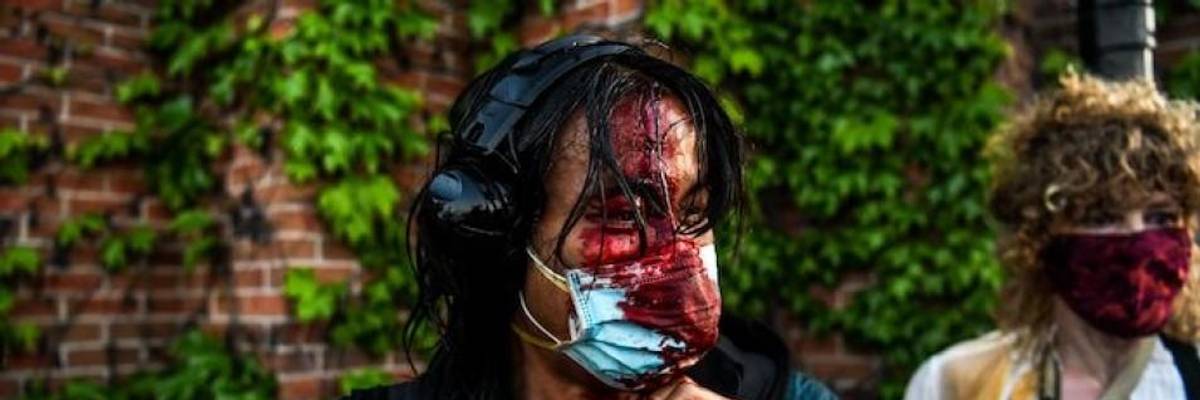
A journalist is seen bleeding after police started firing tear gas and rubber bullets near the 5th police precinct following a demonstration to call for justice for George Floyd, a black man who died while in custody of the Minneapolis police, on May 30, 2020 in Minneapolis. (Photo: Chandan Khanna/AFP via Getty Images)
A new report draws a "devastating" picture of press freedoms in the United States, finding that 2020 has seen a 1200% increase in the number of journalists arrested compared to 2019.
According to Freedom of the Press Foundation (FPF), there were 117 arrests or detainments of journalists--a figure that stood at just 9 the year before. The organization used data from the U.S. Press Freedom Tracker--a project of FPF and the Committee to Protect Journalists--and found 1000 press freedom violations including physical attacks and border stops. "We know of no police officer criminally charged for illegally arresting a journalist," the report adds.
"This report shows an unprecedented press freedom crisis engulfing the United States," FPF executive director Trevor Timm said in a statement.
The "most startling statistics," says the report, occurred in the week after the May 25 police killing George Floyd in Minneapolis. That time frame included 71 journalists arrested while covering protests.
"So many of the journalists arrested in the United States in 2020 were reporting on protests that it was perhaps inevitable reporters would be caught up in the same police techniques typically used to break up demonstrations," the report states, and points to the tactic of so-called kettling. "Kettling in particular shows up in nearly two dozen of the arrests and detentions that the U.S Press Freedom Tracker has documented across the country."
"Time and again," says the report, "police disregarded press freedom rights when their kettled crowds included journalists."
The report also draws attention to press violations that occurred in Portland, and "the dangers [that] intensified when, on President Donald Trump's orders, federal agents were deployed in the city."
"The Department of Homeland Security tapped protesters' phones and established 'intelligence reports' on journalists who published leaked documents about the agency's operations," the report adds.
Among the journalists whose harrowing tales are recounted in the report is Grace Morgan.
An independent journalist, Morgan was covering the arrest of a protester in Portland when federal agents slammed her to the ground and sprayed her in the eyes with mace.
Beyond abuses associated with journalists covering the national social justice uprising, "the electoral loss by a president who had spent much of his administration vilifying the press sparked one of the biggest spikes in press freedom violations since the first month of the George Floyd protests in May and June," says the report.
Throughout the year, the report says that many of the arrests were accompanied by police violence. In fact, according to the tracker data, 26% of the arrests included police deploying "unnecessary use of force," which may include knocking journalists to the ground, pepper-spraying them, or whacking them in the gut with a baton.
Still other journalists faced police violence such as being hit with projectile while reporting before being arrested.
The report further notes that, while many saw their charges dropped, at least 16 journalists--including 10 freelancers--are still facing legal "long-term legal trouble."
While the tally of journalists arrested dwarfs those of previous years, it may not be exhaustive; the report points out that the organization is still sorting through a dozen other possible violations that occurred this year.
"Journalists should not have to worry about being arrested for doing their job," added Timm, "yet across the country police have disregarded their rights on a staggering scale."
"We hope this report will spur local, state, and federal officials to act," he said.
Calling the findings "devastating," Kirstin McCudden, managing editor of the U.S.Press Freedom Tracker, writes in the report's foreword, "The courage and commitment of these journalists, arrested or detained for exercising rights promised to them in the Constitution, is anything but a statistic."
Dear Common Dreams reader, It’s been nearly 30 years since I co-founded Common Dreams with my late wife, Lina Newhouser. We had the radical notion that journalism should serve the public good, not corporate profits. It was clear to us from the outset what it would take to build such a project. No paid advertisements. No corporate sponsors. No millionaire publisher telling us what to think or do. Many people said we wouldn't last a year, but we proved those doubters wrong. Together with a tremendous team of journalists and dedicated staff, we built an independent media outlet free from the constraints of profits and corporate control. Our mission has always been simple: To inform. To inspire. To ignite change for the common good. Building Common Dreams was not easy. Our survival was never guaranteed. When you take on the most powerful forces—Wall Street greed, fossil fuel industry destruction, Big Tech lobbyists, and uber-rich oligarchs who have spent billions upon billions rigging the economy and democracy in their favor—the only bulwark you have is supporters who believe in your work. But here’s the urgent message from me today. It's never been this bad out there. And it's never been this hard to keep us going. At the very moment Common Dreams is most needed, the threats we face are intensifying. We need your support now more than ever. We don't accept corporate advertising and never will. We don't have a paywall because we don't think people should be blocked from critical news based on their ability to pay. Everything we do is funded by the donations of readers like you. When everyone does the little they can afford, we are strong. But if that support retreats or dries up, so do we. Will you donate now to make sure Common Dreams not only survives but thrives? —Craig Brown, Co-founder |
A new report draws a "devastating" picture of press freedoms in the United States, finding that 2020 has seen a 1200% increase in the number of journalists arrested compared to 2019.
According to Freedom of the Press Foundation (FPF), there were 117 arrests or detainments of journalists--a figure that stood at just 9 the year before. The organization used data from the U.S. Press Freedom Tracker--a project of FPF and the Committee to Protect Journalists--and found 1000 press freedom violations including physical attacks and border stops. "We know of no police officer criminally charged for illegally arresting a journalist," the report adds.
"This report shows an unprecedented press freedom crisis engulfing the United States," FPF executive director Trevor Timm said in a statement.
The "most startling statistics," says the report, occurred in the week after the May 25 police killing George Floyd in Minneapolis. That time frame included 71 journalists arrested while covering protests.
"So many of the journalists arrested in the United States in 2020 were reporting on protests that it was perhaps inevitable reporters would be caught up in the same police techniques typically used to break up demonstrations," the report states, and points to the tactic of so-called kettling. "Kettling in particular shows up in nearly two dozen of the arrests and detentions that the U.S Press Freedom Tracker has documented across the country."
"Time and again," says the report, "police disregarded press freedom rights when their kettled crowds included journalists."
The report also draws attention to press violations that occurred in Portland, and "the dangers [that] intensified when, on President Donald Trump's orders, federal agents were deployed in the city."
"The Department of Homeland Security tapped protesters' phones and established 'intelligence reports' on journalists who published leaked documents about the agency's operations," the report adds.
Among the journalists whose harrowing tales are recounted in the report is Grace Morgan.
An independent journalist, Morgan was covering the arrest of a protester in Portland when federal agents slammed her to the ground and sprayed her in the eyes with mace.
Beyond abuses associated with journalists covering the national social justice uprising, "the electoral loss by a president who had spent much of his administration vilifying the press sparked one of the biggest spikes in press freedom violations since the first month of the George Floyd protests in May and June," says the report.
Throughout the year, the report says that many of the arrests were accompanied by police violence. In fact, according to the tracker data, 26% of the arrests included police deploying "unnecessary use of force," which may include knocking journalists to the ground, pepper-spraying them, or whacking them in the gut with a baton.
Still other journalists faced police violence such as being hit with projectile while reporting before being arrested.
The report further notes that, while many saw their charges dropped, at least 16 journalists--including 10 freelancers--are still facing legal "long-term legal trouble."
While the tally of journalists arrested dwarfs those of previous years, it may not be exhaustive; the report points out that the organization is still sorting through a dozen other possible violations that occurred this year.
"Journalists should not have to worry about being arrested for doing their job," added Timm, "yet across the country police have disregarded their rights on a staggering scale."
"We hope this report will spur local, state, and federal officials to act," he said.
Calling the findings "devastating," Kirstin McCudden, managing editor of the U.S.Press Freedom Tracker, writes in the report's foreword, "The courage and commitment of these journalists, arrested or detained for exercising rights promised to them in the Constitution, is anything but a statistic."
A new report draws a "devastating" picture of press freedoms in the United States, finding that 2020 has seen a 1200% increase in the number of journalists arrested compared to 2019.
According to Freedom of the Press Foundation (FPF), there were 117 arrests or detainments of journalists--a figure that stood at just 9 the year before. The organization used data from the U.S. Press Freedom Tracker--a project of FPF and the Committee to Protect Journalists--and found 1000 press freedom violations including physical attacks and border stops. "We know of no police officer criminally charged for illegally arresting a journalist," the report adds.
"This report shows an unprecedented press freedom crisis engulfing the United States," FPF executive director Trevor Timm said in a statement.
The "most startling statistics," says the report, occurred in the week after the May 25 police killing George Floyd in Minneapolis. That time frame included 71 journalists arrested while covering protests.
"So many of the journalists arrested in the United States in 2020 were reporting on protests that it was perhaps inevitable reporters would be caught up in the same police techniques typically used to break up demonstrations," the report states, and points to the tactic of so-called kettling. "Kettling in particular shows up in nearly two dozen of the arrests and detentions that the U.S Press Freedom Tracker has documented across the country."
"Time and again," says the report, "police disregarded press freedom rights when their kettled crowds included journalists."
The report also draws attention to press violations that occurred in Portland, and "the dangers [that] intensified when, on President Donald Trump's orders, federal agents were deployed in the city."
"The Department of Homeland Security tapped protesters' phones and established 'intelligence reports' on journalists who published leaked documents about the agency's operations," the report adds.
Among the journalists whose harrowing tales are recounted in the report is Grace Morgan.
An independent journalist, Morgan was covering the arrest of a protester in Portland when federal agents slammed her to the ground and sprayed her in the eyes with mace.
Beyond abuses associated with journalists covering the national social justice uprising, "the electoral loss by a president who had spent much of his administration vilifying the press sparked one of the biggest spikes in press freedom violations since the first month of the George Floyd protests in May and June," says the report.
Throughout the year, the report says that many of the arrests were accompanied by police violence. In fact, according to the tracker data, 26% of the arrests included police deploying "unnecessary use of force," which may include knocking journalists to the ground, pepper-spraying them, or whacking them in the gut with a baton.
Still other journalists faced police violence such as being hit with projectile while reporting before being arrested.
The report further notes that, while many saw their charges dropped, at least 16 journalists--including 10 freelancers--are still facing legal "long-term legal trouble."
While the tally of journalists arrested dwarfs those of previous years, it may not be exhaustive; the report points out that the organization is still sorting through a dozen other possible violations that occurred this year.
"Journalists should not have to worry about being arrested for doing their job," added Timm, "yet across the country police have disregarded their rights on a staggering scale."
"We hope this report will spur local, state, and federal officials to act," he said.
Calling the findings "devastating," Kirstin McCudden, managing editor of the U.S.Press Freedom Tracker, writes in the report's foreword, "The courage and commitment of these journalists, arrested or detained for exercising rights promised to them in the Constitution, is anything but a statistic."