SUBSCRIBE TO OUR FREE NEWSLETTER
Daily news & progressive opinion—funded by the people, not the corporations—delivered straight to your inbox.
5
#000000
#FFFFFF
To donate by check, phone, or other method, see our More Ways to Give page.
Daily news & progressive opinion—funded by the people, not the corporations—delivered straight to your inbox.
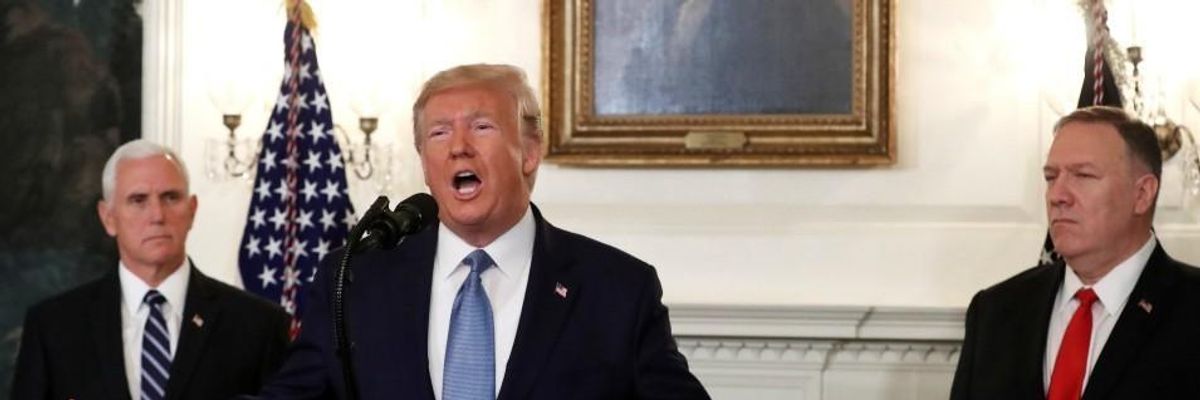
The assassination of a top Iranian nuclear scientists on Friday prompted immediate questions on what role the U.S. may have played in the killing. (Photo: Mark Wilson/Getty Images)
Amid swirling questions over what, if any, role the United States played in the assassination of top Iranian nuclear scientist Mohsen Fakhrizadeh, President Donald Trump on Friday amplified to his 88 million followers a Twitter post describing the killing as a "major psychological and professional blow" to Iran.
Sina Toossi, a senior research analyst at the National Iranian American Council (NIAC), characterized the U.S. president's move as an "implicit approval if there ever was one." The president also retweeted a New York Times report on the killing, an ambush that took place as Fakhrizadeh was traveling by car in northern Iran.
As of this writing, Trump--who ordered the killing of top Iranian Gen. Qasem Soleimani earlier this year--has not otherwise responded to the assassination, which is drawing widespread condemnation from anti-war groups and Iranian officials.
It is not entirely clear who carried out the Fakhrizadeh killing, but some--including Iran's top diplomat, Javad Zarif--said they believe Israel, the top U.S. ally in the region, may be responsible, noting its history of similar attacks.
"Terrorists murdered an eminent Iranian scientist today," said Zarif. "This cowardice--with serious indications of Israeli role--shows desperate warmongering of perpetrators."
Given that the move came in the wake of reports that Trump recently requested options for a military strike on Iran and news that Israel has been preparing for such an attack for weeks, suspicions that the U.S. or Israel--or both--played a role in the killing are hardly fantastical.
As the Times reported, "Mr. Fakhrizadeh had long been the No. 1 target of the Mossad, Israel's intelligence service, which is widely believed to be behind a series of assassinations of scientists a decade ago that included some of Mr. Fakhrizadeh's deputies."
"One American official--along with two other intelligence officials--said that Israel was behind the attack on the scientist," according to the Times. "It was unclear how much the United States may have known about the operation in advance, but the two nations are the closest of allies and have long shared intelligence regarding Iran. The White House and the CIA declined to comment."
Win Without War, an anti-war advocacy group, tweeted Friday that "if the U.S. was involved with this assassination, it will be further evidence on top of the already heaping pile that Trump, Pompeo, and the other war hawks will do everything in their power to prevent the Biden admin from succeeding at diplomacy with Iran."
Paul Kawika Martin, senior director of policy and political affairs at Peace Action, added that the international community "should condemn assassinations, especially those with apparent U.S. complicity to provoke war or block efforts by a new administration to revive the nuclear agreement that made the world safer."
This story has been updated with new reporting on Israel's alleged role in the assassination.
Dear Common Dreams reader, It’s been nearly 30 years since I co-founded Common Dreams with my late wife, Lina Newhouser. We had the radical notion that journalism should serve the public good, not corporate profits. It was clear to us from the outset what it would take to build such a project. No paid advertisements. No corporate sponsors. No millionaire publisher telling us what to think or do. Many people said we wouldn't last a year, but we proved those doubters wrong. Together with a tremendous team of journalists and dedicated staff, we built an independent media outlet free from the constraints of profits and corporate control. Our mission has always been simple: To inform. To inspire. To ignite change for the common good. Building Common Dreams was not easy. Our survival was never guaranteed. When you take on the most powerful forces—Wall Street greed, fossil fuel industry destruction, Big Tech lobbyists, and uber-rich oligarchs who have spent billions upon billions rigging the economy and democracy in their favor—the only bulwark you have is supporters who believe in your work. But here’s the urgent message from me today. It's never been this bad out there. And it's never been this hard to keep us going. At the very moment Common Dreams is most needed, the threats we face are intensifying. We need your support now more than ever. We don't accept corporate advertising and never will. We don't have a paywall because we don't think people should be blocked from critical news based on their ability to pay. Everything we do is funded by the donations of readers like you. When everyone does the little they can afford, we are strong. But if that support retreats or dries up, so do we. Will you donate now to make sure Common Dreams not only survives but thrives? —Craig Brown, Co-founder |
Amid swirling questions over what, if any, role the United States played in the assassination of top Iranian nuclear scientist Mohsen Fakhrizadeh, President Donald Trump on Friday amplified to his 88 million followers a Twitter post describing the killing as a "major psychological and professional blow" to Iran.
Sina Toossi, a senior research analyst at the National Iranian American Council (NIAC), characterized the U.S. president's move as an "implicit approval if there ever was one." The president also retweeted a New York Times report on the killing, an ambush that took place as Fakhrizadeh was traveling by car in northern Iran.
As of this writing, Trump--who ordered the killing of top Iranian Gen. Qasem Soleimani earlier this year--has not otherwise responded to the assassination, which is drawing widespread condemnation from anti-war groups and Iranian officials.
It is not entirely clear who carried out the Fakhrizadeh killing, but some--including Iran's top diplomat, Javad Zarif--said they believe Israel, the top U.S. ally in the region, may be responsible, noting its history of similar attacks.
"Terrorists murdered an eminent Iranian scientist today," said Zarif. "This cowardice--with serious indications of Israeli role--shows desperate warmongering of perpetrators."
Given that the move came in the wake of reports that Trump recently requested options for a military strike on Iran and news that Israel has been preparing for such an attack for weeks, suspicions that the U.S. or Israel--or both--played a role in the killing are hardly fantastical.
As the Times reported, "Mr. Fakhrizadeh had long been the No. 1 target of the Mossad, Israel's intelligence service, which is widely believed to be behind a series of assassinations of scientists a decade ago that included some of Mr. Fakhrizadeh's deputies."
"One American official--along with two other intelligence officials--said that Israel was behind the attack on the scientist," according to the Times. "It was unclear how much the United States may have known about the operation in advance, but the two nations are the closest of allies and have long shared intelligence regarding Iran. The White House and the CIA declined to comment."
Win Without War, an anti-war advocacy group, tweeted Friday that "if the U.S. was involved with this assassination, it will be further evidence on top of the already heaping pile that Trump, Pompeo, and the other war hawks will do everything in their power to prevent the Biden admin from succeeding at diplomacy with Iran."
Paul Kawika Martin, senior director of policy and political affairs at Peace Action, added that the international community "should condemn assassinations, especially those with apparent U.S. complicity to provoke war or block efforts by a new administration to revive the nuclear agreement that made the world safer."
This story has been updated with new reporting on Israel's alleged role in the assassination.
Amid swirling questions over what, if any, role the United States played in the assassination of top Iranian nuclear scientist Mohsen Fakhrizadeh, President Donald Trump on Friday amplified to his 88 million followers a Twitter post describing the killing as a "major psychological and professional blow" to Iran.
Sina Toossi, a senior research analyst at the National Iranian American Council (NIAC), characterized the U.S. president's move as an "implicit approval if there ever was one." The president also retweeted a New York Times report on the killing, an ambush that took place as Fakhrizadeh was traveling by car in northern Iran.
As of this writing, Trump--who ordered the killing of top Iranian Gen. Qasem Soleimani earlier this year--has not otherwise responded to the assassination, which is drawing widespread condemnation from anti-war groups and Iranian officials.
It is not entirely clear who carried out the Fakhrizadeh killing, but some--including Iran's top diplomat, Javad Zarif--said they believe Israel, the top U.S. ally in the region, may be responsible, noting its history of similar attacks.
"Terrorists murdered an eminent Iranian scientist today," said Zarif. "This cowardice--with serious indications of Israeli role--shows desperate warmongering of perpetrators."
Given that the move came in the wake of reports that Trump recently requested options for a military strike on Iran and news that Israel has been preparing for such an attack for weeks, suspicions that the U.S. or Israel--or both--played a role in the killing are hardly fantastical.
As the Times reported, "Mr. Fakhrizadeh had long been the No. 1 target of the Mossad, Israel's intelligence service, which is widely believed to be behind a series of assassinations of scientists a decade ago that included some of Mr. Fakhrizadeh's deputies."
"One American official--along with two other intelligence officials--said that Israel was behind the attack on the scientist," according to the Times. "It was unclear how much the United States may have known about the operation in advance, but the two nations are the closest of allies and have long shared intelligence regarding Iran. The White House and the CIA declined to comment."
Win Without War, an anti-war advocacy group, tweeted Friday that "if the U.S. was involved with this assassination, it will be further evidence on top of the already heaping pile that Trump, Pompeo, and the other war hawks will do everything in their power to prevent the Biden admin from succeeding at diplomacy with Iran."
Paul Kawika Martin, senior director of policy and political affairs at Peace Action, added that the international community "should condemn assassinations, especially those with apparent U.S. complicity to provoke war or block efforts by a new administration to revive the nuclear agreement that made the world safer."
This story has been updated with new reporting on Israel's alleged role in the assassination.