SUBSCRIBE TO OUR FREE NEWSLETTER
Daily news & progressive opinion—funded by the people, not the corporations—delivered straight to your inbox.
5
#000000
#FFFFFF
To donate by check, phone, or other method, see our More Ways to Give page.
Daily news & progressive opinion—funded by the people, not the corporations—delivered straight to your inbox.
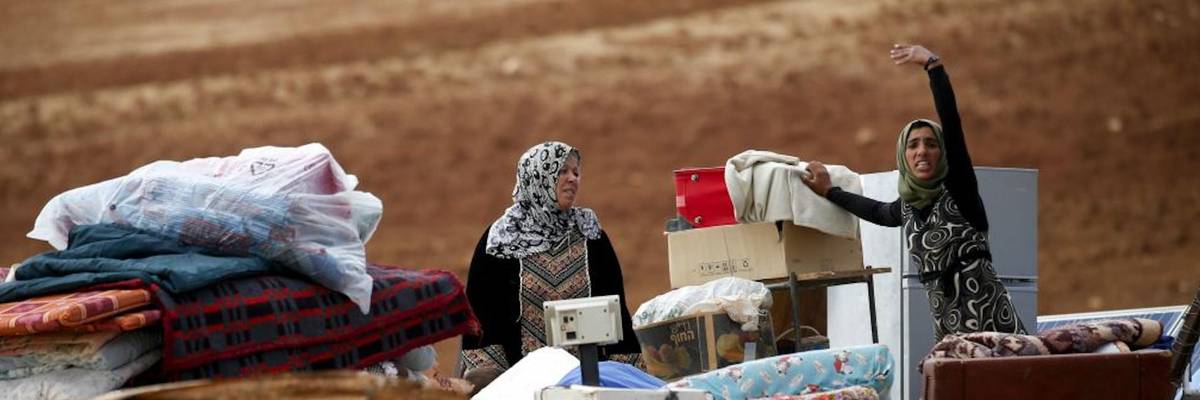
Palestinian Bedouins stand next to their belongings after Israeli soldiers demolished their homes and their hamlet of Khirbet Humsa in the illegally occupied West Bank on November 3, 2020. (Photo: Jaafar Ashtiyeh/AFP via Getty Images)
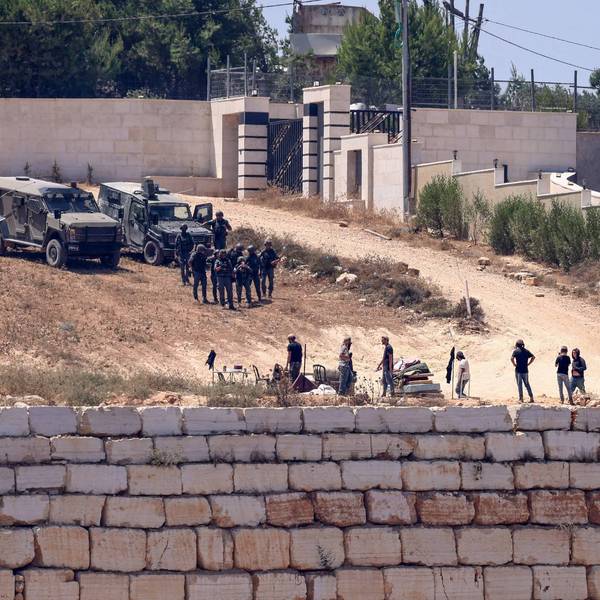
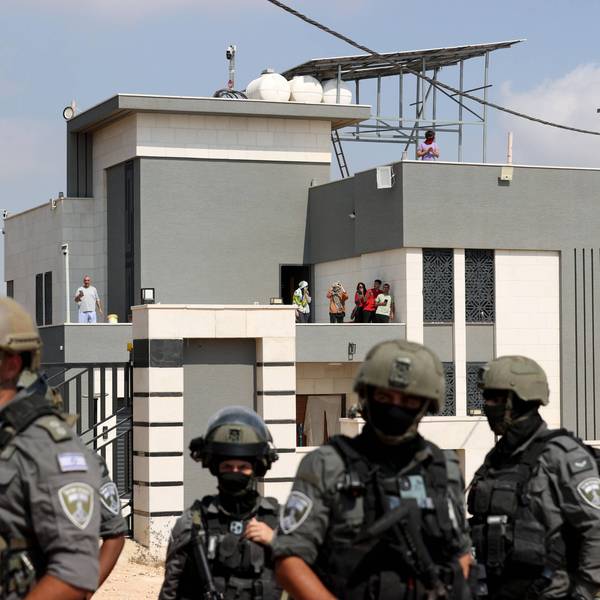
Under cover of the U.S. presidential election, the Israeli military bulldozed an entire Bedouin community in the illegally occupied West Bank of Palestine on Tuesday, leaving scores of people--including more than 40 children--homeless during a cold, driving rainstorm.
Just hours before the cold front rolled through the West Bank, Israel Defense Forces troops razed the Bedouin hamlet of Khirbet Humsa, near Tubas in the Jordan Valley, forcing 74 people including 41 children--one just three months old--out into the approaching storm.
"[This] can only be considered an act of ethnic cleansing against the indigenous Palestinian population."
--Palestinian Centre for Human Rights
The United Nations Office for Coordination of Humanitarian Affairs (OCHA) called the destruction of the community's 76 structures the largest single West Bank demolition in a decade.
The IDF soldiers "completely uprooted everything," Ayman Gharib, an activist with the Popular Resistance Committees, told Middle East Eye, adding that it was "basically anything that these people need to live and survive."
"They did not even take into consideration the humanitarian side, that there are babies, children, elderly people, and women who have spent their night homeless, under the rain," Gharib said of the Israeli soldiers.
"The same goes for the animals, the sheep and cattle, who also spent the night under the rain," he added.
OCHA humanitarian coordinator Yvonne Helle called the Israeli action "the largest forced displacement incident in over four years."
"The destroyed properties--including homes, animal shelters, latrines, and solar panels--were essential to [the] livelihoods, wellbeing, and dignity of community members, whose rights have been violated," Helle said Wednesday.
"Their vulnerability is further compounded by the onset of winter and the ongoing Covid-19 pandemic," she added. "Some of the demolished structures had been donated as humanitarian assistance."
Along with the troops, a busload of Israeli Civil Administration officials removed the villagers' possessions before destroying their homes and other property. Numerous vehicles, including tractors and at least one car, were confiscated.
The hamlet's 11 families were forced to sleep out in the cold with only a small tarpaulin for cover.
Khirbet Humsa residents described the harrowing experience of being forced from their homes by Israeli occupation forces.
"We were about to have lunch when bulldozers suddenly arrived, at 11 in the morning," Aisha Abu Awad told Middle East Eye as she cradled her crying 3-month-old granddaughter.
"Military jeeps and soldiers, they surrounded us," Awad added. "Then they told us to start evacuating, and they began emptying all of our belongings outside."
Displaced resident Yasser Abu al-Kbash told NPR that he is "99% certain this was taking advantage of the U.S. elections."
"[The IDF] bulldozed everything," the 48-year-old shepherd said of Khirbet Humsa, his lifelong home.
The Israeli human rights organization B'Tselem agreed with al-Kbash's assessment.
"The wiping off of a whole community at once is extremely rare, and it seems like Israel was making use of the fact that everyone's attention is currently set elsewhere to move forward with this inhumane act," the group told Agence France-Presse.
The destruction of Khirbet Humsa, which has suffered Israeli home demolitions in the past, is part of Israel's systemic policy of destroying Palestinian homes--and in the case of Bedouins, entire villages--to expel the native population to make way for new or expanded settler colonies exclusively for Jewish residents.
One Bedouin village in the Negev Desert, Al-Araqeeb, has been destroyed by Israeli forces at least 139 times.
The Gaza-based Palestinian Centre for Human Rights condemned the razing of Khirbet Humsa as part of Israel's "annexation and settler-expansion schemes" that "can only be considered an act of ethnic cleansing against the indigenous Palestinian population."
OCHA said that so far this year, 689 Palestinian structures have been demolished throughout the West Bank, already more than in any full year since 2016.
"I remind all parties that the extensive destruction of property and the forcible transfer of protected people in an occupied territory are grave breaches of the Fourth Geneva Convention."
--Yvonne Helle, OCHA
Some 869 Palestinians have been made homeless by these demolitions, which Helle said "are a key means of creating an environment designed to coerce Palestinians to leave their homes."
"I remind all parties that the extensive destruction of property and the forcible transfer of protected people in an occupied territory are grave breaches of the Fourth Geneva Convention," Helle said.
"While assuring that the humanitarian community stands ready to support all those who have been displaced or otherwise affected, I strongly reiterate our call to Israel to immediately halt unlawful demolitions," she added.
Dear Common Dreams reader, It’s been nearly 30 years since I co-founded Common Dreams with my late wife, Lina Newhouser. We had the radical notion that journalism should serve the public good, not corporate profits. It was clear to us from the outset what it would take to build such a project. No paid advertisements. No corporate sponsors. No millionaire publisher telling us what to think or do. Many people said we wouldn't last a year, but we proved those doubters wrong. Together with a tremendous team of journalists and dedicated staff, we built an independent media outlet free from the constraints of profits and corporate control. Our mission has always been simple: To inform. To inspire. To ignite change for the common good. Building Common Dreams was not easy. Our survival was never guaranteed. When you take on the most powerful forces—Wall Street greed, fossil fuel industry destruction, Big Tech lobbyists, and uber-rich oligarchs who have spent billions upon billions rigging the economy and democracy in their favor—the only bulwark you have is supporters who believe in your work. But here’s the urgent message from me today. It's never been this bad out there. And it's never been this hard to keep us going. At the very moment Common Dreams is most needed, the threats we face are intensifying. We need your support now more than ever. We don't accept corporate advertising and never will. We don't have a paywall because we don't think people should be blocked from critical news based on their ability to pay. Everything we do is funded by the donations of readers like you. When everyone does the little they can afford, we are strong. But if that support retreats or dries up, so do we. Will you donate now to make sure Common Dreams not only survives but thrives? —Craig Brown, Co-founder |
Under cover of the U.S. presidential election, the Israeli military bulldozed an entire Bedouin community in the illegally occupied West Bank of Palestine on Tuesday, leaving scores of people--including more than 40 children--homeless during a cold, driving rainstorm.
Just hours before the cold front rolled through the West Bank, Israel Defense Forces troops razed the Bedouin hamlet of Khirbet Humsa, near Tubas in the Jordan Valley, forcing 74 people including 41 children--one just three months old--out into the approaching storm.
"[This] can only be considered an act of ethnic cleansing against the indigenous Palestinian population."
--Palestinian Centre for Human Rights
The United Nations Office for Coordination of Humanitarian Affairs (OCHA) called the destruction of the community's 76 structures the largest single West Bank demolition in a decade.
The IDF soldiers "completely uprooted everything," Ayman Gharib, an activist with the Popular Resistance Committees, told Middle East Eye, adding that it was "basically anything that these people need to live and survive."
"They did not even take into consideration the humanitarian side, that there are babies, children, elderly people, and women who have spent their night homeless, under the rain," Gharib said of the Israeli soldiers.
"The same goes for the animals, the sheep and cattle, who also spent the night under the rain," he added.
OCHA humanitarian coordinator Yvonne Helle called the Israeli action "the largest forced displacement incident in over four years."
"The destroyed properties--including homes, animal shelters, latrines, and solar panels--were essential to [the] livelihoods, wellbeing, and dignity of community members, whose rights have been violated," Helle said Wednesday.
"Their vulnerability is further compounded by the onset of winter and the ongoing Covid-19 pandemic," she added. "Some of the demolished structures had been donated as humanitarian assistance."
Along with the troops, a busload of Israeli Civil Administration officials removed the villagers' possessions before destroying their homes and other property. Numerous vehicles, including tractors and at least one car, were confiscated.
The hamlet's 11 families were forced to sleep out in the cold with only a small tarpaulin for cover.
Khirbet Humsa residents described the harrowing experience of being forced from their homes by Israeli occupation forces.
"We were about to have lunch when bulldozers suddenly arrived, at 11 in the morning," Aisha Abu Awad told Middle East Eye as she cradled her crying 3-month-old granddaughter.
"Military jeeps and soldiers, they surrounded us," Awad added. "Then they told us to start evacuating, and they began emptying all of our belongings outside."
Displaced resident Yasser Abu al-Kbash told NPR that he is "99% certain this was taking advantage of the U.S. elections."
"[The IDF] bulldozed everything," the 48-year-old shepherd said of Khirbet Humsa, his lifelong home.
The Israeli human rights organization B'Tselem agreed with al-Kbash's assessment.
"The wiping off of a whole community at once is extremely rare, and it seems like Israel was making use of the fact that everyone's attention is currently set elsewhere to move forward with this inhumane act," the group told Agence France-Presse.
The destruction of Khirbet Humsa, which has suffered Israeli home demolitions in the past, is part of Israel's systemic policy of destroying Palestinian homes--and in the case of Bedouins, entire villages--to expel the native population to make way for new or expanded settler colonies exclusively for Jewish residents.
One Bedouin village in the Negev Desert, Al-Araqeeb, has been destroyed by Israeli forces at least 139 times.
The Gaza-based Palestinian Centre for Human Rights condemned the razing of Khirbet Humsa as part of Israel's "annexation and settler-expansion schemes" that "can only be considered an act of ethnic cleansing against the indigenous Palestinian population."
OCHA said that so far this year, 689 Palestinian structures have been demolished throughout the West Bank, already more than in any full year since 2016.
"I remind all parties that the extensive destruction of property and the forcible transfer of protected people in an occupied territory are grave breaches of the Fourth Geneva Convention."
--Yvonne Helle, OCHA
Some 869 Palestinians have been made homeless by these demolitions, which Helle said "are a key means of creating an environment designed to coerce Palestinians to leave their homes."
"I remind all parties that the extensive destruction of property and the forcible transfer of protected people in an occupied territory are grave breaches of the Fourth Geneva Convention," Helle said.
"While assuring that the humanitarian community stands ready to support all those who have been displaced or otherwise affected, I strongly reiterate our call to Israel to immediately halt unlawful demolitions," she added.
Under cover of the U.S. presidential election, the Israeli military bulldozed an entire Bedouin community in the illegally occupied West Bank of Palestine on Tuesday, leaving scores of people--including more than 40 children--homeless during a cold, driving rainstorm.
Just hours before the cold front rolled through the West Bank, Israel Defense Forces troops razed the Bedouin hamlet of Khirbet Humsa, near Tubas in the Jordan Valley, forcing 74 people including 41 children--one just three months old--out into the approaching storm.
"[This] can only be considered an act of ethnic cleansing against the indigenous Palestinian population."
--Palestinian Centre for Human Rights
The United Nations Office for Coordination of Humanitarian Affairs (OCHA) called the destruction of the community's 76 structures the largest single West Bank demolition in a decade.
The IDF soldiers "completely uprooted everything," Ayman Gharib, an activist with the Popular Resistance Committees, told Middle East Eye, adding that it was "basically anything that these people need to live and survive."
"They did not even take into consideration the humanitarian side, that there are babies, children, elderly people, and women who have spent their night homeless, under the rain," Gharib said of the Israeli soldiers.
"The same goes for the animals, the sheep and cattle, who also spent the night under the rain," he added.
OCHA humanitarian coordinator Yvonne Helle called the Israeli action "the largest forced displacement incident in over four years."
"The destroyed properties--including homes, animal shelters, latrines, and solar panels--were essential to [the] livelihoods, wellbeing, and dignity of community members, whose rights have been violated," Helle said Wednesday.
"Their vulnerability is further compounded by the onset of winter and the ongoing Covid-19 pandemic," she added. "Some of the demolished structures had been donated as humanitarian assistance."
Along with the troops, a busload of Israeli Civil Administration officials removed the villagers' possessions before destroying their homes and other property. Numerous vehicles, including tractors and at least one car, were confiscated.
The hamlet's 11 families were forced to sleep out in the cold with only a small tarpaulin for cover.
Khirbet Humsa residents described the harrowing experience of being forced from their homes by Israeli occupation forces.
"We were about to have lunch when bulldozers suddenly arrived, at 11 in the morning," Aisha Abu Awad told Middle East Eye as she cradled her crying 3-month-old granddaughter.
"Military jeeps and soldiers, they surrounded us," Awad added. "Then they told us to start evacuating, and they began emptying all of our belongings outside."
Displaced resident Yasser Abu al-Kbash told NPR that he is "99% certain this was taking advantage of the U.S. elections."
"[The IDF] bulldozed everything," the 48-year-old shepherd said of Khirbet Humsa, his lifelong home.
The Israeli human rights organization B'Tselem agreed with al-Kbash's assessment.
"The wiping off of a whole community at once is extremely rare, and it seems like Israel was making use of the fact that everyone's attention is currently set elsewhere to move forward with this inhumane act," the group told Agence France-Presse.
The destruction of Khirbet Humsa, which has suffered Israeli home demolitions in the past, is part of Israel's systemic policy of destroying Palestinian homes--and in the case of Bedouins, entire villages--to expel the native population to make way for new or expanded settler colonies exclusively for Jewish residents.
One Bedouin village in the Negev Desert, Al-Araqeeb, has been destroyed by Israeli forces at least 139 times.
The Gaza-based Palestinian Centre for Human Rights condemned the razing of Khirbet Humsa as part of Israel's "annexation and settler-expansion schemes" that "can only be considered an act of ethnic cleansing against the indigenous Palestinian population."
OCHA said that so far this year, 689 Palestinian structures have been demolished throughout the West Bank, already more than in any full year since 2016.
"I remind all parties that the extensive destruction of property and the forcible transfer of protected people in an occupied territory are grave breaches of the Fourth Geneva Convention."
--Yvonne Helle, OCHA
Some 869 Palestinians have been made homeless by these demolitions, which Helle said "are a key means of creating an environment designed to coerce Palestinians to leave their homes."
"I remind all parties that the extensive destruction of property and the forcible transfer of protected people in an occupied territory are grave breaches of the Fourth Geneva Convention," Helle said.
"While assuring that the humanitarian community stands ready to support all those who have been displaced or otherwise affected, I strongly reiterate our call to Israel to immediately halt unlawful demolitions," she added.