SUBSCRIBE TO OUR FREE NEWSLETTER
Daily news & progressive opinion—funded by the people, not the corporations—delivered straight to your inbox.
5
#000000
#FFFFFF
To donate by check, phone, or other method, see our More Ways to Give page.
Daily news & progressive opinion—funded by the people, not the corporations—delivered straight to your inbox.
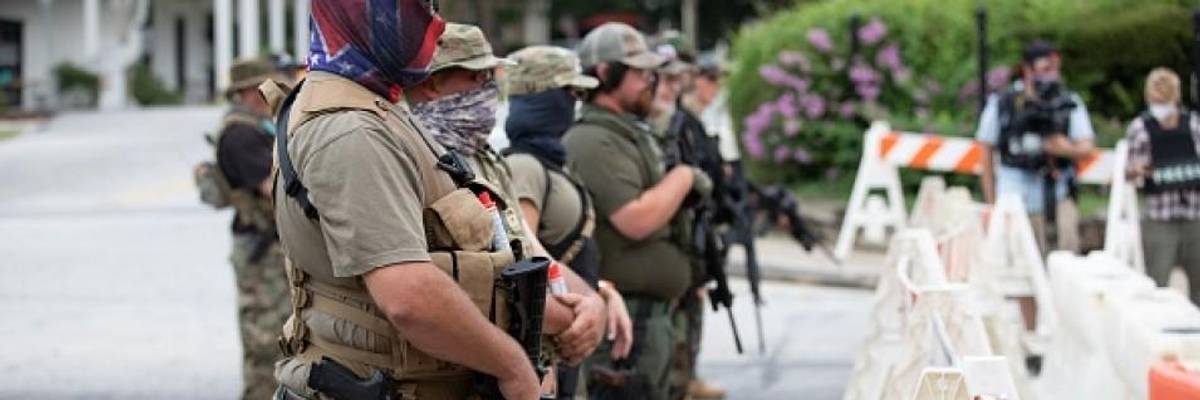
Members of a far-right paramilitary group in downtown Stone Mountain, Georgia on August 15, 2020. (Photo: Logan Cyrus/AFP via Getty Images)
The Australian and New Zealand governments updated just days before the American presidential election advisories to their citizens currently in the U.S., urging them to steer clear of political and election related protests because of the potential for violence.
Australia currently has an overseas travel ban in place, with some exceptions allowed, as a means of stemming the spread of the coronavirus pandemic.
In an update posted October 30, the Department of Foreign Affairs and Trade reiterated to those who may be seeking such an exemption its advice to not travel to the U.S., noting that "Covid-19 remains a serious health risk."
"Take precautions to keep safe during the election season," the department states.
The advisory also points to the "widespread protests and demonstrations" that have swept U.S. cities over the past five months. "Some protests have turned violent. Avoid areas where protests are occurring due to the ongoing potential for unrest and violence."
"Violent crime is more common than in Australia and gun crime is possible in all areas," the government warning states. It also suggests that Aussies residing in the U.S. "learn active shooter drills" and be aware that "medical costs are high."
New Zealand, which is continuing its "do not travel" advisor for any overseas location because of the coronavirus pandemic, likewise drew attention to the ongoing protests in U.S. cities in an advisory posted October 27.
"Even protests or political rallies, which are intended to be peaceful, can result in violence," the New Zealand government's Safe Travel website warns.
Kiwis currently in the U.S. should expect the violence to potentially be meted out by state authorities, the statement warns.
"A strong police and/or National Guard presence can be expected at any further protests. Police measures have, at times, included the use of rubber bullets and/or pepper spray to disperse crowds."
"If you find yourself in an area of protest/political activity or civil unrest," the update adds, "you should leave the area if it is safe to do so or remain indoors until the situation improves."
Dear Common Dreams reader, It’s been nearly 30 years since I co-founded Common Dreams with my late wife, Lina Newhouser. We had the radical notion that journalism should serve the public good, not corporate profits. It was clear to us from the outset what it would take to build such a project. No paid advertisements. No corporate sponsors. No millionaire publisher telling us what to think or do. Many people said we wouldn't last a year, but we proved those doubters wrong. Together with a tremendous team of journalists and dedicated staff, we built an independent media outlet free from the constraints of profits and corporate control. Our mission has always been simple: To inform. To inspire. To ignite change for the common good. Building Common Dreams was not easy. Our survival was never guaranteed. When you take on the most powerful forces—Wall Street greed, fossil fuel industry destruction, Big Tech lobbyists, and uber-rich oligarchs who have spent billions upon billions rigging the economy and democracy in their favor—the only bulwark you have is supporters who believe in your work. But here’s the urgent message from me today. It's never been this bad out there. And it's never been this hard to keep us going. At the very moment Common Dreams is most needed, the threats we face are intensifying. We need your support now more than ever. We don't accept corporate advertising and never will. We don't have a paywall because we don't think people should be blocked from critical news based on their ability to pay. Everything we do is funded by the donations of readers like you. When everyone does the little they can afford, we are strong. But if that support retreats or dries up, so do we. Will you donate now to make sure Common Dreams not only survives but thrives? —Craig Brown, Co-founder |
The Australian and New Zealand governments updated just days before the American presidential election advisories to their citizens currently in the U.S., urging them to steer clear of political and election related protests because of the potential for violence.
Australia currently has an overseas travel ban in place, with some exceptions allowed, as a means of stemming the spread of the coronavirus pandemic.
In an update posted October 30, the Department of Foreign Affairs and Trade reiterated to those who may be seeking such an exemption its advice to not travel to the U.S., noting that "Covid-19 remains a serious health risk."
"Take precautions to keep safe during the election season," the department states.
The advisory also points to the "widespread protests and demonstrations" that have swept U.S. cities over the past five months. "Some protests have turned violent. Avoid areas where protests are occurring due to the ongoing potential for unrest and violence."
"Violent crime is more common than in Australia and gun crime is possible in all areas," the government warning states. It also suggests that Aussies residing in the U.S. "learn active shooter drills" and be aware that "medical costs are high."
New Zealand, which is continuing its "do not travel" advisor for any overseas location because of the coronavirus pandemic, likewise drew attention to the ongoing protests in U.S. cities in an advisory posted October 27.
"Even protests or political rallies, which are intended to be peaceful, can result in violence," the New Zealand government's Safe Travel website warns.
Kiwis currently in the U.S. should expect the violence to potentially be meted out by state authorities, the statement warns.
"A strong police and/or National Guard presence can be expected at any further protests. Police measures have, at times, included the use of rubber bullets and/or pepper spray to disperse crowds."
"If you find yourself in an area of protest/political activity or civil unrest," the update adds, "you should leave the area if it is safe to do so or remain indoors until the situation improves."
The Australian and New Zealand governments updated just days before the American presidential election advisories to their citizens currently in the U.S., urging them to steer clear of political and election related protests because of the potential for violence.
Australia currently has an overseas travel ban in place, with some exceptions allowed, as a means of stemming the spread of the coronavirus pandemic.
In an update posted October 30, the Department of Foreign Affairs and Trade reiterated to those who may be seeking such an exemption its advice to not travel to the U.S., noting that "Covid-19 remains a serious health risk."
"Take precautions to keep safe during the election season," the department states.
The advisory also points to the "widespread protests and demonstrations" that have swept U.S. cities over the past five months. "Some protests have turned violent. Avoid areas where protests are occurring due to the ongoing potential for unrest and violence."
"Violent crime is more common than in Australia and gun crime is possible in all areas," the government warning states. It also suggests that Aussies residing in the U.S. "learn active shooter drills" and be aware that "medical costs are high."
New Zealand, which is continuing its "do not travel" advisor for any overseas location because of the coronavirus pandemic, likewise drew attention to the ongoing protests in U.S. cities in an advisory posted October 27.
"Even protests or political rallies, which are intended to be peaceful, can result in violence," the New Zealand government's Safe Travel website warns.
Kiwis currently in the U.S. should expect the violence to potentially be meted out by state authorities, the statement warns.
"A strong police and/or National Guard presence can be expected at any further protests. Police measures have, at times, included the use of rubber bullets and/or pepper spray to disperse crowds."
"If you find yourself in an area of protest/political activity or civil unrest," the update adds, "you should leave the area if it is safe to do so or remain indoors until the situation improves."