SUBSCRIBE TO OUR FREE NEWSLETTER
Daily news & progressive opinion—funded by the people, not the corporations—delivered straight to your inbox.
5
#000000
#FFFFFF
To donate by check, phone, or other method, see our More Ways to Give page.

With an estimated 66 million ballots already cast and only a week to go until Election Day, new polling released Tuesday shows the vast majority of U.S. voters believe the nation should be prioritizing a transition to 100% clean energy and support legislation to decarbonize the economy over the next few decades.
"Voters strongly support a national transition from dependence on coal, oil, and gas to renewable sources like solar and wind."
-- Anthony Leiserowitz, Yale Program on Climate Change Communication
Climate Nexus, the Yale Program on Climate Change Communication, and the George Mason University Center for Climate Change Communication surveyed (pdf) over 2,000 registered voters online in late September and early October. The poll's margin of error is plus/minus 2.2% at the 95% confidence level.
Pollsters found that 82% of voters somewhat (33%) or strongly (49%) agree that "the primary goal of U.S. energy policy should be achieving 100% clean energy."
Respondents were also asked to weigh in on legislation introduced in Congress "that would set the goal of achieving a 100% clean economy (eliminating fossil fuel emissions from the transportation, electricity, buildings, industry, and agricultural sectors) in the United States by the year 2050."
Over seven in 10 said they somewhat (31%) or strongly (40%) support such legislation--the same total percentage who said they somewhat (32%) or strongly (39%) support "requiring electric utility companies in the United States to generate 100% of their electricity from renewable sources, like wind and solar, by the year 2035."
"The conventional wisdom has clearly changed," Anthony Leiserowitz, director of Yale's program, said in a statement about the survey results Tuesday. "Voters strongly support a national transition from dependence on coal, oil, and gas to renewable sources like solar and wind."
The poll shows majorities of voters believe that transitioning to a 100% clean energy economy would positively impact jobs and economic growth, energy bills, rural and farming communities in their state, and communities of color in their state.
A majority of respondents (62%) also said they would be more likely to or would only vote for a candidate who supports "providing a multi-trillion-dollar federal economic stimulus that prioritizes investments in clean energy infrastructure."
While support for hydraulic fracturing to increase production of natural gas and oil in the U.S. was split, 61% said there needs to be more regulation of fracking and 80% somewhat or strongly support requiring energy companies to install technology to reduce leaks of the potent greenhouse gas methane.
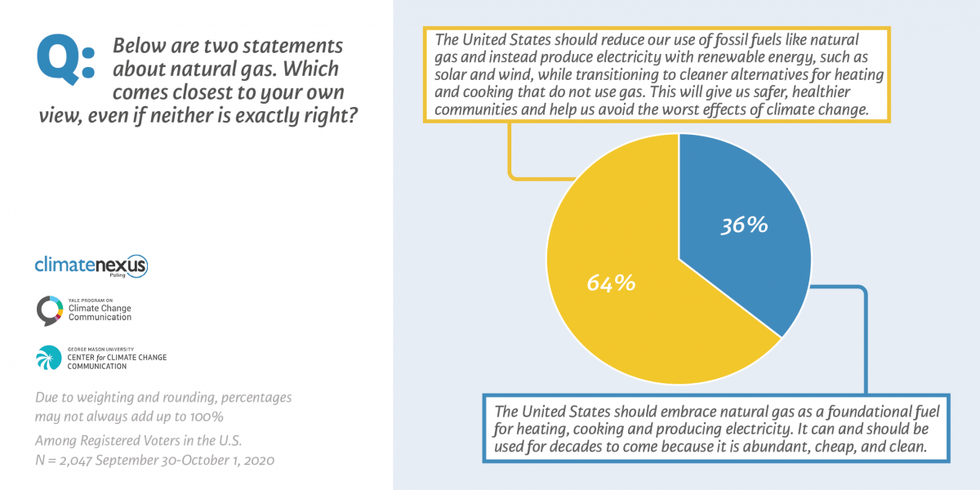
When presented with two statements about natural gas, the majority of voters reiterated that they believe the U.S. should reduce the use of fossil fuels :
"The natural gas industry has spent decades convincing people their product is clean energy, and voters have believed them," said Edward Maibach, director of George Mason's center. "But we now know alarming spikes of methane emissions--caused in part by gas production--are making global warming worse. The public is beginning to catch on to the threat."
Nearly three-quarters (74%) of the poll's respondents somewhat or strongly support creating a jobs program for currently unemployed fossil fuel workers to safely close down tens of thousands of abandoned oil and gas wells that cause water and methane pollution; the same total percentage believe dirty energy companies should be required to cover at least some of the costs.
The new survey echoes polling results released last week following the final debate between President Donald Trump and Democratic nominee Joe Biden. After Biden said that he would phase out the U.S. oil industry in a shift toward clean energy, a Morning Consult/Politico poll found that 57% of voters support a "concerted oil-to-renewables transition," with even greater support among Democrats.
Referencing those findings on Tuesday, Our Daily Planet detailed "why this matters":
As Election Day draws near, new polls by Pew Research found that 68% of registered voters consider climate change to be a "very important" or "somewhat" important issue. Many experts (and even some coal workers) agree that investing in renewable energy will help create jobs and boost the economy. Renewable energy is more economically viable than ever and voters support it. Moderate Dems may have been nervous that Republicans will try to skewer Biden over this remark, but these polls suggest that might not work. The question will be whether it flips any voters in a crucial swing state. Only time will tell.
In response to the fossil fuel discussion at last week's debate, 350 Action North America director Tamara Toles O'Laughlin said in a statement that climate is a top issue for voters and "Biden demonstrated the capacity for leadership our country needs and deserves, including tackling the climate crisis at scale."
"While we may not always agree with his approach, we can see his willingness to listen, proven by a commitment to ending federal subsidies to the oil industry, and we look forward to finding solutions and common ground," she added. "On the other hand, we have Donald Trump, unhinged and desperate, flailing about, spewing a combination of lies and hateful rhetoric at every turn."
350 Action is among the climate advocacy groups that have endorsed Biden. The Democrat has also won the backing of various climate scientists as well as the first-ever endorsement from the editors at Scientific American, who warned last month that "the 2020 election is literally a matter of life and death."
With an estimated 66 million ballots already cast and only a week to go until Election Day, new polling released Tuesday shows the vast majority of U.S. voters believe the nation should be prioritizing a transition to 100% clean energy and support legislation to decarbonize the economy over the next few decades.
"Voters strongly support a national transition from dependence on coal, oil, and gas to renewable sources like solar and wind."
-- Anthony Leiserowitz, Yale Program on Climate Change Communication
Climate Nexus, the Yale Program on Climate Change Communication, and the George Mason University Center for Climate Change Communication surveyed (pdf) over 2,000 registered voters online in late September and early October. The poll's margin of error is plus/minus 2.2% at the 95% confidence level.
Pollsters found that 82% of voters somewhat (33%) or strongly (49%) agree that "the primary goal of U.S. energy policy should be achieving 100% clean energy."
Respondents were also asked to weigh in on legislation introduced in Congress "that would set the goal of achieving a 100% clean economy (eliminating fossil fuel emissions from the transportation, electricity, buildings, industry, and agricultural sectors) in the United States by the year 2050."
Over seven in 10 said they somewhat (31%) or strongly (40%) support such legislation--the same total percentage who said they somewhat (32%) or strongly (39%) support "requiring electric utility companies in the United States to generate 100% of their electricity from renewable sources, like wind and solar, by the year 2035."
"The conventional wisdom has clearly changed," Anthony Leiserowitz, director of Yale's program, said in a statement about the survey results Tuesday. "Voters strongly support a national transition from dependence on coal, oil, and gas to renewable sources like solar and wind."
The poll shows majorities of voters believe that transitioning to a 100% clean energy economy would positively impact jobs and economic growth, energy bills, rural and farming communities in their state, and communities of color in their state.
A majority of respondents (62%) also said they would be more likely to or would only vote for a candidate who supports "providing a multi-trillion-dollar federal economic stimulus that prioritizes investments in clean energy infrastructure."
While support for hydraulic fracturing to increase production of natural gas and oil in the U.S. was split, 61% said there needs to be more regulation of fracking and 80% somewhat or strongly support requiring energy companies to install technology to reduce leaks of the potent greenhouse gas methane.
When presented with two statements about natural gas, the majority of voters reiterated that they believe the U.S. should reduce the use of fossil fuels :
"The natural gas industry has spent decades convincing people their product is clean energy, and voters have believed them," said Edward Maibach, director of George Mason's center. "But we now know alarming spikes of methane emissions--caused in part by gas production--are making global warming worse. The public is beginning to catch on to the threat."
Nearly three-quarters (74%) of the poll's respondents somewhat or strongly support creating a jobs program for currently unemployed fossil fuel workers to safely close down tens of thousands of abandoned oil and gas wells that cause water and methane pollution; the same total percentage believe dirty energy companies should be required to cover at least some of the costs.
The new survey echoes polling results released last week following the final debate between President Donald Trump and Democratic nominee Joe Biden. After Biden said that he would phase out the U.S. oil industry in a shift toward clean energy, a Morning Consult/Politico poll found that 57% of voters support a "concerted oil-to-renewables transition," with even greater support among Democrats.
Referencing those findings on Tuesday, Our Daily Planet detailed "why this matters":
As Election Day draws near, new polls by Pew Research found that 68% of registered voters consider climate change to be a "very important" or "somewhat" important issue. Many experts (and even some coal workers) agree that investing in renewable energy will help create jobs and boost the economy. Renewable energy is more economically viable than ever and voters support it. Moderate Dems may have been nervous that Republicans will try to skewer Biden over this remark, but these polls suggest that might not work. The question will be whether it flips any voters in a crucial swing state. Only time will tell.
In response to the fossil fuel discussion at last week's debate, 350 Action North America director Tamara Toles O'Laughlin said in a statement that climate is a top issue for voters and "Biden demonstrated the capacity for leadership our country needs and deserves, including tackling the climate crisis at scale."
"While we may not always agree with his approach, we can see his willingness to listen, proven by a commitment to ending federal subsidies to the oil industry, and we look forward to finding solutions and common ground," she added. "On the other hand, we have Donald Trump, unhinged and desperate, flailing about, spewing a combination of lies and hateful rhetoric at every turn."
350 Action is among the climate advocacy groups that have endorsed Biden. The Democrat has also won the backing of various climate scientists as well as the first-ever endorsement from the editors at Scientific American, who warned last month that "the 2020 election is literally a matter of life and death."
With an estimated 66 million ballots already cast and only a week to go until Election Day, new polling released Tuesday shows the vast majority of U.S. voters believe the nation should be prioritizing a transition to 100% clean energy and support legislation to decarbonize the economy over the next few decades.
"Voters strongly support a national transition from dependence on coal, oil, and gas to renewable sources like solar and wind."
-- Anthony Leiserowitz, Yale Program on Climate Change Communication
Climate Nexus, the Yale Program on Climate Change Communication, and the George Mason University Center for Climate Change Communication surveyed (pdf) over 2,000 registered voters online in late September and early October. The poll's margin of error is plus/minus 2.2% at the 95% confidence level.
Pollsters found that 82% of voters somewhat (33%) or strongly (49%) agree that "the primary goal of U.S. energy policy should be achieving 100% clean energy."
Respondents were also asked to weigh in on legislation introduced in Congress "that would set the goal of achieving a 100% clean economy (eliminating fossil fuel emissions from the transportation, electricity, buildings, industry, and agricultural sectors) in the United States by the year 2050."
Over seven in 10 said they somewhat (31%) or strongly (40%) support such legislation--the same total percentage who said they somewhat (32%) or strongly (39%) support "requiring electric utility companies in the United States to generate 100% of their electricity from renewable sources, like wind and solar, by the year 2035."
"The conventional wisdom has clearly changed," Anthony Leiserowitz, director of Yale's program, said in a statement about the survey results Tuesday. "Voters strongly support a national transition from dependence on coal, oil, and gas to renewable sources like solar and wind."
The poll shows majorities of voters believe that transitioning to a 100% clean energy economy would positively impact jobs and economic growth, energy bills, rural and farming communities in their state, and communities of color in their state.
A majority of respondents (62%) also said they would be more likely to or would only vote for a candidate who supports "providing a multi-trillion-dollar federal economic stimulus that prioritizes investments in clean energy infrastructure."
While support for hydraulic fracturing to increase production of natural gas and oil in the U.S. was split, 61% said there needs to be more regulation of fracking and 80% somewhat or strongly support requiring energy companies to install technology to reduce leaks of the potent greenhouse gas methane.
When presented with two statements about natural gas, the majority of voters reiterated that they believe the U.S. should reduce the use of fossil fuels :
"The natural gas industry has spent decades convincing people their product is clean energy, and voters have believed them," said Edward Maibach, director of George Mason's center. "But we now know alarming spikes of methane emissions--caused in part by gas production--are making global warming worse. The public is beginning to catch on to the threat."
Nearly three-quarters (74%) of the poll's respondents somewhat or strongly support creating a jobs program for currently unemployed fossil fuel workers to safely close down tens of thousands of abandoned oil and gas wells that cause water and methane pollution; the same total percentage believe dirty energy companies should be required to cover at least some of the costs.
The new survey echoes polling results released last week following the final debate between President Donald Trump and Democratic nominee Joe Biden. After Biden said that he would phase out the U.S. oil industry in a shift toward clean energy, a Morning Consult/Politico poll found that 57% of voters support a "concerted oil-to-renewables transition," with even greater support among Democrats.
Referencing those findings on Tuesday, Our Daily Planet detailed "why this matters":
As Election Day draws near, new polls by Pew Research found that 68% of registered voters consider climate change to be a "very important" or "somewhat" important issue. Many experts (and even some coal workers) agree that investing in renewable energy will help create jobs and boost the economy. Renewable energy is more economically viable than ever and voters support it. Moderate Dems may have been nervous that Republicans will try to skewer Biden over this remark, but these polls suggest that might not work. The question will be whether it flips any voters in a crucial swing state. Only time will tell.
In response to the fossil fuel discussion at last week's debate, 350 Action North America director Tamara Toles O'Laughlin said in a statement that climate is a top issue for voters and "Biden demonstrated the capacity for leadership our country needs and deserves, including tackling the climate crisis at scale."
"While we may not always agree with his approach, we can see his willingness to listen, proven by a commitment to ending federal subsidies to the oil industry, and we look forward to finding solutions and common ground," she added. "On the other hand, we have Donald Trump, unhinged and desperate, flailing about, spewing a combination of lies and hateful rhetoric at every turn."
350 Action is among the climate advocacy groups that have endorsed Biden. The Democrat has also won the backing of various climate scientists as well as the first-ever endorsement from the editors at Scientific American, who warned last month that "the 2020 election is literally a matter of life and death."