SUBSCRIBE TO OUR FREE NEWSLETTER
Daily news & progressive opinion—funded by the people, not the corporations—delivered straight to your inbox.
5
#000000
#FFFFFF
To donate by check, phone, or other method, see our More Ways to Give page.
Daily news & progressive opinion—funded by the people, not the corporations—delivered straight to your inbox.

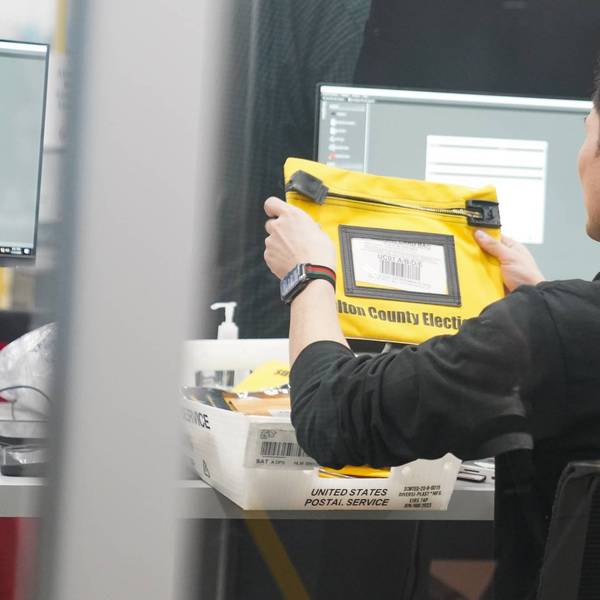
An election worker accepts ballots from voters in cars at a drive-through mail ballot drop-off site at NRG Stadium on October 7, 2020 in Houston, Texas. Gov. Gregg Abbott issued an executive order limiting each county to one mail ballot drop-off site due to the pandemic. (Photo: Go Nakamura/Getty Images)
An ongoing battle in Texas over voters' access to absentee ballot drop-off locations illustrates the consequences of President Donald Trump's relentless focus on stacking the judicial branch with conservative appointees, as a federal appeals court late Monday night upheld Republican Gov. Greg Abbott's limit on voting locations across the state.
A panel of three Trump appointees on the U.S. Court of Appeals for the Fifth Circuit issued a temporary stay on a District Court's earlier ruling, in which Judge Robert Pitman had said Abbott was unfairly cutting off access to voting for people across the state by limiting ballot drop-off locations to one per county.
Following Monday night's ruling, Texas voters are likely to face hours-long lines to drop off their absentee ballots, like those that reporters have recorded in Harris County in recent days.
Trump named his 200th judicial appointee to the federal court system in June, and is working with Senate Majority Leader Mitch McConnell (R-Ky.) to push through the confirmation of Judge Amy Coney Barrett to the U.S. Supreme Court after appointing Justices Neil Gorsuch and Brett Kavanaugh earlier in his term.
On Monday, Democratic strategist Emmy Bengston tweeted, three of Trump's chosen judges upheld "voter suppression."
Abbott and other Republicans claim allowing more than one drop-off location per county would invite so-called "voter fraud"--which multiple studies have found to be extremely rare whether a voter casts a ballot in person, by mail, or by dropping it off.
A record number of Americans have requested absentee ballots this year amid the coronavirus pandemic.
Abbott's attempt to make voting more difficult for people who aim to avoid spreading Covid-19 caught international attention this month, with Spanish politician Alfons Lopez Tena denouncing the move as a "travesty" intended to disenfranchise voters of color in Texas.
In his ruling last week, Pitman sided with a coalition of civil rights groups, including the Texas League of United Latin American Citizens, who filed suit against the state arguing that voters particularly vulnerable to severe cases of Covid-19 would be disenfranchised by Abbott's restrictions.
"Older and disabled voters living in Texas' largest and most populous counties must travel further distances to more crowded ballot return centers where they would be at an increased risk of being infected by the coronavirus in order to exercise their right to vote and have it counted," Pitman wrote in his ruling.
The ruling on Monday, journalist Adam Serwer sarcastically tweeted, illustrates the Republican Party's view that "the constitution very clearly says 'Republicans win every time, especially when disenfranchising millions of voters they think won't support them.'"
" Democracy is ok as long as you vote Republican. If you don't, well, that freedom can be taken away from you because it's not as important as 'liberty,'" wrote Serwer. "What's liberty? It's when one party runs things because it successfully disenfranchises the other party's voters. Any questions?"
Dear Common Dreams reader, It’s been nearly 30 years since I co-founded Common Dreams with my late wife, Lina Newhouser. We had the radical notion that journalism should serve the public good, not corporate profits. It was clear to us from the outset what it would take to build such a project. No paid advertisements. No corporate sponsors. No millionaire publisher telling us what to think or do. Many people said we wouldn't last a year, but we proved those doubters wrong. Together with a tremendous team of journalists and dedicated staff, we built an independent media outlet free from the constraints of profits and corporate control. Our mission has always been simple: To inform. To inspire. To ignite change for the common good. Building Common Dreams was not easy. Our survival was never guaranteed. When you take on the most powerful forces—Wall Street greed, fossil fuel industry destruction, Big Tech lobbyists, and uber-rich oligarchs who have spent billions upon billions rigging the economy and democracy in their favor—the only bulwark you have is supporters who believe in your work. But here’s the urgent message from me today. It's never been this bad out there. And it's never been this hard to keep us going. At the very moment Common Dreams is most needed, the threats we face are intensifying. We need your support now more than ever. We don't accept corporate advertising and never will. We don't have a paywall because we don't think people should be blocked from critical news based on their ability to pay. Everything we do is funded by the donations of readers like you. When everyone does the little they can afford, we are strong. But if that support retreats or dries up, so do we. Will you donate now to make sure Common Dreams not only survives but thrives? —Craig Brown, Co-founder |
An ongoing battle in Texas over voters' access to absentee ballot drop-off locations illustrates the consequences of President Donald Trump's relentless focus on stacking the judicial branch with conservative appointees, as a federal appeals court late Monday night upheld Republican Gov. Greg Abbott's limit on voting locations across the state.
A panel of three Trump appointees on the U.S. Court of Appeals for the Fifth Circuit issued a temporary stay on a District Court's earlier ruling, in which Judge Robert Pitman had said Abbott was unfairly cutting off access to voting for people across the state by limiting ballot drop-off locations to one per county.
Following Monday night's ruling, Texas voters are likely to face hours-long lines to drop off their absentee ballots, like those that reporters have recorded in Harris County in recent days.
Trump named his 200th judicial appointee to the federal court system in June, and is working with Senate Majority Leader Mitch McConnell (R-Ky.) to push through the confirmation of Judge Amy Coney Barrett to the U.S. Supreme Court after appointing Justices Neil Gorsuch and Brett Kavanaugh earlier in his term.
On Monday, Democratic strategist Emmy Bengston tweeted, three of Trump's chosen judges upheld "voter suppression."
Abbott and other Republicans claim allowing more than one drop-off location per county would invite so-called "voter fraud"--which multiple studies have found to be extremely rare whether a voter casts a ballot in person, by mail, or by dropping it off.
A record number of Americans have requested absentee ballots this year amid the coronavirus pandemic.
Abbott's attempt to make voting more difficult for people who aim to avoid spreading Covid-19 caught international attention this month, with Spanish politician Alfons Lopez Tena denouncing the move as a "travesty" intended to disenfranchise voters of color in Texas.
In his ruling last week, Pitman sided with a coalition of civil rights groups, including the Texas League of United Latin American Citizens, who filed suit against the state arguing that voters particularly vulnerable to severe cases of Covid-19 would be disenfranchised by Abbott's restrictions.
"Older and disabled voters living in Texas' largest and most populous counties must travel further distances to more crowded ballot return centers where they would be at an increased risk of being infected by the coronavirus in order to exercise their right to vote and have it counted," Pitman wrote in his ruling.
The ruling on Monday, journalist Adam Serwer sarcastically tweeted, illustrates the Republican Party's view that "the constitution very clearly says 'Republicans win every time, especially when disenfranchising millions of voters they think won't support them.'"
" Democracy is ok as long as you vote Republican. If you don't, well, that freedom can be taken away from you because it's not as important as 'liberty,'" wrote Serwer. "What's liberty? It's when one party runs things because it successfully disenfranchises the other party's voters. Any questions?"
An ongoing battle in Texas over voters' access to absentee ballot drop-off locations illustrates the consequences of President Donald Trump's relentless focus on stacking the judicial branch with conservative appointees, as a federal appeals court late Monday night upheld Republican Gov. Greg Abbott's limit on voting locations across the state.
A panel of three Trump appointees on the U.S. Court of Appeals for the Fifth Circuit issued a temporary stay on a District Court's earlier ruling, in which Judge Robert Pitman had said Abbott was unfairly cutting off access to voting for people across the state by limiting ballot drop-off locations to one per county.
Following Monday night's ruling, Texas voters are likely to face hours-long lines to drop off their absentee ballots, like those that reporters have recorded in Harris County in recent days.
Trump named his 200th judicial appointee to the federal court system in June, and is working with Senate Majority Leader Mitch McConnell (R-Ky.) to push through the confirmation of Judge Amy Coney Barrett to the U.S. Supreme Court after appointing Justices Neil Gorsuch and Brett Kavanaugh earlier in his term.
On Monday, Democratic strategist Emmy Bengston tweeted, three of Trump's chosen judges upheld "voter suppression."
Abbott and other Republicans claim allowing more than one drop-off location per county would invite so-called "voter fraud"--which multiple studies have found to be extremely rare whether a voter casts a ballot in person, by mail, or by dropping it off.
A record number of Americans have requested absentee ballots this year amid the coronavirus pandemic.
Abbott's attempt to make voting more difficult for people who aim to avoid spreading Covid-19 caught international attention this month, with Spanish politician Alfons Lopez Tena denouncing the move as a "travesty" intended to disenfranchise voters of color in Texas.
In his ruling last week, Pitman sided with a coalition of civil rights groups, including the Texas League of United Latin American Citizens, who filed suit against the state arguing that voters particularly vulnerable to severe cases of Covid-19 would be disenfranchised by Abbott's restrictions.
"Older and disabled voters living in Texas' largest and most populous counties must travel further distances to more crowded ballot return centers where they would be at an increased risk of being infected by the coronavirus in order to exercise their right to vote and have it counted," Pitman wrote in his ruling.
The ruling on Monday, journalist Adam Serwer sarcastically tweeted, illustrates the Republican Party's view that "the constitution very clearly says 'Republicans win every time, especially when disenfranchising millions of voters they think won't support them.'"
" Democracy is ok as long as you vote Republican. If you don't, well, that freedom can be taken away from you because it's not as important as 'liberty,'" wrote Serwer. "What's liberty? It's when one party runs things because it successfully disenfranchises the other party's voters. Any questions?"