SUBSCRIBE TO OUR FREE NEWSLETTER
Daily news & progressive opinion—funded by the people, not the corporations—delivered straight to your inbox.
5
#000000
#FFFFFF
To donate by check, phone, or other method, see our More Ways to Give page.
Daily news & progressive opinion—funded by the people, not the corporations—delivered straight to your inbox.
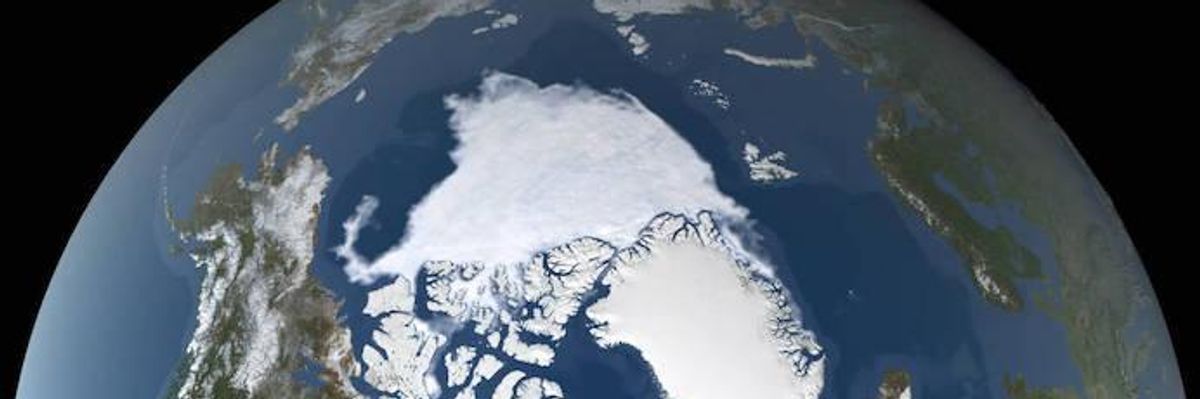
In the Arctic Ocean, sea ice reached its minimum extent of 1.44 million square miles (3.74 million square kilometers) on Sept. 15--the second-lowest extent since modern record keeping began. (Image: NASA's Scientific Visualization Studio)
Arctic sea ice shrank to the second-lowest extent since records began over four decades ago, federal scientists said Monday, prompting renewed warnings about the climate crisis.
The minimum ice cover for 2020 was likely reached on Sept. 15, scientists at the National Snow and Ice Data Center (NSIDC) announced. On that date, ice measured 1.44 million square miles (3.74 million square kilometers). That coverage is 135,000 square miles (350,000 square kilometers) more than the lowest extent of ice recorded in 2012.
"The Earth just rang another alarm bell in the climate emergency," said Arlo Hemphill, senior oceans campaigner at Greenpeace USA.
The near record comes amid what NSIDC director Mark Serreze described as "a crazy year up north, with sea ice at a near-record low, 100-degree F heat waves in Siberia, and massive forest fires."
The finding also marks the continuation of a trend: the 14 lowest minimum Arctic sea ice extents were all recorded in the last 14 years, scientists noted.
"The year 2020 will stand as an exclamation point on the downward trend in Arctic sea ice extent. We are headed towards a seasonally ice-free Arctic Ocean, and this year is another nail in the coffin," said Serreze.
NASA, which supported the analysis, explained further:
A Siberian heat wave in spring 2020 began this year's Arctic sea ice melt season early, and with Arctic temperatures being 14 to 18 degrees Fahrenheit (8 to 10 degrees Celsius) warmer than average, the ice extent kept declining. The 2020 minimum extent was 958,000 square miles (2.48 million square kilometers) below the 1981-2010 average of yearly minimum extents, and 2020 is only the second time on record that the minimum extent has fallen below 1.5 million square miles (4 million square kilometers).
"The extent of summer sea ice in the Arctic can impact local ecosystems, regional and global weather patterns, and ocean circulation," NASA noted, and shared this video to accompany the new analysis:
Serreze added that the ice "is shrinking in the summer, but it's also getting thinner."
"You're losing extent, and you're losing the thick ice as well," he said. "It's a double whammy."
Laura Meller, Greenpeace Nordic Oceans Campaigner, said the new data is cause for concern.
"The rapid disappearance of sea ice is a sobering indicator of how closely our planet is circling the drain," Meller said in a statement from onboard the Greenpeace ship Arctic Sunrise. "As the Arctic melts, the ocean will absorb more heat, and all of us will be more exposed to the devastating effects of climate breakdown."
Dear Common Dreams reader, It’s been nearly 30 years since I co-founded Common Dreams with my late wife, Lina Newhouser. We had the radical notion that journalism should serve the public good, not corporate profits. It was clear to us from the outset what it would take to build such a project. No paid advertisements. No corporate sponsors. No millionaire publisher telling us what to think or do. Many people said we wouldn't last a year, but we proved those doubters wrong. Together with a tremendous team of journalists and dedicated staff, we built an independent media outlet free from the constraints of profits and corporate control. Our mission has always been simple: To inform. To inspire. To ignite change for the common good. Building Common Dreams was not easy. Our survival was never guaranteed. When you take on the most powerful forces—Wall Street greed, fossil fuel industry destruction, Big Tech lobbyists, and uber-rich oligarchs who have spent billions upon billions rigging the economy and democracy in their favor—the only bulwark you have is supporters who believe in your work. But here’s the urgent message from me today. It's never been this bad out there. And it's never been this hard to keep us going. At the very moment Common Dreams is most needed, the threats we face are intensifying. We need your support now more than ever. We don't accept corporate advertising and never will. We don't have a paywall because we don't think people should be blocked from critical news based on their ability to pay. Everything we do is funded by the donations of readers like you. When everyone does the little they can afford, we are strong. But if that support retreats or dries up, so do we. Will you donate now to make sure Common Dreams not only survives but thrives? —Craig Brown, Co-founder |
Arctic sea ice shrank to the second-lowest extent since records began over four decades ago, federal scientists said Monday, prompting renewed warnings about the climate crisis.
The minimum ice cover for 2020 was likely reached on Sept. 15, scientists at the National Snow and Ice Data Center (NSIDC) announced. On that date, ice measured 1.44 million square miles (3.74 million square kilometers). That coverage is 135,000 square miles (350,000 square kilometers) more than the lowest extent of ice recorded in 2012.
"The Earth just rang another alarm bell in the climate emergency," said Arlo Hemphill, senior oceans campaigner at Greenpeace USA.
The near record comes amid what NSIDC director Mark Serreze described as "a crazy year up north, with sea ice at a near-record low, 100-degree F heat waves in Siberia, and massive forest fires."
The finding also marks the continuation of a trend: the 14 lowest minimum Arctic sea ice extents were all recorded in the last 14 years, scientists noted.
"The year 2020 will stand as an exclamation point on the downward trend in Arctic sea ice extent. We are headed towards a seasonally ice-free Arctic Ocean, and this year is another nail in the coffin," said Serreze.
NASA, which supported the analysis, explained further:
A Siberian heat wave in spring 2020 began this year's Arctic sea ice melt season early, and with Arctic temperatures being 14 to 18 degrees Fahrenheit (8 to 10 degrees Celsius) warmer than average, the ice extent kept declining. The 2020 minimum extent was 958,000 square miles (2.48 million square kilometers) below the 1981-2010 average of yearly minimum extents, and 2020 is only the second time on record that the minimum extent has fallen below 1.5 million square miles (4 million square kilometers).
"The extent of summer sea ice in the Arctic can impact local ecosystems, regional and global weather patterns, and ocean circulation," NASA noted, and shared this video to accompany the new analysis:
Serreze added that the ice "is shrinking in the summer, but it's also getting thinner."
"You're losing extent, and you're losing the thick ice as well," he said. "It's a double whammy."
Laura Meller, Greenpeace Nordic Oceans Campaigner, said the new data is cause for concern.
"The rapid disappearance of sea ice is a sobering indicator of how closely our planet is circling the drain," Meller said in a statement from onboard the Greenpeace ship Arctic Sunrise. "As the Arctic melts, the ocean will absorb more heat, and all of us will be more exposed to the devastating effects of climate breakdown."
Arctic sea ice shrank to the second-lowest extent since records began over four decades ago, federal scientists said Monday, prompting renewed warnings about the climate crisis.
The minimum ice cover for 2020 was likely reached on Sept. 15, scientists at the National Snow and Ice Data Center (NSIDC) announced. On that date, ice measured 1.44 million square miles (3.74 million square kilometers). That coverage is 135,000 square miles (350,000 square kilometers) more than the lowest extent of ice recorded in 2012.
"The Earth just rang another alarm bell in the climate emergency," said Arlo Hemphill, senior oceans campaigner at Greenpeace USA.
The near record comes amid what NSIDC director Mark Serreze described as "a crazy year up north, with sea ice at a near-record low, 100-degree F heat waves in Siberia, and massive forest fires."
The finding also marks the continuation of a trend: the 14 lowest minimum Arctic sea ice extents were all recorded in the last 14 years, scientists noted.
"The year 2020 will stand as an exclamation point on the downward trend in Arctic sea ice extent. We are headed towards a seasonally ice-free Arctic Ocean, and this year is another nail in the coffin," said Serreze.
NASA, which supported the analysis, explained further:
A Siberian heat wave in spring 2020 began this year's Arctic sea ice melt season early, and with Arctic temperatures being 14 to 18 degrees Fahrenheit (8 to 10 degrees Celsius) warmer than average, the ice extent kept declining. The 2020 minimum extent was 958,000 square miles (2.48 million square kilometers) below the 1981-2010 average of yearly minimum extents, and 2020 is only the second time on record that the minimum extent has fallen below 1.5 million square miles (4 million square kilometers).
"The extent of summer sea ice in the Arctic can impact local ecosystems, regional and global weather patterns, and ocean circulation," NASA noted, and shared this video to accompany the new analysis:
Serreze added that the ice "is shrinking in the summer, but it's also getting thinner."
"You're losing extent, and you're losing the thick ice as well," he said. "It's a double whammy."
Laura Meller, Greenpeace Nordic Oceans Campaigner, said the new data is cause for concern.
"The rapid disappearance of sea ice is a sobering indicator of how closely our planet is circling the drain," Meller said in a statement from onboard the Greenpeace ship Arctic Sunrise. "As the Arctic melts, the ocean will absorb more heat, and all of us will be more exposed to the devastating effects of climate breakdown."