SUBSCRIBE TO OUR FREE NEWSLETTER
Daily news & progressive opinion—funded by the people, not the corporations—delivered straight to your inbox.
5
#000000
#FFFFFF
To donate by check, phone, or other method, see our More Ways to Give page.
Daily news & progressive opinion—funded by the people, not the corporations—delivered straight to your inbox.
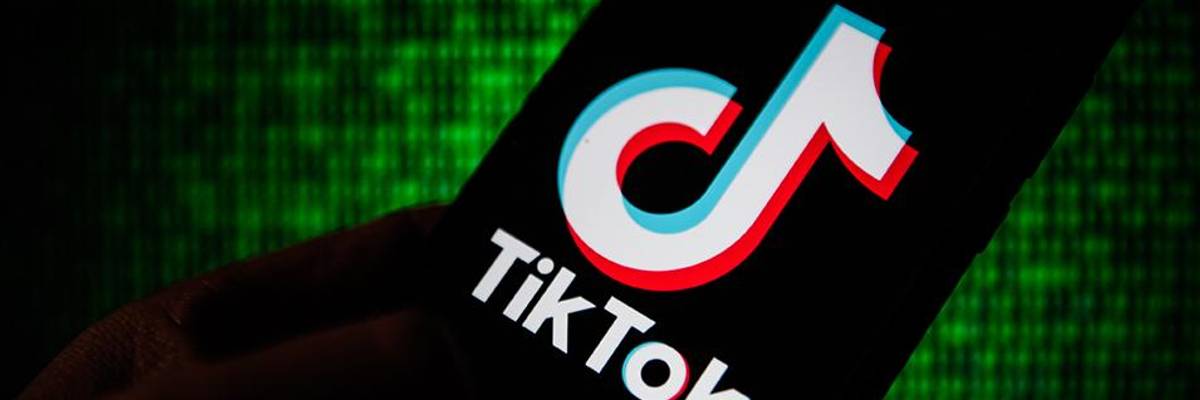
United States Department of Commerce Secretary Wilbur Ross Friday announced a ban on TikTok and WeChat from U.S. app stores. (Photo Illustration: Omar Marques/SOPA Images/LightRocket via Getty Images)
In what free speech advocates say is a violation of the First Amendment, the Trump administration Friday announced a ban on TikTok and WeChat from app stores in the United States.
"This order violates the First Amendment rights of people in the United States by restricting their ability to communicate and conduct important transactions on the two social media platforms," Hina Shamsi, director of the American Civil Liberties Union's National Security Project, said in a statement. "The order also harms the privacy and security of millions of existing TikTok and WeChat users in the United States by blocking software updates, which can fix vulnerabilities and make the apps more secure."
Commerce Secretary Wilbur Ross announced the ban--set to go into effect on Sunday and which follows a controversial executive order issued by President Donald Trump in August--and claimed the popular apps pose a security threat to the United States.
"Today's actions prove once again that President Trump will do everything in his power to guarantee our national security and protect Americans from the threats of the Chinese Communist Party," Ross said. "At the president's direction, we have taken significant action to combat China's malicious collection of American citizens' personal data, while promoting our national values, democratic rules-based norms, and aggressive enforcement of U.S. laws and regulations."
But free speech watchdogs and advocates denounced such reasoning condemned the move.
The order requires that WeChat--which has millions of U.S. users who rely on the app to stay in touch and conduct business with people and companies in China--end payments through its service as of Sunday and prohibits it from getting technical services from vendors, according to the Associated Press.
Similar technical limitations for TikTok don't go into effect until Nov. 12, shortly after the U.S. election. According to reporting from the AP, TikTok has 100 million U.S. users and 700 million globally.
In an interview with Fox Business on Friday, Ross, appeared to misunderstand how mobile app technology works when he attempted to clarify what the order means for TikTok, saying by Sunday the app's users "won't have access to improved apps, updated apps, upgraded apps, or maintenance."
As critics point out, a downloaded app without the ability to access updates poses serious security and privacy risks for users.
As for WeChat, Ross said, "For all practical purposes it will be shut down in the U.S., but only in the U.S., as of midnight Monday."
In an article published last month--when President Trump initially announced plans to ban the apps--Eva Galperin, David Greene and Kurt Opsahle of the Electronic Freedom Foundation (EFF) criticized the Trump administration's claims that banning the apps would be an effort to combat overreach of the Chinese government.
"It is ironic that, while purporting to protect America from China's authoritarian government, President Trump is threatening to ban the TikTok app," they wrote. "Censorship of both speech and social media applications, after all, is one of the hallmarks of the Chinese Internet strategy. While there is significant cause for concern with TikTok's security, privacy, and its relationship with the Chinese government, we should resist a governmental power to ban a popular means of communication and expression."
Additionally, according to the EFF article, banning the apps, which many Americans already have downloaded onto devices, would pose a security threat:
As courts have held, code is speech, and the Supreme Court has recognized that software is a protected means of expression (addressing age warnings for video games). Just as bookstores have a right to sell books protected by the First Amendment, so too do app stores have a right to distribute protected software. Of course, it would be up to Apple and Google to challenge a purported distribution ban on their app store.
As a practical matter, an app store ban would not be particularly effective, as close to 100 million people in the U.S. already have the app. However, an inability to get updates--as a result of a ban--would create a security nightmare. Major vulnerabilities left unpatched would leave TikTok users susceptible to a variety of attackers, up to and including the Chinese government.
U.S. corporations include Oracle have been negotiating terms for a potential buy-out of the company, but, according to the AP, "details remain foggy and the administration is still reviewing it."
On Friday, the AP reported, TikTok expressed "disappointment" over the move and said it would continue to challenge the president's "unjust executive order." WeChat owner Tencent said that it will continue to discuss ways to address concerns with the government and look for long-term solutions, according to the AP.
"In implementing President Trump's abuse of emergency powers, Secretary Ross is undermining our rights and our security," said ACLU's Shamsi. "To truly address privacy concerns raised by social media platforms, Congress should enact comprehensive surveillance reform and strong consumer data privacy legislation."
Dear Common Dreams reader, It’s been nearly 30 years since I co-founded Common Dreams with my late wife, Lina Newhouser. We had the radical notion that journalism should serve the public good, not corporate profits. It was clear to us from the outset what it would take to build such a project. No paid advertisements. No corporate sponsors. No millionaire publisher telling us what to think or do. Many people said we wouldn't last a year, but we proved those doubters wrong. Together with a tremendous team of journalists and dedicated staff, we built an independent media outlet free from the constraints of profits and corporate control. Our mission has always been simple: To inform. To inspire. To ignite change for the common good. Building Common Dreams was not easy. Our survival was never guaranteed. When you take on the most powerful forces—Wall Street greed, fossil fuel industry destruction, Big Tech lobbyists, and uber-rich oligarchs who have spent billions upon billions rigging the economy and democracy in their favor—the only bulwark you have is supporters who believe in your work. But here’s the urgent message from me today. It's never been this bad out there. And it's never been this hard to keep us going. At the very moment Common Dreams is most needed, the threats we face are intensifying. We need your support now more than ever. We don't accept corporate advertising and never will. We don't have a paywall because we don't think people should be blocked from critical news based on their ability to pay. Everything we do is funded by the donations of readers like you. When everyone does the little they can afford, we are strong. But if that support retreats or dries up, so do we. Will you donate now to make sure Common Dreams not only survives but thrives? —Craig Brown, Co-founder |
In what free speech advocates say is a violation of the First Amendment, the Trump administration Friday announced a ban on TikTok and WeChat from app stores in the United States.
"This order violates the First Amendment rights of people in the United States by restricting their ability to communicate and conduct important transactions on the two social media platforms," Hina Shamsi, director of the American Civil Liberties Union's National Security Project, said in a statement. "The order also harms the privacy and security of millions of existing TikTok and WeChat users in the United States by blocking software updates, which can fix vulnerabilities and make the apps more secure."
Commerce Secretary Wilbur Ross announced the ban--set to go into effect on Sunday and which follows a controversial executive order issued by President Donald Trump in August--and claimed the popular apps pose a security threat to the United States.
"Today's actions prove once again that President Trump will do everything in his power to guarantee our national security and protect Americans from the threats of the Chinese Communist Party," Ross said. "At the president's direction, we have taken significant action to combat China's malicious collection of American citizens' personal data, while promoting our national values, democratic rules-based norms, and aggressive enforcement of U.S. laws and regulations."
But free speech watchdogs and advocates denounced such reasoning condemned the move.
The order requires that WeChat--which has millions of U.S. users who rely on the app to stay in touch and conduct business with people and companies in China--end payments through its service as of Sunday and prohibits it from getting technical services from vendors, according to the Associated Press.
Similar technical limitations for TikTok don't go into effect until Nov. 12, shortly after the U.S. election. According to reporting from the AP, TikTok has 100 million U.S. users and 700 million globally.
In an interview with Fox Business on Friday, Ross, appeared to misunderstand how mobile app technology works when he attempted to clarify what the order means for TikTok, saying by Sunday the app's users "won't have access to improved apps, updated apps, upgraded apps, or maintenance."
As critics point out, a downloaded app without the ability to access updates poses serious security and privacy risks for users.
As for WeChat, Ross said, "For all practical purposes it will be shut down in the U.S., but only in the U.S., as of midnight Monday."
In an article published last month--when President Trump initially announced plans to ban the apps--Eva Galperin, David Greene and Kurt Opsahle of the Electronic Freedom Foundation (EFF) criticized the Trump administration's claims that banning the apps would be an effort to combat overreach of the Chinese government.
"It is ironic that, while purporting to protect America from China's authoritarian government, President Trump is threatening to ban the TikTok app," they wrote. "Censorship of both speech and social media applications, after all, is one of the hallmarks of the Chinese Internet strategy. While there is significant cause for concern with TikTok's security, privacy, and its relationship with the Chinese government, we should resist a governmental power to ban a popular means of communication and expression."
Additionally, according to the EFF article, banning the apps, which many Americans already have downloaded onto devices, would pose a security threat:
As courts have held, code is speech, and the Supreme Court has recognized that software is a protected means of expression (addressing age warnings for video games). Just as bookstores have a right to sell books protected by the First Amendment, so too do app stores have a right to distribute protected software. Of course, it would be up to Apple and Google to challenge a purported distribution ban on their app store.
As a practical matter, an app store ban would not be particularly effective, as close to 100 million people in the U.S. already have the app. However, an inability to get updates--as a result of a ban--would create a security nightmare. Major vulnerabilities left unpatched would leave TikTok users susceptible to a variety of attackers, up to and including the Chinese government.
U.S. corporations include Oracle have been negotiating terms for a potential buy-out of the company, but, according to the AP, "details remain foggy and the administration is still reviewing it."
On Friday, the AP reported, TikTok expressed "disappointment" over the move and said it would continue to challenge the president's "unjust executive order." WeChat owner Tencent said that it will continue to discuss ways to address concerns with the government and look for long-term solutions, according to the AP.
"In implementing President Trump's abuse of emergency powers, Secretary Ross is undermining our rights and our security," said ACLU's Shamsi. "To truly address privacy concerns raised by social media platforms, Congress should enact comprehensive surveillance reform and strong consumer data privacy legislation."
In what free speech advocates say is a violation of the First Amendment, the Trump administration Friday announced a ban on TikTok and WeChat from app stores in the United States.
"This order violates the First Amendment rights of people in the United States by restricting their ability to communicate and conduct important transactions on the two social media platforms," Hina Shamsi, director of the American Civil Liberties Union's National Security Project, said in a statement. "The order also harms the privacy and security of millions of existing TikTok and WeChat users in the United States by blocking software updates, which can fix vulnerabilities and make the apps more secure."
Commerce Secretary Wilbur Ross announced the ban--set to go into effect on Sunday and which follows a controversial executive order issued by President Donald Trump in August--and claimed the popular apps pose a security threat to the United States.
"Today's actions prove once again that President Trump will do everything in his power to guarantee our national security and protect Americans from the threats of the Chinese Communist Party," Ross said. "At the president's direction, we have taken significant action to combat China's malicious collection of American citizens' personal data, while promoting our national values, democratic rules-based norms, and aggressive enforcement of U.S. laws and regulations."
But free speech watchdogs and advocates denounced such reasoning condemned the move.
The order requires that WeChat--which has millions of U.S. users who rely on the app to stay in touch and conduct business with people and companies in China--end payments through its service as of Sunday and prohibits it from getting technical services from vendors, according to the Associated Press.
Similar technical limitations for TikTok don't go into effect until Nov. 12, shortly after the U.S. election. According to reporting from the AP, TikTok has 100 million U.S. users and 700 million globally.
In an interview with Fox Business on Friday, Ross, appeared to misunderstand how mobile app technology works when he attempted to clarify what the order means for TikTok, saying by Sunday the app's users "won't have access to improved apps, updated apps, upgraded apps, or maintenance."
As critics point out, a downloaded app without the ability to access updates poses serious security and privacy risks for users.
As for WeChat, Ross said, "For all practical purposes it will be shut down in the U.S., but only in the U.S., as of midnight Monday."
In an article published last month--when President Trump initially announced plans to ban the apps--Eva Galperin, David Greene and Kurt Opsahle of the Electronic Freedom Foundation (EFF) criticized the Trump administration's claims that banning the apps would be an effort to combat overreach of the Chinese government.
"It is ironic that, while purporting to protect America from China's authoritarian government, President Trump is threatening to ban the TikTok app," they wrote. "Censorship of both speech and social media applications, after all, is one of the hallmarks of the Chinese Internet strategy. While there is significant cause for concern with TikTok's security, privacy, and its relationship with the Chinese government, we should resist a governmental power to ban a popular means of communication and expression."
Additionally, according to the EFF article, banning the apps, which many Americans already have downloaded onto devices, would pose a security threat:
As courts have held, code is speech, and the Supreme Court has recognized that software is a protected means of expression (addressing age warnings for video games). Just as bookstores have a right to sell books protected by the First Amendment, so too do app stores have a right to distribute protected software. Of course, it would be up to Apple and Google to challenge a purported distribution ban on their app store.
As a practical matter, an app store ban would not be particularly effective, as close to 100 million people in the U.S. already have the app. However, an inability to get updates--as a result of a ban--would create a security nightmare. Major vulnerabilities left unpatched would leave TikTok users susceptible to a variety of attackers, up to and including the Chinese government.
U.S. corporations include Oracle have been negotiating terms for a potential buy-out of the company, but, according to the AP, "details remain foggy and the administration is still reviewing it."
On Friday, the AP reported, TikTok expressed "disappointment" over the move and said it would continue to challenge the president's "unjust executive order." WeChat owner Tencent said that it will continue to discuss ways to address concerns with the government and look for long-term solutions, according to the AP.
"In implementing President Trump's abuse of emergency powers, Secretary Ross is undermining our rights and our security," said ACLU's Shamsi. "To truly address privacy concerns raised by social media platforms, Congress should enact comprehensive surveillance reform and strong consumer data privacy legislation."