SUBSCRIBE TO OUR FREE NEWSLETTER
Daily news & progressive opinion—funded by the people, not the corporations—delivered straight to your inbox.
5
#000000
#FFFFFF
To donate by check, phone, or other method, see our More Ways to Give page.
Daily news & progressive opinion—funded by the people, not the corporations—delivered straight to your inbox.
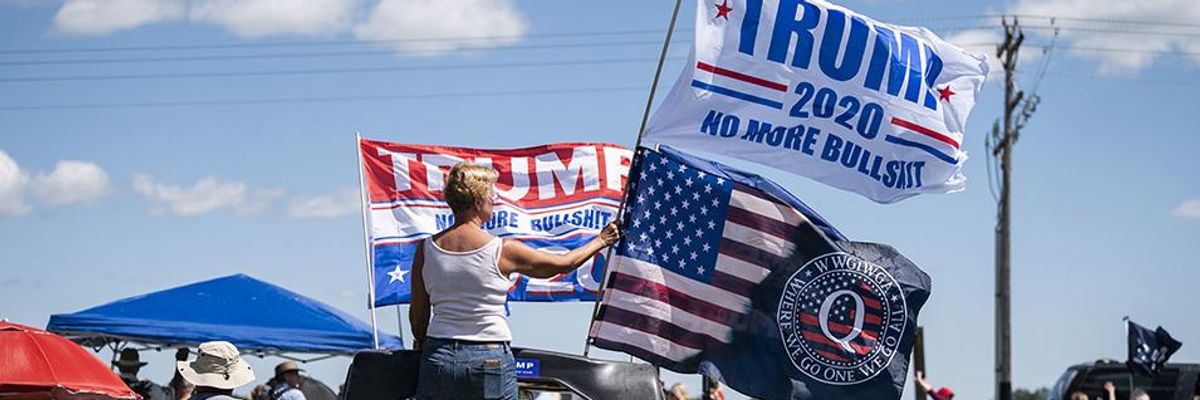
A woman holds a Trump 2020 flag and a QAnon flag outside of Mankato Regional Airport as President Donald Trump makes a campaign stop on August 17, 2020 in Mankato, Minnesota. (Photo: Stephen Maturen/Getty Images)
On the heels of President Donald Trump's warm remarks about far-right conspiracy theory QAnon and its supporters, activists are calling on the Republican Party to join them in condemning the group and the president's support of it.
"This moment was an inevitability," Brian Friedberg, a senior researcher at Harvard's Shorenstein Center on Media, Politics, and Public Policy, who has followed QAnon closely for years, told The Guardian Wednesday.
"The only real hope now is for a large group of Republicans with power--and with power among Republicans--to come out against this despite what Trump said today," Friedberg said.
At a press conference Wednesday, responding to a question from a reporter, Trump indicated didn't know much about QAnon, despite them being listed by the FBI as a domestic terror threat in May of 2019.
"I've heard these are people that love our country," said Trump. "So I don't know really anything about it other than they do supposedly like me."
The president has repeatedly amplified QAnon-supporter comments on Twitter, and he used the platform to congratulate Republican businesswoman and QAnon ally Marjorie Taylor Greene on her primary win for a U.S. House seat in Georgia last week.
When pressed about the group's theory that it is "secretly saving the world from this Satanic cult of pedophiles and cannibals," Trump asked, "Is that a good thing, or a bad thing?"
"If I can help save the world from problems, I'm willing to do it, I'm willing to put myself out there and we are, actually," the president said. "We're saving the world from a radical left philosophy that will destroy this country and, when this country is gone, the rest of the world will follow."
The commander-in-chief also noted--after saying he didn't "know much" about the group--that QAnon supporters "don't like seeing what's going on in places like Portland and places like Chicago and other cities and states," referring to Black Lives Matter protests Trump has railed against, going so far as to send federal agents into cities to quell the demonstrations.
Former Florida Governor Jeb Bush, a Republican, tweeted his disapproval of the president's remarks Wednesday, saying, "Nut jobs, haters, and racists have no place in either party."
Democratic presidential nominee Joe Biden's campaign released a statement Wednesday condemning Trump's remarks.
"After calling neo-Nazis and white supremacists in Charlottesville 'fine people' and tear gassing peaceful protesters following the murder of George Floyd, Donald Trump just sought to legitimize a conspiracy theory that the FBI has identified as a domestic terrorism threat," campaign spokesperson Andrew Bates said. "Our country needs leadership that will bring us together more than ever to form a more perfect union. We have to win this battle for the soul of our nation."
Also on Wednesday, Facebook announced it removed 790 QAnon groups from its platform and "restricted" thousands more on Facebook and Instagram, which the company owns.
The tech giant has faced criticism for not removing misinformation and hate speech from its platform ahead of the November election.
"It's important to understand that these groups don't get this big from infrastructure that they built; they get this big by leveraging the infrastructure of the platforms," Joan Donovan, the research director of Harvard's Shorenstein Center on Media, Politics and Public Policy told The Guardian. "Had Facebook taken action back at the time when Reddit took action, we wouldn't be in this same position."
Dear Common Dreams reader, It’s been nearly 30 years since I co-founded Common Dreams with my late wife, Lina Newhouser. We had the radical notion that journalism should serve the public good, not corporate profits. It was clear to us from the outset what it would take to build such a project. No paid advertisements. No corporate sponsors. No millionaire publisher telling us what to think or do. Many people said we wouldn't last a year, but we proved those doubters wrong. Together with a tremendous team of journalists and dedicated staff, we built an independent media outlet free from the constraints of profits and corporate control. Our mission has always been simple: To inform. To inspire. To ignite change for the common good. Building Common Dreams was not easy. Our survival was never guaranteed. When you take on the most powerful forces—Wall Street greed, fossil fuel industry destruction, Big Tech lobbyists, and uber-rich oligarchs who have spent billions upon billions rigging the economy and democracy in their favor—the only bulwark you have is supporters who believe in your work. But here’s the urgent message from me today. It's never been this bad out there. And it's never been this hard to keep us going. At the very moment Common Dreams is most needed, the threats we face are intensifying. We need your support now more than ever. We don't accept corporate advertising and never will. We don't have a paywall because we don't think people should be blocked from critical news based on their ability to pay. Everything we do is funded by the donations of readers like you. When everyone does the little they can afford, we are strong. But if that support retreats or dries up, so do we. Will you donate now to make sure Common Dreams not only survives but thrives? —Craig Brown, Co-founder |
On the heels of President Donald Trump's warm remarks about far-right conspiracy theory QAnon and its supporters, activists are calling on the Republican Party to join them in condemning the group and the president's support of it.
"This moment was an inevitability," Brian Friedberg, a senior researcher at Harvard's Shorenstein Center on Media, Politics, and Public Policy, who has followed QAnon closely for years, told The Guardian Wednesday.
"The only real hope now is for a large group of Republicans with power--and with power among Republicans--to come out against this despite what Trump said today," Friedberg said.
At a press conference Wednesday, responding to a question from a reporter, Trump indicated didn't know much about QAnon, despite them being listed by the FBI as a domestic terror threat in May of 2019.
"I've heard these are people that love our country," said Trump. "So I don't know really anything about it other than they do supposedly like me."
The president has repeatedly amplified QAnon-supporter comments on Twitter, and he used the platform to congratulate Republican businesswoman and QAnon ally Marjorie Taylor Greene on her primary win for a U.S. House seat in Georgia last week.
When pressed about the group's theory that it is "secretly saving the world from this Satanic cult of pedophiles and cannibals," Trump asked, "Is that a good thing, or a bad thing?"
"If I can help save the world from problems, I'm willing to do it, I'm willing to put myself out there and we are, actually," the president said. "We're saving the world from a radical left philosophy that will destroy this country and, when this country is gone, the rest of the world will follow."
The commander-in-chief also noted--after saying he didn't "know much" about the group--that QAnon supporters "don't like seeing what's going on in places like Portland and places like Chicago and other cities and states," referring to Black Lives Matter protests Trump has railed against, going so far as to send federal agents into cities to quell the demonstrations.
Former Florida Governor Jeb Bush, a Republican, tweeted his disapproval of the president's remarks Wednesday, saying, "Nut jobs, haters, and racists have no place in either party."
Democratic presidential nominee Joe Biden's campaign released a statement Wednesday condemning Trump's remarks.
"After calling neo-Nazis and white supremacists in Charlottesville 'fine people' and tear gassing peaceful protesters following the murder of George Floyd, Donald Trump just sought to legitimize a conspiracy theory that the FBI has identified as a domestic terrorism threat," campaign spokesperson Andrew Bates said. "Our country needs leadership that will bring us together more than ever to form a more perfect union. We have to win this battle for the soul of our nation."
Also on Wednesday, Facebook announced it removed 790 QAnon groups from its platform and "restricted" thousands more on Facebook and Instagram, which the company owns.
The tech giant has faced criticism for not removing misinformation and hate speech from its platform ahead of the November election.
"It's important to understand that these groups don't get this big from infrastructure that they built; they get this big by leveraging the infrastructure of the platforms," Joan Donovan, the research director of Harvard's Shorenstein Center on Media, Politics and Public Policy told The Guardian. "Had Facebook taken action back at the time when Reddit took action, we wouldn't be in this same position."
On the heels of President Donald Trump's warm remarks about far-right conspiracy theory QAnon and its supporters, activists are calling on the Republican Party to join them in condemning the group and the president's support of it.
"This moment was an inevitability," Brian Friedberg, a senior researcher at Harvard's Shorenstein Center on Media, Politics, and Public Policy, who has followed QAnon closely for years, told The Guardian Wednesday.
"The only real hope now is for a large group of Republicans with power--and with power among Republicans--to come out against this despite what Trump said today," Friedberg said.
At a press conference Wednesday, responding to a question from a reporter, Trump indicated didn't know much about QAnon, despite them being listed by the FBI as a domestic terror threat in May of 2019.
"I've heard these are people that love our country," said Trump. "So I don't know really anything about it other than they do supposedly like me."
The president has repeatedly amplified QAnon-supporter comments on Twitter, and he used the platform to congratulate Republican businesswoman and QAnon ally Marjorie Taylor Greene on her primary win for a U.S. House seat in Georgia last week.
When pressed about the group's theory that it is "secretly saving the world from this Satanic cult of pedophiles and cannibals," Trump asked, "Is that a good thing, or a bad thing?"
"If I can help save the world from problems, I'm willing to do it, I'm willing to put myself out there and we are, actually," the president said. "We're saving the world from a radical left philosophy that will destroy this country and, when this country is gone, the rest of the world will follow."
The commander-in-chief also noted--after saying he didn't "know much" about the group--that QAnon supporters "don't like seeing what's going on in places like Portland and places like Chicago and other cities and states," referring to Black Lives Matter protests Trump has railed against, going so far as to send federal agents into cities to quell the demonstrations.
Former Florida Governor Jeb Bush, a Republican, tweeted his disapproval of the president's remarks Wednesday, saying, "Nut jobs, haters, and racists have no place in either party."
Democratic presidential nominee Joe Biden's campaign released a statement Wednesday condemning Trump's remarks.
"After calling neo-Nazis and white supremacists in Charlottesville 'fine people' and tear gassing peaceful protesters following the murder of George Floyd, Donald Trump just sought to legitimize a conspiracy theory that the FBI has identified as a domestic terrorism threat," campaign spokesperson Andrew Bates said. "Our country needs leadership that will bring us together more than ever to form a more perfect union. We have to win this battle for the soul of our nation."
Also on Wednesday, Facebook announced it removed 790 QAnon groups from its platform and "restricted" thousands more on Facebook and Instagram, which the company owns.
The tech giant has faced criticism for not removing misinformation and hate speech from its platform ahead of the November election.
"It's important to understand that these groups don't get this big from infrastructure that they built; they get this big by leveraging the infrastructure of the platforms," Joan Donovan, the research director of Harvard's Shorenstein Center on Media, Politics and Public Policy told The Guardian. "Had Facebook taken action back at the time when Reddit took action, we wouldn't be in this same position."