SUBSCRIBE TO OUR FREE NEWSLETTER
Daily news & progressive opinion—funded by the people, not the corporations—delivered straight to your inbox.
5
#000000
#FFFFFF
To donate by check, phone, or other method, see our More Ways to Give page.
Daily news & progressive opinion—funded by the people, not the corporations—delivered straight to your inbox.
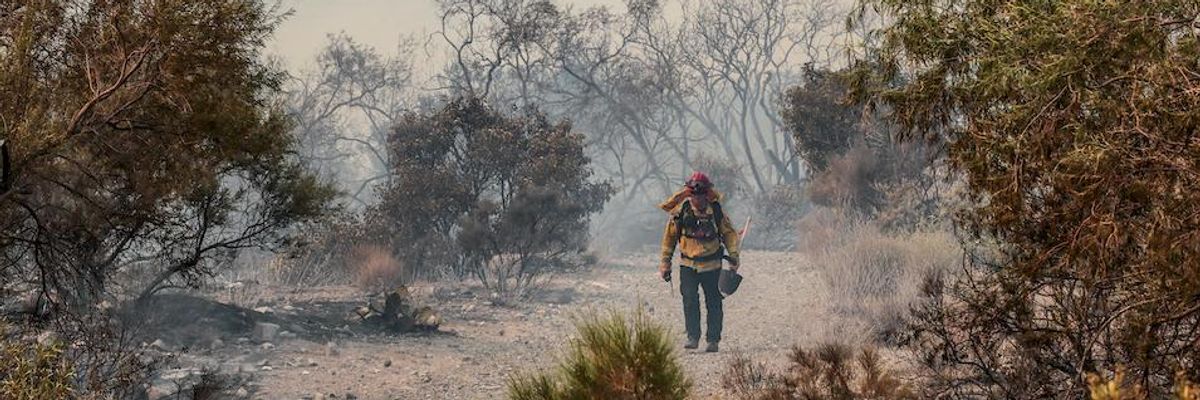
Smoldering brush remains after fire swept through the Whitewater Preserve Trail in the San Gorgonio Mountains in California on August 2, 2020. (Photo: Robert Gauthier/Los Angeles Times via Getty Images)
A new study warns that the annual global death rate from the climate crisis could equal or even exceed current mortality levels from all infectious diseases combined by the end of the century if bold action is not taken.
"We are studying the risk of death faced by our own children," said University of California public policy professor Solomon Hsiang, one of the report's co-authors. "Today's 10-year-old fifth grader will turn 65 in 2075, facing mortality risks from climate change every year of their retirement. Failing to address climate change is not that different from driving your kids around without a seat belt: you are putting their lives at risk."
The study, "Valuing the Global Mortality Consequences of Climate Change Accounting for Adaptation Costs and Benefits," was published in the National Bureau of Economic Research on Monday.
According to Climate Impact Lab, which produced the report, the study "finds that in a world with continued high fossil-fuel emissions, warmer temperatures will rank among the world's most significant public health threats by the end of the century."
As Climate Impact Lab explained:
The study projects that climate change's effect on temperatures could raise global mortality rates by 73 deaths per 100,000 people in 2100 under a continued high emissions scenario, compared to a world with no warming. That level is roughly equal to the current death rate for all infectious diseases--including tuberculosis, HIV/AIDS, malaria, dengue, yellow fever, and diseases transmitted by ticks, mosquitos, and parasites--combined (approximately 74 deaths per 100,000 globally).
"Our data indicate that with the continued growth of greenhouse gas emissions, the temperature effects of climate change are projected to be five times deadlier than recent U.S. flu seasons," said report co-author Michael Greenstone, a University of Chicago economics professor. "In poor hot countries, the heat may be even more threatening than cancer and heart disease are today."
The study also found that the economic cost of addressing the climate crisis will only increase if little or nothing is done to reduce emissions--"emitting one additional ton of CO2 today costs ourselves and future generations a total of $36.6 under a continued high emissions scenario and $17.1 under a moderate emissions scenario."
"Just as countries are impacted in different ways by extreme temperatures today, we find that the trend will continue and perhaps even intensify into the future as adaptation becomes more and more critical to people's survival," said co-author Amir Jina, an assistant professor at the University of Chicago Harris School of Public Policy. "Indeed, some will need to choose between paying a high cost to adapt and death."
Citing the social and economic upheaval sparked by the current Covid-19 pandemic, Jina told the Guardian that the unchecked climate crisis would have far-reaching negative impacts.
"It's plausible that we could have the worst-case scenario and that would involve drastic measures such as lots of people migrating," Jina said. "Much like when Covid overwhelms a healthcare system, it's hard to tell what will happen when climate change will put systems under pressure like that. We need to understand the risk and invest to mitigate that risk, before we really start to notice the impacts."
Trevor Houser, a partner at analyst firm Rhodium Group and another report co-author, sounded a hopeful note, saying that if nations take decisive action now to combat the climate crisis, there's hope that the dire predictions in the study won't come to pass.
"The world can still change course by aggressively reducing emissions, and in doing so has the potential to deliver some of the most significant public health gains in human history," said Houser.
Dear Common Dreams reader, It’s been nearly 30 years since I co-founded Common Dreams with my late wife, Lina Newhouser. We had the radical notion that journalism should serve the public good, not corporate profits. It was clear to us from the outset what it would take to build such a project. No paid advertisements. No corporate sponsors. No millionaire publisher telling us what to think or do. Many people said we wouldn't last a year, but we proved those doubters wrong. Together with a tremendous team of journalists and dedicated staff, we built an independent media outlet free from the constraints of profits and corporate control. Our mission has always been simple: To inform. To inspire. To ignite change for the common good. Building Common Dreams was not easy. Our survival was never guaranteed. When you take on the most powerful forces—Wall Street greed, fossil fuel industry destruction, Big Tech lobbyists, and uber-rich oligarchs who have spent billions upon billions rigging the economy and democracy in their favor—the only bulwark you have is supporters who believe in your work. But here’s the urgent message from me today. It's never been this bad out there. And it's never been this hard to keep us going. At the very moment Common Dreams is most needed, the threats we face are intensifying. We need your support now more than ever. We don't accept corporate advertising and never will. We don't have a paywall because we don't think people should be blocked from critical news based on their ability to pay. Everything we do is funded by the donations of readers like you. When everyone does the little they can afford, we are strong. But if that support retreats or dries up, so do we. Will you donate now to make sure Common Dreams not only survives but thrives? —Craig Brown, Co-founder |
A new study warns that the annual global death rate from the climate crisis could equal or even exceed current mortality levels from all infectious diseases combined by the end of the century if bold action is not taken.
"We are studying the risk of death faced by our own children," said University of California public policy professor Solomon Hsiang, one of the report's co-authors. "Today's 10-year-old fifth grader will turn 65 in 2075, facing mortality risks from climate change every year of their retirement. Failing to address climate change is not that different from driving your kids around without a seat belt: you are putting their lives at risk."
The study, "Valuing the Global Mortality Consequences of Climate Change Accounting for Adaptation Costs and Benefits," was published in the National Bureau of Economic Research on Monday.
According to Climate Impact Lab, which produced the report, the study "finds that in a world with continued high fossil-fuel emissions, warmer temperatures will rank among the world's most significant public health threats by the end of the century."
As Climate Impact Lab explained:
The study projects that climate change's effect on temperatures could raise global mortality rates by 73 deaths per 100,000 people in 2100 under a continued high emissions scenario, compared to a world with no warming. That level is roughly equal to the current death rate for all infectious diseases--including tuberculosis, HIV/AIDS, malaria, dengue, yellow fever, and diseases transmitted by ticks, mosquitos, and parasites--combined (approximately 74 deaths per 100,000 globally).
"Our data indicate that with the continued growth of greenhouse gas emissions, the temperature effects of climate change are projected to be five times deadlier than recent U.S. flu seasons," said report co-author Michael Greenstone, a University of Chicago economics professor. "In poor hot countries, the heat may be even more threatening than cancer and heart disease are today."
The study also found that the economic cost of addressing the climate crisis will only increase if little or nothing is done to reduce emissions--"emitting one additional ton of CO2 today costs ourselves and future generations a total of $36.6 under a continued high emissions scenario and $17.1 under a moderate emissions scenario."
"Just as countries are impacted in different ways by extreme temperatures today, we find that the trend will continue and perhaps even intensify into the future as adaptation becomes more and more critical to people's survival," said co-author Amir Jina, an assistant professor at the University of Chicago Harris School of Public Policy. "Indeed, some will need to choose between paying a high cost to adapt and death."
Citing the social and economic upheaval sparked by the current Covid-19 pandemic, Jina told the Guardian that the unchecked climate crisis would have far-reaching negative impacts.
"It's plausible that we could have the worst-case scenario and that would involve drastic measures such as lots of people migrating," Jina said. "Much like when Covid overwhelms a healthcare system, it's hard to tell what will happen when climate change will put systems under pressure like that. We need to understand the risk and invest to mitigate that risk, before we really start to notice the impacts."
Trevor Houser, a partner at analyst firm Rhodium Group and another report co-author, sounded a hopeful note, saying that if nations take decisive action now to combat the climate crisis, there's hope that the dire predictions in the study won't come to pass.
"The world can still change course by aggressively reducing emissions, and in doing so has the potential to deliver some of the most significant public health gains in human history," said Houser.
A new study warns that the annual global death rate from the climate crisis could equal or even exceed current mortality levels from all infectious diseases combined by the end of the century if bold action is not taken.
"We are studying the risk of death faced by our own children," said University of California public policy professor Solomon Hsiang, one of the report's co-authors. "Today's 10-year-old fifth grader will turn 65 in 2075, facing mortality risks from climate change every year of their retirement. Failing to address climate change is not that different from driving your kids around without a seat belt: you are putting their lives at risk."
The study, "Valuing the Global Mortality Consequences of Climate Change Accounting for Adaptation Costs and Benefits," was published in the National Bureau of Economic Research on Monday.
According to Climate Impact Lab, which produced the report, the study "finds that in a world with continued high fossil-fuel emissions, warmer temperatures will rank among the world's most significant public health threats by the end of the century."
As Climate Impact Lab explained:
The study projects that climate change's effect on temperatures could raise global mortality rates by 73 deaths per 100,000 people in 2100 under a continued high emissions scenario, compared to a world with no warming. That level is roughly equal to the current death rate for all infectious diseases--including tuberculosis, HIV/AIDS, malaria, dengue, yellow fever, and diseases transmitted by ticks, mosquitos, and parasites--combined (approximately 74 deaths per 100,000 globally).
"Our data indicate that with the continued growth of greenhouse gas emissions, the temperature effects of climate change are projected to be five times deadlier than recent U.S. flu seasons," said report co-author Michael Greenstone, a University of Chicago economics professor. "In poor hot countries, the heat may be even more threatening than cancer and heart disease are today."
The study also found that the economic cost of addressing the climate crisis will only increase if little or nothing is done to reduce emissions--"emitting one additional ton of CO2 today costs ourselves and future generations a total of $36.6 under a continued high emissions scenario and $17.1 under a moderate emissions scenario."
"Just as countries are impacted in different ways by extreme temperatures today, we find that the trend will continue and perhaps even intensify into the future as adaptation becomes more and more critical to people's survival," said co-author Amir Jina, an assistant professor at the University of Chicago Harris School of Public Policy. "Indeed, some will need to choose between paying a high cost to adapt and death."
Citing the social and economic upheaval sparked by the current Covid-19 pandemic, Jina told the Guardian that the unchecked climate crisis would have far-reaching negative impacts.
"It's plausible that we could have the worst-case scenario and that would involve drastic measures such as lots of people migrating," Jina said. "Much like when Covid overwhelms a healthcare system, it's hard to tell what will happen when climate change will put systems under pressure like that. We need to understand the risk and invest to mitigate that risk, before we really start to notice the impacts."
Trevor Houser, a partner at analyst firm Rhodium Group and another report co-author, sounded a hopeful note, saying that if nations take decisive action now to combat the climate crisis, there's hope that the dire predictions in the study won't come to pass.
"The world can still change course by aggressively reducing emissions, and in doing so has the potential to deliver some of the most significant public health gains in human history," said Houser.