SUBSCRIBE TO OUR FREE NEWSLETTER
Daily news & progressive opinion—funded by the people, not the corporations—delivered straight to your inbox.
5
#000000
#FFFFFF
To donate by check, phone, or other method, see our More Ways to Give page.
Daily news & progressive opinion—funded by the people, not the corporations—delivered straight to your inbox.
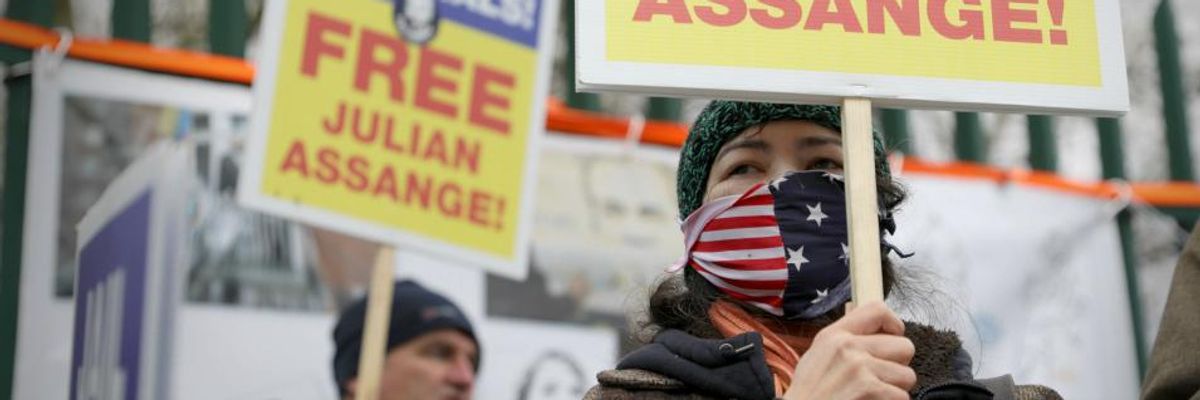
Demonstrators stand outside a court in London demanding the release of WikiLeaks founder Julian Assange on Feb. 26, 2020. (Photo: Tim Ireland/Xinhua via Getty)
In a move free press advocates decried as an escalation of the Trump administration's dangerous assault on journalism, the U.S. Department of Justice late Wednesday filed a superseding indictment against Julian Assange accusing the jailed WikiLeaks founder and publisher of attempting to recruit hackers to provide the outlet with classified information.
"The indictment continues to charge him with violating the Espionage Act based on WikiLeaks publications exposing war crimes committed by the U.S. government."
--Barry Pollack, attorney for Julian Assange
Though the Justice Department's filing does not contain any new charges against Assange--currently imprisoned in the U.K. as he fights an extradition attempt by the U.S., which has charged him with violating the Espionage Act--the Freedom of the Press Foundation said Thursday that the indictment "has all the same problems as the old one."
"Source communication and publishing are not crimes. They didn't add any new charges. They didn't really change any old ones. And using the Espionage Act is beyond the pale," the group wrote in a series of tweets. "We know Trump has been privately musing about how to jail journalists. We know an Assange conviction under the Espionage Act--whether you like him or not--could be used against the New York Times and many other outlets. This indictment could not be more dangerous."
The Associated Press reported that the DOJ indictment accuses Assange of seeking "to recruit hackers at conferences in Europe and Asia who could provide his anti-secrecy website with classified information, and conspired with members of hacking organizations."
"Beyond recruiting hackers at conferences, the indictment accuses Assange of conspiring with members of hacking groups known as LulzSec and Anonymous," according to AP. "He also worked with a 17-year-old hacker who gave him information stolen from a bank and directed the teenager to steal additional material, including audio recordings of high-ranking government officials, prosecutors say."
Last May, a federal grand jury charged Assange with 17 counts of violating the 1917 Espionage Act for obtaining and publishing classified information--including evidence of U.S. war crimes. At the time, press freedom defenders condemned the charges as a profound threat to journalism and the First Amendment. If extradicted to the U.S., Assange could face decades in prison.
Barry Pollack, Assange's attorney, said in a statement Wednesday that the Trump administration's "relentless pursuit of Julian Assange poses a grave threat to journalists everywhere and to the public's right to know."
"While today's superseding indictment is yet another chapter in the U.S. government's effort to persuade the public that its pursuit of Julian Assange is based on something other than his publication of newsworthy truthful information," said Pollack, "the indictment continues to charge him with violating the Espionage Act based on WikiLeaks publications exposing war crimes committed by the U.S. government."
Dear Common Dreams reader, It’s been nearly 30 years since I co-founded Common Dreams with my late wife, Lina Newhouser. We had the radical notion that journalism should serve the public good, not corporate profits. It was clear to us from the outset what it would take to build such a project. No paid advertisements. No corporate sponsors. No millionaire publisher telling us what to think or do. Many people said we wouldn't last a year, but we proved those doubters wrong. Together with a tremendous team of journalists and dedicated staff, we built an independent media outlet free from the constraints of profits and corporate control. Our mission has always been simple: To inform. To inspire. To ignite change for the common good. Building Common Dreams was not easy. Our survival was never guaranteed. When you take on the most powerful forces—Wall Street greed, fossil fuel industry destruction, Big Tech lobbyists, and uber-rich oligarchs who have spent billions upon billions rigging the economy and democracy in their favor—the only bulwark you have is supporters who believe in your work. But here’s the urgent message from me today. It's never been this bad out there. And it's never been this hard to keep us going. At the very moment Common Dreams is most needed, the threats we face are intensifying. We need your support now more than ever. We don't accept corporate advertising and never will. We don't have a paywall because we don't think people should be blocked from critical news based on their ability to pay. Everything we do is funded by the donations of readers like you. When everyone does the little they can afford, we are strong. But if that support retreats or dries up, so do we. Will you donate now to make sure Common Dreams not only survives but thrives? —Craig Brown, Co-founder |
In a move free press advocates decried as an escalation of the Trump administration's dangerous assault on journalism, the U.S. Department of Justice late Wednesday filed a superseding indictment against Julian Assange accusing the jailed WikiLeaks founder and publisher of attempting to recruit hackers to provide the outlet with classified information.
"The indictment continues to charge him with violating the Espionage Act based on WikiLeaks publications exposing war crimes committed by the U.S. government."
--Barry Pollack, attorney for Julian Assange
Though the Justice Department's filing does not contain any new charges against Assange--currently imprisoned in the U.K. as he fights an extradition attempt by the U.S., which has charged him with violating the Espionage Act--the Freedom of the Press Foundation said Thursday that the indictment "has all the same problems as the old one."
"Source communication and publishing are not crimes. They didn't add any new charges. They didn't really change any old ones. And using the Espionage Act is beyond the pale," the group wrote in a series of tweets. "We know Trump has been privately musing about how to jail journalists. We know an Assange conviction under the Espionage Act--whether you like him or not--could be used against the New York Times and many other outlets. This indictment could not be more dangerous."
The Associated Press reported that the DOJ indictment accuses Assange of seeking "to recruit hackers at conferences in Europe and Asia who could provide his anti-secrecy website with classified information, and conspired with members of hacking organizations."
"Beyond recruiting hackers at conferences, the indictment accuses Assange of conspiring with members of hacking groups known as LulzSec and Anonymous," according to AP. "He also worked with a 17-year-old hacker who gave him information stolen from a bank and directed the teenager to steal additional material, including audio recordings of high-ranking government officials, prosecutors say."
Last May, a federal grand jury charged Assange with 17 counts of violating the 1917 Espionage Act for obtaining and publishing classified information--including evidence of U.S. war crimes. At the time, press freedom defenders condemned the charges as a profound threat to journalism and the First Amendment. If extradicted to the U.S., Assange could face decades in prison.
Barry Pollack, Assange's attorney, said in a statement Wednesday that the Trump administration's "relentless pursuit of Julian Assange poses a grave threat to journalists everywhere and to the public's right to know."
"While today's superseding indictment is yet another chapter in the U.S. government's effort to persuade the public that its pursuit of Julian Assange is based on something other than his publication of newsworthy truthful information," said Pollack, "the indictment continues to charge him with violating the Espionage Act based on WikiLeaks publications exposing war crimes committed by the U.S. government."
In a move free press advocates decried as an escalation of the Trump administration's dangerous assault on journalism, the U.S. Department of Justice late Wednesday filed a superseding indictment against Julian Assange accusing the jailed WikiLeaks founder and publisher of attempting to recruit hackers to provide the outlet with classified information.
"The indictment continues to charge him with violating the Espionage Act based on WikiLeaks publications exposing war crimes committed by the U.S. government."
--Barry Pollack, attorney for Julian Assange
Though the Justice Department's filing does not contain any new charges against Assange--currently imprisoned in the U.K. as he fights an extradition attempt by the U.S., which has charged him with violating the Espionage Act--the Freedom of the Press Foundation said Thursday that the indictment "has all the same problems as the old one."
"Source communication and publishing are not crimes. They didn't add any new charges. They didn't really change any old ones. And using the Espionage Act is beyond the pale," the group wrote in a series of tweets. "We know Trump has been privately musing about how to jail journalists. We know an Assange conviction under the Espionage Act--whether you like him or not--could be used against the New York Times and many other outlets. This indictment could not be more dangerous."
The Associated Press reported that the DOJ indictment accuses Assange of seeking "to recruit hackers at conferences in Europe and Asia who could provide his anti-secrecy website with classified information, and conspired with members of hacking organizations."
"Beyond recruiting hackers at conferences, the indictment accuses Assange of conspiring with members of hacking groups known as LulzSec and Anonymous," according to AP. "He also worked with a 17-year-old hacker who gave him information stolen from a bank and directed the teenager to steal additional material, including audio recordings of high-ranking government officials, prosecutors say."
Last May, a federal grand jury charged Assange with 17 counts of violating the 1917 Espionage Act for obtaining and publishing classified information--including evidence of U.S. war crimes. At the time, press freedom defenders condemned the charges as a profound threat to journalism and the First Amendment. If extradicted to the U.S., Assange could face decades in prison.
Barry Pollack, Assange's attorney, said in a statement Wednesday that the Trump administration's "relentless pursuit of Julian Assange poses a grave threat to journalists everywhere and to the public's right to know."
"While today's superseding indictment is yet another chapter in the U.S. government's effort to persuade the public that its pursuit of Julian Assange is based on something other than his publication of newsworthy truthful information," said Pollack, "the indictment continues to charge him with violating the Espionage Act based on WikiLeaks publications exposing war crimes committed by the U.S. government."