SUBSCRIBE TO OUR FREE NEWSLETTER
Daily news & progressive opinion—funded by the people, not the corporations—delivered straight to your inbox.
5
#000000
#FFFFFF
To donate by check, phone, or other method, see our More Ways to Give page.
Daily news & progressive opinion—funded by the people, not the corporations—delivered straight to your inbox.
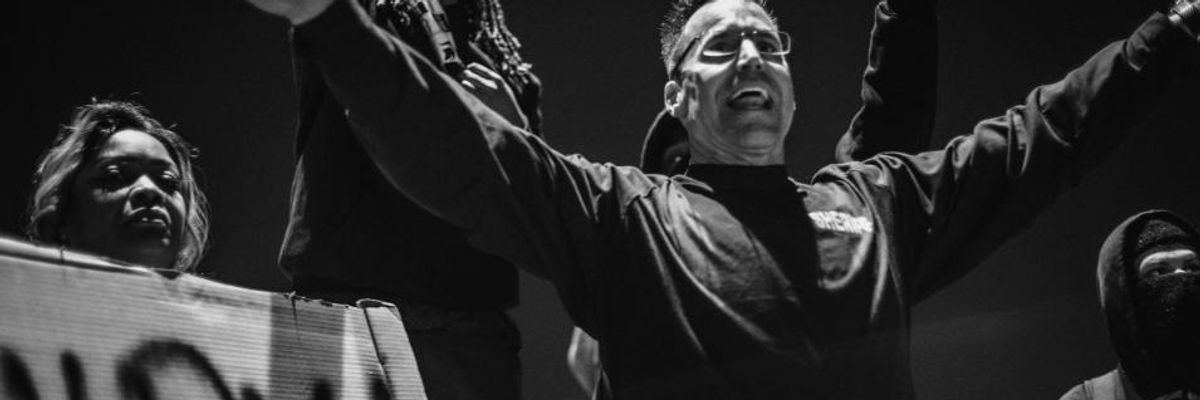
Genesee County Sheriff Chris Swanson alongside people in Flint, Michigan demonstrating against police violence and the killing of George Floyd in neighboring Minnesota last week. "When we reached the police station, the officers were lined up and everyone immediately took a knee," said local photographer Leni Kei Williams who documented what transpired. "The Sheriff asked one question... 'We are mad too! What can we do?' and the crowd responded, 'Join us.'" And then they did. (Photo: Leni Kei Photography / Used with permission)
Amid a national wave of uprisings against police brutality in response to last week's brutal murder of George Floyd in Minneapolis, Minnesota--but in contrast to a wave of aggressive and violent responses from law enforcement to those demonstrations--a scene in Flint, Michigan that played out Saturday evening offered an alternative to aggressive police tactics as a local sheriff and his fellow officers laid down their riot gear and joined with those members of the community who came out to voice their outrage and sorrow.
"When we reached the police station, the officers were lined up and everyone immediately took a knee. The Sheriff asked one question... 'We are mad too! What can we do?' and the crowd responded, 'Join us.'"
--Leni Kei Williams, photographer
When Genesee County Sheriff Chris Swanson, his deputies, and local officers were confronted by community members who marched on the Flint Township police station, witnesses described how Swanson told the crowd he wanted their pleas to be heard and that the police wanted to be in service of their demands and the protest itself.
After communicating with protest leaders and others, Swanson put down his riot gear and told the crowd he and other officers would join with them.
"We wanna be with y'all. I took my helmet off, laid the batons down," said Swanson as the crowd cheered him on and offered high-fives. "I want to make this a parade, not a protest."
What transpired was documented in a powerful photo essay by Leni Kei Williams, a local photographer, who posted the experience to Facebook.
"We weren't sure what to expect. With everything we have been seeing on the news, it wasn't clear what would happen but as we were walking, it was beautiful to see people of every race, age, demographic come together and unite," Williams wrote. "When we reached the police station, the officers were lined up and everyone immediately took a knee. The Sheriff asked one question... 'We are mad too! What can we do?' and the crowd responded, 'Join us.'"
Williams's husband Deonta Williams, also a photographer, shot video of the march and later uploaded this video:
"You got little ones here, you got dogs," Swanson said to the crowd in remarks caught on camera by others. "So listen, I'm just telling you, these cops love you. That cop over there, hugs people. So you just tell us what to do."
Watch:
"We can't forget on all our police cars across the nation it says, 'protect and serve.' That means all people, that means all people deserve the same dignity," Swanson later told local news outlet WJRT. "If you can't call out what's wrong, try to make it right. And that's the magic we saw tonight. Nobody's arrested, nobody got hurt. This is how it's supposed to be."
While Minneapolis police officer Derek Chauvin was arrested and charged Friday with 3rd-degree murder for the killing of Floyd, the other three officers on the scene at the time--two of whom can be seen in footage sitting on the man's back while the other stood over and did nothing to stop them--have yet to be taken into custody or charged. And while angry protests that have erupted over recent days in countless cities and communities nationwide have been met with violent police counter measures, what happened in Flint stood out to people as an example of progress and how law enforcement agencies should respond to communities that are grieving and rightly upset over the injustices of society.
"This is the way it's supposed to be--the police working with the community," said Swanson on Saturday night as he marched with demonstrators. "When we see injustice, we call it out on the police side and on the community side. All we had to do was talk to them, and now we're walking with them. ... The cops in this community, we condemn what happened. That guy (Chauvin) is not one of us."
"Do I think we still have a long way to go? Definitely. Do I think this has solved the issue between police and unarmed black, human beings? No. But I do believe that this type of leadership is a positive step in the right direction and gives me hope for black men and women around the world and for all of humanity."
In a message to Common Dreams about what happened in Flint, Williams said, "Seeing a community who has seen so much hardship and pain come together to show leadership, unity and strength regardless of religion, age and race was such a humbling experience in itself. There was such a peace and feeling of hope in the air. And when the police department took their helmets off and dropped their batons when asked to join to March, they responded 'Let's go! We can walk all night!" This was history."
Williams noted that of course society's pervasive injustices and ongong police violence would not come to end simply because of what transpired in Flint but said it was uplifting and should be seen as a ray of hope and progress nonetheless.
"Leaders facing leaders, coming together in peace," Williams said. "Do I think we still have a long way to go? Definitely. Do I think this has solved the issue between police and unarmed black, human beings? No. But I do believe that this type of leadership is a positive step in the right direction and gives me hope for black men and women around the world and for all of humanity."
Dear Common Dreams reader, It’s been nearly 30 years since I co-founded Common Dreams with my late wife, Lina Newhouser. We had the radical notion that journalism should serve the public good, not corporate profits. It was clear to us from the outset what it would take to build such a project. No paid advertisements. No corporate sponsors. No millionaire publisher telling us what to think or do. Many people said we wouldn't last a year, but we proved those doubters wrong. Together with a tremendous team of journalists and dedicated staff, we built an independent media outlet free from the constraints of profits and corporate control. Our mission has always been simple: To inform. To inspire. To ignite change for the common good. Building Common Dreams was not easy. Our survival was never guaranteed. When you take on the most powerful forces—Wall Street greed, fossil fuel industry destruction, Big Tech lobbyists, and uber-rich oligarchs who have spent billions upon billions rigging the economy and democracy in their favor—the only bulwark you have is supporters who believe in your work. But here’s the urgent message from me today. It's never been this bad out there. And it's never been this hard to keep us going. At the very moment Common Dreams is most needed, the threats we face are intensifying. We need your support now more than ever. We don't accept corporate advertising and never will. We don't have a paywall because we don't think people should be blocked from critical news based on their ability to pay. Everything we do is funded by the donations of readers like you. When everyone does the little they can afford, we are strong. But if that support retreats or dries up, so do we. Will you donate now to make sure Common Dreams not only survives but thrives? —Craig Brown, Co-founder |
Amid a national wave of uprisings against police brutality in response to last week's brutal murder of George Floyd in Minneapolis, Minnesota--but in contrast to a wave of aggressive and violent responses from law enforcement to those demonstrations--a scene in Flint, Michigan that played out Saturday evening offered an alternative to aggressive police tactics as a local sheriff and his fellow officers laid down their riot gear and joined with those members of the community who came out to voice their outrage and sorrow.
"When we reached the police station, the officers were lined up and everyone immediately took a knee. The Sheriff asked one question... 'We are mad too! What can we do?' and the crowd responded, 'Join us.'"
--Leni Kei Williams, photographer
When Genesee County Sheriff Chris Swanson, his deputies, and local officers were confronted by community members who marched on the Flint Township police station, witnesses described how Swanson told the crowd he wanted their pleas to be heard and that the police wanted to be in service of their demands and the protest itself.
After communicating with protest leaders and others, Swanson put down his riot gear and told the crowd he and other officers would join with them.
"We wanna be with y'all. I took my helmet off, laid the batons down," said Swanson as the crowd cheered him on and offered high-fives. "I want to make this a parade, not a protest."
What transpired was documented in a powerful photo essay by Leni Kei Williams, a local photographer, who posted the experience to Facebook.
"We weren't sure what to expect. With everything we have been seeing on the news, it wasn't clear what would happen but as we were walking, it was beautiful to see people of every race, age, demographic come together and unite," Williams wrote. "When we reached the police station, the officers were lined up and everyone immediately took a knee. The Sheriff asked one question... 'We are mad too! What can we do?' and the crowd responded, 'Join us.'"
Williams's husband Deonta Williams, also a photographer, shot video of the march and later uploaded this video:
"You got little ones here, you got dogs," Swanson said to the crowd in remarks caught on camera by others. "So listen, I'm just telling you, these cops love you. That cop over there, hugs people. So you just tell us what to do."
Watch:
"We can't forget on all our police cars across the nation it says, 'protect and serve.' That means all people, that means all people deserve the same dignity," Swanson later told local news outlet WJRT. "If you can't call out what's wrong, try to make it right. And that's the magic we saw tonight. Nobody's arrested, nobody got hurt. This is how it's supposed to be."
While Minneapolis police officer Derek Chauvin was arrested and charged Friday with 3rd-degree murder for the killing of Floyd, the other three officers on the scene at the time--two of whom can be seen in footage sitting on the man's back while the other stood over and did nothing to stop them--have yet to be taken into custody or charged. And while angry protests that have erupted over recent days in countless cities and communities nationwide have been met with violent police counter measures, what happened in Flint stood out to people as an example of progress and how law enforcement agencies should respond to communities that are grieving and rightly upset over the injustices of society.
"This is the way it's supposed to be--the police working with the community," said Swanson on Saturday night as he marched with demonstrators. "When we see injustice, we call it out on the police side and on the community side. All we had to do was talk to them, and now we're walking with them. ... The cops in this community, we condemn what happened. That guy (Chauvin) is not one of us."
"Do I think we still have a long way to go? Definitely. Do I think this has solved the issue between police and unarmed black, human beings? No. But I do believe that this type of leadership is a positive step in the right direction and gives me hope for black men and women around the world and for all of humanity."
In a message to Common Dreams about what happened in Flint, Williams said, "Seeing a community who has seen so much hardship and pain come together to show leadership, unity and strength regardless of religion, age and race was such a humbling experience in itself. There was such a peace and feeling of hope in the air. And when the police department took their helmets off and dropped their batons when asked to join to March, they responded 'Let's go! We can walk all night!" This was history."
Williams noted that of course society's pervasive injustices and ongong police violence would not come to end simply because of what transpired in Flint but said it was uplifting and should be seen as a ray of hope and progress nonetheless.
"Leaders facing leaders, coming together in peace," Williams said. "Do I think we still have a long way to go? Definitely. Do I think this has solved the issue between police and unarmed black, human beings? No. But I do believe that this type of leadership is a positive step in the right direction and gives me hope for black men and women around the world and for all of humanity."
Amid a national wave of uprisings against police brutality in response to last week's brutal murder of George Floyd in Minneapolis, Minnesota--but in contrast to a wave of aggressive and violent responses from law enforcement to those demonstrations--a scene in Flint, Michigan that played out Saturday evening offered an alternative to aggressive police tactics as a local sheriff and his fellow officers laid down their riot gear and joined with those members of the community who came out to voice their outrage and sorrow.
"When we reached the police station, the officers were lined up and everyone immediately took a knee. The Sheriff asked one question... 'We are mad too! What can we do?' and the crowd responded, 'Join us.'"
--Leni Kei Williams, photographer
When Genesee County Sheriff Chris Swanson, his deputies, and local officers were confronted by community members who marched on the Flint Township police station, witnesses described how Swanson told the crowd he wanted their pleas to be heard and that the police wanted to be in service of their demands and the protest itself.
After communicating with protest leaders and others, Swanson put down his riot gear and told the crowd he and other officers would join with them.
"We wanna be with y'all. I took my helmet off, laid the batons down," said Swanson as the crowd cheered him on and offered high-fives. "I want to make this a parade, not a protest."
What transpired was documented in a powerful photo essay by Leni Kei Williams, a local photographer, who posted the experience to Facebook.
"We weren't sure what to expect. With everything we have been seeing on the news, it wasn't clear what would happen but as we were walking, it was beautiful to see people of every race, age, demographic come together and unite," Williams wrote. "When we reached the police station, the officers were lined up and everyone immediately took a knee. The Sheriff asked one question... 'We are mad too! What can we do?' and the crowd responded, 'Join us.'"
Williams's husband Deonta Williams, also a photographer, shot video of the march and later uploaded this video:
"You got little ones here, you got dogs," Swanson said to the crowd in remarks caught on camera by others. "So listen, I'm just telling you, these cops love you. That cop over there, hugs people. So you just tell us what to do."
Watch:
"We can't forget on all our police cars across the nation it says, 'protect and serve.' That means all people, that means all people deserve the same dignity," Swanson later told local news outlet WJRT. "If you can't call out what's wrong, try to make it right. And that's the magic we saw tonight. Nobody's arrested, nobody got hurt. This is how it's supposed to be."
While Minneapolis police officer Derek Chauvin was arrested and charged Friday with 3rd-degree murder for the killing of Floyd, the other three officers on the scene at the time--two of whom can be seen in footage sitting on the man's back while the other stood over and did nothing to stop them--have yet to be taken into custody or charged. And while angry protests that have erupted over recent days in countless cities and communities nationwide have been met with violent police counter measures, what happened in Flint stood out to people as an example of progress and how law enforcement agencies should respond to communities that are grieving and rightly upset over the injustices of society.
"This is the way it's supposed to be--the police working with the community," said Swanson on Saturday night as he marched with demonstrators. "When we see injustice, we call it out on the police side and on the community side. All we had to do was talk to them, and now we're walking with them. ... The cops in this community, we condemn what happened. That guy (Chauvin) is not one of us."
"Do I think we still have a long way to go? Definitely. Do I think this has solved the issue between police and unarmed black, human beings? No. But I do believe that this type of leadership is a positive step in the right direction and gives me hope for black men and women around the world and for all of humanity."
In a message to Common Dreams about what happened in Flint, Williams said, "Seeing a community who has seen so much hardship and pain come together to show leadership, unity and strength regardless of religion, age and race was such a humbling experience in itself. There was such a peace and feeling of hope in the air. And when the police department took their helmets off and dropped their batons when asked to join to March, they responded 'Let's go! We can walk all night!" This was history."
Williams noted that of course society's pervasive injustices and ongong police violence would not come to end simply because of what transpired in Flint but said it was uplifting and should be seen as a ray of hope and progress nonetheless.
"Leaders facing leaders, coming together in peace," Williams said. "Do I think we still have a long way to go? Definitely. Do I think this has solved the issue between police and unarmed black, human beings? No. But I do believe that this type of leadership is a positive step in the right direction and gives me hope for black men and women around the world and for all of humanity."