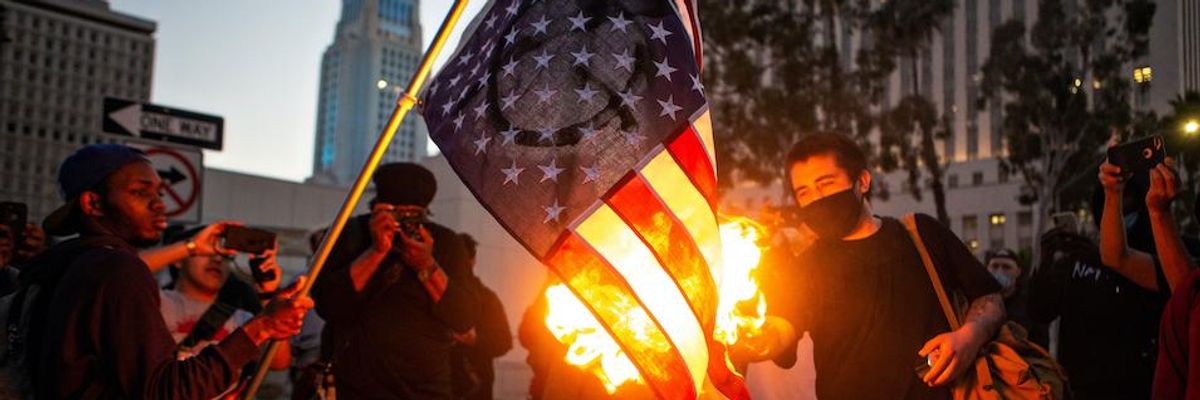
A protester holds an American flag as a fellow demonstrator lights it on fire to protest the killing of George Floyd in Minnesota by police Wednesday, May 27, 2020 in Los Angeles.
Anger and Unrest Nationwide as Protests Over Killing of George Floyd Spread Across US Cities
"When people look to these individuals who are frustrated, who are angry, for not just Mr. Floyd but countless others for whom there was no video evidence, as there was in this case, who lost their lives—that is what you are seeing bubble up."
Demonstrations against the culture of racism and brutality that defines U.S. policing spread across the country Thursday evening in response to the killing of unarmed black man George Floyd by officers from the Minneapolis Police Department.
From New York to Memphis to Oakland, protesters and police departments in city after city faced off, sometimes violently.
Video from Manhattan's Union Square shows police attacking a protester, with one officer breaking his baton while beating a demonstrator.
Photographer Dee Delgado, who was on the scene, told Gothamist that he had seen seven or eight arrests and that clashes between police and demonstrators continued "flaring up."
"I just witnessed an officer put his knee on somebody's neck," said Delgado.
In Columbus, Ohio demonstrators breached the state house before being attacked by police wielding tear gas.
So Columbus going crazy right now pic.twitter.com/01K7BJ2NaD
-- gavin mounts (@gtmounts) May 29, 2020
Police in Phoenix fired rubber bullets into a crowd of demonstrators outside of police headquarters. Demonstrators also marched on city hall and the state capitol.
"Things got a little rough there towards the end," demonstration organizer Jarrett Maupin told the Arizona Republic. "The Capitol was our end game and we made it there. Our event was nonviolent."
Shots rang out in Denver as protesters blocked traffic in the city, though no injuries were reported, as police and protesters faced off throughout the night.
State Rep. Leslise Herod told the New York Times that shots were fired at the protest as demonstrators were gathered peacefully.
"This was a completely peaceful rally and someone shot into the crowd and at folks who were protesting in support of the black community and against police brutality," said Herod.
An unidentified woman driving a black SUV rammed her car at Denver protesters in a separate, earlier incident.
Louisville, Kentucky protesters were also protesting against their city's police department's killing of an unarmed black woman, Breonna Taylor, on March 13. Demonstrators filled the streets and began shaking a police prisoner convoy truck--slashing its tires and breaking its windows--before shots were fired at the crowd.
Seven people were reportedly wounded, though nobody was killed.
Demonstrations also took place in Memphis, Fontana, California, and Albuquerque, and other cities.
In Los Angeles, protesters assembled across the city, including in front of police headquarters, to express their anger and frustration over Floyd's killing.
"When people look to these individuals who are frustrated, who are angry, for not just Mr. Floyd but countless others for whom there was no video evidence, as there was in this case, who lost their lives--that is what you are seeing bubble up," CBS News reporter Vladimir Duthiers said Thursday.
City mayors and local and state officials urged demonstrators to protest peacefully, but the tense situations--and police responses to the protests--led to violence in a number of cities.
Phoenix demonstrator Jordan Walker bemoaned the fact that authorities have so little interest in addressing police culture that the only way for the people to demand change is to turn out en masse in the street.
"We shouldn't have to do this in order to be heard," said Walker. "We shouldn't have to do this in order for justice to be made."
We are at a crossroads
This country and this world are at a monumental crossroads. In a few short weeks, US voters will have an opportunity to beat back the forces of fascism and confront the billionaires who are rigging the economy, our media system, and our democracy, making it increasingly impossible for ordinary people to get by. We’re not just talking about the election. We’re talking about what must be done once these fascist elements are vanquished from power. We need a bolder set of solutions than what either major party has so far been willing to offer and a working-class movement ready to fight like hell for it. Trump didn't emerge from nowhere. The conditions that fueled MAGA authoritarianism were created by decades of radical neoliberal economic policies and a corrupt political system dominated by corporate interests. They slashed taxes on the super-rich, promising that the benefits would trickle down. They said giveaways to the corporate titans would make life more affordable for the rest of us. It was all bullshit. And when a bitter, betrayed populace searches for someone to blame, right-wing demagogues have little trouble finding scapegoats. People know when they're being lied to, but you won't hear any of this from the corporate media. Only independent journalism—powered and funded by people who believe in building a better world—can deliver truly trustworthy daily news. Our Fall Campaign is underway, and we need your help. To power our newsroom through the rest of the year, we need to raise $125,000 by midnight on October 31. So if you share our vision, please contribute whatever you can to sustain our work. |
Demonstrations against the culture of racism and brutality that defines U.S. policing spread across the country Thursday evening in response to the killing of unarmed black man George Floyd by officers from the Minneapolis Police Department.
From New York to Memphis to Oakland, protesters and police departments in city after city faced off, sometimes violently.
Video from Manhattan's Union Square shows police attacking a protester, with one officer breaking his baton while beating a demonstrator.
Photographer Dee Delgado, who was on the scene, told Gothamist that he had seen seven or eight arrests and that clashes between police and demonstrators continued "flaring up."
"I just witnessed an officer put his knee on somebody's neck," said Delgado.
In Columbus, Ohio demonstrators breached the state house before being attacked by police wielding tear gas.
So Columbus going crazy right now pic.twitter.com/01K7BJ2NaD
-- gavin mounts (@gtmounts) May 29, 2020
Police in Phoenix fired rubber bullets into a crowd of demonstrators outside of police headquarters. Demonstrators also marched on city hall and the state capitol.
"Things got a little rough there towards the end," demonstration organizer Jarrett Maupin told the Arizona Republic. "The Capitol was our end game and we made it there. Our event was nonviolent."
Shots rang out in Denver as protesters blocked traffic in the city, though no injuries were reported, as police and protesters faced off throughout the night.
State Rep. Leslise Herod told the New York Times that shots were fired at the protest as demonstrators were gathered peacefully.
"This was a completely peaceful rally and someone shot into the crowd and at folks who were protesting in support of the black community and against police brutality," said Herod.
An unidentified woman driving a black SUV rammed her car at Denver protesters in a separate, earlier incident.
Louisville, Kentucky protesters were also protesting against their city's police department's killing of an unarmed black woman, Breonna Taylor, on March 13. Demonstrators filled the streets and began shaking a police prisoner convoy truck--slashing its tires and breaking its windows--before shots were fired at the crowd.
Seven people were reportedly wounded, though nobody was killed.
Demonstrations also took place in Memphis, Fontana, California, and Albuquerque, and other cities.
In Los Angeles, protesters assembled across the city, including in front of police headquarters, to express their anger and frustration over Floyd's killing.
"When people look to these individuals who are frustrated, who are angry, for not just Mr. Floyd but countless others for whom there was no video evidence, as there was in this case, who lost their lives--that is what you are seeing bubble up," CBS News reporter Vladimir Duthiers said Thursday.
City mayors and local and state officials urged demonstrators to protest peacefully, but the tense situations--and police responses to the protests--led to violence in a number of cities.
Phoenix demonstrator Jordan Walker bemoaned the fact that authorities have so little interest in addressing police culture that the only way for the people to demand change is to turn out en masse in the street.
"We shouldn't have to do this in order to be heard," said Walker. "We shouldn't have to do this in order for justice to be made."
Demonstrations against the culture of racism and brutality that defines U.S. policing spread across the country Thursday evening in response to the killing of unarmed black man George Floyd by officers from the Minneapolis Police Department.
From New York to Memphis to Oakland, protesters and police departments in city after city faced off, sometimes violently.
Video from Manhattan's Union Square shows police attacking a protester, with one officer breaking his baton while beating a demonstrator.
Photographer Dee Delgado, who was on the scene, told Gothamist that he had seen seven or eight arrests and that clashes between police and demonstrators continued "flaring up."
"I just witnessed an officer put his knee on somebody's neck," said Delgado.
In Columbus, Ohio demonstrators breached the state house before being attacked by police wielding tear gas.
So Columbus going crazy right now pic.twitter.com/01K7BJ2NaD
-- gavin mounts (@gtmounts) May 29, 2020
Police in Phoenix fired rubber bullets into a crowd of demonstrators outside of police headquarters. Demonstrators also marched on city hall and the state capitol.
"Things got a little rough there towards the end," demonstration organizer Jarrett Maupin told the Arizona Republic. "The Capitol was our end game and we made it there. Our event was nonviolent."
Shots rang out in Denver as protesters blocked traffic in the city, though no injuries were reported, as police and protesters faced off throughout the night.
State Rep. Leslise Herod told the New York Times that shots were fired at the protest as demonstrators were gathered peacefully.
"This was a completely peaceful rally and someone shot into the crowd and at folks who were protesting in support of the black community and against police brutality," said Herod.
An unidentified woman driving a black SUV rammed her car at Denver protesters in a separate, earlier incident.
Louisville, Kentucky protesters were also protesting against their city's police department's killing of an unarmed black woman, Breonna Taylor, on March 13. Demonstrators filled the streets and began shaking a police prisoner convoy truck--slashing its tires and breaking its windows--before shots were fired at the crowd.
Seven people were reportedly wounded, though nobody was killed.
Demonstrations also took place in Memphis, Fontana, California, and Albuquerque, and other cities.
In Los Angeles, protesters assembled across the city, including in front of police headquarters, to express their anger and frustration over Floyd's killing.
"When people look to these individuals who are frustrated, who are angry, for not just Mr. Floyd but countless others for whom there was no video evidence, as there was in this case, who lost their lives--that is what you are seeing bubble up," CBS News reporter Vladimir Duthiers said Thursday.
City mayors and local and state officials urged demonstrators to protest peacefully, but the tense situations--and police responses to the protests--led to violence in a number of cities.
Phoenix demonstrator Jordan Walker bemoaned the fact that authorities have so little interest in addressing police culture that the only way for the people to demand change is to turn out en masse in the street.
"We shouldn't have to do this in order to be heard," said Walker. "We shouldn't have to do this in order for justice to be made."