

SUBSCRIBE TO OUR FREE NEWSLETTER
Daily news & progressive opinion—funded by the people, not the corporations—delivered straight to your inbox.
5
#000000
#FFFFFF
To donate by check, phone, or other method, see our More Ways to Give page.
Daily news & progressive opinion—funded by the people, not the corporations—delivered straight to your inbox.
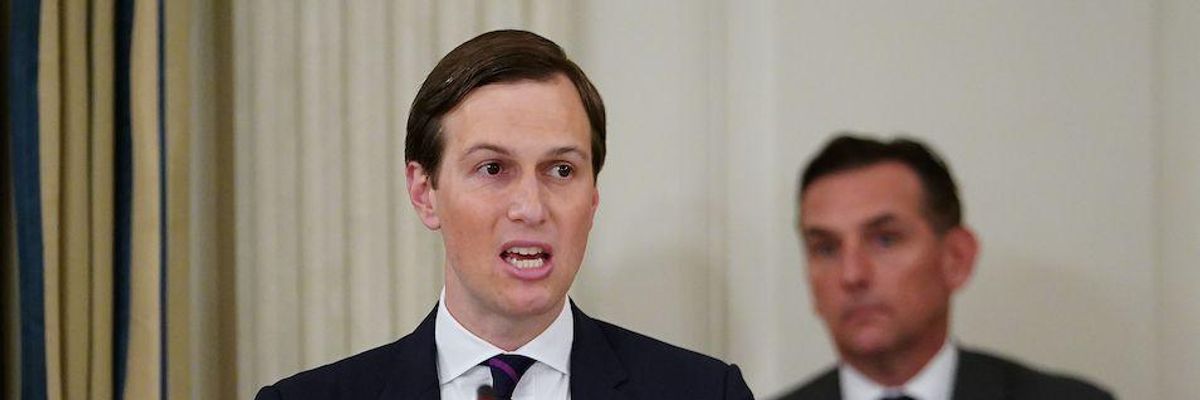
Senior Advisor to President Donald Trump Jared Kushner speaks at a meeting in the State Dining Room of the White House in Washington, DC, on May 8, 2020. (Photo: Mandel Ngan/AFP/Getty Images)
President Donald Trump's son-in-law and special advisor Jared Kushner reportedly urged his father-in-law in the early stages of the coronavirus pandemic not to prioritize testing or ordering potentially life-saving equipment like ventilators because of fears it might drive down stock prices.
Kushner's efforts to convince the president not to take decisive action were first reported in the Financial Times:
"Jared [Kushner] had been arguing that testing too many people, or ordering too many ventilators, would spook the markets and so we just shouldn't do it," says a Trump confidant who speaks to the president frequently. "That advice worked far more powerfully on him than what the scientists were saying. He thinks they always exaggerate."
"And there you have it," tweeted strategist Mark Elliott. "150,000 Americans sacrificed for the stock market."
GQ's Luke Darby pointed out Thursday that the advised ploy didn't even work.
"Kushner's advice did nothing to prevent a market crash," wrote Darby, "and it's likely that the administration's refusal to act in time only threw the economy into more chaos."
"And while the stock market largely affects the investment portfolios of the rich (the wealthiest 10 percent of Americans own more than 80 percent of stocks)," he added, "the fallout has the rest of the country reeling, with a historic 36 million people filing unemployment claims."
The president's obsession with the economy is tied to his re-election hopes, according to the Financial Times reporting:
In the meantime, Trump will probably continue to dangle the prospect of miracle cures. Every week since the start of the outbreak, he has said a vaccine is just around the corner. His latest estimate is that it will be ready by July. Scientists say it will take a year at best to produce an inoculation. Most say 18 months would be lucky. Even that would break all records. The previous fastest development was four years for mumps in the 1960s.
On Thursday, Trump appeared to suggest to reporters at the White House that testing was itself the source of the problem.
"If we didn't do any testing we would have very few cases," the president said.
The Nation writer Jeet Heer was quick to respond.
"It sounds insane when you put it like this," Heer tweeted, "but the idea 'if we didn't do any testing we would have very few cases' is the core of Trump's response to the pandemic."
Dear Common Dreams reader, It’s been nearly 30 years since I co-founded Common Dreams with my late wife, Lina Newhouser. We had the radical notion that journalism should serve the public good, not corporate profits. It was clear to us from the outset what it would take to build such a project. No paid advertisements. No corporate sponsors. No millionaire publisher telling us what to think or do. Many people said we wouldn't last a year, but we proved those doubters wrong. Together with a tremendous team of journalists and dedicated staff, we built an independent media outlet free from the constraints of profits and corporate control. Our mission has always been simple: To inform. To inspire. To ignite change for the common good. Building Common Dreams was not easy. Our survival was never guaranteed. When you take on the most powerful forces—Wall Street greed, fossil fuel industry destruction, Big Tech lobbyists, and uber-rich oligarchs who have spent billions upon billions rigging the economy and democracy in their favor—the only bulwark you have is supporters who believe in your work. But here’s the urgent message from me today. It's never been this bad out there. And it's never been this hard to keep us going. At the very moment Common Dreams is most needed, the threats we face are intensifying. We need your support now more than ever. We don't accept corporate advertising and never will. We don't have a paywall because we don't think people should be blocked from critical news based on their ability to pay. Everything we do is funded by the donations of readers like you. When everyone does the little they can afford, we are strong. But if that support retreats or dries up, so do we. Will you donate now to make sure Common Dreams not only survives but thrives? —Craig Brown, Co-founder |
President Donald Trump's son-in-law and special advisor Jared Kushner reportedly urged his father-in-law in the early stages of the coronavirus pandemic not to prioritize testing or ordering potentially life-saving equipment like ventilators because of fears it might drive down stock prices.
Kushner's efforts to convince the president not to take decisive action were first reported in the Financial Times:
"Jared [Kushner] had been arguing that testing too many people, or ordering too many ventilators, would spook the markets and so we just shouldn't do it," says a Trump confidant who speaks to the president frequently. "That advice worked far more powerfully on him than what the scientists were saying. He thinks they always exaggerate."
"And there you have it," tweeted strategist Mark Elliott. "150,000 Americans sacrificed for the stock market."
GQ's Luke Darby pointed out Thursday that the advised ploy didn't even work.
"Kushner's advice did nothing to prevent a market crash," wrote Darby, "and it's likely that the administration's refusal to act in time only threw the economy into more chaos."
"And while the stock market largely affects the investment portfolios of the rich (the wealthiest 10 percent of Americans own more than 80 percent of stocks)," he added, "the fallout has the rest of the country reeling, with a historic 36 million people filing unemployment claims."
The president's obsession with the economy is tied to his re-election hopes, according to the Financial Times reporting:
In the meantime, Trump will probably continue to dangle the prospect of miracle cures. Every week since the start of the outbreak, he has said a vaccine is just around the corner. His latest estimate is that it will be ready by July. Scientists say it will take a year at best to produce an inoculation. Most say 18 months would be lucky. Even that would break all records. The previous fastest development was four years for mumps in the 1960s.
On Thursday, Trump appeared to suggest to reporters at the White House that testing was itself the source of the problem.
"If we didn't do any testing we would have very few cases," the president said.
The Nation writer Jeet Heer was quick to respond.
"It sounds insane when you put it like this," Heer tweeted, "but the idea 'if we didn't do any testing we would have very few cases' is the core of Trump's response to the pandemic."
President Donald Trump's son-in-law and special advisor Jared Kushner reportedly urged his father-in-law in the early stages of the coronavirus pandemic not to prioritize testing or ordering potentially life-saving equipment like ventilators because of fears it might drive down stock prices.
Kushner's efforts to convince the president not to take decisive action were first reported in the Financial Times:
"Jared [Kushner] had been arguing that testing too many people, or ordering too many ventilators, would spook the markets and so we just shouldn't do it," says a Trump confidant who speaks to the president frequently. "That advice worked far more powerfully on him than what the scientists were saying. He thinks they always exaggerate."
"And there you have it," tweeted strategist Mark Elliott. "150,000 Americans sacrificed for the stock market."
GQ's Luke Darby pointed out Thursday that the advised ploy didn't even work.
"Kushner's advice did nothing to prevent a market crash," wrote Darby, "and it's likely that the administration's refusal to act in time only threw the economy into more chaos."
"And while the stock market largely affects the investment portfolios of the rich (the wealthiest 10 percent of Americans own more than 80 percent of stocks)," he added, "the fallout has the rest of the country reeling, with a historic 36 million people filing unemployment claims."
The president's obsession with the economy is tied to his re-election hopes, according to the Financial Times reporting:
In the meantime, Trump will probably continue to dangle the prospect of miracle cures. Every week since the start of the outbreak, he has said a vaccine is just around the corner. His latest estimate is that it will be ready by July. Scientists say it will take a year at best to produce an inoculation. Most say 18 months would be lucky. Even that would break all records. The previous fastest development was four years for mumps in the 1960s.
On Thursday, Trump appeared to suggest to reporters at the White House that testing was itself the source of the problem.
"If we didn't do any testing we would have very few cases," the president said.
The Nation writer Jeet Heer was quick to respond.
"It sounds insane when you put it like this," Heer tweeted, "but the idea 'if we didn't do any testing we would have very few cases' is the core of Trump's response to the pandemic."

