SUBSCRIBE TO OUR FREE NEWSLETTER
Daily news & progressive opinion—funded by the people, not the corporations—delivered straight to your inbox.
5
#000000
#FFFFFF
To donate by check, phone, or other method, see our More Ways to Give page.
Daily news & progressive opinion—funded by the people, not the corporations—delivered straight to your inbox.
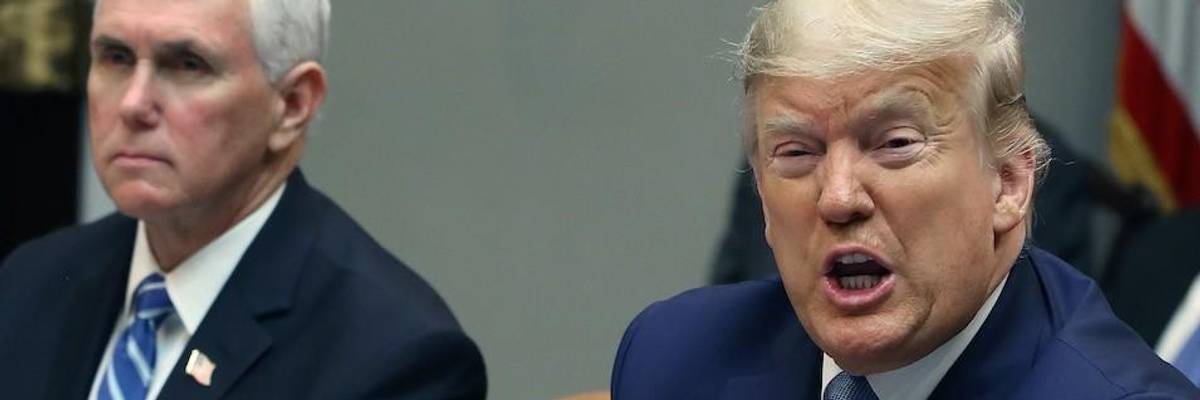
The president's isolationism on Covid-19 could come with disastrous consequences. (Photo: Mark Wilson/Getty Images)
President Donald Trump's brand of "America First" isolationism was on full display Monday as the U.S. declined to participate in a international pledge drive which raised more than $8 billion during its kick-event to create a global fund to develop and deploy diagnostics, treatments, and vaccines to fight the coronavirus pandemic.
"It is a pity the U.S. is not a part of it," Norwegian Prime Minister Erna Solberg, whose country pledged $1 billion to the effort, told Reuters. "When you are in a crisis, you manage it and you do it jointly with others."
As Reuters reported, the pledging conference was the initiative of the European Union, Canada, France, Germany, Italy, Japan, the U.K., Saudi Arabia, Norway, and Spain and featured representatives of nations, civil society groups, and private financial interests.
Reuters broke down the numbers:
The 8-billion-dollar goal was in line with expectations but is only an initial figure. Von der Leyen has said more money will be needed over time.
The Global Preparedness Monitoring Board, a U.N.-backed body focusing on health crises, estimates that of the $8 billion immediately needed, $3 billion will have to be spent to develop, manufacture and distribute a possible vaccine against Covid-19, the EU Commission said.
Another $2.25 billion is needed to develop treatments for Covid-19, $750 million for testing kits, and another $750 million to stockpile protective equipment, such as face masks. The remaining $1.25 billion would go to the World Health Organization to support the most vulnerable countries.
"Today the world showed extraordinary unity for the common good," European Commission president Ursula von der Leyen said in a statement. "Governments and global health organizations joined forces against coronavirus. With such commitment, we are on track for developing, producing, and deploying a vaccine for all."
"However, this is only the beginning," von der Leyen added. "We need to sustain the effort and to stand ready to contribute more. The pledging marathon will continue."
Non-governmental organizations and wealthy individuals are also contributing to the pledge.
"We are facing an unprecedented global health emergency and only a global response can fight a global disease like Covid-19," Peter Sands, executive director of the Global Fund, said in a statement announcing the group's $1 billion contribution to the cause. "To defeat Covid-19, every country's capacity to prevent, detect, and respond to infectious diseases must be reinforced. We must unite to fight."
The U.S. resistance to joining the effort was the topic of a State Department call with reporters Monday as officials declined repeatedly to answer questions on why the U.S. was not joining the effort.
As Common Dreams reported earlier Monday, Trump's resistance to international cooperation on a vaccine is causing critics of the administration to warn the president's "America First" mentality could have severe ramifications for the country and the world.
"The results may be catastrophic," tweeted Ilan Goldberg of the Center for a New American Security.
In an interview with CNN, von der Leyen emphasized that the disease would not be deterred by isolationism.
"We all know that this virus knows no borders and no nationalities," she said.
Dear Common Dreams reader, It’s been nearly 30 years since I co-founded Common Dreams with my late wife, Lina Newhouser. We had the radical notion that journalism should serve the public good, not corporate profits. It was clear to us from the outset what it would take to build such a project. No paid advertisements. No corporate sponsors. No millionaire publisher telling us what to think or do. Many people said we wouldn't last a year, but we proved those doubters wrong. Together with a tremendous team of journalists and dedicated staff, we built an independent media outlet free from the constraints of profits and corporate control. Our mission has always been simple: To inform. To inspire. To ignite change for the common good. Building Common Dreams was not easy. Our survival was never guaranteed. When you take on the most powerful forces—Wall Street greed, fossil fuel industry destruction, Big Tech lobbyists, and uber-rich oligarchs who have spent billions upon billions rigging the economy and democracy in their favor—the only bulwark you have is supporters who believe in your work. But here’s the urgent message from me today. It's never been this bad out there. And it's never been this hard to keep us going. At the very moment Common Dreams is most needed, the threats we face are intensifying. We need your support now more than ever. We don't accept corporate advertising and never will. We don't have a paywall because we don't think people should be blocked from critical news based on their ability to pay. Everything we do is funded by the donations of readers like you. When everyone does the little they can afford, we are strong. But if that support retreats or dries up, so do we. Will you donate now to make sure Common Dreams not only survives but thrives? —Craig Brown, Co-founder |
President Donald Trump's brand of "America First" isolationism was on full display Monday as the U.S. declined to participate in a international pledge drive which raised more than $8 billion during its kick-event to create a global fund to develop and deploy diagnostics, treatments, and vaccines to fight the coronavirus pandemic.
"It is a pity the U.S. is not a part of it," Norwegian Prime Minister Erna Solberg, whose country pledged $1 billion to the effort, told Reuters. "When you are in a crisis, you manage it and you do it jointly with others."
As Reuters reported, the pledging conference was the initiative of the European Union, Canada, France, Germany, Italy, Japan, the U.K., Saudi Arabia, Norway, and Spain and featured representatives of nations, civil society groups, and private financial interests.
Reuters broke down the numbers:
The 8-billion-dollar goal was in line with expectations but is only an initial figure. Von der Leyen has said more money will be needed over time.
The Global Preparedness Monitoring Board, a U.N.-backed body focusing on health crises, estimates that of the $8 billion immediately needed, $3 billion will have to be spent to develop, manufacture and distribute a possible vaccine against Covid-19, the EU Commission said.
Another $2.25 billion is needed to develop treatments for Covid-19, $750 million for testing kits, and another $750 million to stockpile protective equipment, such as face masks. The remaining $1.25 billion would go to the World Health Organization to support the most vulnerable countries.
"Today the world showed extraordinary unity for the common good," European Commission president Ursula von der Leyen said in a statement. "Governments and global health organizations joined forces against coronavirus. With such commitment, we are on track for developing, producing, and deploying a vaccine for all."
"However, this is only the beginning," von der Leyen added. "We need to sustain the effort and to stand ready to contribute more. The pledging marathon will continue."
Non-governmental organizations and wealthy individuals are also contributing to the pledge.
"We are facing an unprecedented global health emergency and only a global response can fight a global disease like Covid-19," Peter Sands, executive director of the Global Fund, said in a statement announcing the group's $1 billion contribution to the cause. "To defeat Covid-19, every country's capacity to prevent, detect, and respond to infectious diseases must be reinforced. We must unite to fight."
The U.S. resistance to joining the effort was the topic of a State Department call with reporters Monday as officials declined repeatedly to answer questions on why the U.S. was not joining the effort.
As Common Dreams reported earlier Monday, Trump's resistance to international cooperation on a vaccine is causing critics of the administration to warn the president's "America First" mentality could have severe ramifications for the country and the world.
"The results may be catastrophic," tweeted Ilan Goldberg of the Center for a New American Security.
In an interview with CNN, von der Leyen emphasized that the disease would not be deterred by isolationism.
"We all know that this virus knows no borders and no nationalities," she said.
President Donald Trump's brand of "America First" isolationism was on full display Monday as the U.S. declined to participate in a international pledge drive which raised more than $8 billion during its kick-event to create a global fund to develop and deploy diagnostics, treatments, and vaccines to fight the coronavirus pandemic.
"It is a pity the U.S. is not a part of it," Norwegian Prime Minister Erna Solberg, whose country pledged $1 billion to the effort, told Reuters. "When you are in a crisis, you manage it and you do it jointly with others."
As Reuters reported, the pledging conference was the initiative of the European Union, Canada, France, Germany, Italy, Japan, the U.K., Saudi Arabia, Norway, and Spain and featured representatives of nations, civil society groups, and private financial interests.
Reuters broke down the numbers:
The 8-billion-dollar goal was in line with expectations but is only an initial figure. Von der Leyen has said more money will be needed over time.
The Global Preparedness Monitoring Board, a U.N.-backed body focusing on health crises, estimates that of the $8 billion immediately needed, $3 billion will have to be spent to develop, manufacture and distribute a possible vaccine against Covid-19, the EU Commission said.
Another $2.25 billion is needed to develop treatments for Covid-19, $750 million for testing kits, and another $750 million to stockpile protective equipment, such as face masks. The remaining $1.25 billion would go to the World Health Organization to support the most vulnerable countries.
"Today the world showed extraordinary unity for the common good," European Commission president Ursula von der Leyen said in a statement. "Governments and global health organizations joined forces against coronavirus. With such commitment, we are on track for developing, producing, and deploying a vaccine for all."
"However, this is only the beginning," von der Leyen added. "We need to sustain the effort and to stand ready to contribute more. The pledging marathon will continue."
Non-governmental organizations and wealthy individuals are also contributing to the pledge.
"We are facing an unprecedented global health emergency and only a global response can fight a global disease like Covid-19," Peter Sands, executive director of the Global Fund, said in a statement announcing the group's $1 billion contribution to the cause. "To defeat Covid-19, every country's capacity to prevent, detect, and respond to infectious diseases must be reinforced. We must unite to fight."
The U.S. resistance to joining the effort was the topic of a State Department call with reporters Monday as officials declined repeatedly to answer questions on why the U.S. was not joining the effort.
As Common Dreams reported earlier Monday, Trump's resistance to international cooperation on a vaccine is causing critics of the administration to warn the president's "America First" mentality could have severe ramifications for the country and the world.
"The results may be catastrophic," tweeted Ilan Goldberg of the Center for a New American Security.
In an interview with CNN, von der Leyen emphasized that the disease would not be deterred by isolationism.
"We all know that this virus knows no borders and no nationalities," she said.