

SUBSCRIBE TO OUR FREE NEWSLETTER
Daily news & progressive opinion—funded by the people, not the corporations—delivered straight to your inbox.
5
#000000
#FFFFFF
To donate by check, phone, or other method, see our More Ways to Give page.
Daily news & progressive opinion—funded by the people, not the corporations—delivered straight to your inbox.
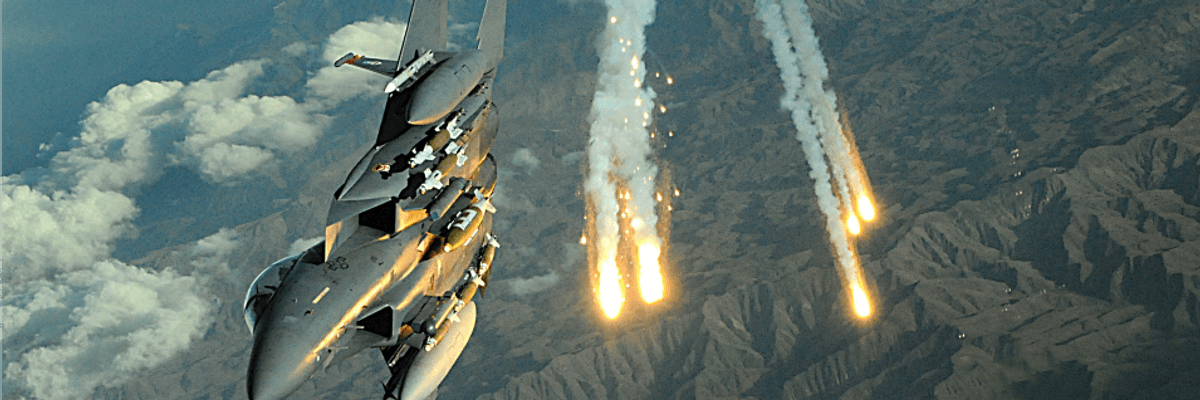
An F-15E Strike Eagle from Bagram Air Base deploys flares over Afghanistan Nov. 12, 2008. (Photo: U.S. Air Force/Staff Sgt. Aaron Allmon)
The U.S. military dropped a record-breaking number of bombs on Afghanistan in 2019, the Air Force announced Tuesday, drawing criticism from observers who wondered what purpose the continued barrage of the war-torn country after over 18 years of war could serve.
"Isn't this an admission of colossal failure?" tweeted CounterPunch editor Jeffrey St. Clair. "Who are we bombing? Why? What will it yield but more war?"
The munitions data (pdf) was published Monday by U.S. Air Forces Central Command. Air Force jets dropped 7,423 bombs on Afghanistan in 2019, the highest number since records began in 2006--beating out 2018.
Stars and Stripes explained how the bombing affects the Afghan people:
The AFCENT figures include bomb and missile strikes, 105 mm shells fired by AC-130 gunships and strafing fire from 20 mm cannons and up.
Airstrikes, predominantly conducted by U.S. forces, caused 579 of the 1,149 civilian war fatalities attributed to pro-government forces in Afghanistan during the first nine months of 2019, according to the most recent United Nations data.
As the war in Afghanistan continues, so too does a lack of accountability with the American people from President Donald Trump's administration.
Two members of the president's Cabinet, Secretary of State Mike Pompeo and Acting Secretary of Defense Mark Esper, refused to attend a Congressional hearing on the war Tuesday morning, drawing criticism from Subcommittee on National Security chairman Rep. Stephen Lynch (D-Mass.).
Lynch said in his remarks that the president's strategy in the region is at best incoherent.
"Despite repeated invitations, the Department of State and the Department of Defense refused to make witnesses available to testify today," said Lynch. "That's very disappointing, because I'm concerned that rather than implementing a coherent Afghanistan strategy, U.S. policy in the region is instead being driven by the latest impulse of the commander-in-chief."
U.S. airstrikes killed 15 civilians earlier in January, Stars and Stripes reported last week.
Afghanistan's Independent Human Rights Commission, which reported the strike in a report, said the attack was "a clear violation of human rights."
Dear Common Dreams reader, It’s been nearly 30 years since I co-founded Common Dreams with my late wife, Lina Newhouser. We had the radical notion that journalism should serve the public good, not corporate profits. It was clear to us from the outset what it would take to build such a project. No paid advertisements. No corporate sponsors. No millionaire publisher telling us what to think or do. Many people said we wouldn't last a year, but we proved those doubters wrong. Together with a tremendous team of journalists and dedicated staff, we built an independent media outlet free from the constraints of profits and corporate control. Our mission has always been simple: To inform. To inspire. To ignite change for the common good. Building Common Dreams was not easy. Our survival was never guaranteed. When you take on the most powerful forces—Wall Street greed, fossil fuel industry destruction, Big Tech lobbyists, and uber-rich oligarchs who have spent billions upon billions rigging the economy and democracy in their favor—the only bulwark you have is supporters who believe in your work. But here’s the urgent message from me today. It's never been this bad out there. And it's never been this hard to keep us going. At the very moment Common Dreams is most needed, the threats we face are intensifying. We need your support now more than ever. We don't accept corporate advertising and never will. We don't have a paywall because we don't think people should be blocked from critical news based on their ability to pay. Everything we do is funded by the donations of readers like you. When everyone does the little they can afford, we are strong. But if that support retreats or dries up, so do we. Will you donate now to make sure Common Dreams not only survives but thrives? —Craig Brown, Co-founder |
The U.S. military dropped a record-breaking number of bombs on Afghanistan in 2019, the Air Force announced Tuesday, drawing criticism from observers who wondered what purpose the continued barrage of the war-torn country after over 18 years of war could serve.
"Isn't this an admission of colossal failure?" tweeted CounterPunch editor Jeffrey St. Clair. "Who are we bombing? Why? What will it yield but more war?"
The munitions data (pdf) was published Monday by U.S. Air Forces Central Command. Air Force jets dropped 7,423 bombs on Afghanistan in 2019, the highest number since records began in 2006--beating out 2018.
Stars and Stripes explained how the bombing affects the Afghan people:
The AFCENT figures include bomb and missile strikes, 105 mm shells fired by AC-130 gunships and strafing fire from 20 mm cannons and up.
Airstrikes, predominantly conducted by U.S. forces, caused 579 of the 1,149 civilian war fatalities attributed to pro-government forces in Afghanistan during the first nine months of 2019, according to the most recent United Nations data.
As the war in Afghanistan continues, so too does a lack of accountability with the American people from President Donald Trump's administration.
Two members of the president's Cabinet, Secretary of State Mike Pompeo and Acting Secretary of Defense Mark Esper, refused to attend a Congressional hearing on the war Tuesday morning, drawing criticism from Subcommittee on National Security chairman Rep. Stephen Lynch (D-Mass.).
Lynch said in his remarks that the president's strategy in the region is at best incoherent.
"Despite repeated invitations, the Department of State and the Department of Defense refused to make witnesses available to testify today," said Lynch. "That's very disappointing, because I'm concerned that rather than implementing a coherent Afghanistan strategy, U.S. policy in the region is instead being driven by the latest impulse of the commander-in-chief."
U.S. airstrikes killed 15 civilians earlier in January, Stars and Stripes reported last week.
Afghanistan's Independent Human Rights Commission, which reported the strike in a report, said the attack was "a clear violation of human rights."
The U.S. military dropped a record-breaking number of bombs on Afghanistan in 2019, the Air Force announced Tuesday, drawing criticism from observers who wondered what purpose the continued barrage of the war-torn country after over 18 years of war could serve.
"Isn't this an admission of colossal failure?" tweeted CounterPunch editor Jeffrey St. Clair. "Who are we bombing? Why? What will it yield but more war?"
The munitions data (pdf) was published Monday by U.S. Air Forces Central Command. Air Force jets dropped 7,423 bombs on Afghanistan in 2019, the highest number since records began in 2006--beating out 2018.
Stars and Stripes explained how the bombing affects the Afghan people:
The AFCENT figures include bomb and missile strikes, 105 mm shells fired by AC-130 gunships and strafing fire from 20 mm cannons and up.
Airstrikes, predominantly conducted by U.S. forces, caused 579 of the 1,149 civilian war fatalities attributed to pro-government forces in Afghanistan during the first nine months of 2019, according to the most recent United Nations data.
As the war in Afghanistan continues, so too does a lack of accountability with the American people from President Donald Trump's administration.
Two members of the president's Cabinet, Secretary of State Mike Pompeo and Acting Secretary of Defense Mark Esper, refused to attend a Congressional hearing on the war Tuesday morning, drawing criticism from Subcommittee on National Security chairman Rep. Stephen Lynch (D-Mass.).
Lynch said in his remarks that the president's strategy in the region is at best incoherent.
"Despite repeated invitations, the Department of State and the Department of Defense refused to make witnesses available to testify today," said Lynch. "That's very disappointing, because I'm concerned that rather than implementing a coherent Afghanistan strategy, U.S. policy in the region is instead being driven by the latest impulse of the commander-in-chief."
U.S. airstrikes killed 15 civilians earlier in January, Stars and Stripes reported last week.
Afghanistan's Independent Human Rights Commission, which reported the strike in a report, said the attack was "a clear violation of human rights."

