SUBSCRIBE TO OUR FREE NEWSLETTER
Daily news & progressive opinion—funded by the people, not the corporations—delivered straight to your inbox.
5
#000000
#FFFFFF
To donate by check, phone, or other method, see our More Ways to Give page.
Daily news & progressive opinion—funded by the people, not the corporations—delivered straight to your inbox.
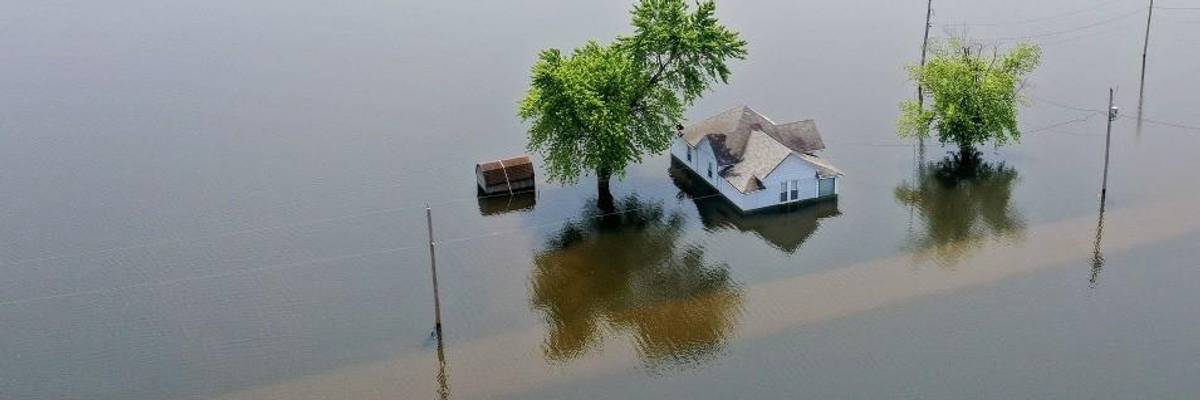
Floodwater from the Mississippi River rises around a home on June 1, 2019 in West Alton, Missouri. (Photo: Scott Olson/Getty Images)
The planet just closed out the costliest decade ever for natural disasters, insurance broker Aon said Wednesday.
The economic losses from 2010-2019, according to Aon's Weather, Climate & Catastrophe Insight: 2019 Annual Report (pdf), hit nearly $3 trillion. That's up from 1.8 trillion recorded between 2000 and 2009.
"Perhaps the biggest takeaway from the last decade of natural disasters," said Steve Bowen, director and meteorologist at Aon's Impact Forecasting team, "was the emergence of previously considered 'secondary' perils--such as wildfire, flood, and drought--becoming much more costly and impactful."
"Scientific research indicates that climate change will continue to affect all types of weather phenomena and subsequently impact increasingly urbanized areas," he added.
The Asia-Pacific area took the biggest economic hit from disasters. It had 44 percent of the decade's economic losses at about $1 .3 trillion. Convective storms and hurricanes helped put the United States in second place, with the country suffering $906 billion. The report adds:
When comparing losses of the 2000s versus the 2010s, the most considerable uptick occurred in the Americas; notably the Caribbean. The region registered a 192 percent increase in economic costs from natural perils in the 2010s compared to the 2000s. This was largely driven by the historic Atlantic hurricane season of 2017 and Hurricane Dorian in 2019.
Focusing on just 2019, over 400 natural disasters struck globally, said Aon, with costs hitting $232 billion.
Over 10,000 people also lost their lives to natural disasters, the report notes.
"Five of the top 10 costliest disasters of 2019 were flood-related," the publication adds. Those include the summer Monsoon floods in China, which cost $15 billion and took the lives of 300 people, and the Mississippi Basin Floods that resulted in $10 billion in losses.
Among the other highlights from 2019, as noted by Aon:
Aon's report comes a week after scientists confirmed 2019 was the second-warmest year on record and ended the warmest decade on record.
The publication also comes as climate activists direct their demands for urgent action to address the climate ecological crises to the global elite gathered in Davos, Switzerland for the World Economic Forum's summit.
Swedish teen Greta Thunberg added her voice to that chorus, tell summit-goers: "Let's be clear: we don't need a low carbon economy; we don't need to lower emissions. Our emissions have to stop if we are to have a chance to stay below the 1.5 degree target."
"Our house is still on fire," she said. "Your inaction is fueling the flames by the hour. We are still telling you to panic, and to act as if you loved your children above all else."
Dear Common Dreams reader, It’s been nearly 30 years since I co-founded Common Dreams with my late wife, Lina Newhouser. We had the radical notion that journalism should serve the public good, not corporate profits. It was clear to us from the outset what it would take to build such a project. No paid advertisements. No corporate sponsors. No millionaire publisher telling us what to think or do. Many people said we wouldn't last a year, but we proved those doubters wrong. Together with a tremendous team of journalists and dedicated staff, we built an independent media outlet free from the constraints of profits and corporate control. Our mission has always been simple: To inform. To inspire. To ignite change for the common good. Building Common Dreams was not easy. Our survival was never guaranteed. When you take on the most powerful forces—Wall Street greed, fossil fuel industry destruction, Big Tech lobbyists, and uber-rich oligarchs who have spent billions upon billions rigging the economy and democracy in their favor—the only bulwark you have is supporters who believe in your work. But here’s the urgent message from me today. It's never been this bad out there. And it's never been this hard to keep us going. At the very moment Common Dreams is most needed, the threats we face are intensifying. We need your support now more than ever. We don't accept corporate advertising and never will. We don't have a paywall because we don't think people should be blocked from critical news based on their ability to pay. Everything we do is funded by the donations of readers like you. When everyone does the little they can afford, we are strong. But if that support retreats or dries up, so do we. Will you donate now to make sure Common Dreams not only survives but thrives? —Craig Brown, Co-founder |
The planet just closed out the costliest decade ever for natural disasters, insurance broker Aon said Wednesday.
The economic losses from 2010-2019, according to Aon's Weather, Climate & Catastrophe Insight: 2019 Annual Report (pdf), hit nearly $3 trillion. That's up from 1.8 trillion recorded between 2000 and 2009.
"Perhaps the biggest takeaway from the last decade of natural disasters," said Steve Bowen, director and meteorologist at Aon's Impact Forecasting team, "was the emergence of previously considered 'secondary' perils--such as wildfire, flood, and drought--becoming much more costly and impactful."
"Scientific research indicates that climate change will continue to affect all types of weather phenomena and subsequently impact increasingly urbanized areas," he added.
The Asia-Pacific area took the biggest economic hit from disasters. It had 44 percent of the decade's economic losses at about $1 .3 trillion. Convective storms and hurricanes helped put the United States in second place, with the country suffering $906 billion. The report adds:
When comparing losses of the 2000s versus the 2010s, the most considerable uptick occurred in the Americas; notably the Caribbean. The region registered a 192 percent increase in economic costs from natural perils in the 2010s compared to the 2000s. This was largely driven by the historic Atlantic hurricane season of 2017 and Hurricane Dorian in 2019.
Focusing on just 2019, over 400 natural disasters struck globally, said Aon, with costs hitting $232 billion.
Over 10,000 people also lost their lives to natural disasters, the report notes.
"Five of the top 10 costliest disasters of 2019 were flood-related," the publication adds. Those include the summer Monsoon floods in China, which cost $15 billion and took the lives of 300 people, and the Mississippi Basin Floods that resulted in $10 billion in losses.
Among the other highlights from 2019, as noted by Aon:
Aon's report comes a week after scientists confirmed 2019 was the second-warmest year on record and ended the warmest decade on record.
The publication also comes as climate activists direct their demands for urgent action to address the climate ecological crises to the global elite gathered in Davos, Switzerland for the World Economic Forum's summit.
Swedish teen Greta Thunberg added her voice to that chorus, tell summit-goers: "Let's be clear: we don't need a low carbon economy; we don't need to lower emissions. Our emissions have to stop if we are to have a chance to stay below the 1.5 degree target."
"Our house is still on fire," she said. "Your inaction is fueling the flames by the hour. We are still telling you to panic, and to act as if you loved your children above all else."
The planet just closed out the costliest decade ever for natural disasters, insurance broker Aon said Wednesday.
The economic losses from 2010-2019, according to Aon's Weather, Climate & Catastrophe Insight: 2019 Annual Report (pdf), hit nearly $3 trillion. That's up from 1.8 trillion recorded between 2000 and 2009.
"Perhaps the biggest takeaway from the last decade of natural disasters," said Steve Bowen, director and meteorologist at Aon's Impact Forecasting team, "was the emergence of previously considered 'secondary' perils--such as wildfire, flood, and drought--becoming much more costly and impactful."
"Scientific research indicates that climate change will continue to affect all types of weather phenomena and subsequently impact increasingly urbanized areas," he added.
The Asia-Pacific area took the biggest economic hit from disasters. It had 44 percent of the decade's economic losses at about $1 .3 trillion. Convective storms and hurricanes helped put the United States in second place, with the country suffering $906 billion. The report adds:
When comparing losses of the 2000s versus the 2010s, the most considerable uptick occurred in the Americas; notably the Caribbean. The region registered a 192 percent increase in economic costs from natural perils in the 2010s compared to the 2000s. This was largely driven by the historic Atlantic hurricane season of 2017 and Hurricane Dorian in 2019.
Focusing on just 2019, over 400 natural disasters struck globally, said Aon, with costs hitting $232 billion.
Over 10,000 people also lost their lives to natural disasters, the report notes.
"Five of the top 10 costliest disasters of 2019 were flood-related," the publication adds. Those include the summer Monsoon floods in China, which cost $15 billion and took the lives of 300 people, and the Mississippi Basin Floods that resulted in $10 billion in losses.
Among the other highlights from 2019, as noted by Aon:
Aon's report comes a week after scientists confirmed 2019 was the second-warmest year on record and ended the warmest decade on record.
The publication also comes as climate activists direct their demands for urgent action to address the climate ecological crises to the global elite gathered in Davos, Switzerland for the World Economic Forum's summit.
Swedish teen Greta Thunberg added her voice to that chorus, tell summit-goers: "Let's be clear: we don't need a low carbon economy; we don't need to lower emissions. Our emissions have to stop if we are to have a chance to stay below the 1.5 degree target."
"Our house is still on fire," she said. "Your inaction is fueling the flames by the hour. We are still telling you to panic, and to act as if you loved your children above all else."