SUBSCRIBE TO OUR FREE NEWSLETTER
Daily news & progressive opinion—funded by the people, not the corporations—delivered straight to your inbox.
5
#000000
#FFFFFF
To donate by check, phone, or other method, see our More Ways to Give page.
Daily news & progressive opinion—funded by the people, not the corporations—delivered straight to your inbox.
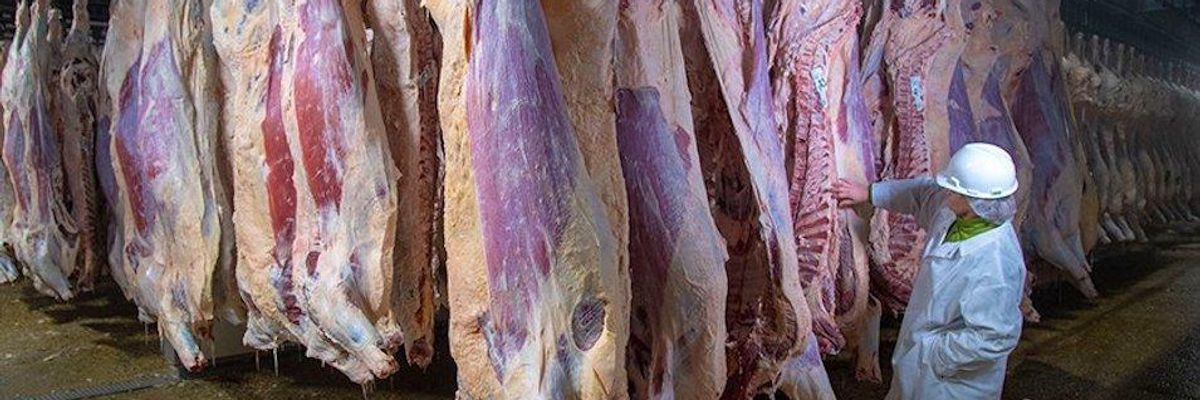
A USDA inspector with pig carcasses. (Photo: Food & Water Watch)
A lawsuit filed Monday against President Donald Trump's loosening of regulations in pork inspection plants aims to stop the rules from taking effect to protect consumers from illness and death.
The suit, which targets Trump's New Swine Inspection System (NSIS), was filed by Food & Water Watch, the Center for Food Safety, and two supporting members.
" USDA cannot do that when it takes a back seat and lets the slaughter plants largely regulate themselves."
--Ryan Talbott, Center for Food Safety
"There is no gray area here," said Food & Water Watch senior staff attorney Zach Corrigan in a statement. "The new rules curtail the ability of federal inspectors to detect serious food-safety problems and expose those who consume such pork products to serious health threats like salmonella."
According to a press release from the two groups, the new Department of Agriculture (USDA) rules are "a draconian reversal to the swine slaughter inspection system that has existed in the United States since 1906."
"We're suing the crap out of USDA for... feeding us crap," tweeted Food & Water Watch commmunications manager Jackie Filson.
Under the new regulations put forth by the Trump administration, federal inspectors are no longer responsible for examining the animals before and after slaughter and will see a reduced role on the line.
According to Food & Water Watch:
The new rules prevent such inspection and hand over these responsibilities to the slaughter companies themselves. They also surrender federal control over removing contamination from carcasses to slaughter companies without any minimum training requirements for slaughter-plant employees.
"Reducing the number of trained federal inspectors and increasing line speeds is a recipe for disaster," Center for Food Safety staff attorney Ryan Talbott said in a statement.
"USDA has an obligation to protect the health and welfare of consumers," added Talbott. "USDA cannot do that when it takes a back seat and lets the slaughter plants largely regulate themselves."
Dear Common Dreams reader, It’s been nearly 30 years since I co-founded Common Dreams with my late wife, Lina Newhouser. We had the radical notion that journalism should serve the public good, not corporate profits. It was clear to us from the outset what it would take to build such a project. No paid advertisements. No corporate sponsors. No millionaire publisher telling us what to think or do. Many people said we wouldn't last a year, but we proved those doubters wrong. Together with a tremendous team of journalists and dedicated staff, we built an independent media outlet free from the constraints of profits and corporate control. Our mission has always been simple: To inform. To inspire. To ignite change for the common good. Building Common Dreams was not easy. Our survival was never guaranteed. When you take on the most powerful forces—Wall Street greed, fossil fuel industry destruction, Big Tech lobbyists, and uber-rich oligarchs who have spent billions upon billions rigging the economy and democracy in their favor—the only bulwark you have is supporters who believe in your work. But here’s the urgent message from me today. It's never been this bad out there. And it's never been this hard to keep us going. At the very moment Common Dreams is most needed, the threats we face are intensifying. We need your support now more than ever. We don't accept corporate advertising and never will. We don't have a paywall because we don't think people should be blocked from critical news based on their ability to pay. Everything we do is funded by the donations of readers like you. When everyone does the little they can afford, we are strong. But if that support retreats or dries up, so do we. Will you donate now to make sure Common Dreams not only survives but thrives? —Craig Brown, Co-founder |
A lawsuit filed Monday against President Donald Trump's loosening of regulations in pork inspection plants aims to stop the rules from taking effect to protect consumers from illness and death.
The suit, which targets Trump's New Swine Inspection System (NSIS), was filed by Food & Water Watch, the Center for Food Safety, and two supporting members.
" USDA cannot do that when it takes a back seat and lets the slaughter plants largely regulate themselves."
--Ryan Talbott, Center for Food Safety
"There is no gray area here," said Food & Water Watch senior staff attorney Zach Corrigan in a statement. "The new rules curtail the ability of federal inspectors to detect serious food-safety problems and expose those who consume such pork products to serious health threats like salmonella."
According to a press release from the two groups, the new Department of Agriculture (USDA) rules are "a draconian reversal to the swine slaughter inspection system that has existed in the United States since 1906."
"We're suing the crap out of USDA for... feeding us crap," tweeted Food & Water Watch commmunications manager Jackie Filson.
Under the new regulations put forth by the Trump administration, federal inspectors are no longer responsible for examining the animals before and after slaughter and will see a reduced role on the line.
According to Food & Water Watch:
The new rules prevent such inspection and hand over these responsibilities to the slaughter companies themselves. They also surrender federal control over removing contamination from carcasses to slaughter companies without any minimum training requirements for slaughter-plant employees.
"Reducing the number of trained federal inspectors and increasing line speeds is a recipe for disaster," Center for Food Safety staff attorney Ryan Talbott said in a statement.
"USDA has an obligation to protect the health and welfare of consumers," added Talbott. "USDA cannot do that when it takes a back seat and lets the slaughter plants largely regulate themselves."
A lawsuit filed Monday against President Donald Trump's loosening of regulations in pork inspection plants aims to stop the rules from taking effect to protect consumers from illness and death.
The suit, which targets Trump's New Swine Inspection System (NSIS), was filed by Food & Water Watch, the Center for Food Safety, and two supporting members.
" USDA cannot do that when it takes a back seat and lets the slaughter plants largely regulate themselves."
--Ryan Talbott, Center for Food Safety
"There is no gray area here," said Food & Water Watch senior staff attorney Zach Corrigan in a statement. "The new rules curtail the ability of federal inspectors to detect serious food-safety problems and expose those who consume such pork products to serious health threats like salmonella."
According to a press release from the two groups, the new Department of Agriculture (USDA) rules are "a draconian reversal to the swine slaughter inspection system that has existed in the United States since 1906."
"We're suing the crap out of USDA for... feeding us crap," tweeted Food & Water Watch commmunications manager Jackie Filson.
Under the new regulations put forth by the Trump administration, federal inspectors are no longer responsible for examining the animals before and after slaughter and will see a reduced role on the line.
According to Food & Water Watch:
The new rules prevent such inspection and hand over these responsibilities to the slaughter companies themselves. They also surrender federal control over removing contamination from carcasses to slaughter companies without any minimum training requirements for slaughter-plant employees.
"Reducing the number of trained federal inspectors and increasing line speeds is a recipe for disaster," Center for Food Safety staff attorney Ryan Talbott said in a statement.
"USDA has an obligation to protect the health and welfare of consumers," added Talbott. "USDA cannot do that when it takes a back seat and lets the slaughter plants largely regulate themselves."