

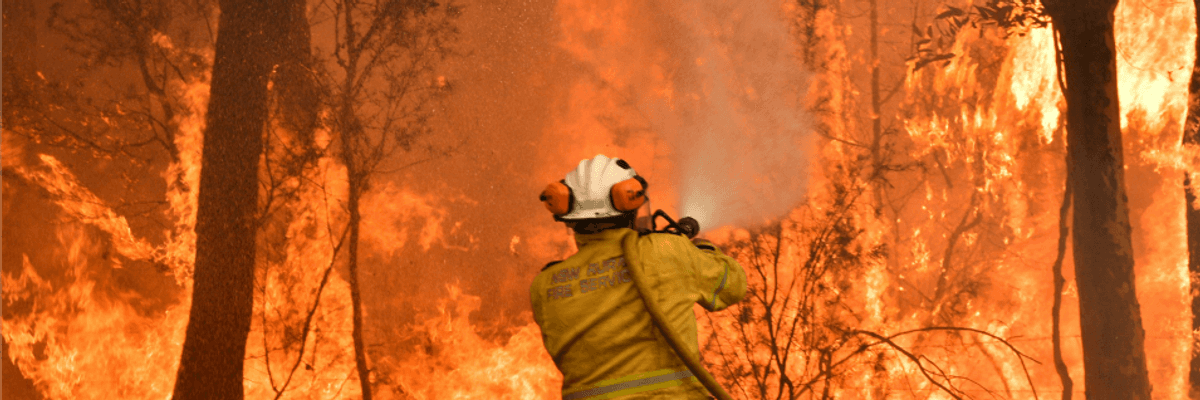
A firefighter attempts to residential areas from encroaching bushfires in the Central Coast around 90-110 kilometres north of Sydney, Australia on December 10, 2019. (Photo: Saeed Khan/AFP via Getty Images)
'An Unthinkable and Unlivable Reality': Australia Sees Hottest Day on Record as National Average Temperature Hits 105.6degF
"We are in a climate emergency," said meteorologist Eric Holthaus.
With destructive wildfires raging across the country amid a severe drought, Australia on Tuesday experienced its hottest day on record as the national average maximum temperature reached an unprecedented 40.9degC (105.6degF).
"The driving force behind this is climate change."
--Greg Mullins, former Fire and Rescue commissioner of New South Wales
"That was the national average temperature. Some places were far hotter," tweeted meteorologist Eric Holthaus. "Truly, an unthinkable and unlivable reality. We are in a climate emergency."
Australia's Bureau of Meteorology announced the new record temperature Tuesday, noting that the previous high of 40.9degC (104.5degF) was set in January 2013.
Dean Narramore of the Bureau of Meteorology told the New York Times that Australia's unprecedented heat is likely to get worse in the coming days as dry conditions continue.
"Friday looks like it will be a very bad day," said Narramore. "All of this is connected. A record-late monsoon in India means the rain will be late coming to Australia, it's the worst fire season we've seen across Australia, it's warming through climate change, and it's only the third week of summer."
The record-breaking heat comes as more than 100 wildfires are currently burning across Australia, devastating millions of acres of land and enveloping densely populated cities like Sydney in toxic smoke.
The Guardian reported last week that bushfires in New South Wales and Queensland have emitted 250 million tons of carbon dioxide since August--nearly half of the country's annual total greenhouse gas emissions.
Greg Mullins, former Fire and Rescue commissioner of New South Wales, told CNN Tuesday that "more country has been burned, more homes lost, three times more homes lost than our worst previous fire season in history and the fires are still burning."
"The driving force behind this is climate change," said Mullins. "In our decades of service, we've seen Australia become drier, hotter, and extreme weather conditions far more severe."
We are at a crossroads
This country and this world are at a monumental crossroads. In a few short weeks, US voters will have an opportunity to beat back the forces of fascism and confront the billionaires who are rigging the economy, our media system, and our democracy, making it increasingly impossible for ordinary people to get by. We’re not just talking about the election. We’re talking about what must be done once these fascist elements are vanquished from power. We need a bolder set of solutions than what either major party has so far been willing to offer and a working-class movement ready to fight like hell for it. Trump didn't emerge from nowhere. The conditions that fueled MAGA authoritarianism were created by decades of radical neoliberal economic policies and a corrupt political system dominated by corporate interests. They slashed taxes on the super-rich, promising that the benefits would trickle down. They said giveaways to the corporate titans would make life more affordable for the rest of us. It was all bullshit. And when a bitter, betrayed populace searches for someone to blame, right-wing demagogues have little trouble finding scapegoats. People know when they're being lied to, but you won't hear any of this from the corporate media. Only independent journalism—powered and funded by people who believe in building a better world—can deliver truly trustworthy daily news. Our Fall Campaign is underway, and we need your help. To power our newsroom through the rest of the year, we need to raise $125,000 by midnight on October 31. So if you share our vision, please contribute whatever you can to sustain our work. |
With destructive wildfires raging across the country amid a severe drought, Australia on Tuesday experienced its hottest day on record as the national average maximum temperature reached an unprecedented 40.9degC (105.6degF).
"The driving force behind this is climate change."
--Greg Mullins, former Fire and Rescue commissioner of New South Wales
"That was the national average temperature. Some places were far hotter," tweeted meteorologist Eric Holthaus. "Truly, an unthinkable and unlivable reality. We are in a climate emergency."
Australia's Bureau of Meteorology announced the new record temperature Tuesday, noting that the previous high of 40.9degC (104.5degF) was set in January 2013.
Dean Narramore of the Bureau of Meteorology told the New York Times that Australia's unprecedented heat is likely to get worse in the coming days as dry conditions continue.
"Friday looks like it will be a very bad day," said Narramore. "All of this is connected. A record-late monsoon in India means the rain will be late coming to Australia, it's the worst fire season we've seen across Australia, it's warming through climate change, and it's only the third week of summer."
The record-breaking heat comes as more than 100 wildfires are currently burning across Australia, devastating millions of acres of land and enveloping densely populated cities like Sydney in toxic smoke.
The Guardian reported last week that bushfires in New South Wales and Queensland have emitted 250 million tons of carbon dioxide since August--nearly half of the country's annual total greenhouse gas emissions.
Greg Mullins, former Fire and Rescue commissioner of New South Wales, told CNN Tuesday that "more country has been burned, more homes lost, three times more homes lost than our worst previous fire season in history and the fires are still burning."
"The driving force behind this is climate change," said Mullins. "In our decades of service, we've seen Australia become drier, hotter, and extreme weather conditions far more severe."
With destructive wildfires raging across the country amid a severe drought, Australia on Tuesday experienced its hottest day on record as the national average maximum temperature reached an unprecedented 40.9degC (105.6degF).
"The driving force behind this is climate change."
--Greg Mullins, former Fire and Rescue commissioner of New South Wales
"That was the national average temperature. Some places were far hotter," tweeted meteorologist Eric Holthaus. "Truly, an unthinkable and unlivable reality. We are in a climate emergency."
Australia's Bureau of Meteorology announced the new record temperature Tuesday, noting that the previous high of 40.9degC (104.5degF) was set in January 2013.
Dean Narramore of the Bureau of Meteorology told the New York Times that Australia's unprecedented heat is likely to get worse in the coming days as dry conditions continue.
"Friday looks like it will be a very bad day," said Narramore. "All of this is connected. A record-late monsoon in India means the rain will be late coming to Australia, it's the worst fire season we've seen across Australia, it's warming through climate change, and it's only the third week of summer."
The record-breaking heat comes as more than 100 wildfires are currently burning across Australia, devastating millions of acres of land and enveloping densely populated cities like Sydney in toxic smoke.
The Guardian reported last week that bushfires in New South Wales and Queensland have emitted 250 million tons of carbon dioxide since August--nearly half of the country's annual total greenhouse gas emissions.
Greg Mullins, former Fire and Rescue commissioner of New South Wales, told CNN Tuesday that "more country has been burned, more homes lost, three times more homes lost than our worst previous fire season in history and the fires are still burning."
"The driving force behind this is climate change," said Mullins. "In our decades of service, we've seen Australia become drier, hotter, and extreme weather conditions far more severe."