SUBSCRIBE TO OUR FREE NEWSLETTER
Daily news & progressive opinion—funded by the people, not the corporations—delivered straight to your inbox.
5
#000000
#FFFFFF
To donate by check, phone, or other method, see our More Ways to Give page.
Daily news & progressive opinion—funded by the people, not the corporations—delivered straight to your inbox.
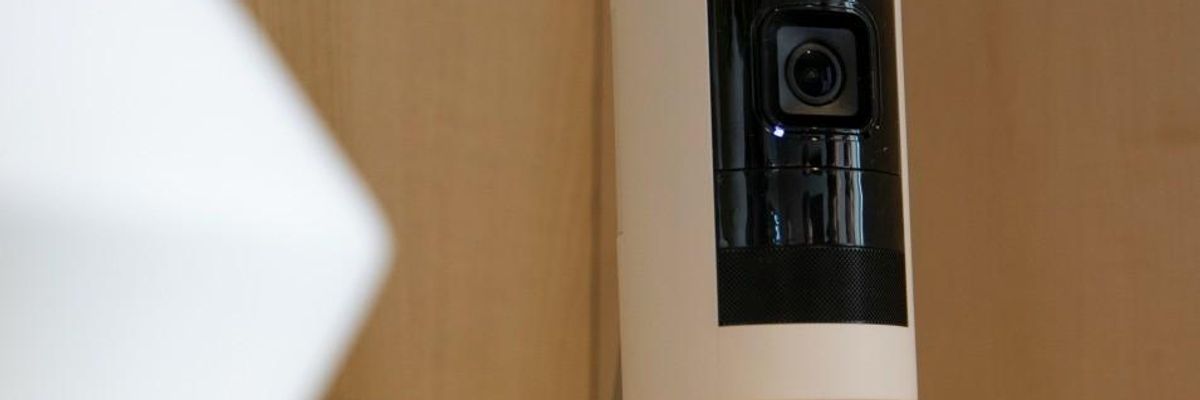
An Amazon Ring camera is pictured at Amazon headquarters on September 20, 2018 in Seattle, Washington. (Photo: Stephen Brashear/Getty Images)
Amazon on Tuesday confirmed in responses to an investigation by Sen. Ed Markey its critics' worst fears about the privacy violations inherent in the use of the company's Ring home surveillance system.
Markey began his inquiry into Ring in September, demanding answers from Amazon about how it protects the privacy of people who use the electronic doorbell system, which allows people to install video cameras outside their homes which can film their doorstep and property as well as the surrounding area.
The civil liberties group Electronic Frontier Foundation tweeted that Amazon's answer was: "Basically, they don't."
Markey revealed Tuesday that, especially considering Ring's partnerships with more than 400 police departments across the U.S., video captured by the technology including footage captured at Ring users' homes could be kept indefinitely by law enforcement agencies and could end up in the hands of third parties.
The senator called the results of his inquiry "nothing short of chilling."
"Connected doorbells are well on their way to becoming a mainstay of American households," said Markey. "Amazon Ring's policies are an open door for privacy and civil liberty violations."
While Ring is marketed to the public as a product that will safeguard people's homes, the digital rights group Fight for the Future said Markey's findings demonstrate that Amazon's surveillance technology endangers Americans.
"Amazon plays on people's fears to sell them surveillance products, and then turns around and puts them and their neighbors in danger," said deputy director Evan Greer. "Through consumer products like Ring, Amazon is collecting footage and all the data needed to build a nationwide surveillance network."
In response to Markey's questions, Amazon officials confirmed a number of fears about the technology, including:
According to Fight for the Future, the investigation shows that "millions of Americans are being swept up in captured video footage without any knowledge of the threats. And now Amazon openly admits that it has enacted no policies or oversight to protect them."
People all over the country--even non-Ring users--are "completely vulnerable to the whims of whoever gains access to surveillance footage whether it be Amazon employees, police departments, or hackers taking advantage of Amazon's lax security protections," Greer said.
"This is an unprecedented assault on our security, constitutionally protected rights, and communities," Greer added. "Amazon's admissions to Sen. Markey show that we need an immediate full scale congressional investigation into this tech titan's surveillance practices."
Other critics expressed anger over the findings on social media.
On Wednesday Markey was joined by Sens. Chris Coons (D-Del.), Chris Van Hollen (D-Md.), and Ron Wyden (D-Ore.) in demanding an explanation from Amazon CEO Jeff Bezos about what they called potential threats to national security brought about by Ring's collection and sharing of video surveillance.
"Amazon...holds a vast amount of deeply sensitive data and video footage detailing the lives of millions of Americans in and near their homes," wrote the lawmakers. "If hackers or foreign actors were to gain access to this data, it would not only threaten the privacy and safety of the impacted Americans; it could also threaten U.S. national security. Personal data can be exploited by foreign intelligence services to amplify the impact of espionage and influence operations."
"Americans who make the choice to install Ring products in and outside their homes do so under the assumption that they are as your website proclaims 'making the neighborhood safer,'" the senators added. "As such, the American people have a right to know who else is looking at the data they provide to Ring, and if that data is secure from hackers."
Dear Common Dreams reader, It’s been nearly 30 years since I co-founded Common Dreams with my late wife, Lina Newhouser. We had the radical notion that journalism should serve the public good, not corporate profits. It was clear to us from the outset what it would take to build such a project. No paid advertisements. No corporate sponsors. No millionaire publisher telling us what to think or do. Many people said we wouldn't last a year, but we proved those doubters wrong. Together with a tremendous team of journalists and dedicated staff, we built an independent media outlet free from the constraints of profits and corporate control. Our mission has always been simple: To inform. To inspire. To ignite change for the common good. Building Common Dreams was not easy. Our survival was never guaranteed. When you take on the most powerful forces—Wall Street greed, fossil fuel industry destruction, Big Tech lobbyists, and uber-rich oligarchs who have spent billions upon billions rigging the economy and democracy in their favor—the only bulwark you have is supporters who believe in your work. But here’s the urgent message from me today. It's never been this bad out there. And it's never been this hard to keep us going. At the very moment Common Dreams is most needed, the threats we face are intensifying. We need your support now more than ever. We don't accept corporate advertising and never will. We don't have a paywall because we don't think people should be blocked from critical news based on their ability to pay. Everything we do is funded by the donations of readers like you. When everyone does the little they can afford, we are strong. But if that support retreats or dries up, so do we. Will you donate now to make sure Common Dreams not only survives but thrives? —Craig Brown, Co-founder |
Amazon on Tuesday confirmed in responses to an investigation by Sen. Ed Markey its critics' worst fears about the privacy violations inherent in the use of the company's Ring home surveillance system.
Markey began his inquiry into Ring in September, demanding answers from Amazon about how it protects the privacy of people who use the electronic doorbell system, which allows people to install video cameras outside their homes which can film their doorstep and property as well as the surrounding area.
The civil liberties group Electronic Frontier Foundation tweeted that Amazon's answer was: "Basically, they don't."
Markey revealed Tuesday that, especially considering Ring's partnerships with more than 400 police departments across the U.S., video captured by the technology including footage captured at Ring users' homes could be kept indefinitely by law enforcement agencies and could end up in the hands of third parties.
The senator called the results of his inquiry "nothing short of chilling."
"Connected doorbells are well on their way to becoming a mainstay of American households," said Markey. "Amazon Ring's policies are an open door for privacy and civil liberty violations."
While Ring is marketed to the public as a product that will safeguard people's homes, the digital rights group Fight for the Future said Markey's findings demonstrate that Amazon's surveillance technology endangers Americans.
"Amazon plays on people's fears to sell them surveillance products, and then turns around and puts them and their neighbors in danger," said deputy director Evan Greer. "Through consumer products like Ring, Amazon is collecting footage and all the data needed to build a nationwide surveillance network."
In response to Markey's questions, Amazon officials confirmed a number of fears about the technology, including:
According to Fight for the Future, the investigation shows that "millions of Americans are being swept up in captured video footage without any knowledge of the threats. And now Amazon openly admits that it has enacted no policies or oversight to protect them."
People all over the country--even non-Ring users--are "completely vulnerable to the whims of whoever gains access to surveillance footage whether it be Amazon employees, police departments, or hackers taking advantage of Amazon's lax security protections," Greer said.
"This is an unprecedented assault on our security, constitutionally protected rights, and communities," Greer added. "Amazon's admissions to Sen. Markey show that we need an immediate full scale congressional investigation into this tech titan's surveillance practices."
Other critics expressed anger over the findings on social media.
On Wednesday Markey was joined by Sens. Chris Coons (D-Del.), Chris Van Hollen (D-Md.), and Ron Wyden (D-Ore.) in demanding an explanation from Amazon CEO Jeff Bezos about what they called potential threats to national security brought about by Ring's collection and sharing of video surveillance.
"Amazon...holds a vast amount of deeply sensitive data and video footage detailing the lives of millions of Americans in and near their homes," wrote the lawmakers. "If hackers or foreign actors were to gain access to this data, it would not only threaten the privacy and safety of the impacted Americans; it could also threaten U.S. national security. Personal data can be exploited by foreign intelligence services to amplify the impact of espionage and influence operations."
"Americans who make the choice to install Ring products in and outside their homes do so under the assumption that they are as your website proclaims 'making the neighborhood safer,'" the senators added. "As such, the American people have a right to know who else is looking at the data they provide to Ring, and if that data is secure from hackers."
Amazon on Tuesday confirmed in responses to an investigation by Sen. Ed Markey its critics' worst fears about the privacy violations inherent in the use of the company's Ring home surveillance system.
Markey began his inquiry into Ring in September, demanding answers from Amazon about how it protects the privacy of people who use the electronic doorbell system, which allows people to install video cameras outside their homes which can film their doorstep and property as well as the surrounding area.
The civil liberties group Electronic Frontier Foundation tweeted that Amazon's answer was: "Basically, they don't."
Markey revealed Tuesday that, especially considering Ring's partnerships with more than 400 police departments across the U.S., video captured by the technology including footage captured at Ring users' homes could be kept indefinitely by law enforcement agencies and could end up in the hands of third parties.
The senator called the results of his inquiry "nothing short of chilling."
"Connected doorbells are well on their way to becoming a mainstay of American households," said Markey. "Amazon Ring's policies are an open door for privacy and civil liberty violations."
While Ring is marketed to the public as a product that will safeguard people's homes, the digital rights group Fight for the Future said Markey's findings demonstrate that Amazon's surveillance technology endangers Americans.
"Amazon plays on people's fears to sell them surveillance products, and then turns around and puts them and their neighbors in danger," said deputy director Evan Greer. "Through consumer products like Ring, Amazon is collecting footage and all the data needed to build a nationwide surveillance network."
In response to Markey's questions, Amazon officials confirmed a number of fears about the technology, including:
According to Fight for the Future, the investigation shows that "millions of Americans are being swept up in captured video footage without any knowledge of the threats. And now Amazon openly admits that it has enacted no policies or oversight to protect them."
People all over the country--even non-Ring users--are "completely vulnerable to the whims of whoever gains access to surveillance footage whether it be Amazon employees, police departments, or hackers taking advantage of Amazon's lax security protections," Greer said.
"This is an unprecedented assault on our security, constitutionally protected rights, and communities," Greer added. "Amazon's admissions to Sen. Markey show that we need an immediate full scale congressional investigation into this tech titan's surveillance practices."
Other critics expressed anger over the findings on social media.
On Wednesday Markey was joined by Sens. Chris Coons (D-Del.), Chris Van Hollen (D-Md.), and Ron Wyden (D-Ore.) in demanding an explanation from Amazon CEO Jeff Bezos about what they called potential threats to national security brought about by Ring's collection and sharing of video surveillance.
"Amazon...holds a vast amount of deeply sensitive data and video footage detailing the lives of millions of Americans in and near their homes," wrote the lawmakers. "If hackers or foreign actors were to gain access to this data, it would not only threaten the privacy and safety of the impacted Americans; it could also threaten U.S. national security. Personal data can be exploited by foreign intelligence services to amplify the impact of espionage and influence operations."
"Americans who make the choice to install Ring products in and outside their homes do so under the assumption that they are as your website proclaims 'making the neighborhood safer,'" the senators added. "As such, the American people have a right to know who else is looking at the data they provide to Ring, and if that data is secure from hackers."