SUBSCRIBE TO OUR FREE NEWSLETTER
Daily news & progressive opinion—funded by the people, not the corporations—delivered straight to your inbox.
5
#000000
#FFFFFF
To donate by check, phone, or other method, see our More Ways to Give page.
Daily news & progressive opinion—funded by the people, not the corporations—delivered straight to your inbox.
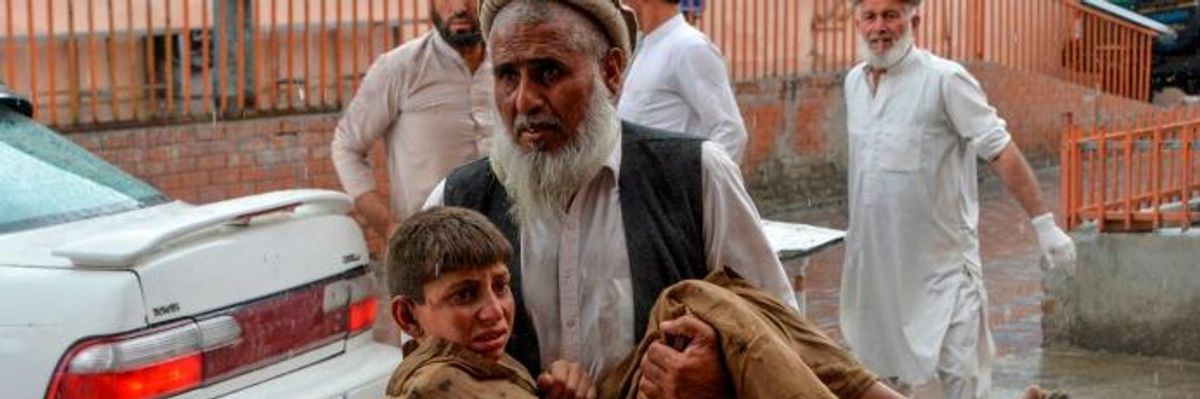
A volunteer carries an injured youth to a hospital following a bomb blast in Haska Mina district of Nangarhar Province on October 18, 2019. (Photo: Noorullah Shirzada/AFP via Getty Images)
Scores of people were killed Friday after blasts rocked a mosque in eastern Afghanistan--just a day after the United Nations said that civilian casualties in the country hit record levels.
The explosions in the province of Nagarhar came during Friday prayers. Attahullah Khogyani, a spokesman for the provincial governor, said that bombs had been placed inside the mosque. As of this writing, no group has claimed responsibility.
Children were among the 62 dead and 36 wounded, Khogyani said.
"It was a heartbreaking scene I witnessed," said tribal elder Malik Mohammadi Gul Shinwari.
On Thursday, the U.N. Assistance Mission in Afghanistan (UNAMA) released new figures showing "an unprecedented number of civilian casualties."
During the three-month period from July 1 to September 30, UNAMA documented 4,313 civilian casualties, comprised of 1,174 deaths and 3,139 injured. That tally, said UNAMA, marks "the highest number of civilian casualties that it has recorded in a single quarter since it began systematic documentation in 2009." The figure also represents a 42 percent increase compared to the same three-month period in 2018.
UNAMA attributed the increase mainly to anti-government forces, especially the Taliban. The U.N. noted that in the first half of the year, pro-government including U.S.-backed forces caused more civilian deaths.
The latest figures bring UNAMA's total so far in 2019 to 8,239 civilian casualties, representing 2,563 killed and 5,676 injured.
"Civilian casualties at record-high levels clearly show the need for all parties concerned to pay much more attention to protecting the civilian population, including through a review of conduct during combat operations," said Tadamichi Yamamoto, head of UNAMA.
"The harm caused to civilians by the fighting in Afghanistan signals the importance of peace talks leading to a ceasefire and a permanent political settlement to the conflict; there is no other way forward," he continued.
"Civilian casualties are totally unacceptable,"said Yamamoto, "especially in the context of the widespread recognition that there can be no military solution to the conflict in Afghanistan."
Dear Common Dreams reader, It’s been nearly 30 years since I co-founded Common Dreams with my late wife, Lina Newhouser. We had the radical notion that journalism should serve the public good, not corporate profits. It was clear to us from the outset what it would take to build such a project. No paid advertisements. No corporate sponsors. No millionaire publisher telling us what to think or do. Many people said we wouldn't last a year, but we proved those doubters wrong. Together with a tremendous team of journalists and dedicated staff, we built an independent media outlet free from the constraints of profits and corporate control. Our mission has always been simple: To inform. To inspire. To ignite change for the common good. Building Common Dreams was not easy. Our survival was never guaranteed. When you take on the most powerful forces—Wall Street greed, fossil fuel industry destruction, Big Tech lobbyists, and uber-rich oligarchs who have spent billions upon billions rigging the economy and democracy in their favor—the only bulwark you have is supporters who believe in your work. But here’s the urgent message from me today. It's never been this bad out there. And it's never been this hard to keep us going. At the very moment Common Dreams is most needed, the threats we face are intensifying. We need your support now more than ever. We don't accept corporate advertising and never will. We don't have a paywall because we don't think people should be blocked from critical news based on their ability to pay. Everything we do is funded by the donations of readers like you. When everyone does the little they can afford, we are strong. But if that support retreats or dries up, so do we. Will you donate now to make sure Common Dreams not only survives but thrives? —Craig Brown, Co-founder |
Scores of people were killed Friday after blasts rocked a mosque in eastern Afghanistan--just a day after the United Nations said that civilian casualties in the country hit record levels.
The explosions in the province of Nagarhar came during Friday prayers. Attahullah Khogyani, a spokesman for the provincial governor, said that bombs had been placed inside the mosque. As of this writing, no group has claimed responsibility.
Children were among the 62 dead and 36 wounded, Khogyani said.
"It was a heartbreaking scene I witnessed," said tribal elder Malik Mohammadi Gul Shinwari.
On Thursday, the U.N. Assistance Mission in Afghanistan (UNAMA) released new figures showing "an unprecedented number of civilian casualties."
During the three-month period from July 1 to September 30, UNAMA documented 4,313 civilian casualties, comprised of 1,174 deaths and 3,139 injured. That tally, said UNAMA, marks "the highest number of civilian casualties that it has recorded in a single quarter since it began systematic documentation in 2009." The figure also represents a 42 percent increase compared to the same three-month period in 2018.
UNAMA attributed the increase mainly to anti-government forces, especially the Taliban. The U.N. noted that in the first half of the year, pro-government including U.S.-backed forces caused more civilian deaths.
The latest figures bring UNAMA's total so far in 2019 to 8,239 civilian casualties, representing 2,563 killed and 5,676 injured.
"Civilian casualties at record-high levels clearly show the need for all parties concerned to pay much more attention to protecting the civilian population, including through a review of conduct during combat operations," said Tadamichi Yamamoto, head of UNAMA.
"The harm caused to civilians by the fighting in Afghanistan signals the importance of peace talks leading to a ceasefire and a permanent political settlement to the conflict; there is no other way forward," he continued.
"Civilian casualties are totally unacceptable,"said Yamamoto, "especially in the context of the widespread recognition that there can be no military solution to the conflict in Afghanistan."
Scores of people were killed Friday after blasts rocked a mosque in eastern Afghanistan--just a day after the United Nations said that civilian casualties in the country hit record levels.
The explosions in the province of Nagarhar came during Friday prayers. Attahullah Khogyani, a spokesman for the provincial governor, said that bombs had been placed inside the mosque. As of this writing, no group has claimed responsibility.
Children were among the 62 dead and 36 wounded, Khogyani said.
"It was a heartbreaking scene I witnessed," said tribal elder Malik Mohammadi Gul Shinwari.
On Thursday, the U.N. Assistance Mission in Afghanistan (UNAMA) released new figures showing "an unprecedented number of civilian casualties."
During the three-month period from July 1 to September 30, UNAMA documented 4,313 civilian casualties, comprised of 1,174 deaths and 3,139 injured. That tally, said UNAMA, marks "the highest number of civilian casualties that it has recorded in a single quarter since it began systematic documentation in 2009." The figure also represents a 42 percent increase compared to the same three-month period in 2018.
UNAMA attributed the increase mainly to anti-government forces, especially the Taliban. The U.N. noted that in the first half of the year, pro-government including U.S.-backed forces caused more civilian deaths.
The latest figures bring UNAMA's total so far in 2019 to 8,239 civilian casualties, representing 2,563 killed and 5,676 injured.
"Civilian casualties at record-high levels clearly show the need for all parties concerned to pay much more attention to protecting the civilian population, including through a review of conduct during combat operations," said Tadamichi Yamamoto, head of UNAMA.
"The harm caused to civilians by the fighting in Afghanistan signals the importance of peace talks leading to a ceasefire and a permanent political settlement to the conflict; there is no other way forward," he continued.
"Civilian casualties are totally unacceptable,"said Yamamoto, "especially in the context of the widespread recognition that there can be no military solution to the conflict in Afghanistan."