SUBSCRIBE TO OUR FREE NEWSLETTER
Daily news & progressive opinion—funded by the people, not the corporations—delivered straight to your inbox.
5
#000000
#FFFFFF
To donate by check, phone, or other method, see our More Ways to Give page.
Daily news & progressive opinion—funded by the people, not the corporations—delivered straight to your inbox.
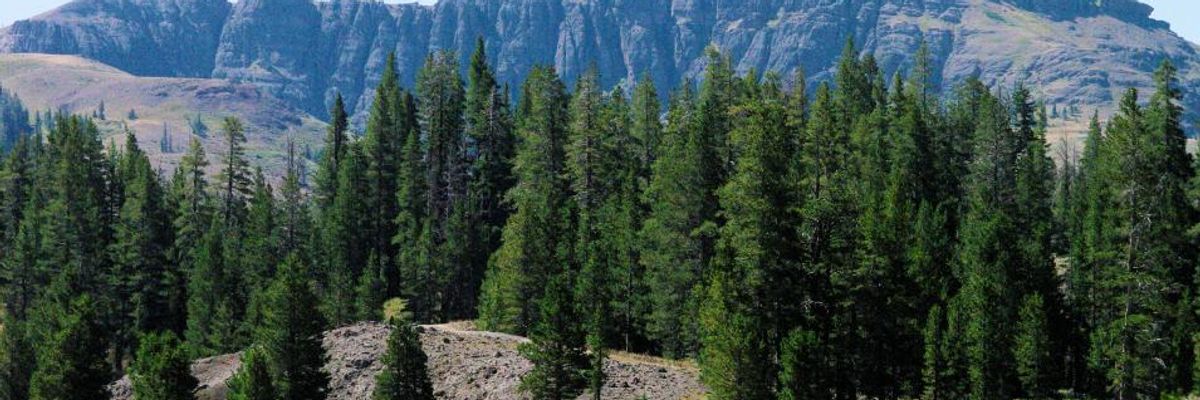
The Amador-Calaveras Consensus Group Cornerstone Project in the Eldorado and Stanislaus National Forests, California in 2016. (Photo: Eldorado National Forest)
Youth climate leader Greta Thunberg and writer and environmentalist George Monbiot explain in a short video published Thursday by The Guardian how the world can tackle the human-caused climate crisis by harnessing nature's restorative powers.
"We are living in the beginning of a mass extinction. Our climate is breaking down. Children like me are giving up their education to protest," says 16-year-old Thunberg. "But we can still fix this--you can still fix this."
Watch:
The short film, produced by Tom Mustill of Gripping Films, was released ahead of the youth-led global climate strike and the United Nations Climate Action Summit--where it will be shown to experts and heads of state, according to The Guardian.
Monbiot is a Guardian columnist and a leader of the Natural Climate Solutions campaign. Launched in April by activists, experts, and writers, the bold campaign calls for battling climate and ecological breakdown by not only transitioning the world away from fossil fuels to renewable energy but also "drawing carbon dioxide out of the air by protecting and restoring ecosystems."
"Mangroves, peatbogs, jungles, marshes, seabeds, kelp forests, swamps, coral reefs, they take carbon out of the air and lock it away. Nature is a tool we can use to repair our broken climate."
--George Monbiot, campaign leader
In the new video, Monbiot and Thunberg discuss the climate and ecological crises--touching on issues such as melting Arctic ice, declining biodiversity, and deforestation of rainforests--and the scientifically established ways that nature can help.
"There is a magic machine that sucks carbon out of the air, costs very little, and builds itself. It's called a tree," Monbiot says. "Mangroves, peatbogs, jungles, marshes, seabeds, kelp forests, swamps, coral reefs, they take carbon out of the air and lock it away. Nature is a tool we can use to repair our broken climate."
As the world endured sweltering temperatures this summer, the journal Science published a study which found that planting billions of trees and restoring forests to capture atmospheric carbon would be the "most effective" strategy for battling the climate emergency.
While Monbiot lays out the major potential for natural climate solutions in the film, Thunberg points out that "right now, we are ignoring them."
The pair also highlights the huge disparity between how much taxpayer money governments pour into fossil fuel subsidies compared with nature-based solutions.
"We need to stop funding things that destroy nature," says Monbiot, "and pay for things that help it."
"It is that simple," adds Thunberg. "Protect. Restore. Fund."
Reporting on the video Thursday, The Guardian noted that "global carbon emissions must be halved in the next decade to avoid serious impacts from global heating, but they are still rising. It is therefore near certain that carbon dioxide will have to be removed from the atmosphere, and technology such as burying CO2 underground has not been demonstrated at scale."
As Shyla Raghav of Conservation International--which helped fund the film--put it: "The fact is, we simply will not succeed in avoiding climate breakdown without nature."
Preserving nature is incredibly popular across the globe, according to a new poll by the National Geographic Society and Ipsos, which surveyed 12,000 adults in Australia, Brazil, China, Great Britain, India, Indonesia, Kenya, Mexico, South Africa, South Korea, the United Arab Emirates, and the United States. The majority of respondents said they support a proposal--made famous by biologist E.O. Wilson--to set aside half of the planet as nature to safeguard biodiversity and prevent mass extinction.
Responding to the significant public support for the Half-Earth plan, National Geographic Society executive vice president and chief scientist Jonathan Baillie concluded, "People want what is scientifically needed for us to have a secure future."
Dear Common Dreams reader, It’s been nearly 30 years since I co-founded Common Dreams with my late wife, Lina Newhouser. We had the radical notion that journalism should serve the public good, not corporate profits. It was clear to us from the outset what it would take to build such a project. No paid advertisements. No corporate sponsors. No millionaire publisher telling us what to think or do. Many people said we wouldn't last a year, but we proved those doubters wrong. Together with a tremendous team of journalists and dedicated staff, we built an independent media outlet free from the constraints of profits and corporate control. Our mission has always been simple: To inform. To inspire. To ignite change for the common good. Building Common Dreams was not easy. Our survival was never guaranteed. When you take on the most powerful forces—Wall Street greed, fossil fuel industry destruction, Big Tech lobbyists, and uber-rich oligarchs who have spent billions upon billions rigging the economy and democracy in their favor—the only bulwark you have is supporters who believe in your work. But here’s the urgent message from me today. It's never been this bad out there. And it's never been this hard to keep us going. At the very moment Common Dreams is most needed, the threats we face are intensifying. We need your support now more than ever. We don't accept corporate advertising and never will. We don't have a paywall because we don't think people should be blocked from critical news based on their ability to pay. Everything we do is funded by the donations of readers like you. When everyone does the little they can afford, we are strong. But if that support retreats or dries up, so do we. Will you donate now to make sure Common Dreams not only survives but thrives? —Craig Brown, Co-founder |
Youth climate leader Greta Thunberg and writer and environmentalist George Monbiot explain in a short video published Thursday by The Guardian how the world can tackle the human-caused climate crisis by harnessing nature's restorative powers.
"We are living in the beginning of a mass extinction. Our climate is breaking down. Children like me are giving up their education to protest," says 16-year-old Thunberg. "But we can still fix this--you can still fix this."
Watch:
The short film, produced by Tom Mustill of Gripping Films, was released ahead of the youth-led global climate strike and the United Nations Climate Action Summit--where it will be shown to experts and heads of state, according to The Guardian.
Monbiot is a Guardian columnist and a leader of the Natural Climate Solutions campaign. Launched in April by activists, experts, and writers, the bold campaign calls for battling climate and ecological breakdown by not only transitioning the world away from fossil fuels to renewable energy but also "drawing carbon dioxide out of the air by protecting and restoring ecosystems."
"Mangroves, peatbogs, jungles, marshes, seabeds, kelp forests, swamps, coral reefs, they take carbon out of the air and lock it away. Nature is a tool we can use to repair our broken climate."
--George Monbiot, campaign leader
In the new video, Monbiot and Thunberg discuss the climate and ecological crises--touching on issues such as melting Arctic ice, declining biodiversity, and deforestation of rainforests--and the scientifically established ways that nature can help.
"There is a magic machine that sucks carbon out of the air, costs very little, and builds itself. It's called a tree," Monbiot says. "Mangroves, peatbogs, jungles, marshes, seabeds, kelp forests, swamps, coral reefs, they take carbon out of the air and lock it away. Nature is a tool we can use to repair our broken climate."
As the world endured sweltering temperatures this summer, the journal Science published a study which found that planting billions of trees and restoring forests to capture atmospheric carbon would be the "most effective" strategy for battling the climate emergency.
While Monbiot lays out the major potential for natural climate solutions in the film, Thunberg points out that "right now, we are ignoring them."
The pair also highlights the huge disparity between how much taxpayer money governments pour into fossil fuel subsidies compared with nature-based solutions.
"We need to stop funding things that destroy nature," says Monbiot, "and pay for things that help it."
"It is that simple," adds Thunberg. "Protect. Restore. Fund."
Reporting on the video Thursday, The Guardian noted that "global carbon emissions must be halved in the next decade to avoid serious impacts from global heating, but they are still rising. It is therefore near certain that carbon dioxide will have to be removed from the atmosphere, and technology such as burying CO2 underground has not been demonstrated at scale."
As Shyla Raghav of Conservation International--which helped fund the film--put it: "The fact is, we simply will not succeed in avoiding climate breakdown without nature."
Preserving nature is incredibly popular across the globe, according to a new poll by the National Geographic Society and Ipsos, which surveyed 12,000 adults in Australia, Brazil, China, Great Britain, India, Indonesia, Kenya, Mexico, South Africa, South Korea, the United Arab Emirates, and the United States. The majority of respondents said they support a proposal--made famous by biologist E.O. Wilson--to set aside half of the planet as nature to safeguard biodiversity and prevent mass extinction.
Responding to the significant public support for the Half-Earth plan, National Geographic Society executive vice president and chief scientist Jonathan Baillie concluded, "People want what is scientifically needed for us to have a secure future."
Youth climate leader Greta Thunberg and writer and environmentalist George Monbiot explain in a short video published Thursday by The Guardian how the world can tackle the human-caused climate crisis by harnessing nature's restorative powers.
"We are living in the beginning of a mass extinction. Our climate is breaking down. Children like me are giving up their education to protest," says 16-year-old Thunberg. "But we can still fix this--you can still fix this."
Watch:
The short film, produced by Tom Mustill of Gripping Films, was released ahead of the youth-led global climate strike and the United Nations Climate Action Summit--where it will be shown to experts and heads of state, according to The Guardian.
Monbiot is a Guardian columnist and a leader of the Natural Climate Solutions campaign. Launched in April by activists, experts, and writers, the bold campaign calls for battling climate and ecological breakdown by not only transitioning the world away from fossil fuels to renewable energy but also "drawing carbon dioxide out of the air by protecting and restoring ecosystems."
"Mangroves, peatbogs, jungles, marshes, seabeds, kelp forests, swamps, coral reefs, they take carbon out of the air and lock it away. Nature is a tool we can use to repair our broken climate."
--George Monbiot, campaign leader
In the new video, Monbiot and Thunberg discuss the climate and ecological crises--touching on issues such as melting Arctic ice, declining biodiversity, and deforestation of rainforests--and the scientifically established ways that nature can help.
"There is a magic machine that sucks carbon out of the air, costs very little, and builds itself. It's called a tree," Monbiot says. "Mangroves, peatbogs, jungles, marshes, seabeds, kelp forests, swamps, coral reefs, they take carbon out of the air and lock it away. Nature is a tool we can use to repair our broken climate."
As the world endured sweltering temperatures this summer, the journal Science published a study which found that planting billions of trees and restoring forests to capture atmospheric carbon would be the "most effective" strategy for battling the climate emergency.
While Monbiot lays out the major potential for natural climate solutions in the film, Thunberg points out that "right now, we are ignoring them."
The pair also highlights the huge disparity between how much taxpayer money governments pour into fossil fuel subsidies compared with nature-based solutions.
"We need to stop funding things that destroy nature," says Monbiot, "and pay for things that help it."
"It is that simple," adds Thunberg. "Protect. Restore. Fund."
Reporting on the video Thursday, The Guardian noted that "global carbon emissions must be halved in the next decade to avoid serious impacts from global heating, but they are still rising. It is therefore near certain that carbon dioxide will have to be removed from the atmosphere, and technology such as burying CO2 underground has not been demonstrated at scale."
As Shyla Raghav of Conservation International--which helped fund the film--put it: "The fact is, we simply will not succeed in avoiding climate breakdown without nature."
Preserving nature is incredibly popular across the globe, according to a new poll by the National Geographic Society and Ipsos, which surveyed 12,000 adults in Australia, Brazil, China, Great Britain, India, Indonesia, Kenya, Mexico, South Africa, South Korea, the United Arab Emirates, and the United States. The majority of respondents said they support a proposal--made famous by biologist E.O. Wilson--to set aside half of the planet as nature to safeguard biodiversity and prevent mass extinction.
Responding to the significant public support for the Half-Earth plan, National Geographic Society executive vice president and chief scientist Jonathan Baillie concluded, "People want what is scientifically needed for us to have a secure future."